Travel lines are short lines on the outer edge of the palm, low on the Mount of the Moon, plus fine lines that leave the life line and bend toward that area. Palmistry tradition reads them as journeys, restlessness and a love of change. They cannot show a visa, a date or a move abroad.
Key takeaways
- Where: the little-finger side of the palm, between the head line and the wrist, on the pad palmists call the Mount of the Moon.
- Four kinds: short lines on that mount, a fine line leaving the life line, a line rising from the wrist, and a split life line.
- The “foreign travel line”: usually means a life line branch curving to the Moon mount, Cheiro’s strongest travel sign.
- The classics disagree: Cheiro read these lines as journeys; Benham said the cross lines on the edge were wrongly called travel lines.
- Number means little: no study counts them, and one line is not one trip.
- Not science: the creases are real; reading trips from them is tradition.
Scan your palm free in Astrova AI
“Do I have a foreign travel line?” is one of the most common questions people bring to a palm reading, especially in India, where the yatra rekha and videsh yatra rekha are household words. This guide shows exactly where to look, explains the four kinds of line palmists call travel lines and what the classical books say about each, and is honest about what a crease on your hand can and cannot tell you.
Where are travel lines on the palm?
Hold your palm up and look at the side opposite the thumb, the outer edge that would hit a table in a karate chop. Palmists call this edge the percussion. The soft, fleshy pad on that side, below the head line and above the wrist, is the Mount of the Moon (also called the Mount of Luna, or Chandra parvat in Indian palmistry). Our guide to the palm mounts explains what tradition links with each pad.
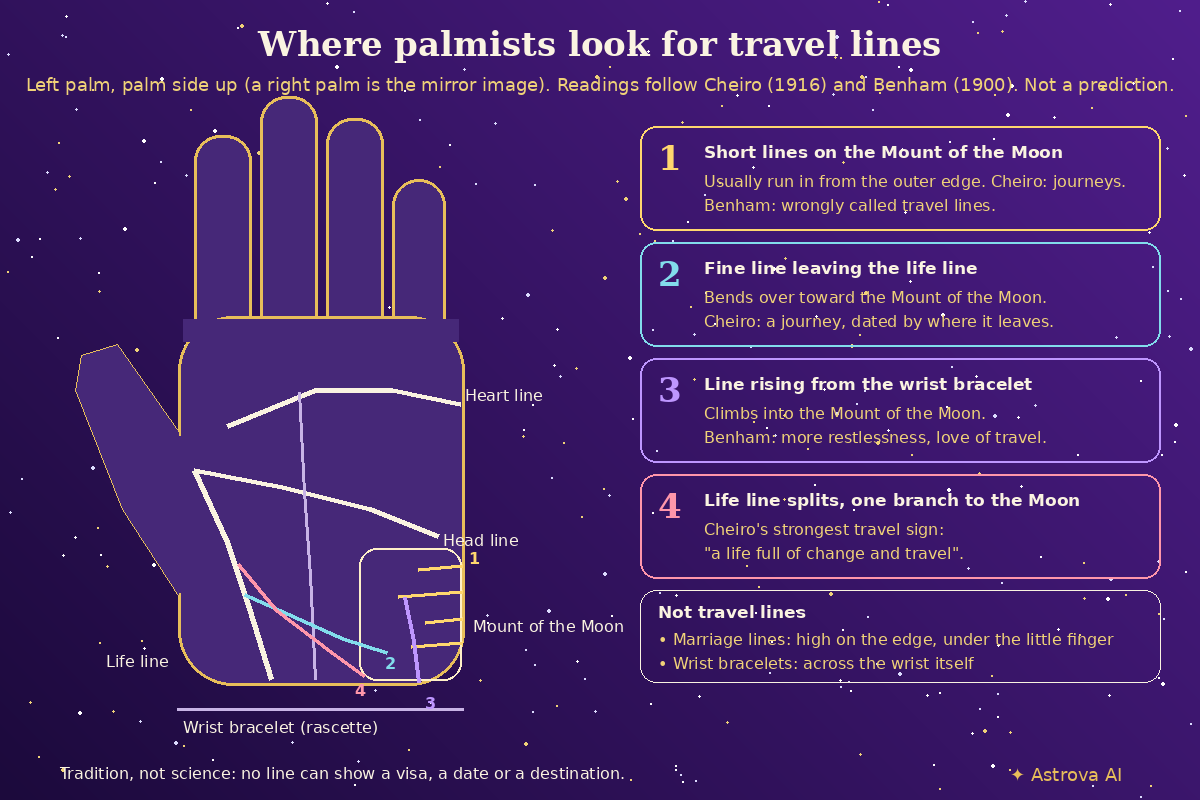
In Palmistry for All (1916, free on Project Gutenberg), Cheiro wrote that travels “may be seen on the hand by the little lines that leave the Line of Life and bend over towards the Mount of the Moon and also by the lines found on this Mount”. So there are two main places to look: the Moon mount itself, and the lower part of the life line, the curved line around the base of the thumb.
The four kinds of travel line, and what tradition reads
| What you see | Where | What the classical books read |
|---|---|---|
| 1. Short lines on the Mount of the Moon | Usually running in from the outer edge, low on the palm | Cheiro: travels and voyages. Benham (1900): these cross lines “have been erroneously called travel lines”; he read them instead as a nervous, restless nature and, in his system, a delicate constitution (an equally unproven claim) |
| 2. A fine line leaving the life line | Branches off the lower life line and bends toward the Moon mount | Cheiro: a journey, which he dated by where the branch leaves the life line |
| 3. A line rising from the wrist | Starts at the first wrist crease (the rascette, or first bracelet line) and climbs into the Moon mount | Benham accepted these as “Travel lines”: more restlessness and longer journeys |
| 4. A life line that splits | One branch keeps round the thumb, the other leans toward the Moon mount | Cheiro: “the entire life will be full of change and travel”; if the whole line sweeps over, a life spent far from one’s birthplace |
Notice that all four point the same way: toward the outer, lower palm. Tradition links the Moon mount with imagination, restlessness and a liking for water and distance, and that is really what these readings are about. They describe a temperament, the person who wants to see new places, more than a list of trips.
Is there a foreign travel line?
Not as one fixed line. When people search for the foreign travel line, they usually mean kind 4 above: a life line that divides, with one branch curving toward the Moon mount. Cheiro called this the sign of a life “full of change and travel”, and when the life line itself sweeps over to the Moon mount, he wrote that the person “will settle nowhere”.
The forked life line is common, though, and forks have other traditional readings too. Our guide to the forked life line covers them. In Vedic astrology, foreign travel is judged from the chart rather than the hand, mainly the 12th house. Either way, settling abroad depends on visas, money, work and choices, and no line or planet can promise it.
How to find your travel lines: step by step
- Use side light. Hold the outer edge of your hand toward a window or lamp. Overhead light flattens fine creases.
- Cup your hand slightly. Folding the palm a little makes the edge lines stand out.
- Find the right zone. Look below the head line and above the wrist, on the little-finger side. Lines high on the edge, just under the little finger and above the heart line, are marriage lines, not travel lines.
- Check the lower life line. Look for a fine line peeling off it and bending toward the Moon mount, or a full split.
- Look at the wrist. See whether any line rises from the first wrist crease into the Moon mount.
- Compare both hands. Note which kinds appear on which hand.
Worked example (illustrative)
This is a made-up hand used only to show the method. It is not a real person or a real reading.
Ravi, 26, writes with his right hand. On his right palm he sees three short lines coming in from the outer edge, low on the Moon mount, one of them clearly longer and deeper. His life line has a fine branch about two-thirds of the way down that bends toward the Moon mount. His left palm shows only one faint edge line and no branch.
- Placement. The edge lines sit below the head line on the Moon mount, so they are travel lines in the classical sense, not marriage lines.
- Kinds present. Kind 1 (edge lines) and kind 2 (a life line branch). No split life line, so Cheiro’s strongest sign is absent.
- Hands compared. More lines on the writing hand. Tradition would say the wish to travel has grown with his choices rather than being there from birth.
- Traditional summary. A restless, curious streak and at least one important move or journey in the life. Cheiro would go further and put an age on the branch by dividing the life line into seven-year periods; we leave that out, because no line can give a date.
- What it does not tell him. Whether he will get a job abroad, which country, or when. Those depend on his plans and circumstances. A palmist would read these lines together with his head line, fate line and mounts, and so should he.
Get your full palm reading in Astrova AI
Signs at the end of a travel line
Cheiro also read small marks at the end of a line from the life line: a cross for a journey ending in disappointment, an island for loss, a square for danger escaped. He even listed birth-date ranges that, he believed, made travel by water or land riskier. These are the parts of the tradition that have aged worst. They are forecasts about events with nothing behind them, and such marks are a millimetre or two across, easy to misread. We record them so you know where the claims come from, not so you cancel a trip. For the classical meanings of these shapes elsewhere on the palm, see our guides to the triangle and the mystic cross.
Tradition vs science
The lines are real anatomy. Palm creases form where the skin folds as the hand closes (BBC Science Focus), and the outer edge of the palm folds a lot when you grip or cup your hand. Fine creases also change with age, dryness and work, which is why travel lines come and go more than the main lines.
The meaning is tradition. Palmistry is widely viewed as a pseudoscience, because its schools contradict each other and its predictions lack evidence (Palmistry, Wikipedia). Travel lines show this clearly: Cheiro read the edge lines as journeys, while Benham, writing at almost the same time, said the same lines had been “erroneously called travel lines” (The Laws of Scientific Hand Reading, 1900). Enjoy them as a prompt to think about how much you value change and new places, not as a forecast. For an honest look at how apps read lines, see whether AI palmistry really works, or try an AI palm reading to see how your lines fit together. Another commonly misread line is the Girdle of Venus.
FAQs
Which hand shows travel lines, left or right?
Look at both. Many palmists read the hand you write with as the life you are building and the other hand as what you were born with. In the Indian custom, a man’s right hand and a woman’s left hand are read first. If the lines appear on both hands, tradition calls the restless streak stronger.
Is there a foreign travel line in palmistry?
Not one fixed line. People searching for the videsh yatra rekha usually mean the strongest classical sign: a life line that splits, with one branch curving toward the Mount of the Moon, which Cheiro read as a life of change and travel. It is a reading of temperament. No crease can show a visa, a job abroad or a move.
What does it mean if I have no travel lines?
Nothing to worry about. Cheiro linked a life line with no branches toward the Mount of the Moon to a settled life near home, but that was written over a century ago, when long journeys were far rarer. Faint creases are also easy to miss in flat light. People with bare palms travel and move abroad all the time.
How many travel lines is normal?
There is no normal number. Some hands show one clear line on the outer edge, others five or six fine ones, and some none. No study has counted them, and reading the number of lines as the number of trips is a popular shortcut, not a tested method.
Can travel lines change over time?
Yes. They are fine creases, and minor creases change more than the main lines. Benham noted that cross lines on the side of the hand often appear in older people who did not have them when young. A new line is not a new trip on the way.
Download Astrova AI on Google Play
AI palm reading, Kundli, daily Rashifal and 24/7 AI astrologer chat in 9 Indian languages. For entertainment and self-reflection.
Sources: Cheiro, Palmistry for All, 1916, chapter XIV, Travels, Voyages and Accidents (Project Gutenberg) · William G. Benham, The Laws of Scientific Hand Reading, 1900, Mount of the Moon and Rascettes (Internet Archive) · Palmistry (Wikipedia) · Why do we have lines on our palms? (BBC Science Focus)