The Girdle of Venus is a curved minor line, often broken, that arcs above the heart line, under the middle and ring fingers. Palmistry tradition reads it as a sensitive, emotionally intense and imaginative nature that feels moods strongly. Many hands don’t have it, and it predicts nothing about love, luck or your future.
Key takeaways
- Where: a half-circle above the heart line, between the base of the index finger and the base of the little finger.
- What tradition reads: sensitivity, quick enthusiasm and strong moods, a nature that “feels a lot”.
- Not about sensuality: Cheiro, the best-known classical palmist, rejected the old “sensual” reading and tied it to the mind instead.
- Broken is normal: most Girdles are a row of short pieces, which tradition reads as the same temperament.
- Rarity is unmeasured: no study counts it, so ignore “rare sign” claims.
- Not science: palm creases are real; the personality meaning is tradition.
Scan your palm free in Astrova AI
The Girdle of Venus has one of the most mixed reputations in palmistry. Older books read it as a warning, while modern sites often call it a sign of rare charm. This guide sticks to what the classical source actually says, shows you how to find it and tell it apart from lookalike lines, explains what each form means in tradition, and is clear about where tradition ends and evidence begins.
Where is the Girdle of Venus on the palm?
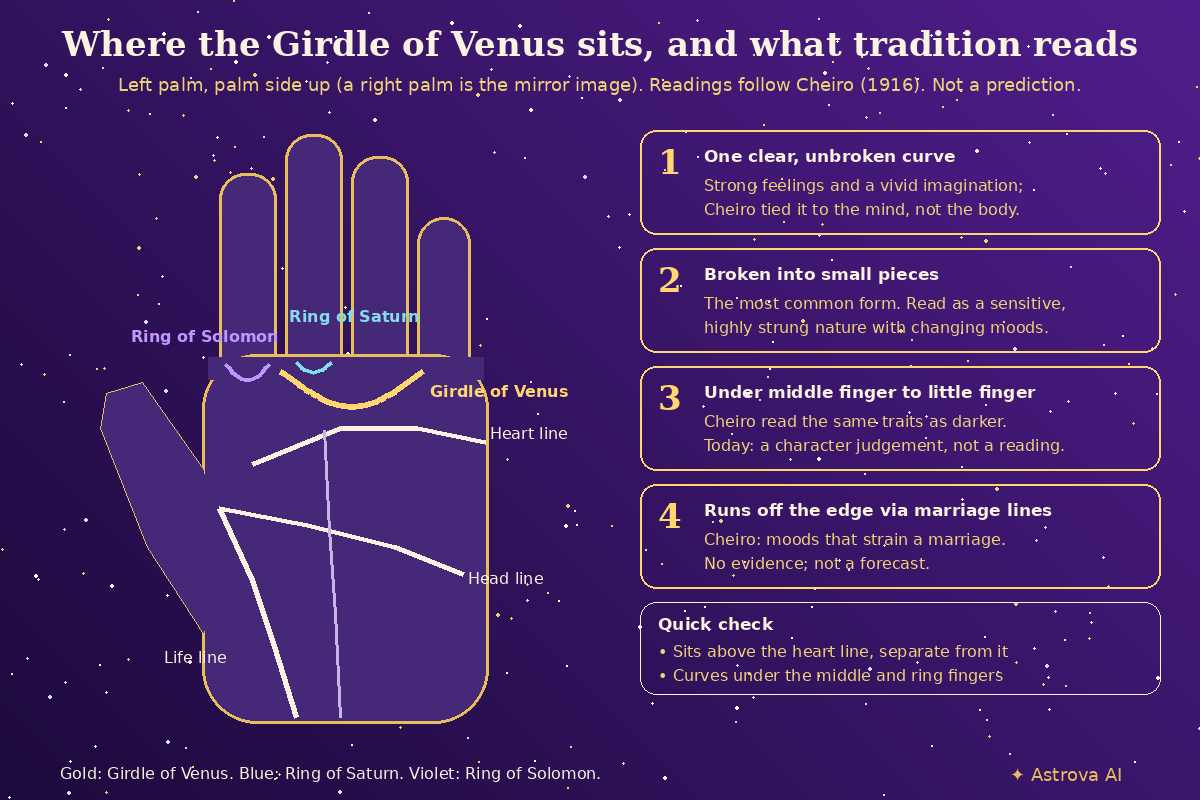
First find your heart line, the main line that runs across the top of the palm just below the fingers. The Girdle of Venus sits above it, in the narrow band between the heart line and the base of the fingers.
In Palmistry for All (1916, free on Project Gutenberg), Cheiro describes it as a “broken or sometimes unbroken kind of semi-circular line” rising from the base of the first (index) finger to the base of the fourth (little) finger. In real hands it usually starts between the index and middle fingers and ends between the ring and little fingers, so it curves under the middle and ring fingers like a shallow bowl.
New to the main lines? Our visual guide to the major palm lines shows each one, and our guide to the palm mounts explains the pads under each finger that palmists name after planets.
How to tell if you have a Girdle of Venus
- Use good light and relax your hand. Bend it very slightly so fine lines show.
- Find the heart line, then look only at the space above it, below the fingers.
- Look for a curve that bows down toward the heart line, starting near the gap between the index and middle fingers and ending near the gap between the ring and little fingers.
- Check it is not the heart line itself. A heart line that sweeps up between the fingers can look similar, but the Girdle is a separate line above it.
- Note its form and which hand it is on. Unbroken, broken, doubled or running off the edge each read slightly differently.
| Line or mark | Where it sits | How to tell it apart |
|---|---|---|
| Heart line | Across the top of the palm, from the little-finger edge | A main line almost everyone has; it runs from the edge of the palm |
| Girdle of Venus | Above the heart line, under the middle and ring fingers | A separate curve, often broken; many hands lack it |
| Ring of Saturn | A small arc around the base of the middle finger only | Much shorter; Cheiro called it “very seldom found” |
| Ring of Solomon | A small arc on the mount below the index finger | Sits under the index finger, not across the middle of the palm’s top |
| Finger-base creases | Where each finger joins the palm | Straight, short folds at each finger, not one long arc |
What does the Girdle of Venus mean? The traditional reading
The name comes from Venus, the planet tradition links with love and feeling, and the line’s position just above the heart line. Many older palmists read it as a sign of sensuality. Cheiro pushed back: he wrote that he had “not in my experience found this mark to indicate the gross sensuality that is so often ascribed to it by other writers”.
His reasoning was that the head line splits the palm into a lower half (the physical side) and an upper half (the mental side). Because the Girdle sits in the upper half, he read it as belonging to the mind and imagination: someone who thinks and feels intensely about love and relationships, rather than someone who acts on every impulse. In everyday language, modern readers describe it as a sensitive, easily moved, highly strung nature, quick to get excited and quick to feel hurt.
That is the part worth keeping. Several of Cheiro’s harsher comments, such as calling people with this mark “very difficult to live with”, are character judgements from 1916, and nothing in a palm can confirm them.
Broken, unbroken, double: what each form means
| Form | Cheiro’s reading, in plain words | How to take it today |
|---|---|---|
| One clear, unbroken curve | The full reading: a mind that dwells on love and feeling more than the body acts on it | Strong feelings and a vivid imagination |
| Broken into small pieces | “Little meaning” except a moody, highly strung temperament | The most common form; sensitivity shown in changing moods |
| Starting under the middle finger (Saturn) and ending under the little finger (Mercury) | The same qualities in a darker, more brooding form | Nothing; this is a character judgement, not a reading |
| Running off the edge of the hand through the marriage lines | Moods that make marriage difficult | Nothing as a forecast; see the FAQ below |
The marriage lines are the short horizontal lines on the edge of the palm below the little finger. See what the marriage line means in palmistry for how tradition reads them.
Girdle of Venus on the left hand vs the right hand
Cheiro’s general rule for any line was to read both hands together: the left hand as natural tendencies and the right hand as what a person develops. A mark on both hands, he said, is “more decided”. His reasoning assumed a right-handed person, so many modern palmists swap the two for left-handed readers.
- Non-writing hand only: a sensitive streak a person was born with but has learned to steady.
- Writing hand only: sensitivity that shows up strongly in daily life now.
- Both hands: the strongest form of the reading in this tradition.
Worked example (illustrative)
Arjun is a made-up person used only to show the method. This is not a reading of a real hand.
- What he sees. Arjun is right-handed. Above the heart line on his right palm there are three short dashes in a curved row, from between his index and middle fingers to between his ring and little fingers. His left palm shows one faint, mostly unbroken curve in the same place.
- Is it a Girdle of Venus? Yes: it is above and separate from the heart line, and it curves under the middle and ring fingers. It is not the Ring of Saturn, which would circle only the middle finger.
- Form. Broken on the right hand, nearly whole on the left. In Cheiro’s terms, the broken form reads as moodiness more than the full “intense imagination” reading.
- Hand. Present on both hands, so the tradition would call the temperament “more decided”: a sensitive nature from the start that now shows mostly in up-and-down moods.
- Traditional summary. Someone who gets deeply absorbed in people, music or ideas, picks up on atmosphere quickly and can be hurt by small things.
- What it does not tell him. Nothing about his behaviour, his marriage, his health or his future. A palmist would read it together with his heart line, head line and mounts, and so should he.
Get your full palm reading in Astrova AI
Is the Girdle of Venus good or bad?
Neither. In the oldest, most moralising books it was treated as a warning, while some modern sites call it a mark of rare charm or creativity. Both go further than the tradition supports. The most balanced reading, Cheiro’s, is simply that it shows a feeling, imaginative, highly strung nature, which comes with obvious strengths (empathy, creativity, enthusiasm) and obvious challenges (moodiness, taking things personally).
Other small palm marks carry their own traditional meanings, such as the mystic cross, the star and the M sign.
How rare is the Girdle of Venus?
Honestly, nobody knows. We found no study that has counted it in a population, so “rare sign” and percentage claims online have no source. Two things make it hard to count: it is often only a few faint pieces, and readers disagree on how many dashes make a Girdle. What can be said is that many hands have no Girdle at all, and a single clear, unbroken curve is less common than a broken one.
Tradition vs science
The lines are real anatomy. Palm creases form where the skin folds as you close your hand (BBC Science Focus), and anyone can check whether a curve sits above their heart line.
The meaning is tradition. Palmistry is widely viewed as a pseudoscience because different schools contradict each other and its predictions lack evidence (Palmistry, Wikipedia). The Girdle of Venus shows this well: the same line was read as a vice by some writers and as a gift by others. Enjoy it as a cultural practice and a prompt for self-reflection, not as a verdict on your character. To see how your lines fit together, try an AI palm reading, and read whether AI palmistry really works for an honest look at its limits. For another commonly misread pattern, see what a Simian line means.
FAQs
Is the Girdle of Venus rare?
Nobody has measured it. We found no study that counts how many people have a Girdle of Venus, so treat claims like “only 5% of people” as unsourced. Many hands have no Girdle at all, and when it does appear it is often just a few short broken pieces rather than one clear curve.
What does a broken Girdle of Venus mean?
In Cheiro’s Palmistry for All (1916), a Girdle made of little pieces has “little meaning” beyond showing a moody, highly strung temperament. It is also the most common form. Fine creases under the fingers can simply be how your skin folds, so do not read much into a few faint dashes.
Does the Girdle of Venus mean a person is promiscuous?
No. Some older palmists linked the line to sensuality, but Cheiro wrote that he had not found it to indicate “the gross sensuality” other writers gave it. He read it as belonging to the mind and imagination, not behaviour. And no palm line can tell you anything about a person’s actual conduct.
How is the Girdle of Venus different from the heart line?
The heart line is a main line that runs across the palm just below the fingers, usually from the edge under the little finger toward the index or middle finger. The Girdle of Venus is a separate, shorter arc above it, curving under the middle and ring fingers, and many hands do not have it.
Does the Girdle of Venus affect marriage?
Not as a prediction. Cheiro claimed that a Girdle running off the side of the hand through the marriage lines showed moods that strain a marriage, but that is an old opinion with no evidence behind it. Relationships depend on people and choices, not on a crease in the palm.
Download Astrova AI on Google Play
AI palm reading, Kundli, daily Rashifal and 24/7 AI astrologer chat in 9 Indian languages. For entertainment and self-reflection.
Sources: Cheiro, Palmistry for All, 1916, chapters on the Girdle of Venus, the Ring of Saturn, La Croix Mystique and right and left hands (Project Gutenberg) · Palmistry (Wikipedia) · Why do we have lines on our palms? (BBC Science Focus)