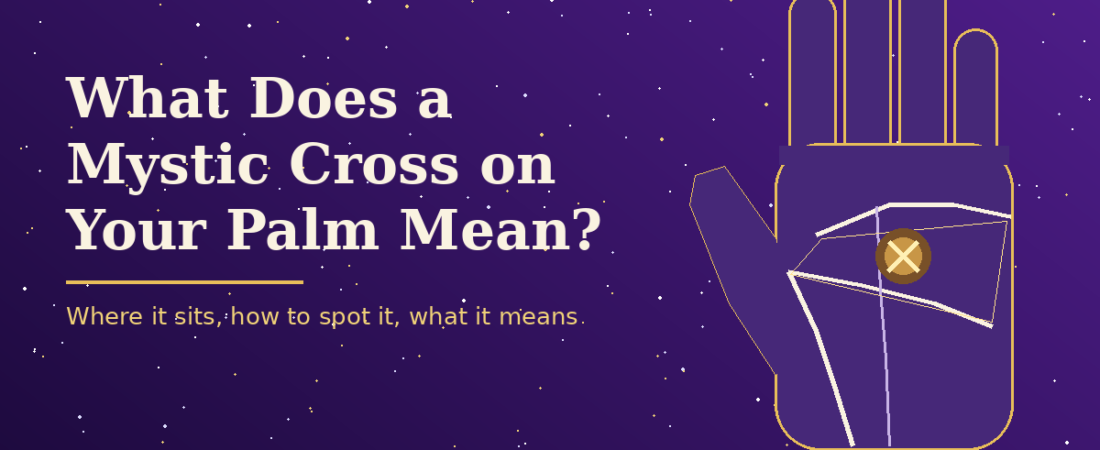
A mystic cross is a small, separate X-shaped mark in the space between the heart line and the head line, usually under the middle finger. Palmistry tradition, following the palmist Cheiro, reads it as a natural interest in spiritual and mystical subjects. It is not a sign of psychic power, luck or a fixed future.
Key takeaways
- Where: in the quadrangle, the space between your heart line and head line. Cheiro called it “La Croix Mystique”.
- What tradition reads: a natural gift for, or interest in, mysticism and spiritual study.
- Position changes the reading: near the index finger, in the centre on the fate line, or lower toward the Mount of the Moon each mean something slightly different.
- Check both hands: in Cheiro’s system the left shows tendencies and the right shows what you develop.
- Rarity is unmeasured: no study has counted it, so treat “1% of people” claims as marketing.
- Not science: palm creases are real; the personality meaning is tradition.
Scan your palm free in Astrova AI
The mystic cross is one of the most searched palm marks, and one of the most exaggerated online. This guide sticks to what the classical palmistry books actually say, shows you where to look, how to tell a true mystic cross from lookalikes, what each position means in tradition, and where tradition ends and evidence begins.
Where is the mystic cross on the palm?
Start with the two horizontal lines across your palm. The heart line runs just below the fingers, and the head line runs across the middle of the palm. The space between them is called the quadrangle.
In Palmistry for All (1916, free on Project Gutenberg), Cheiro wrote that “La Croix Mystique” is found in this quadrangle. It is “more usually found in the centre”, but can sit nearer one side or the other. In practice, most readers look first under the middle finger, close to where the fate line passes through.
New to the main lines? Our visual guide to the major palm lines shows each one.
How to tell if you have a true mystic cross
- Use good light and relax your hand. Cup it very slightly so the fine lines show, but don’t squeeze.
- Find the quadrangle. Locate the heart line and head line, then look only at the space between them.
- Look for a small, clear X or plus sign. It should be made of two short lines that cross each other, not a smudge or a single line with a branch.
- Check that it stands on its own. Most readers want it clear of the heart and head lines. Cheiro read small crosses touching the head line differently (as warnings of accidents, an old claim with no evidence behind it), which is one reason the distinction matters.
- Note where it sits and on which hand. Position and hand both change the traditional reading.
| What you see | Is it a mystic cross? |
|---|---|
| A small, separate X between the heart and head lines | Yes, the classic form |
| A small cross lying on the fate line, in the centre of the quadrangle | Yes in Cheiro’s description; stricter modern readers prefer one that touches no line |
| A small cross touching or sitting on the head line | No; Cheiro read crosses on the head line as a separate sign |
| A large X formed where your main lines cross | No; that is a different pattern, not described as a mystic cross |
| Two faint lines that only just touch | Usually no; most readers want a clearly formed cross |
What does a mystic cross mean? The traditional reading
Cheiro’s core reading is short: the mark “denotes a natural gift or talent for mysticism and occultism of all kinds”. In everyday language, that is someone drawn to spiritual practice, religion, astrology, meditation, symbolism or the deeper “why” behind things.
It stands out in his book because he read most crosses as unfavourable. Crosses on the mounts were mostly warnings in his system, with a cross on the Mount of Jupiter as the main exception. The mystic cross, in the quadrangle, is the cross he described as a gift rather than a problem.
What the position of the mystic cross means
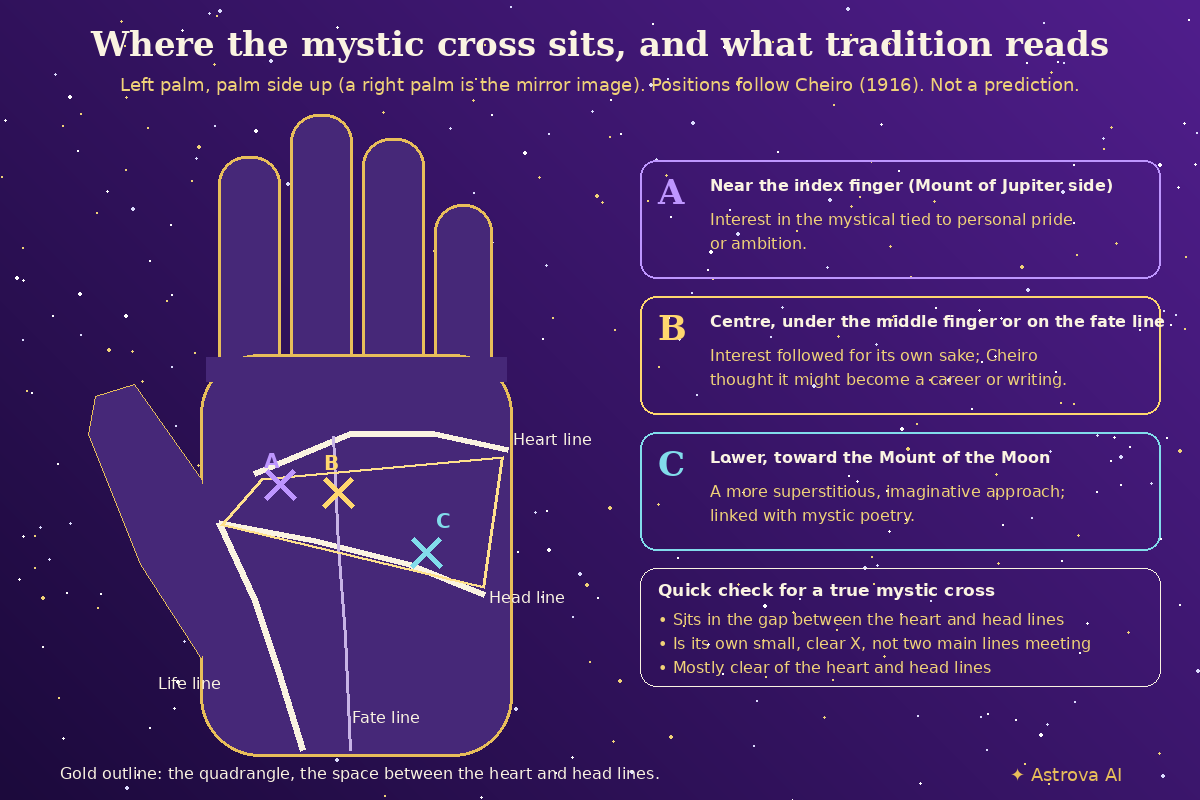
| Position | Cheiro’s reading, in plain words |
|---|---|
| Nearer the index finger (the Mount of Jupiter side) | Interest in mystical subjects that serves personal pride or ambition more than the subject itself. |
| In the centre, across the fate line or under the middle finger (Saturn) | The interest is followed for its own sake, almost like a faith. He thought it could shape a whole career, become a profession, or end up in books. |
| Lower down, nearer the Mount of the Moon | A more superstitious, imaginative approach. He linked it with writing mystic poetry and still influencing others. |
To read these zones you need to know the mounts, the raised pads under each finger and on the edge of the palm. See what the mounts on your palm reveal.
Mystic cross on the left hand vs the right hand
Cheiro’s general rule for any mark was to examine both hands together. He read the left hand as natural tendencies and the right hand as the developed, active side, and said that when both hands show a mark, its meaning “is more decided”. His reasoning assumed the usual right-handed pattern, so many modern palmists swap the two for left-handed readers.
- Left hand only: an inclination toward spiritual interests that may not have been acted on.
- Right hand only: an interest a person has built through study or experience.
- Both hands: the strongest form of the reading in this tradition.
Worked example (illustrative)
Meera is a made-up person used only to show the method. This is not a reading of a real hand.
- What she sees. Meera is right-handed. On her right palm there is a small, clear X between the heart and head lines, under her middle finger, sitting on a faint fate line. Her left palm has a few fine lines in the same area, but no clear cross.
- Is it a mystic cross? Yes in Cheiro’s description: it is in the quadrangle, clearly formed, and touches neither the heart line nor the head line. A stricter reader might note that it rests on the fate line.
- Position. Centre of the quadrangle, on the fate line. In Cheiro’s system that is the “for its own sake” reading.
- Hand. Right hand only, so the traditional reading is an interest she has developed rather than one she was born leaning toward.
- Traditional summary. Someone who has taken up spiritual or reflective study seriously, perhaps through yoga, astrology or religious practice, and might teach or write about it.
- What it does not tell her. Nothing about luck, wealth, marriage, health or psychic ability. A palmist would read it together with her head line, heart line and mounts.
Get your full palm reading in Astrova AI
The Ring of Solomon: a related mark
Cheiro grouped the mystic cross with another “mark of mysticism”, the Ring of Solomon, a curved line on the Mount of Jupiter below the index finger. Where the mystic cross shows interest, he read the Ring of Solomon as wanting the power of “a master or an adept” in such subjects. Another minor line often read alongside these is the Girdle of Venus, a curve above the heart line that tradition links with sensitivity and strong moods. Other small marks have their own traditional meanings too, such as thestar, the triangle and the M sign.
How rare is the mystic cross?
Honestly, nobody knows. We found no study that has counted mystic crosses in a population. Online figures like “only 1%” or “the rarest sign in palmistry” have no source behind them. Two things make any count hard: the quadrangle often has fine lines in it, so small crossings are common, and palmists disagree on how strict to be about a “true” cross. What can be said is that a clear, free-standing cross is less common than any crossing at all.
Tradition vs science
The lines are real anatomy. Palm creases let the skin fold when you close your hand (BBC Science Focus), and anyone can check whether a small cross is there.
The meaning is tradition. Palmistry is widely viewed as a pseudoscience because different schools contradict each other and its predictions lack evidence (Palmistry, Wikipedia). The mystic cross is a good example: even classical writers disagree on its exact form. Enjoy it as a cultural practice and a prompt for self-reflection, not as proof of a gift. If you want to see how your lines fit together, try an AI palm reading, and read whether AI palmistry really works for an honest look at its limits. For another commonly misread pattern, see what a Simian line means.
FAQs
Is a mystic cross on the palm rare?
A clear, free-standing mystic cross is uncommon, but nobody has measured how often it appears. We found no study that counts it, so figures like “only 1 to 3% of people” have no source. Many small crossings in the gap between the heart and head lines are just minor lines meeting, not a textbook mystic cross.
Which hand should I check for a mystic cross?
Check both. Cheiro read the left hand as natural tendencies and the right hand as what a person actually develops, and said a mark on both hands is “more decided”. His reasoning assumed a right-handed person, so many modern palmists swap the two hands for left-handed people.
Does a mystic cross mean I have psychic powers?
No. Palmistry tradition reads it as an interest in, or talent for, spiritual and mystical subjects, not as a power. There is no scientific evidence that any palm mark gives or reveals psychic ability.
Is a big X on the palm the same as a mystic cross?
Not in the classical sense. Cheiro’s mystic cross is a small, separate cross inside the quadrangle, the space between the heart and head lines. A large X formed where your main lines happen to cross is a different pattern, and Cheiro’s book does not describe it as a mystic cross.
What is the difference between the mystic cross and the Ring of Solomon?
Both are “marks of mysticism” in Cheiro’s book. The mystic cross sits between the heart and head lines and shows interest in the mystical. The Ring of Solomon is a curved line on the Mount of Jupiter, below the index finger, which he read as wanting mastery of such subjects.
Download Astrova AI on Google Play
AI palm reading, Kundli, daily Rashifal and 24/7 AI astrologer chat in 9 Indian languages. For entertainment and self-reflection.
Sources: Cheiro, Palmistry for All, 1916, chapters on La Croix Mystique, the cross, right and left hands, and the quadrangle (Project Gutenberg) · Palmistry (Wikipedia) · Why do we have lines on our palms? (BBC Science Focus)