🔮 Get Your Free Navagraha Reading — Download Astrova AI
Every planet in your birth chart is not just a rock in space — it is a living deity with a story, a blessing, and a lesson. Understanding who they are changes how you read your Kundli forever.
What Are the Navagraha and Why Do They Matter in Your Life?
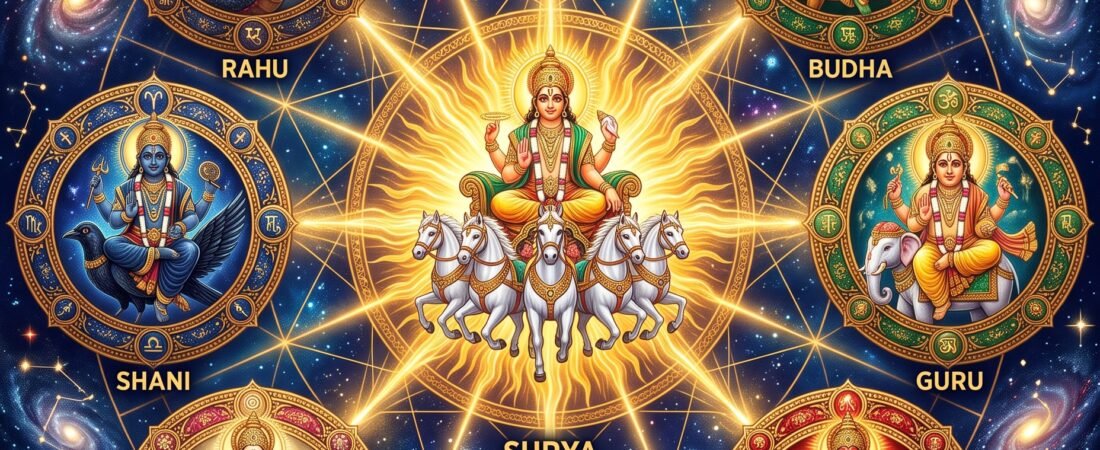
The Navagraha — literally “nine gras” or “nine seizers” — are the nine celestial bodies that Vedic astrology believes seize hold of your destiny at the moment of your birth. Unlike Western astrology, which treats planets as impersonal forces, Jyotish Shastra gives each one a divine form, a personality, a vehicle (vahana), and a relationship with human karma.
When you open your Janam Kundli, every planet sitting in a house is not merely influencing that area of life — a deity is residing there, shaping your experiences according to cosmic law. This is why remedies in Vedic tradition are always directed at a specific graha through mantras, fasting on specific weekdays, gemstones, and rituals.
In this guide, you will meet all nine planetary deities, understand their astrological role, learn which day belongs to each, and discover how Astrova AI can show you exactly which grahas are active in your chart right now.
The Nine Planetary Deities: A Complete Guide
1. Surya (The Sun) — The Soul King
Planet: Sun ☉
Day: Sunday (Ravivar)
Deity: Lord Surya, the Aditya, son of Aditi and Kashyapa
Vehicle: Seven-horse chariot driven by Aruna (the dawn)
Represents: Soul (Atman), father, government, authority, vitality, self-confidence
In Vedic mythology, Surya is the visible form of Brahman — the supreme reality that dispels darkness. The Surya Siddhanta, one of the oldest astronomical texts (dated between 5th–6th century CE), opens with an invocation to Surya as the source of all cosmic time.
In your Kundli: A strong Sun gives leadership, good health, a strong relationship with your father, and government favour. A weak or afflicted Sun can cause low confidence, eye problems, and friction with authority figures.
Simple remedy: Offer water to the rising Sun every morning (Arghya) while chanting “Om Suryaya Namah.” Sunday fasting is traditionally recommended for strengthening a weak Sun.
2. Chandra (The Moon) — The Mind Goddess
Planet: Moon ☽
Day: Monday (Somavar)
Deity: Lord Chandra (Soma), son of Sage Atri and Anasuya
Vehicle: White antelope or ten-horse chariot
Represents: Mind (Manas), mother, emotions, nourishment, public image, liquids
Chandra rules the Nakshatras (lunar mansions) — all 27 of them fall under his dominion. This is why Vedic astrology uses the Moon sign (Rashi) and Nakshatra as the primary lens for personality reading, not the Sun sign as in Western astrology.
In your Kundli: A strong Moon gives emotional stability, a good memory, a nurturing nature, and public popularity. An afflicted Moon can cause anxiety, mood swings, insomnia, and maternal relationship issues.
Simple remedy: Fasting on Mondays and offering milk or white flowers to Lord Shiva (who carries the Moon on his head) is the classical remedy. Wearing a pearl (Moti) after astrological consultation is also prescribed.
3. Mangal (Mars) — The Warrior
Planet: Mars ♂
Day: Tuesday (Mangalvar)
Deity: Lord Mangal (Kartikeya/Skanda), son of Shiva and Parvati, commander of the Deva army
Vehicle: Red goat or chariot drawn by red horses
Represents: Courage, siblings (especially brothers), land, property, engineering, blood, aggression
Mangal is perhaps the most feared graha in popular astrology because of his association with Mangal Dosha (Mars affliction in marriage compatibility). But Mars is not inherently negative — he is the planet of righteous action, protection, and the energy to fight for dharma.
In your Kundli: A strong Mars gives courage, athletic ability, engineering talent, and property ownership. An afflicted Mars can cause anger issues, accidents, blood-related health problems, and the famous Manglik Dosha in marriage matching.
Simple remedy: Reciting the Hanuman Chalisa on Tuesdays is the most widely prescribed Mars remedy in North Indian tradition. Fasting on Tuesdays and avoiding non-vegetarian food on this day is also recommended.
4. Budha (Mercury) — The Prince
Planet: Mercury ☿
Day: Wednesday (Budhvar)
Deity: Lord Budha, son of Chandra (Moon) and Tara (wife of Brihaspati)
Vehicle: Green lion or chariot drawn by wind
Represents: Intelligence, speech, commerce, mathematics, younger siblings, humour
The birth story of Budha is one of the most dramatic in the Puranas. Tara, wife of Guru Brihaspati (Jupiter), was abducted by Chandra (Moon). Budha was born from this union, triggering a war between the Devas and Asuras — known as the Tarakamaya War — before Brihaspati reclaimed Tara and accepted Budha as his son.
In your Kundli: A strong Mercury gives sharp intellect, good communication skills, business acumen, and a sense of humour. An afflicted Mercury can cause speech problems, learning difficulties, and business losses.
Simple remedy: Feeding green grass to cows on Wednesdays, wearing green clothing, and reciting the Vishnu Sahasranama are classical Mercury remedies. Emerald (Panna) is the prescribed gemstone.
5. Guru / Brihaspati (Jupiter) — The Divine Priest
Planet: Jupiter ♃
Day: Thursday (Guruvar/Brihaspativar)
Deity: Lord Brihaspati, Guru of the Devas, son of Sage Angira
Vehicle: Golden chariot drawn by eight yellow horses
Represents: Wisdom, spirituality, children, wealth expansion, husband (in a woman’s chart), dharma
Brihaspati is the heaviest graha in Vedic astrology — literally called the “Guru” because he teaches the gods. When Jupiter transits into a new zodiac sign, it triggers major shifts in collective fortune. The famous Jupiter Dasha (Mahadasha) in Vimshottari is considered the most transformative period of a person’s life.
In your Kundli: A strong Jupiter gives wisdom, spiritual inclination, good children, financial prosperity, and a strong moral compass. An afflicted Jupiter can cause dogmatism, weight gain, liver problems, and spiritual confusion.
Simple remedy: Wearing yellow on Thursdays, applying a saffron tilak, and donating turmeric, chana dal, or gold on Guruvar are time-tested Jupiter remedies.
6. Shukra (Venus) — The Asura Guru
Planet: Venus ♀
Day: Friday (Shukravar)
Deity: Lord Shukracharya, Guru of the Asuras, son of Sage Bhrigu
Vehicle: White horse, camel, or chariot drawn by white horses
Represents: Love, marriage, luxury, arts, beauty, vehicles, semen/reproductive health
Shukra is one of the most fascinating deities in the Puranic pantheon. He is the guru of the Asuras (demons), yet he possesses the Sanjeevani Vidya — the knowledge of reviving the dead. This knowledge is what made the Asuras nearly invincible in their battles against the Devas, and it is why Lord Shiva ultimately consumed Shukra to prevent the cosmic balance from being destroyed.
In your Kundli: A strong Venus gives a loving marriage, artistic talent, material comfort, charm, and good reproductive health. An afflicted Venus can cause relationship problems, luxury addiction, skin issues, and financial waste.
Simple remedy: Wearing white on Fridays, offering white flowers to Goddess Lakshmi, and using perfumes/fragrances daily are classical Venus remedies. Diamond and white sapphire are the prescribed gemstones.
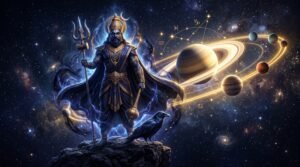
7. Shani (Saturn) — The Lord of Karma
Planet: Saturn ♄
Day: Saturday (Shanivar)
Deity: Lord Shani Dev, son of Surya (Sun) and Chhaya (Shadow)
Vehicle: Vulture or crow, sometimes a black horse
Represents: Karma, discipline, delay, old age, servants, chronic disease, longevity
Shani is the most feared planet in Indian astrology — but this fear is largely misplaced. Shani is not a punisher; he is the cosmic accountant who delivers exactly what your karma deserves, neither more nor less. The famous story of Shani and King Harishchandra illustrates this: Shani’s tests were harsh, but they ultimately proved the king’s dharma was unshakeable.
In your Kundli: A well-placed Saturn gives discipline, longevity, success through hard work, and mastery over time. An afflicted Saturn causes delays, chronic health issues, isolation, and the famous Sade Sati and Kaalsarp Dosha effects.
Simple remedy: Donating black sesame seeds (til), black urad dal, or iron items on Saturdays. Lighting a sesame-oil diya under a Peepal tree on Saturday evening is one of the most powerful Shani remedies in folk tradition.
8. Rahu — The Shadow Dragon’s Head
Planet: North Lunar Node (ascending node)
Day: Saturday (with Shani) or Wednesday (with Budha)
Deity: Rahu, the severed head of the Asura Svarbhanu
Vehicle: Dark chariot drawn by eight black horses
Represents: Obsession, foreign lands, technology, sudden gains, illusions, politics
The mythology of Rahu comes from the Samudra Manthan (churning of the ocean). When the Devas and Asuras churned the cosmic ocean for Amrita (the nectar of immortality), the Asura Svarbhanu disguised himself as a Deva and sat between the Sun and Moon. When Lord Vishnu discovered the deception, he used his Sudarshana Chakra to sever Svarbhanu’s head — but the Amrita had already reached his throat, making the head immortal. That head became Rahu, and the tail became Ketu. Ever since, Rahu “swallows” the Sun and Moon during eclipses.
In your Kundli: Rahu gives unconventional ambition, interest in foreign cultures, technological aptitude, and sudden rises. An afflicted Rahu causes addictions, phobias, scandals, and chronic confusion.
Simple remedy: Donating blue or black blankets to the needy on Saturdays. Reciting the Rahu Beej Mantra (“Om Bhram Bhreem Bhraum Sah Rahave Namah”) 18,000 times during Rahu Dasha is the classical prescription.
9. Ketu — The Shadow Dragon’s Tail
Planet: South Lunar Node (descending node)
Day: Tuesday (with Mangal) or Saturday (with Shani)
Deity: Ketu, the headless body of Svarbhanu
Vehicle: Multi-coloured chariot or vulture
Represents: Spirituality, detachment, past-life karma, moksha, sudden losses, mysticism
While Rahu represents worldly obsession, Ketu represents the opposite — detachment and liberation. In Vedic philosophy, Ketu is considered a moksha karaka (significator of liberation). People with a strong Ketu often feel detached from material life and are drawn to spiritual practices, meditation, and ascetic traditions.
In your Kundli: A well-placed Ketu gives spiritual insight, intuitive knowledge, and the ability to let go. An afflicted Ketu causes sudden losses, mysterious illnesses, feeling directionless, and karmic debts from past lives.
Simple remedy: Worshipping Lord Ganesha (who governs Ketu in many traditions), donating grey/blanket items, and reciting the Ketu Beej Mantra (“Om Sram Sreem Sraum Sah Ketave Namah”).
Navagraha Reference Table: Quick Guide
| Graha | Planet | Day | Colour | Gemstone | Key Domain |
|---|---|---|---|---|---|
| Surya | Sun | Sunday | Gold/Orange | Ruby (Manik) | Soul, Father, Authority |
| Chandra | Moon | Monday | White | Pearl (Moti) | Mind, Mother, Emotions |
| Mangal | Mars | Tuesday | Red | Red Coral (Moonga) | Courage, Property, Siblings |
| Budha | Mercury | Wednesday | Green | Emerald (Panna) | Intelligence, Speech, Business |
| Guru | Jupiter | Thursday | Yellow | Yellow Sapphire (Pukhraj) | Wisdom, Children, Dharma |
| Shukra | Venus | Friday | White/Pink | Diamond (Heera) | Love, Arts, Luxury |
| Shani | Saturn | Saturday | Black/Dark Blue | Blue Sapphire (Neelam) | Karma, Discipline, Longevity |
| Rahu | North Node | Saturday | Blue/Smoke | Hessonite (Gomed) | Ambition, Foreign, Technology |
| Ketu | South Node | Tuesday | Grey/Multi | Cat’s Eye (Lehsunia) | Moksha, Detachment, Past Lives |
How to Know Which Navagraha Is Active in Your Life Right Now
The Vimshottari Dasha system — the planetary period system unique to Vedic astrology — tells you exactly which graha is running your life at any given moment. A Jupiter Dasha lasts 16 years. A Saturn Dasha lasts 19 years. A Rahu Dasha lasts 18 years. Each one colours every area of your life differently.
But Dasha is only half the picture. The transit (Gochar) of planets through the zodiac adds a second layer. When Saturn transits your Moon sign, you experience Sade Sati. When Jupiter aspects your 7th house, marriage possibilities open up. When Rahu transits your Lagna, your entire identity shifts.
Astrova AI calculates all of this automatically. Enter your birth details once, and the app shows you:
- Your current Mahadasha and Antardasha (which planet is ruling your life phase)
- All current planetary transits and which houses they affect in your chart
- Personalized remedies based on your specific graha placements
- Daily Rashifal that accounts for both Dasha and Gochar
The Deeper Wisdom: Navagraha as a Mirror of Human Experience
What makes Vedic astrology uniquely profound is that the Navagraha are not just predictive tools — they are a map of the complete human experience.
Surya gives you identity. Chandra gives you emotion. Mangal gives you the will to act. Budha gives you the intelligence to plan. Guru gives you the wisdom to choose rightly. Shukra gives you the capacity to love and create beauty. Shani gives you the discipline to endure. Rahu gives you the ambition to reach beyond. Ketu gives you the detachment to let go.
Together, these nine forces create the full spectrum of human life — from the material to the spiritual, from the first breath to the final liberation.
The ancient rishis who codified Jyotish were not merely fortune-tellers. They were philosophers who understood that the cosmos and the human being are made of the same fabric. When you study the Navagraha, you are studying yourself.
Frequently Asked Questions
Are Rahu and Ketu real planets?
Rahu and Ketu are not physical planets — they are mathematical points where the Moon’s orbit crosses the ecliptic (the Sun’s apparent path). The ascending node is Rahu; the descending node is Ketu. Vedic astrology treats them as “shadow planets” (Chhaya Grahas) because they have no physical form but exert powerful influence, especially during eclipses.
Can Navagraha remedies really change my destiny?
Vedic tradition holds that whileprarabdha karma (the karma that has already begun to fructify) cannot be fully erased, its intensity can be reduced through sincere remedies. Think of it like medicine — it does not change the disease, but it manages the symptoms and supports healing. The most effective remedy is always aligned with your specific chart, which is why a generic remedy may not work for everyone.
Which Navagraha is the most powerful?
There is no single “most powerful” graha. Each one governs a different domain of life. However, classical texts like the Brihat Parashara Hora Shastra give special importance to Jupiter (for wisdom and dharma) and Saturn (for karma and longevity). The Moon is considered the most important for mental peace and emotional well-being.
How does Astrova AI help me understand my Navagraha?
Astrova AI generates your complete Janam Kundli showing the exact position of all nine grahas at your birth time, calculates your current Dasha periods, shows real-time transits, and provides personalized remedies — all available in 9 Indian languages. The AI astrologer is available 24/7 to answer specific questions about any graha in your chart.
Summary
The Navagraha are the nine divine forces that shape every moment of your life according to Vedic astrology. Each planetary deity — from Surya the Soul King to Ketu the liberator — governs specific areas of your existence. Understanding which grahas are strong or weak in your birth chart, and which Dasha period you are currently running, gives you the self-knowledge to navigate life with wisdom rather than fear. Astrova AI brings this ancient science to your fingertips — free, in your language, available 24/7.
✨ Download Astrova AI — Free Kundli & Navagraha Reading
Explore More Astrova Guides
- How to Read Your Janam Kundli — Complete Vedic Birth Chart Guide
- Daily Rashifal: How to Use Your Horoscope for Better Decisions
- Kundli Milan: The Complete Guide to Vedic Marriage Compatibility
- Sade Sati and Kaalsarp Dosha: What They Really Mean and How to Navigate Them
- AI Astrology vs Traditional Astrologers: Complete Comparison
- AI Palm Reading: How to Read Your Palm Using Artificial Intelligence
About the Author: The Astrova AI editorial team combines traditional Jyotish scholarship with modern AI technology. Our content is reviewed by practicing Vedic astrologers and is grounded in classical texts including the Brihat Parashara Hora Shastra, Surya Siddhanta, Phaladeepika, and Jataka Parijata. Astrova AI is available free on Google Play in 9 Indian languages.
References & Sources
- Brihat Parashara Hora Shastra — translated by Girish Chand Sharma, published by Sagar Publications
- Surya Siddhanta — critical edition, translated by Bapu Deva Sastri (Bibliotheca Indica, 1860)
- Phaladeepika by Mantreswara — translated by R. Santhanam, Sagar Publications
- Jataka Parijata by Vaidyanatha Dikshita — English translation, Sagar Publications
- Drik Panchang — drikpanchang.com (planetary positions and festival dates)
- Swiss Ephemeris — astro.com/swisseph (astronomical ephemeris used for planetary calculations)