What Is Samudra Manthan And How Does It Connect To Rahu, Ketu And Your Kundli?
Quick Answer: Samudra Manthan is the ancient Vedic story of gods and demons churning the cosmic ocean to obtain the nectar of immortality. During this event, Rahu and Ketu were born from the severed head and body of the demon Svarbhanu, making this mythology the foundation of lunar node astrology in your birth chart.
✓ 100% FREE
Discover Your Rahu-Ketu Placement
Get your complete Kundli with lunar node analysis in 9 Indian languages
✓ Free Kundli ✓ AI Astrologer ✓ 9 Languages
The Cosmic Ocean Churning: A Story That Shaped Vedic Astrology
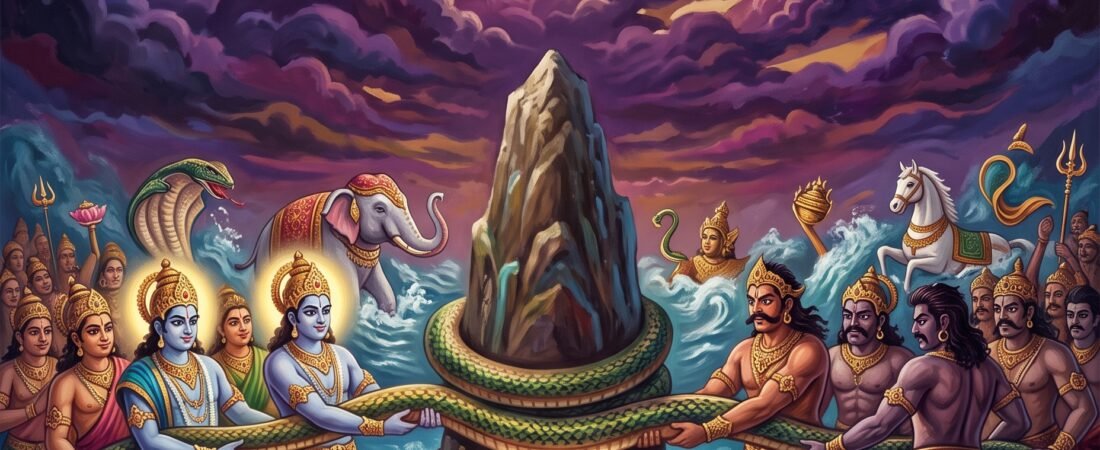
Imagine an event so powerful that it created two of the most feared points in your birth chart. That’s what happened during Samudra Manthan—the churning of the primordial ocean of milk (Kshira Sagara), a story told in the Bhagavata Purana, Vishnu Purana, and Mahabharata.
The gods (Devas) and demons (Asuras) joined forces to churn the ocean using Mount Mandara as the churning rod and the serpent Vasuki as the rope. Their goal? To obtain Amrita, the nectar of immortality. But what emerged from those cosmic waters changed astrology forever.
How Rahu And Ketu Were Born From This Mythology
When the nectar finally appeared, the demon Svarbhanu disguised himself as a god and sat between the Sun and Moon to drink it. Lord Vishnu, in his Mohini form, saw through the deception and used his Sudarshana Chakra to sever the demon’s head.
But by then, the nectar had touched his throat. The head became Rahu (the North Node), and the body became Ketu (the South Node). Because of the nectar, both became immortal—but Rahu’s head can never swallow properly, and Ketu’s body has no mouth to taste anything.
This is why, in Vedic astrology, Rahu and Ketu are called “shadow planets” or “lunar nodes.” They have no physical form, yet their influence is as powerful as any planet. Every solar eclipse is Rahu swallowing the Sun, and every lunar eclipse is Rahu swallowing the Moon—only for the light to escape through Ketu’s open body.
What Samudra Manthan Means For Your Kundli
The story isn’t just mythology—it’s a map of karmic patterns. Rahu represents your insatiable desires, obsessions, and the areas where you feel incomplete. Ketu represents what you’ve already mastered in past lives, the talents that come naturally but that you may take for granted.
When you generate your Janam Kundli in Astrova AI, you’ll see exactly which houses Rahu and Ketu occupy in your birth chart. This tells you:
- Rahu’s house: Where you’re meant to grow, learn, and face challenges in this lifetime
- Ketu’s house: Where you have natural talent but may feel detached or unfulfilled
- Their axis: The karmic lesson you’re working through across multiple lifetimes
For example, if Rahu is in your 10th house (career) and Ketu is in your 4th house (home), you’re being pushed toward public achievement and away from domestic comfort. The mythology of Samudra Manthan explains why this tension exists—it’s the same cosmic drama playing out in your life.
The 14 Ratnas (Treasures) That Emerged From The Ocean
Samudra Manthan didn’t just produce Rahu and Ketu. Fourteen treasures emerged from the churning, each connected to a planet or astrological principle:
| Treasure (Ratna) | Planet/Principle | Astrological Significance |
|---|---|---|
| Kamadhenu (wish-fulfilling cow) | Venus (Shukra) | Luxury, comfort, material abundance |
| Uchchaihshravas (seven-headed horse) | Sun (Surya) | Power, authority, fame |
| Airavata (white elephant) | Moon (Chandra) | Emotional stability, royal status |
| Kaustubha gem | Mars (Mangal) | Courage, protection, vitality |
| Parijata tree | Jupiter (Guru) | Wisdom, knowledge, spiritual growth |
| Apsaras (celestial nymphs) | Mercury (Budha) | Communication, arts, intelligence |
| Lakshmi (goddess of wealth) | Venus (Shukra) | Prosperity, beauty, relationships |
| Dhanvantari (physician of gods) | Jupiter (Guru) | Health, healing, Ayurveda |
| Amrita (nectar of immortality) | Moon (Chandra) | Longevity, spiritual liberation |
| Halahala (poison) | Saturn (Shani) | Suffering, karma, transformation |
| Sharanga (bow) | Mars (Mangal) | War, defense, determination |
| Shankha (conch) | Mercury (Budha) | Speech, music, victory |
| Rahu (head of Svarbhanu) | North Node | Obsession, ambition, illusion |
| Ketu (body of Svarbhanu) | South Node | Detachment, past-life karma, liberation |
Notice how Saturn (Shani) received the poison (Halahala)? This is why Saturn is associated with suffering and hard karma—it drank the poison to save the universe, just as Lord Shiva did in the related myth. If Saturn is strong in your Kundli, you have the capacity to transform pain into wisdom.
How To Use This Mythology For Astrological Remedies
Understanding Samudra Manthan isn’t just academic—it gives you practical remedies for Rahu and Ketu doshas in your chart:
1. For Rahu affliction (confusion, addiction, sudden misfortune):
- Feed black sesame seeds to birds on Saturdays
- Wear a Hessonite gemstone (after consulting an astrologer)
- Chant the Rahu mantra: “Om Bhram Bhreem Bhraum Sah Rahave Namah”
- Donate blue cloth or blankets to the needy
2. For Ketu affliction (detachment, health issues, spiritual confusion):
- Feed dogs or cows on Tuesdays
- Wear a Cat’s Eye gemstone (after consultation)
- Chant the Ketu mantra: “Om Sram Sreem Sraum Sah Ketave Namah”
- Practice meditation and seva (selfless service)
3. For Rahu-Ketu transit periods (Sade Sati or Dasha):
- Recite the Vishnu Sahasranama (1000 names of Vishnu) regularly
- Perform Rahu-Ketu Shanti Puja during eclipses
- Avoid starting major ventures during eclipse periods
- Focus on spiritual practices rather than material goals
✓ 100% FREE
Check Your Rahu-Ketu Placement Now
AI-powered Kundli analysis with personalized remedies
No credit card required • Instant results
The Deeper Lesson: Why This Mythology Matters Today
Samudra Manthan teaches us that both gods and demons had to work together to obtain the nectar. In your life, this means you must integrate both your light and shadow aspects to achieve wholeness.
Rahu shows you what you desire but haven’t integrated yet. Ketu shows you what you’ve already mastered but may be avoiding. The tension between them is your soul’s growth edge.
When you understand this cosmic story, you stop fearing Rahu and Ketu. Instead, you see them as teachers—pointing you toward the lessons you came here to learn. The ocean of your consciousness is being churned by life’s challenges, and from that churning, wisdom emerges.
Frequently Asked Questions
1. Is Rahu a real planet in Vedic astrology?
No, Rahu is not a physical planet. It’s the North Lunar Node—the point where the Moon’s orbit crosses the ecliptic (the Sun’s apparent path). In Vedic astrology, it’s treated as a “shadow planet” because of its powerful influence on eclipses and karmic patterns.
2. Why are Rahu and Ketu always opposite each other?
They represent the axis of your karmic journey. If Rahu is in your 1st house (self), Ketu is in your 7th house (relationships). This shows the tension between personal growth and partnership that you’re meant to balance.
3. Can Samudra Manthan remedies really change my destiny?
Vedic astrology teaches that remedies (upayas) can mitigate difficult karma, not erase it. Think of them as reducing the intensity of a lesson rather than skipping it entirely. The goal is to learn the lesson with less suffering.
4. How do I know if Rahu or Ketu is afflicting my chart?
Common signs of Rahu affliction include sudden obsessions, addictions, confusion, or unexpected ups and downs. Ketu affliction often shows as detachment, health issues, or feeling spiritually lost. Generate your free Kundli in Astrova AI to see their exact placement.
5. What’s the connection between Samudra Manthan and eclipses?
Every solar eclipse is Rahu “swallowing” the Sun, and every lunar eclipse is Rahu swallowing the Moon. Because Rahu has no body, the light always escapes through Ketu. This is why eclipses are considered times of heightened karmic activity and spiritual transformation.
Explore More Astrova Guides
- Generate Your Janam Kundli Online Free — Complete Step-by-Step Guide
- Rashi Chart Meaning: How To Read Your Birth Chart
- What Does Your Moon Sign Reveal About Your Emotions And Intuition?
- What Is Manglik Dosha? Complete Guide And Remedies
- What Is Sade Sati? Complete Guide And Remedies
- How To Use AI Astrology For Daily Life Guidance
About The Astrova AI Editorial Team
The Astrova AI Editorial Team combines traditional Vedic astrology knowledge with modern AI technology. Our content is based on classical Jyotish texts including the Brihat Parashara Hora Shastra, Phaladeepika, and Jataka Parijata, verified by experienced astrologers and made accessible through our free AI-powered platform. We believe everyone deserves access to accurate astrological guidance, which is why our app offers free Kundli generation, daily Rashifal, and 24/7 AI astrologer chat in 9 Indian languages.
Ready to explore your cosmic blueprint? Download Astrova AI and discover what the stars have written for you — completely free.
Related posts:
 What Does Your Marriage Line on the Palm Reveal About Your Love Life and Relationship Timing?
 What Is Kemadruma Yoga In Your Kundli And Does It Really Cause Poverty?
 What Is Ashtakavarga in Vedic Astrology and How Does This Point System Predict Planetary Strength
 What Does Jupiter (Guru) in Your Kundli Reveal About Wisdom, Wealth and Spiritual Growth?