What Is the Mythology of Rahu and Ketu — and Why Do They Rule Eclipses in Vedic Astrology?
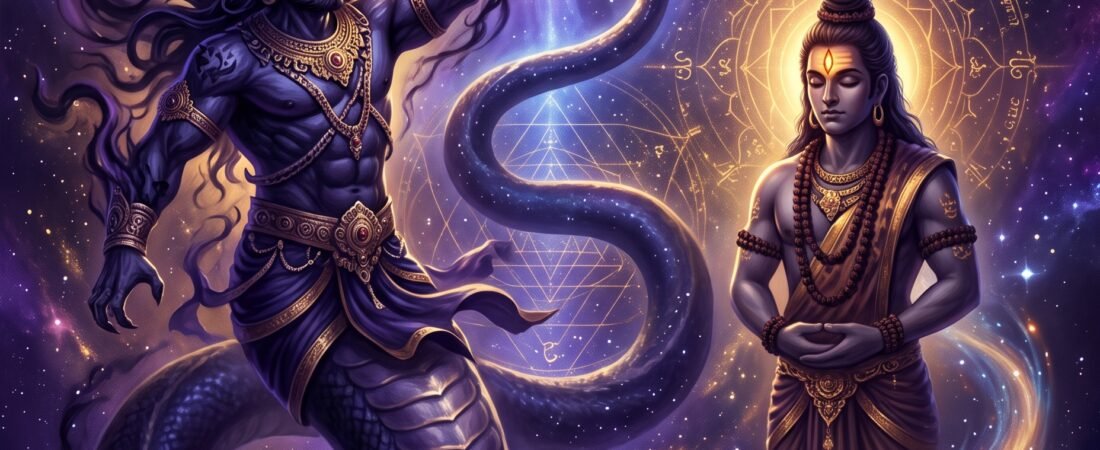
Quick Answer: Rahu and Ketu are the North and South lunar nodes — not physical planets but mathematical points where the Moon’s orbit crosses the ecliptic. In Hindu mythology, they are the severed head and body of the demon Swarbhanu, who tried to steal the nectar of immortality during the Samudra Manthan (churning of the ocean). Lord Vishnu, in his Mohini avatar, beheaded the demon, but Swarbhanu had already consumed a drop of amrita, making the severed head (Rahu) and body (Ketu) immortal. In Vedic astrology, Rahu and Ketu cause eclipses by “swallowing” the Sun and Moon, and their transits through your Kundli mark periods of intense karmic transformation.
🔮 Discover Your Rahu-Ketu Transit & Karmic Path
Get your free Kundli with Rahu-Ketu house placement, Dasha analysis and remedies — in 9 Indian languages.
⭐ Free Kundli • Daily Rashifal • AI Astrologer 24/7
The Samudra Manthan: How Rahu and Ketu Were Born
The story of Rahu and Ketu begins with one of the most dramatic episodes in Hindu mythology — the Samudra Manthan, or churning of the cosmic ocean. This event is described in the Bhagavata Purana (Canto 8, Chapters 6-12), the Vishnu Purana (Book 1, Chapter 18), and the Mahabharata (Adi Parva, Section 18).
The Devas (gods) and Asuras (demons) joined forces to churn the ocean of milk in search of amrita — the nectar of immortality. They used Mount Mandara as the churning rod and the serpent Vasuki as the rope. Lord Vishnu took the form of Kurma (the cosmic tortoise) to support the mountain on his back.
As the churning progressed, fourteen precious gems and divine beings emerged from the ocean — including Dhanvantari carrying the pot of amrita. The moment the nectar appeared, the Asuras rushed to seize it. To protect the nectar, Vishnu transformed into Mohini — an enchantingly beautiful woman. The Asuras, mesmerized, asked Mohini to distribute the nectar fairly.
Mohini began serving the amrita to the Devas in an orderly line. Among the Asuras, the demon Swarbhanu — a master of disguise — noticed the trick. He transformed himself into a Deva, took his place between Chandra (the Moon god) and Surya (the Sun god), and raised the cup of amrita to his lips.
The Sun and Moon immediately recognized the impostor and cried out to Mohini. In that instant, Vishnu hurled his Sudarshana Chakra and severed Swarbhanu’s head. But the demon had already swallowed a single drop of the nectar.
That drop of amrita made the severed head immortal. The head became Rahu and the body became Ketu. Since then, Rahu — driven by hatred for the Sun and Moon — eternally chases and swallows them, causing solar and lunar eclipses. The Sun and Moon always re-emerge because only the head was made immortal; the body (Ketu) cannot sustain the act.
Who Is Rahu? The Shadow Planet of Obsession and Ambition
In Vedic astrology, Rahu is called the North Lunar Node — the point where the Moon’s orbit crosses the ecliptic moving northward. Rahu has no physical body. It is a mathematical point, yet its influence is considered as powerful as any planet.
Rahu represents:
- Worldly desire and obsession — the head without a body can never be satisfied. It craves experiences, status, and material achievement endlessly.
- Innovation and unconventional thinking — Rahu breaks taboos and rules. It governs technology, foreign lands, mass movements, and anything that disrupts the status quo.
- Illusion (Maya) — Rahu creates smoke screens. It amplifies attachment to outcomes that may not serve your soul’s growth.
- Sudden, dramatic change — Rahu’s transits often bring unexpected events: sudden fame, sudden loss, sudden shifts in direction.
The classical text Phaladeepika by Mantreswara (Chapter 27) describes Rahu as having the nature of Saturn and Venus combined — it gives material results similar to the planet it conjoins with, but with an obsessive, amplifying quality.
Who Is Ketu? The Shadow Planet of Liberation and Detachment
Ketu is the South Lunar Node — the point where the Moon’s orbit crosses the ecliptic moving southward. If Rahu is the head that craves, Ketu is the body without a head — it acts without thinking, without desire, without attachment.
Ketu represents:
- Spiritual liberation (Moksha) — Ketu strips away worldly attachments. Its periods often bring isolation, loss, or disillusionment that pushes the native toward inner seeking.
- Past-life karma — Ketu carries the residue of skills, traumas, and patterns from previous births. What comes naturally to you may be Ketu’s gift from a past life.
- Intuition and psychic ability — without the rational head, Ketu operates through instinct, dreams, and extrasensory perception.
- Detachment — Ketu’s periods teach non-attachment. People often lose what they cling to during Ketu transits, but gain inner peace in return.
The Brihat Parashara Hora Shastra (Chapter 4) classifies Rahu and Ketu as shadow planets (Chhaya Grahas) with the same dasha (planetary period) weight as full planets in the Vimshottari system — Rahu rules an 18-year Mahadasha and Ketu rules a 7-year Mahadasha.
Rahu and Ketu in Your Kundli: The Karmic Axis
In your birth chart, Rahu and Ketu always sit exactly opposite each other, forming what astrologers call the karmic axis. Where Rahu sits shows what your soul is drawn to in this lifetime — the obsession, the ambition, the lesson you keep chasing. Where Ketu sits shows what you already mastered in a past life — the area where you feel detached, bored, or inexplicably skilled.
| House Position | Rahu’s Effect (Obsession) | Ketu’s Effect (Detachment) |
|---|---|---|
| 1st / 7th axis | Identity, self-image, public persona | Relationships, partnerships, marriage |
| 2nd / 8th axis | Wealth, family, speech | Transformation, longevity, occult |
| 3rd / 9th axis | Courage, communication, siblings | Dharma, spirituality, higher learning |
| 4th / 10th axis | Home, mother, emotional security | Career, public status, authority |
| 5th / 11th axis | Creativity, children, intelligence | Social networks, gains, aspirations |
| 6th / 12th axis | Enemies, health, service | Foreign lands, liberation, expenses |
Why Do Rahu and Ketu Cause Eclipses?
The mythology maps directly onto the astronomy. An eclipse occurs when the Sun, Moon, and one of the lunar nodes align:
- Solar eclipse: The New Moon occurs at or near Rahu or Ketu. The Moon passes between the Earth and the Sun, and the shadow node “swallows” the Sun’s light.
- Lunar eclipse: The Full Moon occurs at or near Rahu or Ketu. The Earth passes between the Sun and Moon, and the shadow node “swallows” the Moon’s light.
In mythology, this is Rahu literally chasing and devouring the Sun (Surya) and Moon (Chandra) in revenge for exposing his deception during the Samudra Manthan. Because only his head is immortal, the Sun and Moon always emerge again — the eclipse is temporary.
In astrology, eclipses are considered the most powerful transit events. Any planet or house touched by an eclipse in your Kundli undergoes intense transformation during the following months. The Skanda Purana states that eclipses are also moments when karmic debts accelerate — remedies performed during an eclipse (such as mantra japa, charity, or fasting) are said to carry multiplied spiritual merit.
Rahu-Ketu Remedies: What the Ancient Texts Prescribe
Vedic astrology offers specific remedies for balancing Rahu and Ketu’s influence. These are drawn from the Garuda Purana, the Skanda Purana, and the remedial sections of the Brihat Parashara Hora Shastra:
For Rahu affliction (obsession, anxiety, sudden misfortune):
- Chant the Rahu Beej Mantra: “Om Bhram Bhreem Bhraum Sah Rahave Namah” (18,000 repetitions in one month is the classical prescription)
- Donate blue or black cloth, sesame seeds, or a iron weight on Saturdays
- Wear a Hessonite (Gomed) gemstone after consulting a qualified astrologer
- Perform Rahu Kaal remedies — avoid starting important work during Rahu Kaal (the inauspicious 90-minute window that shifts daily)
For Ketu affliction (isolation, confusion, spiritual restlessness):
- Chant the Ketu Beej Mantra: “Om Sram Sreem Sraum Sah Ketave Namah” (17,000 repetitions)
- Donate grey or multi-colored cloth, blankets, or food to ascetics
- Serve dogs and stray animals — Ketu is associated with animals in Vedic tradition
- Practice meditation and pranayama — Ketu rewards spiritual discipline
How Astrova AI Helps You Understand Your Rahu-Ketu Transit
Understanding where Rahu and Ketu sit in your birth chart — and what their current transit means for you — requires an accurate Janam Kundli and a knowledgeable interpretation. Astrova AI makes this accessible:
- Free Janam Kundli generation — enter your birth details and get a complete chart with Rahu-Ketu house placement, aspects, and Dasha periods calculated using the Swiss Ephemeris.
- AI Astrologer chat — ask specific questions like “What does my Rahu in the 7th house mean for my marriage?” or “When does my Rahu Mahadasha end?” and get Vedic-based answers in seconds.
- Sade Sati and Kaalsarp analysis — since Sade Sati is triggered by Saturn’s transit relative to your Moon sign, and Kaalsarp Dosha is defined by all planets falling between Rahu and Ketu, both analyses require accurate node positions. Astrova calculates these automatically.
- Available in 9 Indian languages — Hindi, Tamil, Telugu, Kannada, Malayalam, Bengali, Marathi, Gujarati, and English.
🔮 Get Your Free Kundli with Rahu-Ketu Analysis
Know your karmic axis, Dasha periods, and personalized remedies — powered by Vedic astrology and AI.
Download Free → No Credit Card
⭐ Free Kundli • Palm Reading • Daily Rashifal • AI Astrologer
Frequently Asked Questions
1. Are Rahu and Ketu real planets?
No. Rahu and Ketu are not physical planets. They are mathematical points — the North and South lunar nodes where the Moon’s orbit intersects the ecliptic plane. In Vedic astrology, they are treated as “shadow planets” (Chhaya Grahas) with influence equal to or greater than physical planets.
2. How long do Rahu and Ketu stay in one zodiac sign?
Rahu and Ketu spend approximately 18 months in each zodiac sign, completing a full cycle through all 12 signs in about 18 years. Rahu always moves retrograde (backward), and Ketu sits exactly 180 degrees opposite.
3. Is Rahu always bad in astrology?
No. While Rahu is classified as a malefic in classical texts, its effects depend entirely on its house placement, conjunctions, and Dasha timing. Rahu in the 3rd, 6th, or 11th house can produce excellent results (vipareeta raj yoga). Many successful politicians, technologists, and innovators have strong Rahu placements.
4. What is Kaalsarp Dosha and how is it related to Rahu-Ketu?
Kaalsarp Dosha occurs when all seven classical planets (Sun through Saturn) fall between Rahu and Ketu in the birth chart. This creates a “serpent’s coil” around the chart. The severity depends on which houses Rahu and Ketu occupy. Astrova AI can check whether you have Kaalsarp Dosha in seconds.
5. Can Rahu-Ketu remedies really reduce negative effects?
Classical texts like the Garuda Purana and Brihat Parashara Hora Shastra prescribe specific mantras, donations, and rituals for Rahu-Ketu pacification. While scientific evidence for gemstone or mantra efficacy is limited, millions of practitioners report subjective benefits. The remedies also serve a psychological function — they create a sense of agency during uncertain periods.
Explore More Astrova Guides
- How to Generate Your Janam Kundli Online Free — Step by Step
- Daily Rashifal: How to Read Your Horoscope Using Your Moon Sign
- Kundli Milan: The Complete Guide to Guna Milan for Marriage
- Sade Sati: How to Check It in Your Kundli and Reduce Its Effects
- AI Palm Reading: How It Works and What Your Palm Lines Reveal
- How to Use AI Astrology for Daily Life Guidance
About the Astrova AI Editorial Team
The Astrova AI Editorial Team combines expertise in Vedic astrology (Jyotish Shastra), classical Sanskrit texts, and modern AI technology. Our content draws from authoritative sources including the Brihat Parashara Hora Shastra, Phaladeepika by Mantreswara, Bhagavata Purana, Vishnu Purana, and Skanda Purana. Every article is reviewed for astrological accuracy and practical usefulness. Have a correction or question? We welcome feedback. Reach us at support@theastrova.com.
Related posts:
 How to read your own palm at home — step-by-step guide — Complete Guide 2026
 How to check your daily Rashifal using your Moon sign — step by step — Complete Guide 2026
 How to identify Kaalsarp Dosha in your Kundli — visual guide — Complete Guide 2026
How accurate is AI Kundli matching vs traditional astrologer matching? — Complete Guide 2026
How to identify Kaalsarp Dosha in your Kundli — visual guide — Complete Guide 2026
How accurate is AI Kundli matching vs traditional astrologer matching? — Complete Guide 2026