Who Are the Navagrahas? The Nine Planetary Deities Who Shape Your Destiny
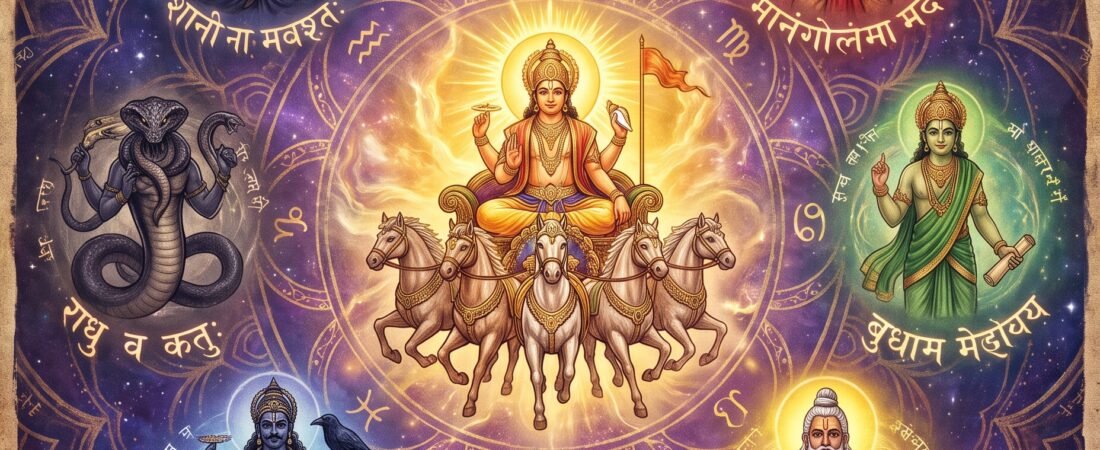
The Navagrahas are the nine planetary deities of Vedic astrology: Surya (Sun), Chandra (Moon), Mangal (Mars), Budh (Mercury), Guru (Jupiter), Shukra (Venus), Shani (Saturn), Rahu and Ketu. Each governs specific areas of life, and their positions in your Kundli shape your karma, personality and destiny.
In Vedic astrology, the cosmos is not merely a collection of rocks and gas floating in space. Each celestial body is considered a living deity—a conscious force that influences human life, karma, and destiny. These nine planetary deities, known as the Navagrahas, form the foundation of Jyotish Shastra (Vedic astrology) and have been worshipped for thousands of years across India.
Get your personalised reading in the Astrova AI app
Free AI palm reading, Janam Kundli and daily Rashifal on your phone.
Understanding who these deities are, what they govern, and how they affect your life can transform the way you see your horoscope. This guide explores the mythology, symbolism, and astrological significance of each Navagraha, drawing from ancient texts like the Brihat Parashara Hora Shastra, Rigveda, and Vishnu Purana.
What Are the Navagrahas?
The word “Navagraha” comes from Sanskrit: nava meaning “nine” and graha meaning “seizer” or “celestial body that grasps.” These nine entities are believed to seize or influence human destiny through their cosmic positions at the time of birth.
The Navagrahas include:
- Surya (Sun)
- Chandra (Moon)
- Mangala (Mars)
- Budha (Mercury)
- Guru/Brihaspati (Jupiter)
- Shukra (Venus)
- Shani (Saturn)
- Rahu (North Lunar Node)
- Ketu (South Lunar Node)
Unlike Western astrology, which focuses primarily on the physical planets, Vedic astrology treats these as divine beings with personalities, curses, boons, and cosmic roles. They are not just symbols—they are considered actual consciousnesses that interact with human karma.
The Mythology Behind Each Planetary Deity
1. Surya (Sun) — The Soul King
Mythology: Surya is the son of the sage Kashyapa and Aditi, one of the twelve Adityas. According to the Rigveda, he rides a golden chariot drawn by seven horses (representing the seven chakras or seven colors of light). His wife is Sanjna, daughter of Vishwakarma, who created a shadow duplicate (Chhaya) to replace herself when she couldn’t bear Surya’s radiance.
Astrological Significance: Surya represents the soul (Atman), father, authority, government, vitality, and self-confidence. A strong Sun in the horoscope indicates leadership qualities, good health, and recognition. A weak Sun can cause issues with father, authority figures, or self-esteem.
Governs: Leo (Simha Rashi)
Day: Sunday
Color: Gold, orange, red
2. Chandra (Moon) — The Mind Goddess
Mythology: Chandra was born from the eye of the cosmic being during creation. He married the 27 Nakshatras (lunar mansions), daughters of Daksha, but favored Rohini most. This angered Daksha, who cursed Chandra to wane. The gods intervened, and Shiva granted him a boon: he would wax and wane cyclically rather than disappear completely.
Astrological Significance: Chandra represents the mind (Manas), mother, emotions, intuition, and public image. A strong Moon indicates emotional stability, good memory, and nurturing nature. A weak Moon can cause anxiety, mood swings, or maternal issues.
Governs: Cancer (Karka Rashi)
Day: Monday
Color: White, silver
3. Mangala (Mars) — The Warrior God
Mythology: Mangala emerged from Shiva’s sweat when he was angered by the demon Andhaka. Shiva assigned him to Earth as his son. Mangala is depicted as red-complexioned, riding a ram, and holding a spear or mace. He is the celestial commander-in-chief of the gods.
Astrological Significance: Mangala represents courage, siblings (especially brothers), land, property, physical energy, and aggression. A strong Mars indicates bravery, athletic ability, and engineering skills. A weak Mars can cause cowardice, debts, or Manglik Dosha (affecting marriage).
Governs: Aries (Mesha) and Scorpio (Vrishchika)
Day: Tuesday
Color: Red
4. Budha (Mercury) — The Prince of Intelligence
Mythology: Budha is the son of Chandra (Moon) and Tara (wife of Brihaspati). His birth resulted from a celestial affair that caused a war between the gods and demons. Despite his controversial origin, Budha became the deity of wisdom, learning, and communication.
Astrological Significance: Budha represents intelligence, speech, mathematics, commerce, and younger siblings. A strong Mercury indicates sharp intellect, good communication skills, and business acumen. A weak Mercury can cause learning difficulties, speech problems, or poor decision-making.
Governs: Gemini (Mithuna) and Virgo (Kanya)
Day: Wednesday
Color: Green
5. Guru/Brihaspati (Jupiter) — The Divine Teacher
Mythology: Brihaspati is the guru (teacher) of the gods and the regent of Jupiter. He is the son of the sage Angiras and is married to Tara. He is known for his vast knowledge of the Vedas, shastras, and all branches of learning. The gods seek his counsel in all matters.
Astrological Significance: Guru represents wisdom, spirituality, children (especially sons), fortune, and expansion. A strong Jupiter indicates wisdom, good fortune, spiritual inclination, and respect in society. A weak Jupiter can cause lack of direction, poor judgment, or issues with children.
Governs: Sagittarius (Dhanu) and Pisces (Meena)
Day: Thursday
Color: Yellow, gold
6. Shukra (Venus) — The Mentor of Demons
Mythology: Shukra is the guru of the Asuras (demons) and the regent of Venus. He is the son of the sage Bhrigu and is known for his knowledge of the Sanjeevani Vidya—the ability to revive the dead. This knowledge made the demons nearly invincible in their battles against the gods.
Astrological Significance: Shukra represents love, marriage, luxury, arts, beauty, and vehicles. A strong Venus indicates a happy married life, artistic talent, wealth, and comfort. A weak Venus can cause marital discord, lack of creativity, or financial struggles.
Governs: Taurus (Vrishabha) and Libra (Tula)
Day: Friday
Color: White, pink
7. Shani (Saturn) — The Lord of Karma
Mythology: Shani is the son of Surya (Sun) and Chhaya (shadow). When he was born, Surya was displeased because Shani’s dark complexion suggested he was not his biological son. Chhaya cursed Surya, and later Shani cursed his father to be born on Earth as the sage Sukracharya. Shani is known for his slow movement and his role as the dispenser of karma.
Astrological Significance: Shani represents discipline, hard work, longevity, obstacles, and justice. A strong Saturn indicates perseverance, organizational skills, and longevity. A weak Saturn can cause delays, chronic diseases, or Sade Sati (a 7.5-year period of challenges).
Governs: Capricorn (Makara) and Aquarius (Kumbha)
Day: Saturday
Color: Black, dark blue
8. Rahu — The Shadow of Desire
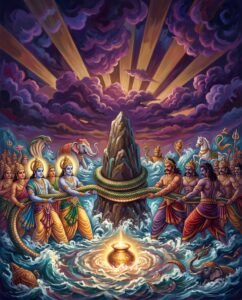
Mythology: Rahu is not a physical planet but the north lunar node. According to the Vishnu Purana, during the churning of the ocean (Samudra Manthan), the demon Swarbhanu stole the nectar of immortality. Vishnu, in his Mohini avatar, beheaded him, but since he had already consumed the nectar, his head became immortal as Rahu and his tail as Ketu. Rahu eternally chases the sun and moon, causing eclipses.
Astrological Significance: Rahu represents obsession, foreign lands, unconventional thinking, and sudden changes. A strong Rahu can bring unexpected success, political power, or foreign travel. A weak Rahu can cause addiction, illusions, or scandals.
Day: Saturday (with Shani)
Color: Smoky gray, black
9. Ketu — The Shadow of Liberation
Mythology: Ketu is the tail of the demon Swarbhanu (Rahu’s body). While Rahu represents worldly desires, Ketu represents detachment and spiritual liberation (Moksha). Ketu is often depicted as a serpent tail and is associated with Ganesha in some traditions.
Astrological Significance: Ketu represents spirituality, past-life karma, sudden events, and isolation. A strong Ketu indicates spiritual inclination, research ability, and detachment from materialism. A weak Ketu can cause confusion, phobias, or sudden losses.
Day: Saturday (with Shani and Rahu)
Color: Red, multi-colored
How the Navagrahas Influence Your Life
The positions of these nine deities in your birth chart (Janam Kundli) at the exact moment of your birth determine your personality, strengths, challenges, and life path. Each planet occupies a specific house and zodiac sign, creating a unique cosmic blueprint.
For example:
- If Jupiter is in your 2nd house (wealth), you may receive financial support through wisdom, teaching, or spiritual pursuits.
- If Saturn is in your 7th house (marriage), you may experience delays or challenges in relationships but ultimately build a stable, long-lasting partnership.
- If Rahu is in your 10th house (career), you may achieve sudden fame or work in unconventional fields like technology, research, or foreign affairs.
The Navagrahas also interact with each other through conjunctions, aspects, and planetary periods (Dashas). These interactions create complex patterns that Vedic astrologers interpret to predict timing of events and recommend remedies.
Traditional Remedies to Strengthen Weak Planets
Vedic astrology offers various remedies to strengthen weak or afflicted planets. These remedies are based on the principle that specific actions, mantras, and offerings can appease the planetary deities and reduce their negative effects.
| Planet | Remedy | Mantra |
|---|---|---|
| Sun | Offer water to the rising sun daily | Om Hraam Hreem Hroum Sah Suryaya Namah |
| Moon | Wear a pearl or keep rice in your pocket | Om Shraam Shreem Shroum Sah Chandraya Namah |
| Mars | Donate red lentils on Tuesdays | Om Kraam Kreem Kroum Sah Bhaumaya Namah |
| Mercury | Wear green clothes on Wednesdays | Om Braam Breem Broum Sah Budhaya Namah |
| Jupiter | Donate yellow items on Thursdays | Om Graam Greem Groum Sah Gurave Namah |
| Venus | Wear white clothes and fragrances on Fridays | Om Draam Dreem Droum Sah Shukraya Namah |
| Saturn | Donate black sesame seeds on Saturdays | Om Praam Preem Proum Sah Shanaye Namah |
| Rahu | Donate blue clothes or blankets | Om Bhraam Bhreem Bhroum Sah Rahave Namah |
| Ketu | Donate to spiritual causes or temples | Om Sraam Sreem Sroum Sah Ketave Namah |
These remedies are most effective when performed with faith, consistency, and under the guidance of a qualified astrologer. The exact remedy depends on your specific birth chart and the nature of the planetary affliction.
How Astrova AI Helps You Understand the Navagrahas
Understanding the Navagrahas and their influence on your life requires accurate birth chart calculations and expert interpretation. Astrova AI: Astrology & Kundli makes this ancient wisdom accessible to everyone through advanced AI technology.
With Astrova AI, you can:
- Generate your complete Janam Kundli in seconds, showing the exact positions of all nine Navagrahas at your birth time
- Read daily, weekly, and monthly Rashifal (horoscope) based on your Moon sign, updated with current planetary transits
- Check Kundli Milan (horoscope matching) for marriage compatibility, including Guna Milan and Manglik Dosha analysis
- Learn about Sade Sati and Kaalsarp Dosha—two of the most feared planetary periods—and get personalized remedies
- Chat with the 24/7 AI Astrologer to ask specific questions about your planets, Dashas, and transits
- Try AI Palm Reading to discover additional insights about your destiny through the ancient art of Hasta Samudrika Shastra
Astrova AI is available in 9 Indian languages (Hindi, Tamil, Telugu, Kannada, Malayalam, Marathi, Gujarati, Bengali, and English) and is 100% free to use. No credit card required.
Frequently Asked Questions
Are the Navagrahas real gods or just symbols?
In Vedic tradition, the Navagrahas are considered both deities (conscious beings) and symbolic representations of cosmic forces. Whether you view them as literal gods or archetypes, their influence on human psychology and life patterns is well-documented in Jyotish Shastra.
Can I change my destiny by worshipping the Navagrahas?
Vedic astrology teaches that while your birth chart shows your Prarabdha Karma (destiny from past lives), you can mitigate negative influences through remedies, good actions, and spiritual practices. The Navagrahas are not fatalistic—they show tendencies, not absolute certainties.
What is the difference between Rahu-Ketu and the other planets?
Rahu and Ketu are shadow planets (lunar nodes), not physical celestial bodies. They represent karmic axes—Rahu shows what you desire in this life, while Ketu shows what you’re meant to release. Their effects are often sudden and karmic, unlike the gradual influence of physical planets.
How often do the Navagrahas’ positions change?
Each planet moves at a different speed. The Moon changes signs every 2.5 days, Mercury and Venus every few weeks, the Sun monthly, Mars every 45 days, Jupiter and Saturn every year (Saturn takes 2.5 years per sign), and Rahu-Ketu every 18 months. These movements create daily, monthly, and yearly horoscope changes.
Can Astrova AI tell me which Navagraha is weak in my chart?
Yes. Astrova AI’s Janam Kundli feature calculates the exact strength (Shadbala) of each planet in your birth chart and highlights which planets are strong, weak, or afflicted. You can then use the AI Astrologer chat to ask for personalized remedies.
Explore More Astrova Guides
Continue your journey into Vedic astrology with these comprehensive guides:
- How to Read Your Janam Kundli — Complete Birth Chart Guide
- How to Check Daily Rashifal — Your Vedic Horoscope Guide
- Kundli Milan for Marriage — Guna Matching & Compatibility Guide
- Sade Sati Explained — What It Is & Powerful Remedies
- AI Palm Reading — How to Read Your Own Palm at Home
- AI Astrology — How Artificial Intelligence is Transforming Vedic Astrology
About the Author
Astrova AI Editorial Team
The Astrova AI Editorial Team combines traditional Vedic astrology knowledge with modern AI technology to make ancient wisdom accessible to everyone. Our content is based on classical Jyotish texts including the Brihat Parashara Hora Shastra, Phaladeepika, Saravali, and Jataka Parijata, as well as contemporary astrological research.
We believe that astrology is not about fear or fatalism—it’s about self-awareness, timing, and making informed decisions. Our mission is to help you understand your cosmic blueprint and use it to live a more fulfilling life.
Have a correction or question? We welcome feedback. Reach us at support@theastrova.com.
Get your personalised reading in the Astrova AI app
Free AI palm reading, Janam Kundli and daily Rashifal on your phone.
Related posts:
 The Samudra Manthan Story: How Rahu and Ketu Were Born From the Churning of the Cosmic Ocean
 What Is the Mythology of Rahu and Ketu — and Why Do They Rule Eclipses in Vedic Astrology?
 Who Is Lord Dattatreya? The Combined Avatar of Brahma, Vishnu & Shiva in Vedic Tradition
 What Is Samudra Manthan And How Does It Connect To Rahu, Ketu And Your Kundli?