What Is the Astrological Significance of Eclipses in Hindu Mythology?
Every eclipse feels like the sky itself is holding its breath. The sun dims. The air cools. Birds go silent. For thousands of years, Hindu tradition has understood eclipses — Grahan — as far more than an astronomical event. They are cosmic turning points, moments when the veil between the material and spiritual worlds grows thin, and when the planetary forces that govern your life undergo a powerful reset.
If you have ever felt uneasy, emotionally raw, or strangely energised during an eclipse, Vedic astrology says that is not coincidence. It is Rahu and Ketu doing their work. This guide explains the mythology behind eclipses, what they mean astrologically, and what you can actually do during them.
🔮 Get Your Free Eclipse Reading
Find out which house Rahu and Ketu are transiting in YOUR Kundli right now
⭐ 4.5 Rating | AI-Powered Vedic Astrology | No Credit Card
The Ancient Mythology Behind Eclipses: The Story of Rahu and Ketu
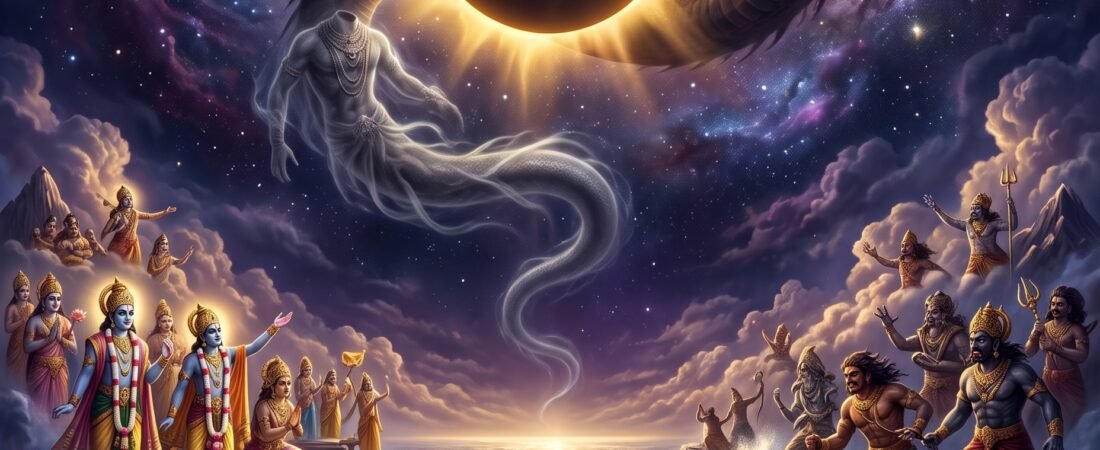
The story of eclipses begins with one of the most dramatic events in Hindu cosmology — the Samudra Manthan, the churning of the cosmic ocean.
According to the Vishnu Purana and the Bhagavata Purana, the Devas (celestial beings) and the Asuras (demons) joined forces to churn the ocean of milk in search of Amrit — the nectar of immortality. Lord Vishnu took the form of Mohini, an enchantress of unparalleled beauty, and was tasked with distributing the Amrit only to the Devas.
But one Asura — Svarbhanu — saw through the plan. He disguised himself as a Deva, sat between the Sun (Surya) and the Moon (Chandra), and raised the cup of Amrit to his lips.
The Sun and Moon recognised the deception and alerted Lord Vishnu. In that instant, Vishnu hurled his Sudarshana Chakra and severed Svarbhanu’s head from his body.
But the Amrit had already touched the Asura’s tongue. He could not die.
What happened next explains every eclipse you will ever see:
- The head became Rahu — the north lunar node, a shadow planet with an insatiable hunger for the Sun and Moon.
- The body became Ketu — the south lunar node, a headless shadow planet representing detachment and karmic release.
Since that day, Rahu chases the Sun and Moon across the sky. When he catches one, he swallows it — causing an eclipse. But because he has no body, the Sun or Moon passes through his throat and emerges on the other side. The eclipse ends. Light returns.
Why Are Rahu and Ketu Called “Shadow Planets”?
In Vedic astrology, Rahu and Ketu are not physical planets. They are mathematical points — the lunar nodes — where the Moon’s orbit crosses the ecliptic (the Sun’s apparent path).
| Property | Rahu (North Node) | Ketu (South Node) |
|---|---|---|
| Astronomical identity | Ascending lunar node | Descending lunar node |
| Mythological form | Head of Svarbhanu (serpent) | Body of Svarbhanu (dragon tail) |
| Represents | Desire, obsession, worldly ambition, foreign influences | Detachment, spirituality, past karma, moksha |
| Element | Air / Wind (Vata) | Fire (Agni) |
| Colour | Dark / Smoky blue | Red / Flame |
| Direction | Southwest | Southeast |
| Orbital cycle | ~18 months per zodiac sign | ~18 months per zodiac sign (always opposite Rahu) |
They are always exactly opposite each other in the zodiac. When Rahu enters Aries, Ketu enters Libra. This 180-degree axis is the karmic axis — the line along which your soul’s growth is being pushed during this lifetime.
What Happens Astrologically During an Eclipse?
An eclipse is essentially a supercharged conjunction of the Sun or Moon with Rahu or Ketu. Here is what each type means:
Solar Eclipse (Surya Grahan) — Rahu or Ketu meets the Sun
A solar eclipse occurs when the new Moon aligns with Rahu or Ketu. Astrologically, the Sun represents your soul, vitality, father, government authority, and core identity. When Rahu swallows the Sun:
- Your sense of identity may feel destabilised
- Relationships with authority figures (father, boss, government) may be tested
- Hidden truths about your path come to light
- Old patterns of ego and pride are forcibly broken down
A solar eclipse is Rahu saying: “You thought you knew who you were. Let me show you what you have been avoiding.”
Lunar Eclipse (Chandra Grahan) — Rahu or Ketu meets the Moon
A lunar eclipse occurs when the full Moon aligns with Rahu or Ketu. The Moon represents your mind, emotions, mother, public life, and inner peace. When Rahu or Ketu shadows the Moon:
- Emotional intensity spikes — anxiety, dreams, and sensitivity increase
- Relationships and domestic life may surface unresolved tensions
- Your mental health needs extra care during this window
- Past emotional karma resurfaces for resolution
Lunar eclipses are generally considered more impactful on daily life because the Moon governs the mind, and Vedic astrology places extraordinary importance on the Moon sign (Rashi).
The Eclipse Axis: How Rahu and Ketu Affect Your Kundli
Every eclipse activates the houses in your birth chart where Rahu and Ketu currently sit. This is why the same eclipse affects different people in completely different ways.
| Rahu’s House | What Gets Amplified | Ketu’s House (Opposite) | What Gets Released |
|---|---|---|---|
| 1st House | Identity, self-image, physical body | 7th House | Partnerships, marriage, business relationships |
| 4th House | Home, mother, emotional foundation | 10th House | Career, public reputation, authority |
| 8th House | Transformation, secrets, longevity | 2nd House | Wealth, family, speech |
| 12th House | Foreign lands, spirituality, liberation | 6th House | Enemies, debts, daily routine, health |
The house Rahu occupies shows where you are being pulled toward new experiences — often uncomfortably. The house Ketu occupies shows where you are being asked to let go of attachment. Together, they create a tension that drives your soul’s evolution.
Eclipse Remedies in Vedic Tradition
Hindu scriptures prescribe specific practices during eclipses to transform the intense energy into spiritual growth rather than fear. These remedies come from the Garuda Purana, the Padma Purana, and the Brihat Parashara Hora Shastra.
Before the Eclipse (Sutak Period)
- Stop eating — the traditional Sutak period begins 9 hours before a solar eclipse and 12 hours before a lunar eclipse. Cooked food is considered energetically contaminated.
- Cleanse your space — bathe, clean the house, and place tulsi (holy basil) leaves in water and food items.
- Avoid important decisions — do not start new ventures, sign contracts, or make major purchases during the eclipse window.
During the Eclipse
- Chant mantras — the most powerful eclipse mantras are the Mahamrityunjaya Mantra (for protection), the Vishnu Sahasranama, and the Rahu/Ketu Beej mantras:
Rahu Beej Mantra: Om Bhram Bhreem Bhraum Sah Rahave Namah
Ketu Beej Mantra: Om Sram Sreem Sraum Sah Ketave Namah
- Mediate and pray — the eclipse window is considered the most powerful time for meditation, japa, and spiritual practice. The thinning of the material veil makes inner work more potent.
- Do not sleep — traditional texts advise staying awake during the eclipse. Sleep during Grahan is considered inauspicious.
After the Eclipse
- Take a purifying bath — bathe immediately after the eclipse ends.
- Donate — giving to charity during an eclipse is said to multiply the merit exponentially. Black sesame seeds, blankets, and food are traditional eclipse donations.
- Wear a Tulsi mala — Tulsi is considered protective against the negative effects of Rahu and Ketu.
How to Check Your Personal Eclipse Impact Using Your Kundli
The generic eclipse remedies above help everyone, but your personal eclipse experience depends entirely on which houses Rahu and Ketu occupy in your birth chart. To find out:
- Generate your Janam Kundli — you need your exact birth date, time, and place.
- Locate Rahu and Ketu — they are marked as “Ra” and “Ke” (or ☊ and ☋) in your chart.
- Note the houses — which houses do they sit in? Which zodiac signs?
- Check the current transit — where are Rahu and Ketu right now? Are they crossing a sensitive point in your chart?
- Read the eclipse through YOUR chart — an eclipse in your 10th house affects your career; in your 4th house, it affects your home and mother.
🪷 See Your Rahu-Ketu Axis Right Now
Astrova AI generates your complete Kundli with Rahu and Ketu house positions in seconds
⭐ Available in 9 Indian Languages | 100% Free
Scientific Context: What Modern Astronomy Says
While Vedic astrology provides the spiritual framework, it is worth noting what modern astronomy confirms:
- Eclipses occur when the Sun, Earth, and Moon align at the lunar nodes — the exact points Vedic astrology identifies as Rahu and Ketu.
- The node cycle is approximately 18.6 years, which is why Rahu and Ketu return to the same zodiac position roughly every 18 years.
- Solar eclipses can only happen at the new Moon; lunar eclipses only at the full Moon — matching the Vedic description perfectly.
- During a total solar eclipse, the Earth’s magnetic field does experience measurable fluctuations, and animal behaviour changes have been documented — lending some support to the traditional belief that eclipses carry unusual energetic effects.
Whether you approach eclipses through mythology, astrology, or astronomy, one thing is clear: they are not ordinary days. They are cosmic inflection points.
Frequently Asked Questions
Are eclipses always bad in Vedic astrology?
No. While eclipses carry intense energy, they are not inherently negative. Rahu amplifies ambition and worldly desire; Ketu accelerates spiritual growth and detachment. An eclipse can trigger a breakthrough as powerfully as a breakdown. The effect depends on your individual Kundli and which houses are activated.
Can pregnant women watch an eclipse?
Traditional Hindu texts advise pregnant women to stay indoors and avoid watching the eclipse directly. This is a cultural practice rooted in the belief that eclipse radiation may affect the foetus. From a medical standpoint, watching a solar eclipse without proper eye protection is harmful for everyone — pregnant or not.
How long does an eclipse’s astrological effect last?
The immediate eclipse window lasts a few hours, but Vedic astrologers consider the effects to unfold over 6 months to 1 year after the event. The full impact of a Rahu or Ketu transit through a zodiac sign lasts approximately 18 months, which is how long each node remains in one sign.
What is the difference between a solar eclipse and a lunar eclipse in astrology?
A solar eclipse (Rahu/Ketu conjunct the Sun) primarily affects your identity, vitality, authority relationships, and soul path. A lunar eclipse (Rahu/Ketu conjunct the Moon) primarily affects your emotions, mental health, mother, domestic life, and public image. Lunar eclipses are generally considered more personally impactful because the Moon governs the mind.
Can I eat during an eclipse?
Traditional Vedic practice prescribes fasting during the eclipse period (Sutak). Cooked food is believed to absorb the eclipse’s energetic charge. After the eclipse ends, a purifying bath is taken before eating again. If you cannot fast for health reasons, eating light sattvic food and keeping tulsi leaves nearby is an accepted alternative.
Explore More Astrova Guides
- AI Palm Reading — The Complete Guide to Reading Your Own Palm
- How to Generate Your Janam Kundli Online for Free
- How to Check Your Daily Rashifal Using Your Moon Sign
- What Is Kundli Milan and Why Does It Matter for Your Marriage?
- Sade Sati Explained — What It Is, How It Affects You, and Powerful Remedies
- What Is AI Astrology and How Does It Work?
- What Are Vedic Planetary Remedies and How Do They Work?
About the Author
Astrova AI Editorial is the editorial team behind Astrova AI, a free Vedic astrology app powered by artificial intelligence. Our content draws from classical Jyotish texts including the Brihat Parashara Hora Shastra, the Phaladeepika by Mantreswara, the Saravali by Kalyana Varma, and the Brihat Jataka by Varahamihira. Every article is written to make ancient Vedic wisdom accessible, practical, and free for everyone.
Last updated: August 2026
Related posts:
 How to read your own palm at home — step-by-step guide — Complete Guide 2026
 How to check your daily Rashifal using your Moon sign — step by step — Complete Guide 2026
 How to identify Kaalsarp Dosha in your Kundli — visual guide — Complete Guide 2026
How accurate is AI Kundli matching vs traditional astrologer matching? — Complete Guide 2026
How to identify Kaalsarp Dosha in your Kundli — visual guide — Complete Guide 2026
How accurate is AI Kundli matching vs traditional astrologer matching? — Complete Guide 2026