Moon (Chandra) Mahadasha is the 10-year period of the Moon in the Vimshottari Dasha system. Tradition links it with the mind and emotions, the mother, home, comfort, public image and travel. It is not automatically good or bad. Astrologers judge it by the Moon’s strength and placement in your Kundli, so treat it as a theme, not a promise.
Key takeaways
- Length: 10 years, after the Sun’s 6 years and before Mars’s 7 years.
- Who starts life in it: people whose Moon was in Rohini, Hasta or Shravana nakshatra at birth.
- Traditional themes: feelings and peace of mind, mother and family, home and property, comfort, popularity and journeys.
- What decides it: the Moon’s sign, house, brightness (waxing or waning), company and the house it rules for your ascendant.
- Not science: these are traditional readings, not tested predictions. Persistent low mood or poor sleep needs a doctor, not a dasha chart.
Check your dasha timeline free in Astrova AI
People often notice the Moon’s period because it feels so different from the Sun’s. After six years of ambition, authority and pushing forward, the next ten tend to be described in softer words: home, family, mother, belonging, moods. Some remember these years as the time they married, bought a house or became a parent. Others remember feeling unsettled, moving often or worrying more than usual. So the question people search for is simple: “What will these ten years feel like?” This guide explains what Moon Mahadasha is, when it comes, what tradition says it brings, its nine sub-periods with a worked example, and where tradition ends and evidence begins.
Who the Moon (Chandra) is in Jyotish
In Hindu tradition, Chandra, also called Soma, is the Moon god and one of the Navagraha, the nine planetary deities. Monday (Somavara) is named after him, and Lord Shiva is shown wearing the crescent Moon, a story we cover in why Lord Shiva wears the crescent Moon. White, silver, rice and milk are his traditional colours and offerings, which is why many Moon practices happen on Mondays.
In Jyotish, the Moon is the karaka (indicator) of the mind (manas), emotions, the mother, nourishment, water and the public. It rules Cancer (Karka), is exalted in Taurus and debilitated in Scorpio, and rules three nakshatras: Rohini, Hasta and Shravana. In classical friendship tables the Moon’s friends are the Sun and Mercury, and it treats no planet as an enemy, although Mercury and Saturn are listed as treating the Moon as one. Your Moon sign (Rashi) is also the base of your daily horoscope, as explained in why your Moon sign matters.
When does Moon Mahadasha start?
Your dasha order is fixed at birth by the nakshatra the Moon was in (your janma nakshatra). Life starts in the dasha of that nakshatra’s ruler, and the rest follow in a fixed order: Ketu 7, Venus 20, Sun 6, Moon 10, Mars 7, Rahu 18, Jupiter 16, Saturn 19 and Mercury 17 years. For the full system, see what Vimshottari Dasha is and how to read it.
Because only part of the first dasha is left at birth, the start of the Moon’s period falls in a range. This table adds up the years in the sequence:
| Moon’s birth nakshatra | First dasha | Moon Mahadasha begins at about age |
|---|---|---|
| Rohini, Hasta, Shravana | Moon | Running at birth (0–10 years left) |
| Krittika, Uttara Phalguni, Uttara Ashadha | Sun | 0–6 |
| Bharani, Purva Phalguni, Purva Ashadha | Venus | 6–26 |
| Ashwini, Magha, Mula | Ketu | 26–33 |
| Ashlesha, Jyeshtha, Revati | Mercury | 33–50 |
| Pushya, Anuradha, Uttara Bhadrapada | Saturn | 50–69 |
| Punarvasu, Vishakha, Purva Bhadrapada | Jupiter | 69–85 |
| Ardra, Swati, Shatabhisha | Rahu | 85–103 |
| Mrigashira, Chitra, Dhanishta | Mars | 103–110 |
The cycle is 120 years long, so the Moon’s period comes at most once in a normal lifetime, and for some people not at all. Exact dates depend on how far the Moon had moved through its nakshatra at birth, so an accurate birth time matters. Not sure of your nakshatra? Start with the 27 nakshatras, how to find your Moon sign or make a free Kundli.
Traditional themes: mind, family, career, money, health
Classical texts such as Brihat Parashara Hora Shastra (BPHS) and Phaladeepika describe the Moon’s period in two voices. When the Moon is strong, they speak of peace of mind, prosperity, comforts, clothes and ornaments, family happiness, children and favour from people in power. When the Moon is waning, debilitated or joined with malefics, they speak of worry, loss of money, strain in matters of the mother and friction with authority (BPHS chapter 53 translation, VedicPupil). Here is how modern readings usually describe each area. These are tendencies astrologers look for, not events that will happen.
- Mind and emotions: feelings sit closer to the surface. A strong Moon is read as calm, caring and intuitive; a troubled Moon as moody, anxious or restless.
- Mother, home and family: the mother, home life, property and vehicles often become central. The Moon gets its directional strength in the 4th house of home, so the 4th is read alongside it.
- Career: readings link the period with public-facing and caring work: hospitality, food, nursing, teaching, counselling, sales, travel and anything water-related, and with being liked by the public.
- Money: gains are described as steady rather than sudden, often through family, property or the public. The traditional warning is emotional spending.
- Relationships: marriage, children and closeness are common themes. The caution is taking things personally or needing too much reassurance.
- Health: tradition links the Moon with sleep, fluids, digestion and the chest. Treat this as old symbolism. For any real symptom, or for low mood that lasts, see a doctor or a mental health professional; a dasha is not a diagnosis.
What decides how your Moon period feels
Brightness: waxing or waning Moon
This is the factor most specific to the Moon. Jyotish calls it paksha bala. A Moon born near full Moon (bright, in Shukla Paksha) is read as strong; a Moon born close to new Moon (dark, near the Sun) is read as weak, whatever else the chart shows. The old myth behind the Moon’s waxing and waning is told in the curse of Chandra.
Sign
The Moon in Taurus (exalted) or Cancer (own sign) is read as strong. The Moon in Scorpio (debilitated) is read as weaker, although cancellation rules (neecha bhanga) are checked before assuming the worst.
House placement and the house it rules
Tradition says a strong Moon does well in the kendras (1st, 4th, 7th, 10th) and trikonas (1st, 5th, 9th) and in the 11th, and asks for more care in the 6th, 8th and 12th. The house the Moon rules for your ascendant matters as much. For a Cancer ascendant it is the lagna lord. For Aries it rules the 4th, for Pisces the 5th, for Scorpio the 9th and for Libra the 10th, which tradition reads as helpful. For Leo (12th), Aquarius (6th) and Sagittarius (8th) ascendants it rules harder houses, and for Gemini it rules the 2nd, a maraka house, so many astrologers read its period with more caution there.
Company
The Moon with Jupiter forms Gajakesari Yoga, a classic supportive combination. A Moon with no planets on either side can form Kemadruma Yoga, the “lonely Moon”. The Moon with Saturn, Rahu or Ketu is usually read as emotionally heavier.
See your Moon’s sign, house and nakshatra in Astrova AI
The 9 antardashas inside Moon Mahadasha
Each mahadasha is split into nine sub-periods in a fixed order, starting with its own planet. Each one’s length is 10 years × that planet’s years ÷ 120, so for the Moon each sub-period lasts as many months as the planet has years. The table uses the common 12-months-of-30-days convention, so calculators may differ by a few days.
| No. | Antardasha | Approximate length | Common traditional reading |
|---|---|---|---|
| 1 | Moon–Moon | 10 months | Pure Moon results; depends entirely on the natal Moon |
| 2 | Moon–Mars | 7 months | Energy and money drive; Mars counts the Moon as a friend |
| 3 | Moon–Rahu | 1 year 6 months | Often read as restless or anxious (the eclipse pair) |
| 4 | Moon–Jupiter | 1 year 4 months | Often read as supportive (the Gajakesari pair) |
| 5 | Moon–Saturn | 1 year 7 months | Often read as heavy; Saturn counts the Moon as an enemy |
| 6 | Moon–Mercury | 1 year 5 months | Study, trade and communication; mixed friendship |
| 7 | Moon–Ketu | 7 months | Detachment, inner focus, low motivation |
| 8 | Moon–Venus | 1 year 8 months | Comfort, relationships, home and creative work |
| 9 | Moon–Sun | 6 months | Bridge to Mars; authority and the father come forward |
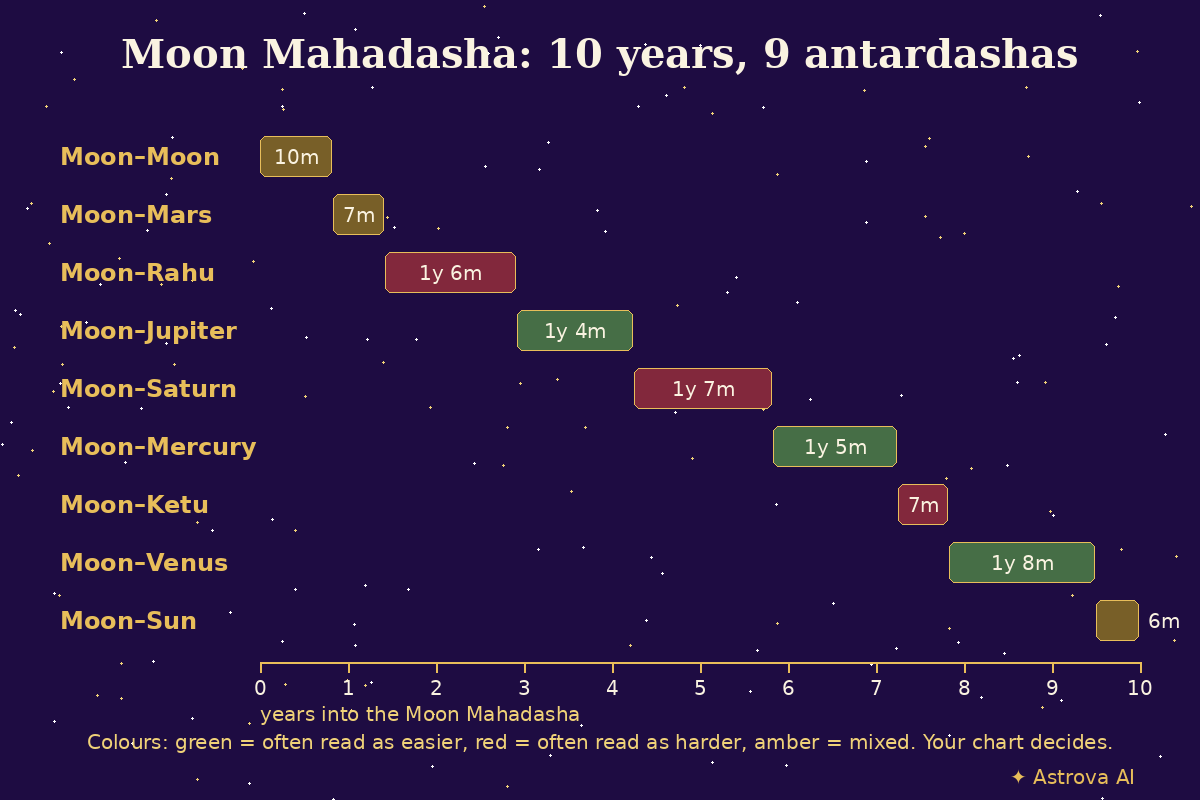
Moon–Rahu, about a year and a half, is the sub-period people worry about most, because Rahu is the node that “swallows” the Moon in eclipse stories. Moon–Saturn, the longest after Venus, is often read as duty and emotional weight. Moon–Jupiter and Moon–Venus are usually the most comfortable. Each still depends on where that planet sits in your own chart. To compare with other periods, read Sun (Surya) Mahadasha, Rahu Mahadasha, Jupiter (Guru) Mahadasha, Shani Mahadasha, Mercury (Budh) Mahadasha and Ketu Mahadasha.
Worked example (illustrative)
This chart is made up to show the method. It is not a real person and not a prediction.
Say someone has a Libra ascendant, and their Moon is in Ashwini nakshatra in Aries, in the 7th house. The Moon is a waxing (bright) Moon, about ten days after new Moon. Ashwini is ruled by Ketu, and say 4 years of Ketu’s dasha were left at birth.
- Timeline: Ketu runs to age 4, Venus 4 to 24, Sun 24 to 30, so Moon Mahadasha runs from age 30 to 40.
- What the Moon rules: for Libra, Cancer is the 10th house, so the Moon is the 10th lord (career and public standing).
- Where it sits: the 7th house of marriage and partnerships, a kendra. A traditional reading would link this decade with career moving through partners, clients and public dealing, and with marriage or business partnerships becoming central.
- Strength: Aries is a neutral sign for the Moon, and a waxing Moon is read as reasonably strong, so the period would be read as mostly constructive, not dramatic either way.
- Sub-periods: Moon–Rahu would run from about age 31 years 5 months to 32 years 11 months and Moon–Saturn from about age 34 years 3 months to 35 years 10 months. Moon–Saturn sounds hard, but for a Libra ascendant Saturn rules the 4th and 5th houses and is called a yogakaraka (a very helpful planet), so many astrologers would soften that reading. Moon–Jupiter (age 32 years 11 months to 34 years 3 months) is the opposite case: Jupiter rules the 3rd and 6th for Libra, so even this “best” sub-period would be read with some care.
The lesson: generic lists of good and bad antardashas are a starting point only. The houses each planet rules for your ascendant can flip the reading, which is why a calculated chart matters more than a blog table.
Traditional remedies, kept simple
Tradition suggests gentle Moon practices, for example:
- Chanting “Om Chandraya Namah” or the Chandra beej mantra “Om Shraam Shreem Shraum Sah Chandraya Namah”, often 108 times on Mondays.
- Offering water or milk to a Shiva Linga on Mondays, or keeping a Monday fast if it suits your health.
- Giving rice, milk, white cloth or food to people in need, often on Mondays or full Moon days.
- Spending time with and caring for your mother or the people who raised you. Many astrologers call this the simplest Moon remedy.
- Looking after the mind in practical ways: fixed sleep and meal times, time near water or in nature, and talking to someone when worry builds up.
Be careful with fear-based selling. Pearl (moti) is the Moon’s traditional gem, but even within astrology it is advised only after a careful chart check, and there is no scientific evidence that a gemstone changes events. See which gemstone suits your Kundli and whether Vedic remedies actually work. For short Moon-sensitive days inside any dasha, see Chandrashtama.
Tradition vs science
The system is real as a tradition. The 10-year length, the order of the dashas and the antardasha maths come from a consistent system described in classical Jyotish texts (Dasha (astrology), Wikipedia). Any good calculator will give the same dates for the same birth details. The Moon’s phases are real astronomy too: they come from the changing angle between the Sun, Earth and Moon.
The predictions are not proven. Whether a Moon period actually brings a house, a marriage or a stressful year is a separate question. Astrology has not shown predictive power in scientific tests and is generally considered a pseudoscience. Even the popular idea that the Moon affects human mood has weak support: reviews of the so-called lunar effect have found no reliable link between the lunar cycle and human behaviour (Lunar effect, Wikipedia). Use a dasha reading for reflection and planning, not as a reason to wait for luck or as a replacement for medical, financial or legal advice.
If you want to see your own dates, Astrova AI’s free Janam Kundli shows your Lagna, Rashi, Nakshatra and Vimshottari Dasha, and you can ask follow-up questions in the AI astrologer chat.
FAQs
How long does Moon Mahadasha last?
Moon (Chandra) Mahadasha lasts 10 years in the 120-year Vimshottari Dasha cycle. It comes after the Sun’s 6 years and before Mars’s 7 years. If your Moon was in Rohini, Hasta or Shravana nakshatra at birth, you start life in it and only live through the part that was left.
Is Moon Mahadasha good or bad?
Neither by default. Astrologers judge it by the Moon’s sign, house, brightness (waxing or waning) and the houses it rules for your ascendant. A strong Moon is read as a time of comfort, family and public goodwill; a weak or afflicted Moon as a time of worry and emotional ups and downs. None of this is a fixed prediction.
Which antardasha is best in Moon Mahadasha?
Many traditional readings name Moon–Jupiter and Moon–Venus as the most comfortable sub-periods, with Moon–Mercury good for study and work. Moon–Rahu, Moon–Saturn and Moon–Ketu are often described as harder. The real result depends on where those planets sit and which houses they rule in your own chart.
What happens after Moon Mahadasha ends?
Mars (Mangal) Mahadasha begins and runs for 7 years. The last sub-period of the Moon’s dasha is Moon–Sun, about 6 months. Tradition reads the change as a move from feelings, home and comfort towards action, effort and drive, so many people use the final months to finish what is open.
Should I wear a pearl (moti) in Moon Mahadasha?
Not automatically. Pearl is the Moon’s traditional gem, but even within astrology it is advised only after a careful chart check, especially when the Moon rules the 6th, 8th or 12th house for your ascendant. There is no scientific evidence that a gemstone changes events, so simple practices like regular sleep and a Monday mantra are a safer start.
Download Astrova AI on Google Play
Free Janam Kundli with Vimshottari Dasha, daily Rashifal and 24/7 AI astrologer chat in 9 Indian languages. For entertainment and self-reflection.
Sources and further reading: Dasha (astrology) (Wikipedia) · Chandra (Wikipedia) · BPHS chapter 53, Moon antardashas (VedicPupil) · Lunar effect (Wikipedia)