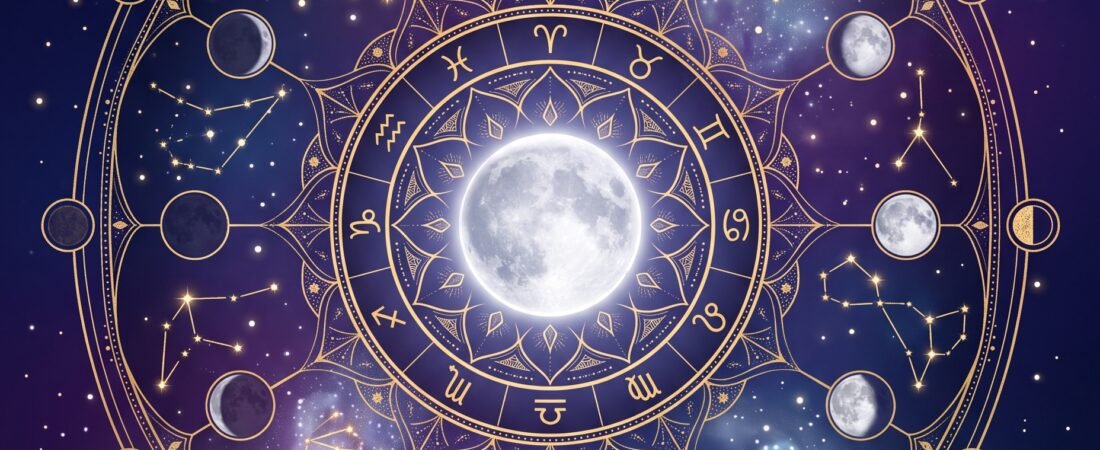
What Is Your Moon Sign, and Why Does It Matter More Than Your Sun Sign?
Quick Answer: Your Moon sign represents your emotional inner world — how you feel, process stress, and seek comfort. While your Sun sign shows the person you want to be, your Moon sign reveals who you actually are when no one is watching. In Vedic astrology (Jyotish), the Moon sign (Chandra Rashi) is considered even more important than the Sun sign because it governs your mind, emotions, and subconscious patterns.
If you have ever wondered why you react differently from people born under the same Sun sign, the answer almost always lies in your Moon sign. It is the hidden layer of your personality that shapes your instincts, your relationships, and the way you handle life’s ups and downs.
📲 Download Astrova AI — FREE Kundli & Moon Sign Reading
What Exactly Is a Moon Sign (Chandra Rashi)?
In Vedic astrology, your Moon sign is determined by the position of the Moon in the zodiac at the exact moment of your birth. Unlike Western astrology, which primarily uses the Sun sign (Surya Rashi), the Indian Jyotish tradition places the Moon at the centre of the birth chart because the Moon governs Manas — the mind and emotional nature.
The ancient text Brihat Parashara Hora Shastra, written by Sage Parashara over 3,000 years ago, explicitly states that the Moon sign is the foundation of the entire horoscope. Every planetary period (Dasha), every transit prediction, and every compatibility analysis in Vedic astrology begins with the Moon sign.
This is why when an Indian astrologer asks for your “date of birth, time, and place,” what they are really calculating is your precise Moon position — because that single data point unlocks the rest of your chart.
Sun Sign vs Moon Sign: What Is the Difference?
| Aspect | Sun Sign (Surya Rashi) | Moon Sign (Chandra Rashi) |
|---|---|---|
| Represents | Your ego, identity, outer personality | Your emotions, instincts, inner self |
| Changes every | ~30 days (Sun enters a new sign monthly) | ~2.5 days (Moon moves through signs rapidly) |
| Governs | Career, ambition, how others see you | Relationships, emotional responses, subconscious |
| Used in | Western astrology (tropical zodiac) | Vedic astrology (sidereal zodiac) |
| Importance in Jyotish | Secondary | Primary — basis of Dasha and predictions |
Here is a practical example: two people born on the same day might both be Aries Sun signs — ambitious, energetic, and assertive on the outside. But if one has a Cancer Moon and the other has a Capricorn Moon, their emotional worlds are completely different. The Cancer Moon person reacts with sensitivity and nurturance; the Capricorn Moon person processes feelings through discipline and self-control.
How to Find Your Moon Sign
Finding your Moon sign requires your exact birth date, birth time, and birth place. Because the Moon changes signs approximately every 2.5 days, even a difference of a few hours can shift your Moon sign entirely.
Here is the step-by-step process:
- Note your exact birth time — check your hospital birth certificate or ask family members. Even a 30-minute error can change the Moon sign if you were born near a sign boundary.
- Use a reliable Kundli generator — the Astrova AI app calculates your Moon sign using the Swiss Ephemeris, the same astronomical data used by professional Jyotish astrologers worldwide.
- Check the sidereal zodiac — Vedic astrology uses the sidereal zodiac (Lahiri Ayanamsa), which is approximately 23-24 degrees behind the tropical zodiac used in Western horoscopes. Your Vedic Moon sign may differ from your Western Sun sign.
The 12 Moon Signs and Their Emotional Nature
Each Moon sign reveals a distinct emotional pattern. Here is a concise guide to all twelve:
| Moon Sign | Emotional Nature | What You Need for Comfort |
|---|---|---|
| ♈ Aries (Mesha) | Impulsive, passionate, quick to anger but quick to forgive | Physical activity, independence, new challenges |
| ♉ Taurus (Vrishabha) | Steady, sensual, resistant to change, deeply loyal | Good food, comfortable surroundings, financial security |
| ♊ Gemini (Mithuna) | Curious, restless, processes feelings through conversation | Mental stimulation, variety, social connection |
| ♋ Cancer (Karka) | Deeply nurturing, moody, emotionally intuitive | Family, home, emotional safety, familiar routines |
| ♌ Leo (Simha) | Proud, generous, needs recognition and warmth | Creative expression, admiration, leadership roles |
| ♍ Virgo (Kanya) | Analytical, worrisome, shows love through service | Order, cleanliness, useful work, health routines |
| ♎ Libra (Tula) | Harmony-seeking, indecisive, avoids conflict | Partnership, beauty, balanced environments |
| ♏ Scorpio (Vrishchika) | Intense, secretive, transformative, deeply feeling | Emotional depth, trust, privacy, meaningful bonds |
| ♐ Sagittarius (Dhanu) | Optimistic, freedom-loving, philosophical | Travel, learning, spiritual exploration, open spaces |
| ♑ Capricorn (Makara) | Reserved, disciplined, processes emotions privately | Structure, achievement, long-term goals, respect |
| ♒ Aquarius (Kumbha) | Detached, humanitarian, unconventional feelings | Intellectual community, freedom, progressive causes |
| ♓ Pisces (Meena) | Sensitive, dreamy, absorbs others’ emotions | Solitude, creative outlets, spiritual practice, water |
Why Vedic Astrology Considers the Moon Sign More Important
The word Jyotish literally means “the science of light,” and in this ancient system, the Moon is the closest celestial body to Earth — making its gravitational and energetic influence on the human mind the most immediate.
Here are the key reasons the Moon sign takes priority in Vedic astrology:
1. The Moon Governs the Mind (Manas)
According to the Srimad Bhagavatam and the Brihat Parashara Hora Shastra, the Moon is the Karaka (significator) of the mind. Your emotional reactions, your peace of mind, your ability to handle stress — all of these are read from the Moon’s position, not the Sun’s.
2. The Vimshottari Dasha System Starts from the Moon
The most widely used predictive system in Vedic astrology — the Vimshottari Dasha, a 120-year planetary period cycle — is calculated based on the Moon’s nakshatra (lunar mansion) at birth. This means your entire life timeline of planetary periods is anchored to your Moon sign.
3. Transits Are Read from the Moon Sign
When astrologers predict the effects of Saturn’s Sade Sati, Jupiter’s transit, or Rahu-Ketu movements, they always measure these transits relative to your Moon sign — never your Sun sign. This is because the Moon represents your lived experience, while the Sun represents your soul’s purpose.
How Your Moon Sign Affects Your Daily Life
Understanding your Moon sign gives you practical insights that go far beyond a daily horoscope:
- Relationships: Your Moon sign determines what makes you feel emotionally secure. A partner whose Moon sign complements yours creates natural emotional harmony — this is the basis of Kundli Milan (horoscope matching) in Indian marriages.
- Decision-making: When you feel “stuck,” it is often because your current planetary transit is pressing against your Moon sign. Knowing this helps you time important decisions with favourable transits.
- Stress management: Each Moon sign has specific comfort patterns. A Taurus Moon needs physical comfort; a Sagittarius Moon needs space and adventure. Fighting your Moon’s nature creates chronic stress.
- Parenting: Your child’s Moon sign reveals what they need to feel safe. A Cancer Moon child needs reassurance; an Aries Moon child needs physical outlets.
How Astrova AI Helps You Understand Your Moon Sign
Astrova AI is a free AI-powered astrology app that generates your complete Janam Kundli (birth chart) in minutes, including your Moon sign analysis. Here is what you get:
- Complete Kundli with Moon sign placement — calculated using the Swiss Ephemeris for accurate sidereal zodiac positions
- Personalized Moon sign reading — emotional nature, strengths, challenges, and compatibility insights
- Dasha timeline — see which planetary period you are currently in and how it interacts with your Moon
- Daily Rashifal based on your Moon sign — not your Sun sign, following authentic Vedic tradition
- Available in 9 Indian languages — Hindi, Tamil, Telugu, Kannada, Malayalam, Marathi, Gujarati, Bengali, and English
- 24/7 AI astrologer — ask specific questions about your Moon sign, transits, or compatibility anytime
📲 Get Your FREE Moon Sign Reading on Astrova AI
Frequently Asked Questions
Can my Moon sign be different from my Sun sign?
Absolutely. The Sun stays in each zodiac sign for about 30 days, while the Moon changes signs every 2.5 days. So two people born on the same day can have completely different Moon signs. This is very common and is one reason why people sometimes feel they “don’t match” their Sun sign horoscope.
Is Moon sign more accurate than Sun sign for predictions?
In Vedic astrology, yes. The Moon sign is the foundation of all predictive calculations — Dasha periods, transit readings, and compatibility matching all begin from the Moon sign. Western astrology uses the Sun sign as its primary reference, but the two systems measure different things.
How do I find my Moon sign if I don’t know my exact birth time?
Without an exact birth time, your Moon sign may be uncertain if you were born near a sign boundary. Some approaches: check your birth certificate, ask elderly family members, or use a birth time rectification technique with an experienced astrologer. Astrova AI’s Kundli generator can show you the Moon sign for a range of times so you can see when it changes.
What is the difference between Moon sign and Nakshatra?
Your Nakshatra (lunar mansion) is a finer division within your Moon sign. Each zodiac sign contains 2⅔ Nakshatras, giving 27 total. The Nakshatra provides even more specific emotional and behavioural insights, and it is the starting point for calculating your Vimshottari Dasha periods.
Does my Moon sign change over time?
No. Your Moon sign is fixed at birth based on the Moon’s position at that exact moment. However, transiting Moons pass through all 12 signs every month, which is why you may feel emotionally different at different times of the month.
Explore More Astrova Guides
- How to Read Your Janam Kundli — Complete Guide
- How to Check Your Daily Rashifal the Right Way
- Kundli Milan: How to Check Astrology Compatibility
- Sade Sati and Kaalsarp Dosha — What They Really Mean
- How to Read Your Palm Using AI — Complete Guide
- What Is AI Astrology? How Artificial Intelligence Is Transforming Vedic Astrology
About the Astrova AI Editorial Team
The Astrova AI Editorial team combines traditional Vedic astrology scholarship with modern AI technology. Our content is reviewed against classical Jyotish texts including the Brihat Parashara Hora Shastra, Phaladeepika by Mantreswara, and Uttara Kalamrita by Kalidasa. We believe that ancient wisdom becomes more powerful when made accessible through technology — which is why we built Astrova AI as a free tool for everyone to explore their astrological journey.
📲 Download Astrova AI — 100% FREE
Related posts:
 Daily vs Weekly vs Yearly Horoscope: Which Should You Trust?
 How to use daily Rashifal to time important life decisions like business launches and interviews
 Vedic Rashifal vs Western Horoscope — Key Differences Explained
 What is a Solar Return chart and how does your birthday predict the year ahead?