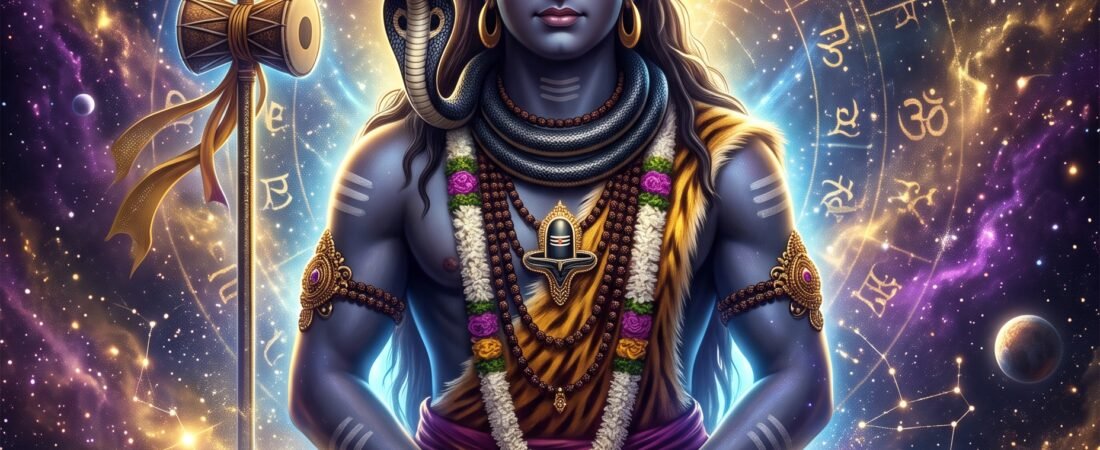
Why Does Lord Shiva Wear A Crescent Moon? The Astrological Secret Behind Chandra’s Refuge
If you’ve ever seen an image of Lord Shiva, you’ve noticed the crescent moon adorning his matted locks. But this isn’t just decorative symbolism — it’s a profound astrological truth that reveals how Vedic astrology understands the Moon’s role in our emotional and spiritual journey.
The short answer: According to Hindu mythology, Chandra (the Moon god) sought refuge with Shiva when he was cursed to wane and lose his radiance. Shiva, the supreme consciousness beyond time and decay, gave the Moon a permanent place in his crown, transforming the cosmic punishment into a symbol of renewal. In Vedic astrology, this story explains why the Moon (Chandra) represents the mind, emotions, and the cyclical nature of life — and why a strong Moon in your kundli brings emotional resilience and spiritual clarity.
But the deeper astrological meaning goes far beyond the myth. Let’s explore what Shiva’s crescent moon reveals about your emotional nature, your relationship with your mother, and how lunar transits shape your inner world.
The Mythology: When Chandra Lost His Light
The story begins in the Satya Yuga, when Chandra (also called Soma) was married to the 27 daughters of Daksha Prajapati — the Nakshatras, or lunar mansions that form the backbone of Vedic astrology’s predictive system.
But Chandra favored Rohini, the most beautiful of the sisters, neglecting the others. The neglected wives complained to their father Daksha, who warned Chandra to treat all his wives equally. When Chandra ignored the warning, Daksha cursed him: “You shall lose your radiance and wane until you disappear completely.”
This curse manifested as the waning moon we see every month — the Krishna Paksha, when the Moon’s light diminishes night by night.
Desperate, Chandra performed intense tapasya (austerities) to Lord Shiva at the sacred forest of Naimisha. Pleased by his devotion, Shiva granted a boon: the curse would remain, but Chandra would be allowed to wax again after reaching complete darkness. And as a permanent mark of protection, Shiva placed the crescent moon in his own hair — symbolizing that even in our darkest emotional cycles, the supreme consciousness holds us.
The Astrological Meaning: Moon As The Mind
In Vedic astrology, the Moon (Chandra) represents:
- The mind (Manas): Your emotional nature, thought patterns, and psychological responses
- The mother: Your relationship with your mother and maternal figures
- Nourishment: How you give and receive emotional sustenance
- Public life: Your reputation and how others perceive you
- Fluidity: Adaptability, imagination, and the subconscious mind
The Moon’s placement in your Janam Kundli — its sign (Rashi), house (Bhava), and aspects (Drishti) — reveals more about your emotional personality than your Sun sign does in Western astrology.
Why The Moon Matters More Than The Sun In Vedic Astrology
Western astrology emphasizes the Sun sign (your zodiac based on the Sun’s position at birth). But Vedic astrology prioritizes the Moon sign (Rashi) because:
- The Moon moves fastest: It changes signs every 2.5 days, making it the most dynamic planetary influence
- The Moon rules the mind: Your Sun sign shows your soul’s purpose, but your Moon sign shows how you actually experience life emotionally
- The Moon governs the Nakshatras: The 27 lunar mansions used for Muhurat timing, compatibility matching, and predictive dashas are all calculated from the Moon’s position
This is why your Astrova AI kundli asks for your exact birth time — even a 2-hour difference can shift your Moon sign, completely changing your emotional blueprint.
Shiva As The Transformer: What The Crescent Moon Teaches Us About Emotional Cycles
Shiva is known as Mahakala — the Lord of Time who transcends time itself. By wearing the crescent moon, he demonstrates mastery over the cyclical nature of emotions.
Think about your own emotional life. You have good days and bad days. Periods of clarity and periods of confusion. Times when you feel expansive (waxing moon) and times when you feel depleted (waning moon).
The mythological story teaches us that these cycles are not flaws — they are the nature of the mind itself. Chandra’s curse represents the inevitable decline that follows attachment and imbalance. But Shiva’s boon represents the possibility of renewal through surrender to higher consciousness.
Practical Astrology: Working With Your Lunar Cycles
Just as the Moon waxes and wanes in the sky, your emotional energy follows a 29.5-day lunar cycle. Here’s how to work with it:
| Lunar Phase | DAYS | Emotional Quality | Best Activities |
|---|---|---|---|
| New Moon (Amavasya) | Day 1 | Introspective, low energy, subconscious surfacing | Meditation, setting intentions, rest |
| Waxing Crescent | Days 2-7 | Growing energy, optimism, initiative | Starting new projects, socializing, learning |
| First Quarter | Days 8-9 | Challenges arise, need for action | Problem-solving, pushing through obstacles |
| Waxing Gibbous | Days 10-14 | Refinement, refinement, refinement | Editing, refining, preparing for completion |
| Full Moon (Purnima) | Day 15 | Peak energy, emotional intensity, culmination | Celebration, completion, release rituals |
| Waning Gibbous | Days 16-22 | Gratitude, sharing wisdom, integration | Teaching, reflecting, giving back |
| Last Quarter | Days 23-24 | Release, letting go, forgiveness | Clearing clutter, ending cycles, forgiveness work |
| Waning Crescent | Days 25-29 | Surrender, rest, preparation | Rest, dreamwork, spiritual practices |
Notice how this mirrors the myth of Chandra? The waning phases (Krishna Paksha) represent the curse — the decline. But the waxing phases (Shukla Paksha) represent the boon — the renewal. And just as Shiva holds the crescent moon eternally, your awareness of these cycles becomes a source of stability.
The Moon In Your Kundli: What Your Moon Sign Reveals
Your Moon sign (Chandra Rashi) reveals your emotional nature. Here’s a brief guide to what each placement means:
- Moon in Aries (Mesha): Emotional impulsiveness, quick to anger but quick to forgive, needs independence
- Moon in Taurus (Vrishabha): Emotionally stable, values comfort and security, stubborn when upset
- Moon in Gemini (Mithuna): Emotionally curious, processes feelings through communication, needs mental stimulation
- Moon in Cancer (Karka): Emotionally nurturing (Moon’s own sign), deeply sensitive, strong mother connection
- Moon in Leo (Simha): Emotionally dramatic, needs recognition, generous with affection
- Moon in Virgo (Kanya): Emotionally analytical, worries easily, shows love through service
- Moon in Libra (Tula): Emotionally harmonious, avoids conflict, needs partnership
- Moon in Scorpio (Vrishchika): Emotionally intense, secretive, transformative emotional nature
- Moon in Sagittarius (Dhanu): Emotionally optimistic, needs freedom, philosophical about feelings
- Moon in Capricorn (Makara): Emotionally reserved, ambitious, matures emotionally over time
- Moon in Aquarius (Kumbha): Emotionally detached, values friendship, unconventional emotional expression
- Moon in Pisces (Meena): Emotionally psychic, absorbs others’ feelings, needs solitude to recharge
Want to know your Moon sign? Generate Your Free Kundli With Astrova AI →
Remedies For A Weak Moon: How To Strengthen Chandra In Your Chart
If your Moon is afflicted (by Rahu, Ketu, Saturn, or placement in a difficult house), you may experience anxiety, mood swings, insomnia, or emotional instability. Here are time-tested remedies:
1. Somvar Vrat (Monday Fasting)
Monday is ruled by the Moon. Fasting on Mondays (or eating only one meal) strengthens lunar energy. Break the fast with white foods like rice, milk, or kheer.
2. Wear Pearl (Moti) Or Moonstone
These lunar gemstones should be worn on the little finger of the right hand on a Monday morning during Shukla Paksha (waxing moon). Consult your kundli first — gemstones only work if the Moon is a beneficial planet for your chart.
3. Chandra Beej Mantra
Chant 108 times on Mondays:
“Om Shraam Shreem Shraum Sah Chandraya Namah”
4. Offer Water To Lord Shiva
Since Shiva holds the crescent moon, offering water (especially milk mixed with water) to the Shivalinga on Mondays pleases both Shiva and Chandra. This is the simplest and most powerful lunar remedy.
5. Respect Your Mother
The Moon represents the mother. Serving your mother, seeking her blessings, and maintaining a good relationship with her strengthens your Moon. If your mother is no longer alive, donate food or clothes to elderly women on Mondays.
How Astrova AI Helps You Understand Your Moon
Your Moon sign is just the beginning. To truly understand your emotional nature, you need to analyze:
- Moon’s house placement: Which area of life your emotions focus on
- Moon’s aspects: Which planets modify your emotional nature
- Nakshatra position: The specific lunar mansion (out of 27) where your Moon sits
- Current lunar transit: How today’s Moon is triggering your natal Moon
Astrova AI’s free Janam Kundli feature calculates all of this in seconds, giving you a detailed emotional profile that would take a human astrologer hours to compute.
Get Your Free Kundli Analysis →
Frequently Asked Questions
Why does Shiva wear a crescent moon and not a full moon?
The crescent represents the waxing phase — the promise of growth and renewal. A full moon would represent completion, but Shiva, as the eternal consciousness, holds the potential for infinite cycles. The crescent also symbolizes the balance between light and darkness, consciousness and unconsciousness.
Is the Moon sign more important than the Ascendant (Lagna)?
Both are crucial, but they serve different purposes. The Ascendant shows your physical body, personality, and life path. The Moon sign shows your emotional nature and mental health. For relationship compatibility and Muhurat timing, the Moon sign is prioritized. For health and career, the Ascendant matters more.
Can a weak Moon cause depression?
In Vedic astrology, a severely afflicted Moon (conjunct Rahu, Ketu, or Saturn, or placed in the 6th, 8th, or 12th house) can indicate emotional vulnerability, anxiety, or mood disorders. However, astrology shows tendencies, not destiny. Proper remedies, therapy, and lifestyle changes can strengthen lunar energy.
Why is Monday associated with the Moon?
In Sanskrit, Monday is “Somvar” — the day of Soma (the Moon god). The seven days of the week are ruled by the seven classical planets, and Monday is ruled by Chandra. This is why lunar remedies are performed on Mondays.
How does the Moon affect marriage compatibility?
In Kundli Milan (horoscope matching), the Moon signs of both partners are compared through the 36-point Guna Milan system. The Moon represents emotional compatibility — if both partners’ Moons are in friendly signs and houses, they understand each other’s emotional needs naturally. A weak Moon match can lead to emotional misunderstandings.
Explore More Astrova Guides
- What Is Vimshottari Dasha And How To Read Your Planetary Periods
- Sade Sati Explained: What It Is, How It Affects You & Powerful Remedies
- Navagraha: The 9 Planetary Deities Of Vedic Astrology
- What Is Your Nakshatra And How Does It Reveal Your True Personality
- Kundli Milan: The Complete Marriage Compatibility Guide
- AI Palm Reading: The Complete Guide
About The Author
Astrova AI Editorial Team
The Astrova AI Editorial team combines traditional Vedic astrology scholarship with modern AI technology. Our content is reviewed by experienced Jyotish acharyas trained in classical texts including Brihat Parashara Hora Shastra, Phaladeepika, and Uttara Kalamrita. We believe that ancient wisdom becomes more powerful when made accessible through technology.
Have a correction or question? We welcome feedback. Reach us at support@theastrova.com.
Published on August 14, 2026 | Last updated: August 14, 2026
Related posts:
 How to read your own palm at home — step-by-step guide — Complete Guide 2026
 How to check your daily Rashifal using your Moon sign — step by step — Complete Guide 2026
 How to identify Kaalsarp Dosha in your Kundli — visual guide — Complete Guide 2026
How accurate is AI Kundli matching vs traditional astrologer matching? — Complete Guide 2026
How to identify Kaalsarp Dosha in your Kundli — visual guide — Complete Guide 2026
How accurate is AI Kundli matching vs traditional astrologer matching? — Complete Guide 2026