Why Does the Moon Wax and Wane? The Ancient Curse of Chandra and Its Astrological Meaning
Quick Answer: In Vedic astrology, the Moon’s waxing and waning cycle stems from the mythological curse placed on Chandra (the Moon God) by his father-in-law Daksha. This 27-day cycle connects to the 27 Nakshatras (lunar mansions) and profoundly influences your mind, emotions, and relationship with your mother. Understanding this cosmic story reveals why your Moon sign matters more than your Sun sign in Vedic astrology.
Discover Your Moon’s Secret Message
Get your complete Janam Kundli with Moon sign analysis, Nakshatra details, and personalized remedies — all powered by AI
The Mythological Origin: Chandra’s Curse
In Hindu mythology, Chandra (the Moon God) married the 27 daughters of Daksha Prajapati — each daughter representing one of the 27 Nakshatras (lunar mansions) that track the Moon’s monthly journey across the sky. These Nakshatras are not just stars; they are cosmic energies that shape your personality, destiny, and life path.
But Chandra had a favorite: Rohini Nakshatra. He spent most of his time with her, neglecting his other 26 wives. The neglected wives complained to their father Daksha, who warned Chandra to treat all his wives equally. Chandra ignored the warning.
Enraged, Daksha cursed Chandra: “Because you have favored one wife over others and ignored your dharma, your body will decay. Your light will fade day by day until you are consumed by darkness.”
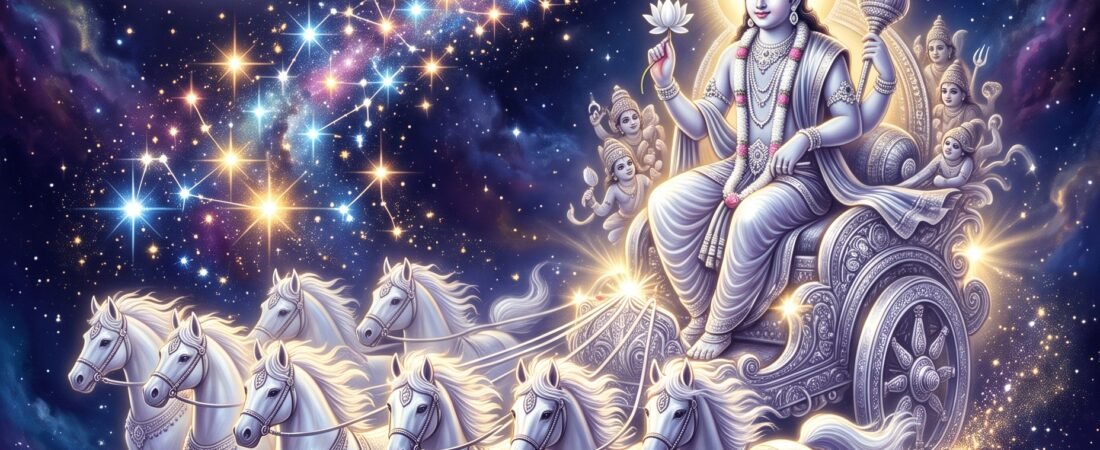
And so the Moon began to wane — losing its brilliance, growing weaker each night. The other gods, seeing the cosmic balance disrupted, intervened. Lord Shiva, the supreme deity, offered Chandra refuge and placed the crescent Moon on his own head, giving Chandra a new source of light. But Daksha’s curse could not be fully revoked — it was modified into a cycle.
The modified curse: Chandra would wax and wane in a 27-day cycle, spending roughly equal time with each of his 27 wives (Nakshatras) as he traveled through the sky. This cycle repeats eternally, symbolizing the rhythm of time, the mind’s fluctuations, and the cosmic dance of creation and dissolution.
The Astrological Significance: Why Your Moon Sign Matters
In Vedic astrology (Jyotish), the Moon (Chandra) represents your mind (Manas), emotions, mother, and inner world. While Western astrology prioritizes the Sun sign, Vedic astrology considers the Moon sign (Rashi) far more important because it reveals:
- Your emotional nature: How you process feelings, react to situations, and find comfort
- Your mental patterns: Your thought processes, memory, and psychological tendencies
- Your relationship with your mother: The Moon’s placement often mirrors your mother’s personality and your bond with her
- Your inner happiness: What brings you peace, security, and emotional fulfillment
- Your subconscious mind: Hidden fears, desires, and karmic patterns from past lives
The Moon changes signs every 2.5 days, spending about 27.3 days to complete one full cycle through all 12 zodiac signs. This rapid movement means the Moon sign is highly specific — two people born on the same day but hours apart can have different Moon signs, leading to vastly different emotional worlds.
The 27 Nakshatras: Chandra’s Cosmic Wives
The 27 Nakshatras are the real “homes” of the Moon. Each Nakshatra spans 13°20′ of the zodiac, and the Moon spends approximately one day in each Nakshatra during its monthly cycle. These are not just astronomical markers — they are living energies that influence your birth chart in profound ways.
| Nakshatra | Zodiac Span | Ruling Deity | Core Energy |
|---|---|---|---|
| Ashwini | 0° – 13°20′ Aries | Ashwini Kumaras | Speed, healing, new beginnings |
| Bharani | 13°20′ – 26°40′ Aries | Yama (Death) | Transformation, endurance, rebirth |
| Krittika | 26°40′ Aries – 10° Taurus | Agni (Fire) | Purification, courage, sharpness |
| Rohini | 10° – 23°20′ Taurus | Brahma (Creator) | Growth, beauty, fertility (Chandra’s favorite) |
| Mrigashira | 23°20′ Taurus – 6°40′ Gemini | Soma (Moon) | Searching, curiosity, sensitivity |
| Ardra | 6°40′ – 20° Gemini | Rudra (Storm) | Destruction, tears, breakthrough |
| Punarvasu | 20° Gemini – 3°20′ Cancer | Aditi (Mother of Gods) | Renewal, return, nurturing |
| Pushya | 3°20′ – 16°40′ Cancer | Brihaspati (Jupiter) | Nourishment, spirituality, protection |
| Ashlesha | 16°40′ – 30° Cancer | Nagas (Serpents) | Mystery, intensity, kundalini |
| Magha | 0° – 13°20′ Leo | Pitris (Ancestors) | Authority, lineage, karma |
| Purva Phalguni | 13°20′ – 26°40′ Leo | Bhaga (Prosperity) | Creativity, relaxation, enjoyment |
| Uttara Phalguni | 26°40′ Leo – 10° Virgo | Aryaman | Commitment, friendship, service |
| Hasta | 10° – 23°20′ Virgo | Savitar (Sun) | Skill, craft, manifestation |
| Chitra | 23°20′ Virgo – 6°40′ Libra | Vishwakarma (Architect) | Beauty, design, perfection |
| Swati | 6°40′ – 20° Libra | Vayu (Wind) | Independence, movement, adaptability |
| Vishakha | 20° Libra – 3°20′ Scorpio | Indra-Agni | Purpose, ambition, multi-focus |
| Anuradha | 3°20′ – 16°40′ Scorpio | Mitra (Friendship) | Devotion, loyalty, transformation |
| Jyeshtha | 16°40′ – 30° Scorpio | Indra (King) | Seniority, protection, supremacy |
| Mula | 0° – 13°20′ Sagittarius | Nirriti (Destruction) | Root causes, liberation, upheaval |
| Purva Ashadha | 13°20′ – 26°40′ Sagittarius | Apas (Water) | Invincibility, enthusiasm, flow |
| Uttara Ashadha | 26°40′ Sag – 10° Cap | Vishvadevas (Universal Gods) | Universal duty, victory, righteousness |
| Shravana | 10° – 23°20′ Capricorn | Vishnu (Preserver) | Learning, listening, integration |
| Dhanishta | 23°20′ Cap – 6°40′ Aquarius | Eight Vasus | Wealth, music, abundance |
| Shatabhisha | 6°40′ – 20° Aquarius | Varuna (Cosmic Waters) | Healing, mystery, cosmic order |
| Purva Bhadrapada | 20° Aquarius – 3°20′ Pisces | Aja Ekapada (One-footed Goat) | Spiritual fire, asceticism, transformation |
| Uttara Bhadrapada | 3°20′ – 16°40′ Pisces | Ahir Budhnya (Dragon of Deep) | Wisdom, depth, cosmic serpent |
| Revati | 16°40′ – 30° Pisces | Pushan (Nourisher) | Protection, journeys, completion |
Your birth Nakshatra (determined by your Moon’s position at birth) reveals deeper layers of your personality than your zodiac sign alone. It shows your soul’s purpose, your karmic patterns, and the specific gifts you bring into this lifetime.
The Moon’s Cycle and Your Emotional Rhythms
The waxing Moon (Shukla Paksha, from New Moon to Full Moon) represents growth, expansion, and building energy. This is the ideal time to start new projects, set intentions, and take action. Your mind feels more optimistic, and your emotional reserves are replenishing.
The waning Moon (Krishna Paksha, from Full Moon to New Moon) represents release, introspection, and letting go. This is the time for reflection, completion, and inner work. Your mind may feel more sensitive, and old patterns may surface for healing.
Understanding this cycle helps you work with cosmic rhythms rather than against them. You’ll notice that certain days feel naturally supportive while others require more patience — and this is not coincidence. It is the Moon’s eternal dance, shaped by Chandra’s ancient curse and blessing.
How Astrova AI Helps You Understand Your Moon
Astrova AI’s Janam Kundli feature generates your complete birth chart in seconds, revealing:
- Your Moon sign (Rashi): The zodiac sign the Moon occupied at your birth, showing your emotional nature
- Your birth Nakshatra: The specific lunar mansion where your Moon sits, revealing your soul’s blueprint
- Moon house placement: Which area of life your emotions and mind are most focused on
- Moon aspects: How other planets influence your emotional world
- Current Moon transit: Where the Moon is right now and how it affects your chart
- Personalized remedies: Mantras, gemstones, and rituals to strengthen a weak Moon
Whether you’re navigating emotional challenges, seeking clarity about your mother relationship, or simply curious about your inner world, your Moon holds the answers. And with Astrova AI, you can access this ancient wisdom anytime, in your preferred language, completely free.
Ready to Meet Your Moon?
Generate your free Janam Kundli and discover the emotional blueprint you were born with
Frequently Asked Questions
Q1: Why is the Moon sign more important than the Sun sign in Vedic astrology?
A: The Moon moves fastest through the zodiac (changing signs every 2.5 days), making it highly specific to your birth moment. It represents your mind, emotions, and inner world — the lens through which you experience life. The Sun represents your soul and ego, but the Moon shows how you actually feel and react day-to-day.
Q2: Can my Moon sign change during my lifetime?
A: No. Your birth Moon sign is fixed based on the Moon’s position at the exact time and place of your birth. However, the transiting Moon moves through all 12 signs every month, temporarily activating different emotional themes in your chart.
Q3: What if I don’t know my exact birth time?
A: Without an accurate birth time, your Moon sign calculation may be incorrect (since the Moon changes signs every 2.5 days). Astrova AI can still generate a chart using a default noon time, but for precise Moon sign and Nakshatra analysis, try to obtain your exact birth time from hospital records or family members.
Q4: What does a weak Moon in my chart mean?
A: A weak Moon (debilitated in Scorpio, afflicted by malefic planets, or placed in difficult houses) can indicate emotional sensitivity, mood fluctuations, anxiety, or challenges with your mother. Remedies include wearing pearl or moonstone, chanting the Moon mantra “Om Som Somaya Namah,” and performing Somvar (Monday) fasting.
Q5: How does the Moon affect my relationship with my mother?
A: The Moon universally signifies the mother in Vedic astrology. Its sign, house, and aspects often mirror your mother’s personality and the quality of your bond. A well-placed Moon suggests a nurturing, supportive mother relationship, while an afflicted Moon may indicate emotional distance, overprotectiveness, or complex dynamics.
Explore More Astrova Guides
- AI Palm Reading: Complete Guide to Reading Your Destiny Lines
- How to Generate Your Janam Kundli Online Free — Step-by-Step
- Daily Rashifal: How to Read Your Moon Sign Horoscope Today
- Kundli Milan: The Complete Marriage Compatibility Guide
- Sade Sati and Kaalsarp Dosha: How to Check and Remedies
- How to Use AI Astrology for Daily Life Guidance
About the Astrova AI Editorial Team
The Astrova AI Editorial Team combines ancient Vedic wisdom with modern AI technology to make astrology accessible to everyone. Our content is rooted in classical Jyotish texts including Brihat Parashara Hora Shastra, Phaladeepika, and Saravali, while leveraging cutting-edge AI to generate accurate birth charts and personalized insights. We believe astrology should empower, not intimidate — which is why we offer our complete Janam Kundli, daily Rashifal, and AI astrologer chat absolutely free, in 9 Indian languages.
References: Brihat Parashara Hora Shastra (Chapter 4: Nakshatra descriptions); Varahamihira’s Brihat Samhita (Chapter 98: Moon’s movement); Mantreswara’s Phaladeepika (Chapter 2: Moon’s effects)
Related posts:
 How to read your own palm at home — step-by-step guide — Complete Guide 2026
 How to check your daily Rashifal using your Moon sign — step by step — Complete Guide 2026
 How to identify Kaalsarp Dosha in your Kundli — visual guide — Complete Guide 2026
How accurate is AI Kundli matching vs traditional astrologer matching? — Complete Guide 2026
How to identify Kaalsarp Dosha in your Kundli — visual guide — Complete Guide 2026
How accurate is AI Kundli matching vs traditional astrologer matching? — Complete Guide 2026