Download Astrova AI — Free Kundli & Astrology
What Is Vimshottari Dasha and Why Does It Matter for Your Life?
Vimshottari Dasha is the Vedic astrology system of planetary periods that reveals which planet is active in your life at any given time. Based on your Moon’s position in one of 27 Nakshatras (lunar mansions) at birth, this 120-year cycle determines the major themes, opportunities, and challenges you’ll experience decade by decade. Understanding your current Dasha helps you make better decisions about career, relationships, health, and spiritual growth.
Think of it like this: your birth chart (Janam Kundli) shows your potential, but the Dasha system shows the timing — when that potential will activate. Two people with identical charts can have completely different life experiences because they’re running different planetary periods.
That’s why Astrova AI includes a complete Vimshottari Dasha calculator in every free Kundli. You’ll see your Mahadasha (major period), Antardasha (sub-period), and even Pratyantardasha (sub-sub-period) with exact start and end dates — no manual calculation needed.
How Does the Vimshottari Dasha System Work?
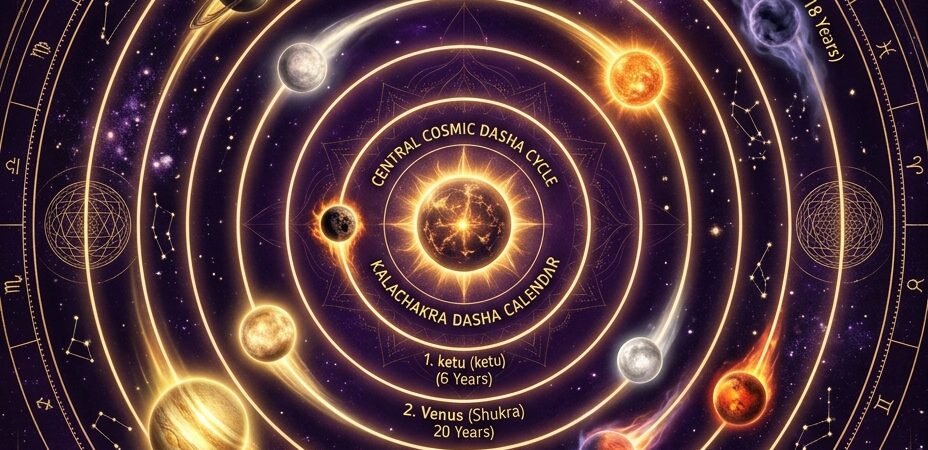
The word “Vimshottari” literally means “120” in Sanskrit, because the complete cycle spans 120 years. Each of the nine planets (Navagraha) rules a specific number of years within this cycle:
| Planet | Years | Key Themes |
|---|---|---|
| Ketu (South Node) | 7 years | Spiritual awakening, detachment, past-life karma |
| Venus (Shukra) | 20 years | Love, luxury, creativity, relationships, wealth |
| Sun (Surya) | 6 years | Leadership, authority, father, government, confidence |
| Moon (Chandra) | 10 years | Emotions, mother, mind, public life, intuition |
| Mars (Mangal) | 7 years | Energy, courage, siblings, property, competition |
| Rahu (North Node) | 18 years | Ambition, foreign connections, technology, obsession |
| Jupiter (Guru) | 16 years | Wisdom, children, education, expansion, luck |
| Saturn (Shani) | 19 years | Discipline, career, delays, maturity, life lessons |
| Mercury (Budh) | 17 years | Communication, business, learning, adaptability |
The starting planet depends on which Nakshatra your Moon occupies at birth. For example, if your Moon is in Ashwini Nakshatra, your life begins with Ketu Dasha. If it’s in Bharani, you start with Venus. The sequence always follows the same order: Ketu → Venus → Sun → Moon → Mars → Rahu → Jupiter → Saturn → Mercury.
What Are Mahadasha, Antardasha, and Pratyantardasha?
The Dasha system works in three nested layers, like Russian dolls:
Mahadasha (Major Period): This is the ruling planet for a span of years. It sets the overall theme of that phase of your life. A Jupiter Mahadasha, for instance, brings 16 years focused on learning, teaching, children, and spiritual growth.
Antardasha (Sub-Period): Within each Mahadasha, the 120-year cycle is subdivided. During a Jupiter Mahadasha, you’ll pass through Antardashas of Jupiter, Saturn, Mercury, Ketu, Venus, Sun, Moon, Mars, and Rahu — in that order. Each Antardasha colors the Mahadasha with its own flavor. Jupiter-Saturn might bring disciplined expansion; Jupiter-Mercury might bring learning through communication.
Pratyantardasha (Sub-Sub-Period): This is the finest level of timing, useful for predicting events within months. It further subdivides each Antardasha using the same planetary sequence.
Here’s a real example from an Astrova user: Priya, 28, from Bangalore, was confused about why her career felt stuck despite good qualifications. Her Astrova Kundli showed she was in Saturn Mahadasha, Rahu Antardasha. Saturn demands patience and hard work; Rahu creates unconventional ambitions. Together, they explained her frustration — she was pushing for rapid success during a period that rewards steady, behind-the-scenes effort. Once she understood the timing, she stopped comparing herself to peers and focused on skill-building. Two years later, during Saturn-Jupiter, she got promoted.
How to Find Your Current Dasha Period
Calculating Vimshottari Dasha manually requires three steps:
- Find your Moon’s exact Nakshatra at the moment of birth (not just the zodiac sign — the Nakshatra is more precise).
- Calculate the balance of Dasha at birth. If your Moon is 3 degrees into a Nakshatra that’s 13°20′ wide, you’ve already experienced part of that Nakshatra’s ruling planet’s Dasha before birth.
- Apply the planetary sequence forward from your birth date to find your current Mahadasha, Antardasha, and Pratyantardasha.
This is where most people get stuck — the math involves converting degrees to time, accounting for the lunar calendar, and tracking multiple nested cycles. That’s exactly why Astrova AI automates it. Enter your birth details once, and your complete Dasha timeline appears with exact dates for every major and sub-period through your entire life.
How Astrova AI Helps You Understand Your Dasha
Astrova AI’s free Kundli generator doesn’t just calculate your Vimshottari Dasha — it explains what each period means for you personally:
- Complete Dasha timeline: See every Mahadasha, Antardasha, and Pratyantardasha with start and end dates from birth to age 120.
- Plain-language interpretations: No Sanskrit jargon. Each period comes with a description of what to expect in career, relationships, health, and spiritual life.
- Remedies for challenging periods: If you’re in a difficult Saturn or Rahu phase, Astrova suggests practical remedies — mantras, gemstones, charitable acts — based on classical Vedic texts.
- Available in 9 Indian languages: Read your Dasha analysis in Hindi, Tamil, Telugu, Kannada, Malayalam, Bengali, Marathi, Gujarati, or English.
- 24/7 AI astrologer: Ask follow-up questions like “When will my Jupiter period start?” or “What should I do during Saturn Mahadasha?” and get instant answers based on your specific chart.
Get Your Free Dasha Analysis on Astrova AI
Can Dasha Predict Exact Events?
This is a common question, and the honest answer is: Dasha shows tendencies, not fixed outcomes. Think of it like weather forecasting. A Saturn period might indicate delays and challenges, but how you respond — whether you use that time for disciplined preparation or resist and struggle — determines the actual outcome.
Classical texts like Brihat Parashara Hora Shastra (the foundational Vedic astrology text, composed around 1500 BCE) emphasize that Dasha must be read alongside the birth chart. A “bad” planet in a strong house position can deliver excellent results during its period. A “good” planet in a weak house may underperform.
That’s why Astrova AI’s interpretations always reference both your Dasha and your natal chart. The AI astrologer can explain how your specific planetary placements modify the general Dasha themes.
Frequently Asked Questions About Vimshottari Dasha
How accurate is Vimshottari Dasha for predicting life events?
Vimshottari Dasha has been used for over 2,000 years and is considered one of the most reliable timing systems in Vedic astrology. However, accuracy depends on the precision of your birth time (even a few minutes can shift the starting Dasha) and the skill of interpretation. Astrova AI uses Swiss Ephemeris data for maximum accuracy.
What happens when two Dashas overlap or transition?
Dasha transitions (called “Dasha sandhi”) can feel turbulent because you’re shifting from one planetary influence to another. The last few months of a Mahadasha often feel like a mix of the outgoing and incoming planets. Astrova shows exact transition dates so you can prepare.
Can Dasha change if I don’t follow remedies?
No. Dasha is a timing system based on your birth chart — it’s fixed, not optional. Remedies don’t change the Dasha; they help you navigate challenging periods more smoothly. Think of Dasha as the season (winter, summer) and remedies as your clothing choices.
Why do some people have different Dasha start dates even with the same Moon sign?
Because Dasha is calculated from the Moon’s exact Nakshatra position (measured in degrees), not just the zodiac sign. Two people born on the same day with Moon in Taurus might have different Nakshatras (Krittika vs. Rohini) and therefore different Dasha sequences.
Is Vimshottari Dasha the only Dasha system?
No. Vedic astrology includes several Dasha systems: Yogini Dasha (36-year cycle), Chara Dasha (based on signs, not planets), and Kalachakra Dasha (used in Tibetan Buddhism). Vimshottari is the most widely used in India because of its accuracy and comprehensive coverage of the 120-year lifespan.
Can I check my Dasha for free?
Yes. Astrova AI’s Janam Kundli generator includes a complete Vimshottari Dasha breakdown at no cost. Download the app, enter your birth details, and your Dasha timeline appears instantly in your preferred language.
Explore More Astrova Guides
- What Is a Janam Kundli and How to Generate Yours Free
- What Is Daily Rashifal and How Does AI Horoscope Work
- Kundli Milan for Marriage: How to Check Compatibility Free
- Sade Sati and Kaalsarp Dosha: Complete Guide with Remedies
- What is AI Palm Reading and How Does It Work?
- AI Astrology vs Traditional Astrologers: Complete Comparison
- What Are Vedic Planetary Remedies and How Do They Work?
About the Author
Astrova AI Editorial — The Astrova editorial team combines classical Jyotish scholarship with modern AI technology. Our content is grounded in foundational texts including Brihat Parashara Hora Shastra, Phaladeepika by Mantreswara, and Brihat Jataka by Varahamihira, while leveraging Swiss Ephemeris precision for all planetary calculations. Every guide is reviewed for accuracy, clarity, and practical usefulness.
Download Astrova AI — Free Kundli & Astrology
Related posts:
 How long does Sade Sati last and when will it end for you?
 What Is Shani Dhaiya (Small Panoti) — How to Identify It in Your Kundli and Find Relief
 What Is Gajakesari Yoga — The Rare Jupiter-Moon Combination for Wealth and Wisdom?
 What Is Kemadruma Yoga in Your Kundli — The Lonely Moon and How to Find Relief