What Is Pitru Dosha in Your Kundli — How to Identify It and What Remedies Actually Work?
Quick Answer: Pitru Dosha is a karmic condition in Vedic astrology that occurs when the Sun, the 9th house, or the 9th house lord in your Kundli is afflicted by Rahu, Ketu, or Saturn. It is believed to indicate unresolved karmic debt to your ancestors (Pitrus), and its traditional symptoms include recurring obstacles in career and marriage, unexplained health issues, financial instability despite hard work, and a persistent sense of ancestral dissatisfaction. Classical remedies include performing Shraddha rituals during Pitru Paksha, offering Tarpan (water oblations), feeding Brahmins and crows, and visiting sacred pilgrimage sites — all of which are designed to pacify the ancestral energy and restore dharma in the family line.
✨ 100% FREE
Check Your Kundli for Pitru Dosha
AI Kundli • Palm Reading • Daily Rashifal • 9 Languages
What Exactly Is Pitru Dosha?
The word Pitru means “father” or “ancestor” in Sanskrit, and Dosha means “affliction” or “imbalance.” In Vedic astrology, Pitru Dosha is not a curse in the way popular culture sometimes portrays it. It is a karmic indicator — a signal in your birth chart that the ancestral lineage (Pitru Loka) carries unresolved energy that is affecting your present life.
The concept rests on a foundational principle of Jyotish Shastra: you are not born as a blank slate. You carry the karmic imprints of your lineage. The Garuda Purana, one of the eighteen Mahapuranas, devotes an entire section (the Preta Khanda) to the relationship between the living and their ancestors, describing how the state of the ancestors’ souls directly influences the fortunes of their descendants.
Similarly, the Brihat Parashara Hora Shastra identifies the Sun as the natural significator (karaka) of the father and the soul, and the 9th house as the house of dharma, fortune, and paternal heritage. When these placements are afflicted, it signals a disruption in the flow of ancestral blessings — which classical astrology interprets as Pitru Dosha.
How Is Pitru Dosha Formed in Your Kundli?
Pitru Dosha is not a single planetary placement. It is a pattern that emerges when specific conditions combine in your birth chart. Here are the primary configurations that astrologers look for:
| Condition | What It Means | Strength of Dosha |
|---|---|---|
| Sun conjunct Rahu | The soul (Sun) is eclipsed by the shadow planet of obsession and past-life karma (Rahu). Indicates ancestral karma related to unfulfilled desires or broken promises. | Strong |
| Sun conjunct Ketu | The soul is separated from its ancestral roots by Ketu (the planet of detachment and past-life completion). Often indicates ancestors who died with unfulfilled spiritual wishes. | Strong |
| Sun conjunct Saturn | The father/soul planet is compressed by Saturn’s karmic discipline. Indicates a lineage marked by hardship, duty, or unexpressed grief. | Moderate to Strong |
| Rahu or Ketu in the 9th house | The house of dharma and ancestors is occupied by shadow planets. Indicates a break in the traditional ancestral practices or a lineage that has neglected Shraddha rituals. | Moderate |
| 9th lord afflicted by Rahu/Ketu/Saturn | The ruler of the ancestral house is under karmic pressure. The dosha manifests through the house where the 9th lord sits. | Moderate |
| Sun in the 6th, 8th, or 12th house with malefic aspect | The soul planet is placed in a dusthana (challenging house) and further afflicted. Indicates ancestral karma manifesting as health, transformation, or loss themes. | Moderate |
| Amavasya (New Moon) birth with afflicted Sun | Born on a New Moon day when the Sun is already eclipsed by the Moon’s proximity, and further afflicted. Considered the strongest indicator of Pitru Dosha in classical texts. | Very Strong |
It is important to understand that having one of these conditions does not automatically mean you have a severe Pitru Dosha. The strength of the dosha depends on several factors: how many conditions are present simultaneously, whether benefic planets like Jupiter aspect the afflicted placements, and whether the running Vimshottari Dasha is activating the afflicted house or planet.
What Are the Traditional Signs of Pitru Dosha in Your Life?
Classical Jyotish texts describe a cluster of life patterns that, when they appear together, suggest Pitru Dosha may be active. These are not diagnostic in a medical sense — they are karmic indicators that an astrologer reads in context with the full chart.
Recurring obstacles in career despite competence: You are qualified, hardworking, and well-intentioned, but promotions stall, projects collapse at the last moment, or opportunities vanish without explanation. This is the most commonly reported symptom, and it aligns with the 9th house’s role as the house of fortune and dharma.
Delays or repeated failures in marriage: Matches fall through, engagements break, or married life is marked by persistent discord. The 9th house governs the father, and in traditional interpretation, the father’s karmic state directly affects the native’s marriage prospects — especially for women, whose 7th house (marriage) is closely linked to the 9th house through the Navamsa chart.
Unexplained health issues that resist treatment: Chronic ailments that do not respond to conventional medicine, particularly those affecting the bones, eyes, or cardiovascular system — all areas governed by the Sun.
Financial instability despite steady income: Money comes in but flows out through unexpected expenses, medical bills, legal disputes, or family obligations. The 2nd house (accumulated wealth) is being drained by karmic obligations that have not been discharged.
A persistent sense of unease or ancestral dissatisfaction: A feeling that “something is not right” in the family, often accompanied by recurring dreams of deceased ancestors, especially during the fortnight of Pitru Paksha (the lunar fortnight dedicated to ancestors, typically falling in September).
Repeated miscarriages or difficulty conceiving: In classical interpretation, this is linked to the 5th house (children) being afflicted through its connection to the 9th house (the 5th from the 5th is the 9th). The Garuda Purana specifically connects this pattern to unperformed ancestral rituals.
None of these signs, taken individually, prove Pitru Dosha. They become meaningful only when they appear as a cluster AND the Kundli shows the corresponding planetary afflictions. This is why generating your Janam Kundli and having it read by a qualified astrologer — or through an AI system trained on classical principles — is the first step.
How to Check If You Have Pitru Dosha in Your Kundli
Here is the step-by-step process for identifying Pitru Dosha in your birth chart:
- Generate your Janam Kundli using your exact birth date, time, and place. Even a 4-minute error in birth time can shift the 9th house cusp, so accuracy matters.
- Locate the Sun in your chart. Note which house it sits in and which planets are conjunct it (within a 5-degree orb).
- Identify the 9th house from your Lagna (Ascendant). Note which sign occupies it and which planets sit there.
- Find the 9th house lord — the planet that rules the zodiac sign in your 9th house. Note where this planet sits and what aspects it receives.
- Check for the affliction patterns listed in the table above. Each match adds to the strength of the dosha.
- Check your birth tithi (lunar day). If you were born on Amavasya (New Moon), Bharani, Magha, or Purva Phalguni nakshatra, these are considered additional Pitru-related indicators.
- Examine the running Dasha. If you are currently running the Dasha or Antar Dasha of a planet involved in the affliction, the dosha is likely active and manifesting in your life right now.
If you do not have your Kundli yet, you can generate your Janam Kundli for free and check these placements directly. The process takes less than two minutes.
The Research Perspective: What Do We Actually Know About Pitru Dosha?
It is important to be honest about the evidence base. Pitru Dosha is a concept from classical Vedic astrology — it is not a hypothesis that has been tested in controlled scientific studies. There are no peer-reviewed papers that measure the correlation between Sun-Rahu conjunctions and career obstacles, or between 9th house afflictions and marriage delays.
What does exist is a substantial body of observational and anecdotal evidence:
- Classical textual authority: The Garuda Purana, Brihat Parashara Hora Shastra, Phaladeepika by Mantreswara, and Muhurta Chintamani all describe ancestral karma and its remedies. These texts have been the foundation of Jyotish practice for centuries.
- Cross-generational practitioner observation: Thousands of Vedic astrologers across India have independently identified the same planetary patterns in clients who report the same cluster of life difficulties. This is not controlled research, but it is a consistent observational pattern across a large practitioner base.
- Cultural continuity: The practice of Shraddha and Tarpan has been continuous in Hindu families for at least 3,000 years. The fact that these rituals persist across regions, languages, and centuries suggests they serve a psychological and spiritual function that families have found valuable — even if the mechanism is not measurable by modern scientific methods.
- Psychological framing: From a modern psychological perspective, Pitru Dosha can be understood as a framework for understanding intergenerational trauma — the well-documented phenomenon where unresolved grief, conflict, or unexpressed emotions in one generation affect the mental health and life outcomes of subsequent generations. The planetary language is the classical container; the underlying phenomenon is recognized in modern epigenetics and family systems therapy.
We present these observations as context, not as proof. Whether you approach Pitru Dosha as a karmic reality, a psychological framework, or a cultural tradition, the remedies are the same — and many people report subjective improvement after performing them.
What Remedies for Pitru Dosha Actually Work?
The classical Vedic remedies (upayas) for Pitru Dosha fall into three categories: ritual, charitable, and devotional. Here is what each involves and when it is traditionally performed:
Ritual Remedies
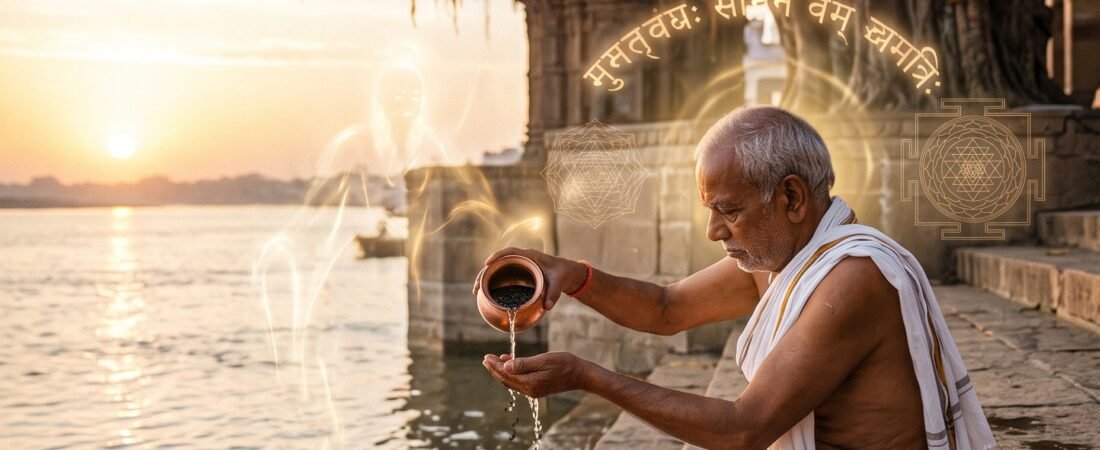
Shraddha during Pitru Paksha: The 16-lunar-day fortnight known as Pitru Paksha (typically September–October) is the dedicated period for ancestral rituals. On the tithi (lunar day) that corresponds to the death date of the ancestor, the family performs Pind Daan (offering of rice balls) and Tarpan (offering of water mixed with black sesame seeds, barley, and kusha grass). This is considered the single most important remedy.
Tarpan on Amavasya: If the exact death date is unknown, performing Tarpan on every Amavasya (New Moon day) is prescribed. The New Moon is traditionally associated with the Pitru Loka (ancestral realm), and offerings made on this day are believed to reach the ancestors directly.
Pind Daan at sacred sites: Performing Pind Daan at Gaya (Bihar), Varanasi (Uttar Pradesh), Nashik (Maharashtra), or Rameshwaram (Tamil Nadu) is considered especially powerful. Gaya, in particular, is described in the Garuda Purana as the place where the demon Gayasura’s body became a sacred site where ancestral souls receive liberation through the rituals performed by their descendants.
Charitable Remedies
Feeding Brahmins: Offering a meal to Brahmins (priests or learned persons) on the ancestor’s tithi is a core part of Shraddha. The food is believed to reach the ancestors through the Brahmin’s digestion.
Feeding crows: During Shraddha, food is placed for crows, which are considered the messengers of the Pitru Loka. If the crow eats the offering, it is taken as a sign that the ancestors have received it.
Donating to the needy: Donating food, clothes, or money to the poor on Amavasya or during Pitru Paksha is prescribed as a remedy that benefits both the ancestors and the living.
Feeding cows: Offering green grass and jaggery to cows, especially on Sundays and Amavasya, strengthens the Sun and is considered a simple but effective remedy for Pitru Dosha.
Devotional Remedies
Chanting the Mahamrityunjaya Mantra: This 12-syllable Shiva mantra is prescribed for all karmic afflictions, including Pitru Dosha. The traditional count is 108 repetitions daily, ideally during the Brahma Muhurta (the 96 minutes before sunrise).
Reciting the Garuda Purana: Reading or listening to a recitation of the Garuda Purana, particularly the Preta Khanda section, during Pitru Paksha is considered one of the most powerful remedies. Many temples organize Garuda Purana recitals during this period.
Performing Surya Namaskar: Since the Sun is the karaka of the father and soul, daily Surya Namaskar (sun salutations) with the Gayatri Mantra strengthens the Sun’s placement and is a simple daily remedy for Pitru Dosha.
Visiting a temple dedicated to Shiva or the Navagraha: Offering water to a Shivalinga and praying for ancestral peace is a widely practised remedy. Navagraha temples, where all nine planetary deities are installed, are also prescribed for pacifying the planetary afflictions that cause Pitru Dosha. For a deeper understanding of the nine planetary deities, see our guide to the Navagraha.
How Long Does It Take for Remedies to Show Results?
Classical texts do not give a fixed timeline. The general principle is that ritual remedies performed with sincerity and consistency begin to show effects within one lunar cycle (approximately one month) to one full year. The most commonly reported timeframe is during the next Pitru Paksha after beginning the remedies — suggesting that the ancestral realm “responds” on its own calendar, not ours.
It is also worth noting that remedies are not a transaction. They are not a payment that cancels a debt. They are a practice of remembrance, respect, and karmic alignment. The people who report the most benefit are those who approach the remedies with genuine intent rather than mechanical performance.
✨ 100% FREE
Get Your Complete Kundli with Dosha Analysis
AI-powered analysis of Pitru Dosha, Sade Sati, and all planetary placements
Frequently Asked Questions
1. Is Pitru Dosha the same as a curse?
No. Pitru Dosha is not a curse in the sense of someone deliberately harming you. It is a karmic condition — an imbalance in the flow of ancestral blessings that can be corrected through the prescribed remedies. The word “dosha” in Jyotish means “imbalance,” not “punishment.”
2. Can Pitru Dosha be cancelled completely?
Classical texts suggest that consistent performance of Shraddha and Tarpan, combined with sincere devotional practice, can pacify the dosha to the point where its effects are no longer felt. However, the karmic pattern remains in the chart — it is neutralized, not erased. Think of it like a debt that has been repaid: the record exists, but the obligation is discharged.
3. What if I do not know my ancestors’ death dates?
Perform Tarpan on every Amavasya (New Moon day). The Amavasya tithi is universally associated with the Pitru Loka, and offerings made on this day reach all ancestors regardless of their specific death date. You can also perform Sarva Pitru Shraddha, which is a general ritual for all ancestors, during Pitru Paksha.
4. Can women perform Pitru Dosha remedies?
Yes. While in some traditional families the Shraddha rituals are performed by the male head of the household, there is no scriptural prohibition against women performing Tarpan, visiting sacred sites, or chanting the prescribed mantras. In fact, many classical texts emphasize that the sincerity of the performer matters more than their gender.
5. How is Pitru Dosha different from Sade Sati?
Sade Sati is a transit-based condition caused by Saturn’s 7.5-year passage through the 12th, 1st, and 2nd houses from your Moon sign. It is temporary and recurring. Pitru Dosha is a birth-chart condition based on natal planetary placements. They can coexist — a person with Pitru Dosha may find that their Sade Sati periods are especially challenging — but they are distinct conditions with different remedies. Learn more about Sade Sati and its remedies.
6. Is Pitru Dosha related to Manglik Dosha?
They are different conditions. Manglik Dosha is caused by Mars’s placement and primarily affects marriage compatibility. Pitru Dosha is caused by the Sun, 9th house, or 9th lord’s affliction and affects overall fortune, career, and ancestral blessings. However, both can be checked through your Kundli Milan before marriage, since both have implications for married life.
Explore More Astrova Guides
- Generate Your Janam Kundli Online Free
- Sade Sati Check — Step-by-Step Kundli Guide with Remedies
- Vedic Remedies (Upayas) — Do They Actually Work?
- What Is Vimshottari Dasha — How to Read Planetary Periods
- Navagraha — The Nine Planetary Deities
- Kundli Milan — Complete Marriage Compatibility Guide
About the Astrova AI Editorial Team
The Astrova AI Editorial Team combines classical Jyotish scholarship with modern AI technology. Our content draws from foundational texts including the Garuda Purana, Brihat Parashara Hora Shastra, Phaladeepika by Mantreswara, and Muhurta Chintamani, alongside contemporary astrological research. We believe astrology should be accessible, practical, and free for everyone.
Have a correction or question? We welcome feedback. Reach us at support@theastrova.com.
✨ 100% FREE
Download Astrova AI — Your Personal Astrologer
AI Kundli • Palm Reading • Daily Rashifal • 9 Indian Languages • 24/7 AI Astrologer
Related posts:
 How to read your own palm at home — step-by-step guide — Complete Guide 2026
 How to check your daily Rashifal using your Moon sign — step by step — Complete Guide 2026
 How to identify Kaalsarp Dosha in your Kundli — visual guide — Complete Guide 2026
How accurate is AI Kundli matching vs traditional astrologer matching? — Complete Guide 2026
How to identify Kaalsarp Dosha in your Kundli — visual guide — Complete Guide 2026
How accurate is AI Kundli matching vs traditional astrologer matching? — Complete Guide 2026