What Is Vimshottari Dasha And How To Read Your Planetary Periods
Quick Answer: Vimshottari Dasha is the Vedic astrology system that divides your life into planetary periods, each ruled by a specific planet that shapes your experiences, opportunities, and challenges for that timeframe. The full cycle spans 120 years, with each planet ruling for a fixed duration based on your birth nakshatra (lunar mansion).
✓ Kundli Analysis
✓ 9 Languages
Why Vimshottari Dasha Matters More Than Your Birth Chart
Your birth chart (Janam Kundli) shows the potential of your life — the strengths, weaknesses, opportunities, and challenges written in the stars at your birth moment. But Vimshottari Dasha reveals the timing — when those potentials activate, when opportunities arrive, and when challenges test you.
Think of it this way: your birth chart is the map, but Dasha is the clock. Without knowing which planetary period you’re in, you’re reading the map without knowing where you are on the journey.
The 120-Year Cycle: How Vimshottari Dasha Works
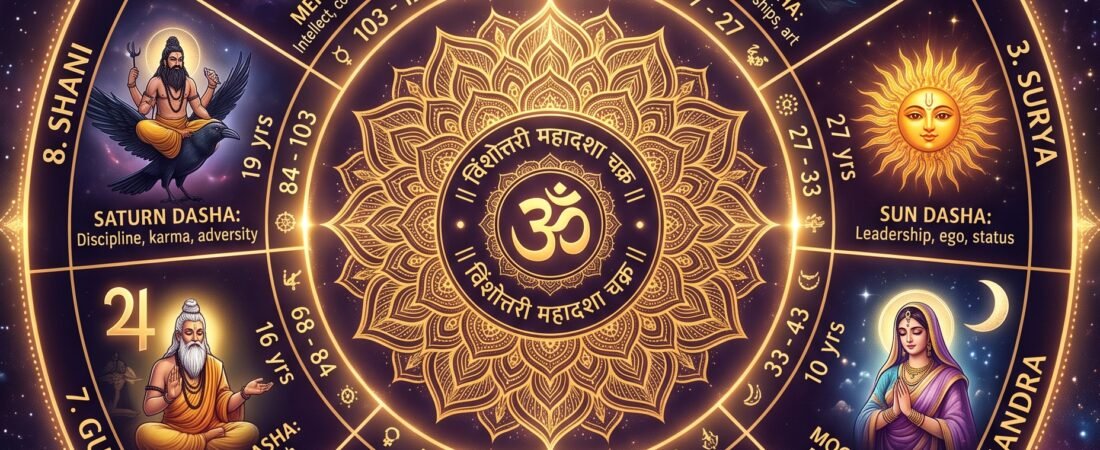
The Vimshottari system assigns fixed durations to each of the nine planets (Navagraha):
| Planet | Duration (Years) | Key Themes |
|---|---|---|
| Ketu | 7 | Spiritual awakening, detachment, past-life karma |
| Venus (Shukra) | 20 | Love, luxury, creativity, relationships, wealth |
| Sun (Surya) | 6 | Authority, career, confidence, father figures |
| Moon (Chandra) | 10 | Emotions, family, intuition, public life |
| Mars (Mangal) | 7 | Energy, courage, property, siblings, ambition |
| Rahu | 18 | Unconventional growth, foreign connections, obsession |
| Jupiter (Guru) | 16 | Wisdom, expansion, children, spirituality, fortune |
| Saturn (Shani) | 19 | Discipline, karma, hard work, delays, mastery |
| Mercury (Budh) | 17 | Communication, business, learning, adaptability |
Source: Brihat Parashara Hora Shastra, Chapter 52, verses 30-45 — the classical text that codified the Vimshottari system.
How to Calculate Your Current Dasha Period
Your Dasha sequence starts with the planet that rules your birth nakshatra (the lunar mansion the Moon occupied at your birth). Here’s how to find it:
- Find your Moon’s nakshatra — This requires your exact birth time, date, and place. The Moon moves through one nakshatra every ~24 hours, so precision matters.
- Identify the ruling planet — Each of the 27 nakshatras is ruled by one of the nine planets. For example, Ashwini is ruled by Ketu, Bharani by Venus, Krittika by the Sun.
- Calculate the balance — If you were born partway through a nakshatra, you inherit the remaining years of that planet’s Dasha. This is called “Dasha balance” or “Sesa Kala.”
- Follow the fixed sequence — After your starting planet, the Dashas proceed in the order: Ketu → Venus → Sun → Moon → Mars → Rahu → Jupiter → Saturn → Mercury → repeat.
Example: If you were born with the Moon in Pushya nakshatra (ruled by Saturn), and you were born 40% through Pushya, you’d start life with 60% of Saturn’s 19-year Dasha remaining = 11.4 years of Saturn Dasha, followed by 17 years of Mercury, then 7 years of Ketu, and so on.
Real-Life Case Study: Why Everything Changed at Age 32
Priya (name changed), a software engineer from Bangalore, came to us confused. Her 20s were stable — good job, steady relationships, predictable life. But at 32, everything shifted. She quit her job, started a business that failed, went through a breakup, and moved to a different city.
“I felt like I wasn’t myself anymore,” she told us. “Was I having a midlife crisis?”
When we calculated her Dasha, the answer was clear: at 32, she had just exited her Venus Dasha (which ran from age 12-32) and entered Sun Dasha. Venus had given her comfort, relationships, and creative expression. Sun demanded independence, authority, and self-definition.
The turbulence wasn’t a crisis — it was a transition. Once she understood the shift, she stopped fighting it. She leaned into Sun’s energy: took leadership roles, set boundaries with family, and built a new identity separate from her career. By 34, her life had stabilized again — but on completely different terms.
The lesson: Dasha transitions often feel like earthquakes, but they’re actually course corrections. Knowing the timing helps you navigate them consciously instead of being blindsided.
How Astrova AI Helps You Understand Your Dasha Periods
Astrova AI’s free Kundli generator calculates your complete Vimshottari Dasha timeline — not just your current period, but every major and sub-period (Antardasha) for your entire life. You’ll see:
- Current Mahadasha and Antardasha — The major planetary period and its sub-period, which together shape your present experiences.
- Start and end dates — Exact dates for each Dasha transition, so you can prepare for shifts in advance.
- Planet-by-planet themes — What each period typically brings (career, relationships, health, spirituality) based on classical interpretations.
- AI Astrologer guidance — Ask our 24/7 AI astrologer specific questions like “What should I focus on during my Jupiter Dasha?” or “Why is my Saturn period so challenging?”
Frequently Asked Questions
1. How accurate is Vimshottari Dasha prediction?
Dasha provides the themes and timing windows for life events, but it doesn’t predict specific outcomes with 100% certainty. Think of it as weather forecasting — it tells you a storm is coming, but how you prepare determines the impact. Classical texts like Phaladeepika and Brihat Jataka emphasize that Dasha must be read alongside the birth chart’s planetary strengths and transits.
2. What if I don’t know my exact birth time?
Without an accurate birth time, your Moon’s nakshatra (and thus your starting Dasha) may be wrong. Astrova AI can still generate a Kundli using a default noon birth time, but for Dasha calculations, we recommend asking family members or checking your birth certificate. Even a 2-hour error can shift your nakshatra.
3. Can two people have the same Dasha period?
Yes — anyone born with the Moon in the same nakshatra (or at the same proportion through it) starts with the same Dasha balance. However, the effects differ because each person’s birth chart has different planetary placements, aspects, and strengths.
4. What is Antardasha (sub-period)?
Each Mahadasha (major period) is divided into nine Antardashas (sub-periods), one for each planet. For example, during a 16-year Jupiter Mahadasha, you’ll experience Jupiter-Jupiter, Jupiter-Saturn, Jupiter-Mercury, etc., in sequence. These sub-periods bring more specific themes within the broader Mahadasha context.
5. Is Saturn Dasha always bad?
No. While Saturn (Shani) is associated with discipline, delays, and karma, Saturn Dasha often brings long-term mastery, career consolidation, and spiritual depth. Many successful people attribute their breakthroughs to Saturn periods — but only after surviving the initial “testing” phase. The key is aligning with Saturn’s values: hard work, integrity, and patience.
Explore More Astrova Guides
- Complete Guide to AI Palm Reading — Discover what your palm lines reveal about your destiny
- Kundli Milan for Marriage Compatibility — Match horoscopes before tying the knot
- Navagraha Remedies for Planetary Peace — Ancient solutions for modern challenges
- Sade Sati Explained — Understand Saturn’s 7.5-year transit and how to navigate it
- AI Astrology Complete Guide — How artificial intelligence is transforming Vedic astrology
About the Astrova AI Editorial Team
The Astrova AI Editorial Team combines traditional Jyotish scholarship with modern AI technology. Our content is rooted in classical texts like Brihat Parashara Hora Shastra, Phaladeepika by Mantreswara, and Brihat Jataka by Varahamihira, while leveraging machine learning to make Vedic wisdom accessible to everyone. We believe astrology should empower, not intimidate — which is why we offer free tools in 9 Indian languages, with no credit card required.
Have a correction or question? We welcome feedback. Reach us at support@theastrova.com.
Related posts:
 How to Read Palm Lines for Beginners – Step by Step Guide
 Why Do Hindu Festivals Fall on Specific Dates? The Astrological Science Behind Muhurat Timing
 What Your Finger Length Ratios Reveal About Your Personality — The Science of 2D:4D
 What Is the Bhrigu Samhita — The Ancient Palm Leaves That Predict Your Destiny?