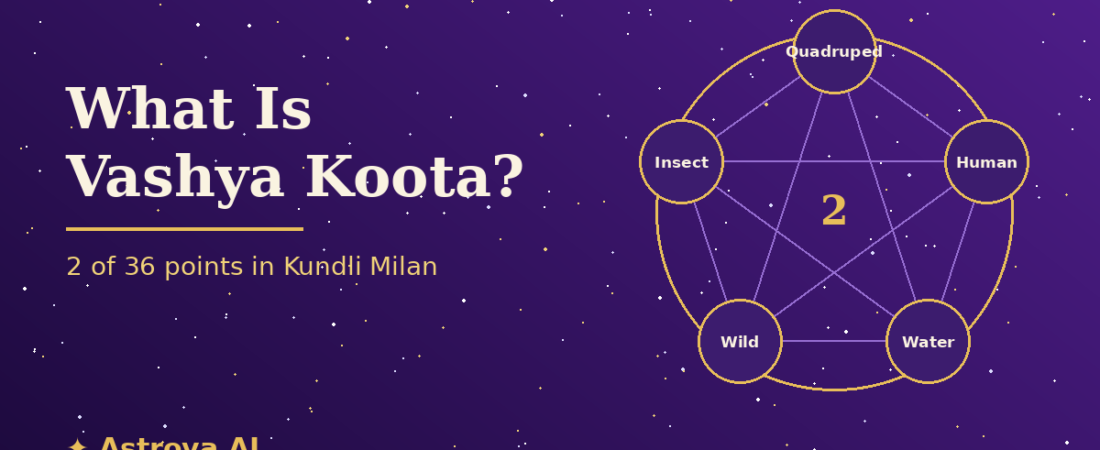
Vashya Koota is the second of the eight kootas in Kundli Milan and is worth 2 of 36 points. It sorts each partner’s Moon sign into one of five groups: quadruped, human, water-dwelling, wild or insect. The same group scores 2. Other pairs score 1, ½ or 0 from a lookup table.
Key takeaways
- “Vashya” means control or influence. Tradition reads this koota as how readily two people respond to each other.
- It uses only the two Moon signs. The five groups are Chatushpada (quadruped), Manava (human), Jalachara (water-dwelling), Vanachara (wild, Leo only) and Keeta (insect, Scorpio only).
- Sagittarius and Capricorn are split at 15°, so for those Moon signs the degree matters, not just the sign.
- In the common table every 0 involves Leo. Leo scores 2 only with another Leo.
- Apps disagree on the split signs and on table direction, so two calculators can give one couple different scores.
- At 2 of 36 points it is the second-smallest koota. Read it with the full score, not on its own.
Check your Kundli Milan free on Astrova AI
What does Vashya Koota measure?
Ashtakoot Guna Milan scores a couple on eight kootas for 36 points. Muhurta Chintamani 6.21 lists them in order: Varna (1 point), Vashya (2), Tara (3), Yoni (4), Graha Maitri (5), Gana (6), Bhakoot (7) and Nadi (8) (Muhurta Chintamani 6.21, VedicPupil).
The classical verse on Vashya, Muhurta Chintamani 6.23, describes which kinds of signs are “under the control” of others: human signs hold sway over all signs except Leo, water signs are their “prey”, and Leo holds sway over all except Scorpio. It then says the remaining relations follow customary practice. So the idea is classical, but the exact point table used today is a later working convention. Tradition reads a good Vashya score as mutual attraction and willingness to adjust. It is not, and should never be used as, a licence for one partner to control the other.
The 5 Vashya groups
You need each partner’s Moon sign (rashi), not the Sun sign. If you are not sure of yours, see how to find your Moon sign.
| Group | Meaning | Moon signs |
|---|---|---|
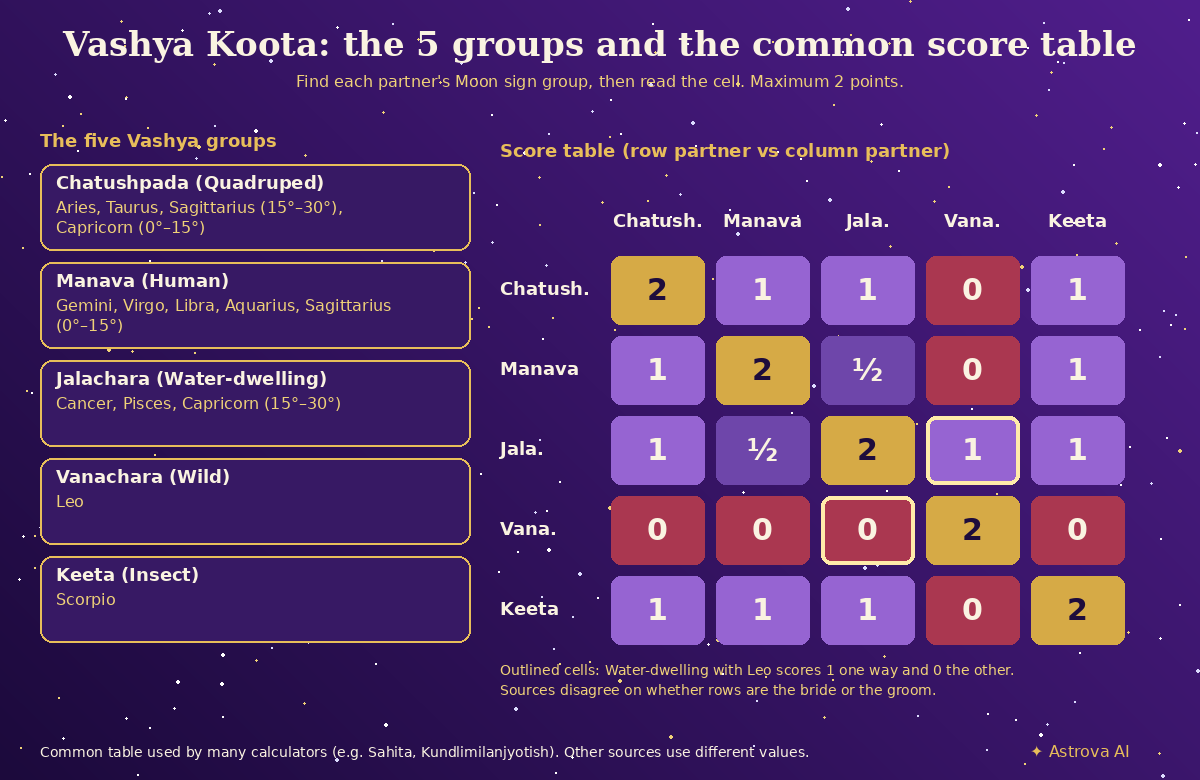
| Chatushpada | Quadruped | Aries, Taurus, Sagittarius (15°–30°), Capricorn (0°–15°) |
| Manava | Human | Gemini, Virgo, Libra, Aquarius, Sagittarius (0°–15°) |
| Jalachara | Water-dwelling | Cancer, Pisces, Capricorn (15°–30°) |
| Vanachara | Wild | Leo |
| Keeta | Insect | Scorpio |
The split signs follow their symbols. Sagittarius is the archer with a human upper body and a horse’s lower body, so its first half is human and its second half quadruped. Capricorn is the sea-goat, so its first half is quadruped and its second half water-dwelling. This half-sign split is given by OnlineJyotish and other classical-style guides. Many apps skip it and put all of Sagittarius in Manava and all of Capricorn in Jalachara (Sahita explains both conventions).
The Vashya Koota score table
This is the table most calculators use. Find one partner’s group on the left and the other’s along the top.
| Chatushpada | Manava | Jalachara | Vanachara | Keeta | |
|---|---|---|---|---|---|
| Chatushpada | 2 | 1 | 1 | 0 | 1 |
| Manava | 1 | 2 | ½ | 0 | 1 |
| Jalachara | 1 | ½ | 2 | 1 | 1 |
| Vanachara | 0 | 0 | 0 | 2 | 0 |
| Keeta | 1 | 1 | 1 | 0 | 2 |
Three patterns stand out:
- The same group always scores 2. So Gemini with Libra, or Cancer with Pisces, gets full points even though the signs differ.
- Every 0 involves Leo. Leo is the only wild sign, and it scores 2 only with another Leo. Expanding the table to all 144 Moon-sign pairs (using whole signs) gives 40 pairs on 2, 55 on 1, 30 on ½ and 19 on 0, and all 19 zeros include Leo.
- Only one pair is lopsided. Water-dwelling with Leo scores 1 one way and 0 the other. Sources disagree on whether the rows are the bride or the groom: OnlineJyotish labels rows as the bride, while Sahita labels them as the groom. That changes the result only for a Leo with a Cancer, Pisces or late-Capricorn partner.
Not every source uses these numbers. Saravali’s Vashya page, for example, gives a different table. If a score surprises you, check which table and which convention the calculator follows.
How to calculate Vashya Koota in 4 steps
- Find both partners’ Moon signs from their Janam Kundli. If a Moon is in Sagittarius or Capricorn, note its degree too.
- Put each Moon sign in its Vashya group using the table above.
- Read the score where the two groups meet: 2, 1, ½ or 0.
- If one partner is Leo and the other is water-dwelling, check which direction your calculator uses.
Worked examples (illustrative)
These are made-up couples used only to show the method. They are not readings of real people.
- Different groups, low score. The bride’s Moon is in Gemini (Manava, human). The groom’s Moon is in Pisces (Jalachara, water-dwelling). Human and water-dwelling meet at ½ of 2, in either direction. That takes 1.5 points off the 36-point total.
- A split sign changes the answer. The bride’s Moon is in Aries (Chatushpada). The groom’s Moon is at 22° Sagittarius. Under the half-sign rule, 22° is in the second half, so he is Chatushpada too, and the couple scores 2 of 2. An app that treats all of Sagittarius as human puts him in Manava instead, and the score drops to 1 of 2. Same couple, one point apart.
- Leo with a water sign. One partner’s Moon is in Leo, the other’s in Cancer. Read water-dwelling against wild and the table gives 1. Read it the other way round and it gives 0. Which one you see depends on whether your calculator treats the row as the bride or the groom.
Example 2 is the most common reason two apps disagree on a Vashya score. If either partner has a Sagittarius or Capricorn Moon, check the degree.
Match two Kundlis and see every koota explained in Astrova AI
Is a low Vashya score a problem?
On its own, rarely. A 0 costs 2 points, which still leaves 34 available. Some calculators call a 0 “Vashya dosha”, and some practitioners list ways it is cancelled: the two Moon-sign lords being the same or friends, the Navamsa ascendant lords being the same or friends, or a full Yoni match (Truthstar’s list of cancellations). We did not find those rules in the classical verse itself, and some guides say Vashya has no classical dosha or cancellation at all. Treat either view as a convention, not a fixed law.
What matters more is the whole picture. If your total is low, read what a low Kundli Milan score means and how the 36-point Guna Milan score is calculated. If you are unsure of a birth time, see whether Kundli Milan works without birth time.
Tradition vs science
The method is a real tradition. The groups and the idea of one sign holding sway over another come from classical texts such as Muhurta Chintamani, and with the same Moon signs and the same table, any calculator gives the same answer.
The predictions are not proven. There is no scientific evidence that the groups of two Moon signs shape attraction, influence or the success of a marriage. Astrology has not shown predictive power in controlled tests and is generally considered a pseudoscience (Astrology and science, Wikipedia). Use Kundli Milan as a cultural tool and a conversation starter. Real compatibility shows in how two people talk, decide and treat each other.
To see both Moon signs, the Vashya group of each partner and every other koota explained in plain language, try Astrova AI’s free Kundli Milan, and ask follow-up questions in the AI astrologer chat.
FAQs
What does 0 in Vashya Koota mean?
In the common table, a 0 means one partner’s Moon sign is Leo and the other’s is not, except Leo with a water sign in one direction. Tradition reads it as a mismatch in how the two respond to each other. It costs 2 of 36 points and leaves 34 still available.
Is there a Vashya dosha, and can it be cancelled?
Some calculators call a 0 a Vashya dosha, and some practitioners list cancellations, such as both Moon-sign lords being the same or friends, or a full Yoni match. We did not find these rules in the classical verse on Vashya, and several sources say it has no classical dosha status. Either way it is a small factor.
Why do apps show different Vashya scores for the same couple?
Three reasons are common. Some apps treat all of Sagittarius as human and all of Capricorn as water-dwelling instead of splitting them at 15 degrees. Sources disagree on whether the table’s rows are the bride or the groom. And a few sites publish a different table altogether.
Do both partners with the same Moon sign get full Vashya points?
Yes. The same Moon sign means the same Vashya group, which scores the full 2 in every table we checked. Partners with different signs in the same group, such as Gemini and Libra, also score 2.
Do I need an exact birth time for Vashya Koota?
Usually only the Moon sign is needed, and the Moon stays in a sign for about two and a quarter days. But if either Moon is in Sagittarius or Capricorn, the degree decides the group, and a birth near a sign change can switch the sign. In those cases the time matters.
Download Astrova AI on Google Play
Free Kundli Milan, Janam Kundli, daily Rashifal and 24/7 AI astrologer chat in 9 Indian languages. For entertainment and self-reflection.
Sources: Muhurta Chintamani 6.23, Vashya verse (VedicPupil) · Muhurta Chintamani 6.21, the eight kootas (VedicPupil) · Vashya groups and table (OnlineJyotish) · Vashya conventions and 12×12 grid (Sahita) · Vashya Koota (Saravali) · Dosha cancellations (Truthstar) · Astrology and science (Wikipedia)