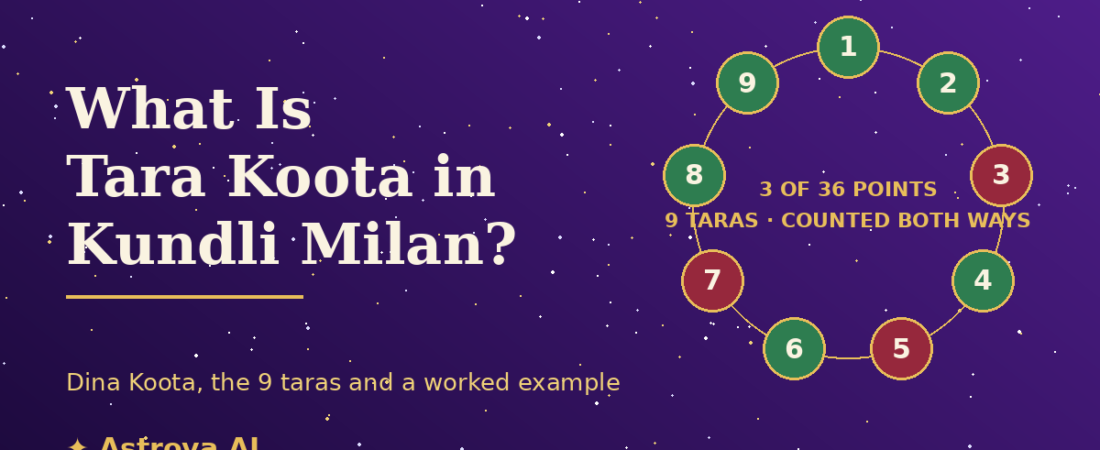
Tara Koota, also called Dina Koota, is the third of the eight kootas in Kundli Milan and is worth 3 of 36 points. You count the nakshatras from the bride’s birth star to the groom’s and back, divide each count by 9, and check the remainder. Remainders 3, 5 and 7 score 0; any other scores 1.5.
Key takeaways
- Tara Koota uses only the two Moon nakshatras (birth stars). Each direction is worth 1.5 points, for a maximum of 3.
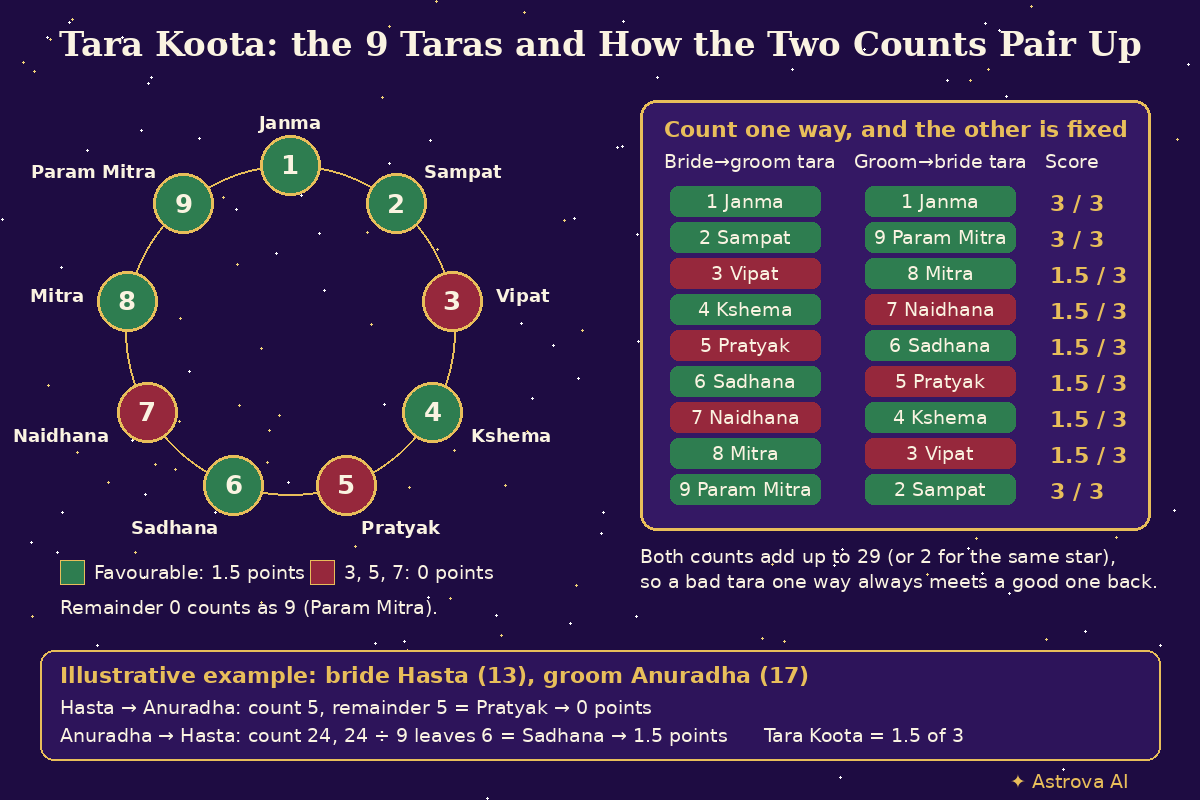
- The remainder names one of nine taras: Janma, Sampat, Vipat, Kshema, Pratyak, Sadhana, Naidhana, Mitra and Param Mitra. A remainder of 0 counts as 9.
- Only Vipat (3), Pratyak (5) and Naidhana (7) are inauspicious. This rule is in Muhurta Chintamani 6.24.
- Under this rule a 0 cannot happen: the two counts always add up to 29, so every couple scores 3 or 1.5. If you see 0, the calculator uses a different convention.
- Tradition links Tara to health, well-being and shared fortune. At 3 of 36 points it is one of the smaller kootas, so read it with the full score.
Check your Kundli Milan free on Astrova AI
What does Tara Koota measure?
Ashtakoot Guna Milan scores a couple on eight kootas for a total of 36 points. Muhurta Chintamani 6.21 lists them in order of weight: Varna (1), Vashya (2), Tara (3), Yoni (4), Graha Maitri (5), Gana (6), Bhakoot (7) and Nadi (8). Tara is third and carries 3 points.
“Tara” means star and “Dina” means day. The koota looks at where each partner’s birth star falls when counted from the other’s. Tradition reads a favourable count as support for each other’s health, well-being and luck, and an unfavourable one as a source of friction or setbacks. It does not use the ascendant, the Sun sign or the Moon sign, only the two nakshatras.
The 9 taras and their points
After dividing the count by 9, the remainder (1 to 8, with 0 read as 9) gives the tara. Names vary a little between books, so common alternatives are in brackets.
| Remainder | Tara | Traditional meaning | Verdict | Points (one direction) |
|---|---|---|---|---|
| 1 | Janma | Birth (the star itself) | Favourable | 1.5 |
| 2 | Sampat (Sampad) | Wealth, gain | Favourable | 1.5 |
| 3 | Vipat (Vipad) | Danger, setbacks | Inauspicious | 0 |
| 4 | Kshema | Well-being, safety | Favourable | 1.5 |
| 5 | Pratyak (Pratyari) | Obstacles, opposition | Inauspicious | 0 |
| 6 | Sadhana (Sadhaka) | Achievement | Favourable | 1.5 |
| 7 | Naidhana (Vadha) | Destruction, endings | Inauspicious | 0 |
| 8 | Mitra | Friend | Favourable | 1.5 |
| 9 | Param Mitra (Ati Mitra) | Close friend | Favourable | 1.5 |
The rule comes from Muhurta Chintamani 6.24: count from the bride’s nakshatra to the groom’s and from the groom’s to the bride’s, divide by nine, and the 3rd, 5th and 7th remainders are bad. Classical tables such as those on OnlineJyotish and Saravali give 1.5 points for each favourable direction. The names sound dramatic, but they are categories in a counting cycle, not predictions of illness or death.
How to calculate Tara Koota in 5 steps
- Find both Moon nakshatras from each person’s Janam Kundli. If you are unsure of yours, see the 27 nakshatras.
- Count forward from the bride’s nakshatra to the groom’s, including both. The starting star counts as 1. If you pass Revati, carry on from Ashwini.
- Divide the count by 9 and keep the remainder. A remainder of 0 means the 9th tara, Param Mitra.
- Repeat the count from the groom’s nakshatra to the bride’s.
- Give 1.5 points to each direction that is not 3, 5 or 7, and add them: 3, 1.5 or 0.
Use this table to number the nakshatras. Each column is one full cycle of nine, so stars in the same row fall on the same tara when counted from Ashwini.
| 1 to 9 | 10 to 18 | 19 to 27 |
|---|---|---|
| 1. Ashwini | 10. Magha | 19. Mula |
| 2. Bharani | 11. Purva Phalguni | 20. Purva Ashadha |
| 3. Krittika | 12. Uttara Phalguni | 21. Uttara Ashadha |
| 4. Rohini | 13. Hasta | 22. Shravana |
| 5. Mrigashira | 14. Chitra | 23. Dhanishta |
| 6. Ardra | 15. Swati | 24. Shatabhisha |
| 7. Punarvasu | 16. Vishakha | 25. Purva Bhadrapada |
| 8. Pushya | 17. Anuradha | 26. Uttara Bhadrapada |
| 9. Ashlesha | 18. Jyeshtha | 27. Revati |
Worked example (illustrative)
This is a made-up couple used only to show the method. It is not a reading of real people.
- Nakshatras. The bride’s Moon is in Hasta (13th nakshatra). The groom’s Moon is in Anuradha (17th).
- Bride to groom. Counting Hasta as 1: Hasta, Chitra, Swati, Vishakha, Anuradha = 5. 5 divided by 9 leaves 5, which is Pratyak tara. Inauspicious, so 0 points.
- Groom to bride. From Anuradha (1) to Revati is 11 stars, then Ashwini to Hasta adds 13 more: 11 + 13 = 24. 24 divided by 9 is 2 with remainder 6, which is Sadhana tara. Favourable, so 1.5 points.
- Total. 0 + 1.5 = 1.5 of 3.
A contrast: if the bride is Krittika (3rd) and the groom Rohini (4th), the forward count is 2, which is Sampat (favourable). The reverse count is 27; 27 divided by 9 leaves 0, which is read as 9, Param Mitra (favourable). Both directions score, so the couple gets the full 3 of 3. This is the case where people most often go wrong by treating a remainder of 0 as nothing.
A quick check you can do by hand: for two different stars, the two counts always add up to 29 (here 5 + 24 = 29, and 2 + 27 = 29). If yours do not, recount.
Match two Kundlis and see every koota explained
Why most couples score 3 or 1.5, never 0
Because the two counts add up to 29, once you know one tara, the other is fixed. The pairs are always 1 with 1, 2 with 9, 3 with 8, 4 with 7, and 5 with 6. Each bad tara (3, 5, 7) is paired with a good one (8, 4, 6), so the two directions can never both fail. We checked this across all 729 ordered pairs of the 27 nakshatras: 243 score 3 (one in three) and 486 score 1.5 (two in three). None scores 0.
You may still see 0 or different numbers because conventions differ. Some calculators count in one direction only. Some schools treat Janma tara (the same star, or stars 9 or 18 apart) as a caution, which makes 0 possible for those pairs. And a few guides list Janma among the bad taras along with 3, 5 and 7. If two reports disagree, check which convention each uses before worrying about the number.
Is a low Tara score a dosha?
Not normally. A 1.5 here is the most common result, and at 3 points Tara is one of the three smallest kootas, after Varna (1) and Vashya (2). It is rarely treated as a separate named dosha in the way Nadi dosha or Bhakoot dosha are. Tara does come up in one other classical rule: Muhurta Chintamani 6.32 lists clean Nadi and star (tara) results among the conditions under which a bad Bhakoot can be accepted. Details vary between schools.
Two practical points. First, the result depends on getting both nakshatras right. The Moon spends roughly a day in each nakshatra, so a birth near a change-over can flip the star; see whether Kundli Milan works without birth time. Second, a single 1.5-point gap rarely decides anything. If your total is low, read what a low Kundli Milan score means and how the 36-point Guna Milan score is calculated.
Tradition vs science
The method is real as a tradition. The counting rule and the nine taras come from classical texts such as Muhurta Chintamani, and with the same nakshatras any careful calculator will reach the same count.
The predictions are not proven. There is no scientific evidence that the distance between two birth stars affects a couple’s health, luck or marriage. Astrology has not shown predictive power in controlled tests and is generally considered a pseudoscience (Astrology and science, Wikipedia). Use Kundli Milan as a cultural tool and a conversation starter, not as a verdict on someone you know and trust.
To see both nakshatras, the tara in each direction and every other koota explained in plain language, try Astrova AI’s free Kundli Milan, and ask follow-up questions in the AI astrologer chat.
FAQs
Can Tara Koota be 0?
Not under the standard rule, where only the 3rd, 5th and 7th taras are bad. The two counts between any pair of nakshatras always add up to 29 (or 2 for the same star), so a bad tara one way is always matched by a good one the other way. Every couple scores 3 or 1.5. A report showing 0 is using a different convention, such as counting one way only or treating Janma as bad.
Is 1.5 out of 3 in Tara Koota bad?
No. A score of 1.5 means one count landed on a favourable tara and the other on Vipat, Pratyak or Naidhana. Under the standard rule two out of every three nakshatra pairings score 1.5, so it is the normal result, not a dosha. It takes 1.5 points off the 36-point total and is read alongside the other kootas.
What happens in Tara Koota if bride and groom have the same nakshatra?
The count from a star to itself is 1, so both directions land on Janma tara. Most calculators treat Janma as acceptable and give the full 3 points. A few schools treat Janma as a caution. The bigger question for a same-nakshatra couple is Nadi, because sharing a nakshatra also means sharing a Nadi.
Why do different apps show different Tara Koota results?
Usually one of three reasons: the app counts in only one direction, it treats Janma tara as unfavourable, or the two birth nakshatras themselves differ because of birth time or ayanamsa settings. Labels can also be shifted by one if a calculator counts exclusively instead of including the starting star. Check the nakshatras first, then the convention.
Do I need an exact birth time to calculate Tara Koota?
You need the Moon’s nakshatra for both people. The Moon stays in one nakshatra for roughly a day, so a birth date is often enough, but if either person was born near a nakshatra change, the time decides which star applies. With a doubtful time, treat the Tara result as provisional.
Download Astrova AI on Google Play
Free Kundli Milan, Janam Kundli, daily Rashifal and 24/7 AI astrologer chat in 9 Indian languages. For entertainment and self-reflection.
Sources: Muhurta Chintamani 6.24, Tara rule (VedicPupil) · Muhurta Chintamani 6.21, the eight kootas (VedicPupil) · Muhurta Chintamani 6.32 (VedicPupil) · Tara Koota scoring table (OnlineJyotish) · Dina Koota and tara cycles (Saravali) · Astrology and science (Wikipedia)