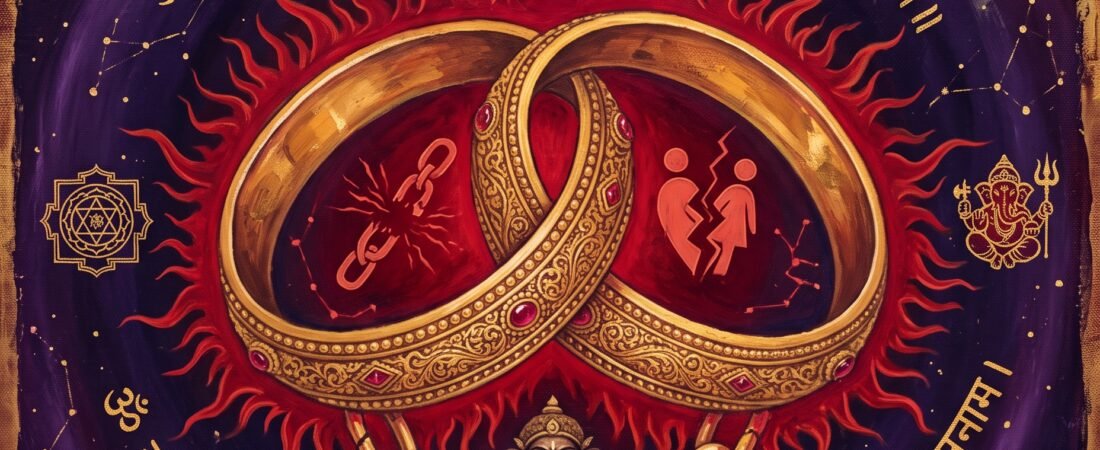
Quick Answer: Nadi Dosha occurs when both the bride and groom share the same Nadi (energy channel) — Aadhi, Madhya, or Antya — based on their Moon’s Nakshatra placement. It is the most heavily weighted dosha in Ashtakoot Guna Milan, carrying a full 8-point deduction from the 36-point compatibility scale. Traditional Jyotish considers Nadi Dosha a serious compatibility concern, but specific exceptions (known as Nadi Bhanga) can cancel its effects entirely.
✨ 100% FREE • No Credit Card Required
Get Your Personalized Astrology Reading
AI Palm Reading • Janam Kundli • Daily Rashifal • Kundli Milan • 24/7 AI Astrologer
Available in 9 Indian languages • Free forever
Among all the doshas examined during Kundli Milan, Nadi Dosha carries the most weight — and the most fear. Many families have rejected otherwise compatible matches solely because of Nadi Dosha, without understanding what it actually means or when it can be cancelled. This guide breaks down the concept from its classical roots to its practical implications for modern marriage matching.
What Is Nadi in Vedic Astrology?
The word Nadi literally means “stream” or “energy channel” in Sanskrit. In Vedic astrology, every Nakshatra (lunar mansion) is assigned to one of three Nadis based on an ancient classification system:
| Nadi Type | Constitution | Nakshatras |
|---|---|---|
| Aadhi Nadi (Vata) | Air constitution — active, mobile, creative | Ashwini, Ashlesha, Magha, Jyeshtha, Mula, Shravana, Dhanishta, Shatabhisha, Revati (note: some texts vary) |
| Madhya Nadi (Pitta) | Fire constitution — intense, ambitious, transformative | Bharani, Krittika, Punarvasu, Pushya, Purva Phalguni, Uttara Phalguni, Hasta, Swati, Anuradha |
| Antya Nadi (Kapha) | Earth/Water constitution — stable, nurturing, grounded | Ashwini (some texts), Rohini, Mrigashira, Ardra, Purva Ashadha, Uttara Ashadha, Chitra, Vishakha, Purva Bhadrapada |
Note: The exact Nakshatra-to-Nadi mapping varies across classical texts. The table above follows the most widely used system from the Muhurta Chintamani tradition. Always verify with your specific Jyotish practitioner.
Why Is Nadi Dosha Considered So Serious?
In the Ashtakoot Guna Milan system (the 8-factor compatibility check), Nadi carries 8 out of 36 total points — more than any other single factor. When both partners share the same Nadi, those 8 points are completely lost, and the match is flagged with Nadi Dosha.
The traditional reasoning is biological and energetic:
- Genetic compatibility: Ancient rishis observed that couples with the same bodily constitution (Vata-Vata, Pitta-Pitta, Kapha-Kapha) tended to have health challenges in offspring. Different constitutions created balance.
- Energy channel conflict: In Ayurvedic and yogic philosophy, the Nadis (Ida, Pingala, Sushumna) govern the flow of prana. Two people with the same Nadi are said to have conflicting energy patterns that create friction in shared life.
- Progeny concerns: Classical texts specifically warn that Nadi Dosha can affect the health and well-being of children born to the union.
Source: Muhurta Chintamani by Acharya Nrisimha Sharma, Chapter on Vivaha (Marriage) Muhurta; Ashtakoot Guna Milan framework as practiced in North Indian Jyotish tradition.
How to Check If You Have Nadi Dosha
Checking for Nadi Dosha requires knowing both partners’ Moon Nakshatras. Here is the process:
- Find your Moon’s Nakshatra — this requires your exact birth date, time, and place to generate your Janam Kundli
- Identify which Nadi your Nakshatra belongs to (Aadhi, Madhya, or Antya)
- Do the same for your partner
- Compare: If both Nadis are the same → Nadi Dosha is present. If different → no Nadi Dosha.
For example: If the bride’s Moon is in Rohini Nakshatra (Antya Nadi) and the groom’s Moon is in Mrigashira (also Antya Nadi), they share the same Nadi and Nadi Dosha applies.
The Exceptions: When Nadi Dosha Gets Cancelled (Nadi Bhanga)
This is the part that most people miss. Nadi Dosha is not absolute. Classical texts describe several conditions under which the dosha is considered cancelled or neutralized:
1. Different Nakshatra Padas (Quarters)
If both partners’ Moons are in the same Nakshatra but in different padas (quarters), some traditions consider the Nadi Dosha cancelled. Each Nakshatra spans 13°20′ and is divided into four 3°20′ padas.
2. Different Rashis (Moon Signs)
If the couple’s Moon signs are different even when their Nakshatras share the same Nadi, some Jyotish traditions consider the dosha weakened or cancelled. This is because the Rashis modify the Nakshatra’s expression.
3. Benefic Jupiter Aspect
When Jupiter aspects the Moon in either partner’s chart, or when Jupiter is strongly placed in the 7th house, many practitioners consider Nadi Dosha neutralized. Jupiter’s grace is said to override dosha-level concerns.
4. Varahamihira’s Exception
The great astronomer-astrologer Varahamihira, in his Brihat Jataka, noted that when the overall Guna Milan score is high (28+ out of 36) and other compatibility factors are strong, a single Nadi Dosha should not disqualify an otherwise excellent match.
5. Same Nadi, Different Sub-Types
Some advanced Nadi analysis systems differentiate between sub-types within each Nadi. If the partners share the broad Nadi category but differ in sub-classification, the dosha may be considered partial rather than full.
What Happens If Nadi Dosha Is Present and Not Cancelled?
Traditional interpretations warn of several potential challenges:
- Health concerns for children born to the union
- Emotional incompatibility — the couple may struggle to understand each other’s fundamental nature
- Reduced harmony in the marital relationship, particularly around daily living patterns
- Lower vitality of the relationship over time
However, it is critical to understand that Nadi Dosha alone does not determine the success or failure of a marriage. The complete Kundli Milan examines 8 factors (Ashtakoot), and Nadi is just one of them. A match with 28+ total Guna points, strong 7th house analysis, and favorable Dashas can thrive even with Nadi Dosha present.
Traditional Remedies for Nadi Dosha
When Nadi Dosha is confirmed and cannot be cancelled through the exceptions above, Vedic tradition offers several remedies:
- Nadi Shanti Puja — a specific ritual performed by qualified priests to pacify the Nadi energy conflict. This is the most commonly recommended remedy.
- Donation of grain and cloth — specific quantities of grain, cloth, and gold are donated on prescribed days, as determined by a Jyotish practitioner.
- Kumbh Vivah or Vishnu Vivah — in extreme cases, a symbolic marriage ceremony is performed before the actual wedding to absorb the dosha’s effects.
- Mantra chanting — the Mrityunjaya Mantra (Om Tryambakam Yajamahe…) is chanted 108 times daily by both partners for a prescribed period.
- Fasting on specific days — determined by the couple’s Nakshatras and the nature of the dosha.
Important: These remedies should only be undertaken under the guidance of a qualified Jyotish practitioner who has examined both complete Kundlis. Do not attempt self-diagnosis or self-remedy based on partial information.
The Modern Perspective: Should Nadi Dosha Stop a Marriage?
This is a question many modern couples ask. Here is a balanced view:
What the data suggests: There is no peer-reviewed statistical study that conclusively proves Nadi Dosha causes marital failure or health problems in offspring. The concept originates from ancient observational wisdom, not from controlled clinical trials. This does not mean it is wrong — it means the evidence base is traditional and experiential rather than statistical.
What experienced practitioners say: Most senior Jyotish practitioners today treat Nadi Dosha as one factor among many in compatibility assessment. A match with 30+ Guna points, strong individual charts, and favorable Dashas is not rejected solely because of Nadi Dosha. The exceptions (Nadi Bhanga) are applied generously by many modern astrologers.
What matters most: The overall compatibility picture — emotional compatibility (Manasik), physical compatibility (Sharirik), intellectual compatibility (Buddhi), and spiritual compatibility (Aatmik) — matters far more than any single dosha.
Check Your Nadi Dosha Status Right Now
To know whether Nadi Dosha applies to your relationship, you need both partners’ Moon Nakshatras — which requires accurate Janam Kundli generation for both people.
Astrova AI’s Kundli Milan feature generates both charts, identifies each person’s Nadi, checks for Nadi Bhanga exceptions, and provides a complete 8-factor Guna Milan analysis — all in under 60 seconds. The app is free, available in 9 Indian languages, and gives you a detailed compatibility report you can discuss with your family and Jyotish practitioner.
✨ 100% FREE • No Credit Card Required
Get Your Personalized Astrology Reading
AI Palm Reading • Janam Kundli • Daily Rashifal • Kundli Milan • 24/7 AI Astrologer
Available in 9 Indian languages • Free forever
Frequently Asked Questions
1. Is Nadi Dosha the most important dosha in Kundli Milan?
It carries the highest single-point weight (8 out of 36), which makes it the most impactful individual factor. However, “most important” depends on context. Bhakoot Dosha (7 points), Gana Dosha (3 points), and other factors collectively matter. A holistic assessment considers all 8 kootas together, not just Nadi.
2. Can Nadi Dosha be present even if the overall Guna Milan score is high?
Yes. It is entirely possible for a couple to score 30+ out of 36 on Ashtakoot Guna Milan while still having Nadi Dosha. In such cases, many practitioners recommend proceeding with the marriage while performing Nadi Shanti Puja as a precautionary remedy.
3. Is Nadi Dosha the same for all communities and traditions?
No. The importance given to Nadi Dosha varies significantly across regional traditions. In South Indian (particularly Tamil and Telugu) Jyotish practice, Nadi Dosha is taken very seriously and is often a dealbreaker. In many North Indian traditions, it is considered but given less absolute weight. Always consult a practitioner familiar with your specific tradition.
4. What if only one partner has the same Nadi — does it still count?
Nadi Dosha is about both partners sharing the same Nadi. If one partner’s Nadi is Aadhi and the other’s is Madhya, there is no Nadi Dosha regardless of what other factors are present. The dosha only applies when both Nadis match.
5. Can Nadi Dosha affect relationships outside of marriage?
Traditionally, Nadi Dosha analysis is specific to marriage compatibility (Vivaha). For business partnerships, friendships, or other relationships, different compatibility frameworks are used. However, some practitioners apply Nadi analysis to any close, long-term partnership where energetic compatibility matters.
📚 Explore More Astrova Guides
- Jupiter (Guru) in Your Kundli — Wisdom, Wealth & Spiritual Growth
- Fate Line on Your Palm — Career, Life Path & Destiny
- Nadi Dosha — How It Affects Marriage Compatibility
- Generate Your Janam Kundli Online Free — Step by Step
- Kundli Milan — Complete Marriage Compatibility Guide
- Sade Sati — Check Your Kundli & Find Remedies
- AI Palm Reading — Complete Guide
- How to Use AI Astrology for Daily Life Guidance
About the Astrova AI Editorial Team
The Astrova AI Editorial Team combines traditional Vedic astrology knowledge with modern AI technology to make Jyotish wisdom accessible to everyone. Our content is designed to help you understand your Kundli, Rashifal, and planetary influences in practical, everyday language.
Have a correction or question? We welcome feedback. Reach us at support@theastrova.com
Related posts:
 What Is the Bhrigu Samhita — The Ancient Palm Leaves That Predict Your Destiny?
 What Does Your Marriage Line on the Palm Reveal About Your Love Life and Relationship Timing?
 What Is Kemadruma Yoga In Your Kundli And Does It Really Cause Poverty?
 What Is Ashtakavarga in Vedic Astrology and How Does This Point System Predict Planetary Strength