An island on a palm line is a small oval where a line splits in two and then rejoins. Classical palmists read it as a weak period for whatever that line stands for, such as health on the life line or career on the fate line. It is a traditional reading, not a medical sign or a prediction.
Key takeaways
- What it is: a line that splits and rejoins, leaving an eye-shaped loop. Two lines that just cross are not an island.
- The old rule: Cheiro called the island “never a fortunate sign”. Benham called it “a warning to look out for something”.
- Meaning depends on the line: health on the life line, thinking on the head line, feelings on the heart line, work on the fate line.
- Position is read as timing: where the island starts and ends marks the period palmists say it covers.
- Some old readings should be dropped: claims about illegitimate birth, seduction or mental illness from an island are not taken seriously today.
- The science: palm lines are flexion creases that form before birth, and palmistry’s readings of them lack evidence.
Scan your palm free in Astrova AI
Look closely at any of your main lines and you may find a spot where it seems to open into a tiny eye or oval before carrying on. Palmists call this an island. Few marks have a worse reputation in the old books, and few cause as much needless worry today. This guide shows how to tell a real island from a look-alike, what the classical palmists said it means on each line, which of their claims to let go, and what the lines are in plain anatomy.
What counts as an island?
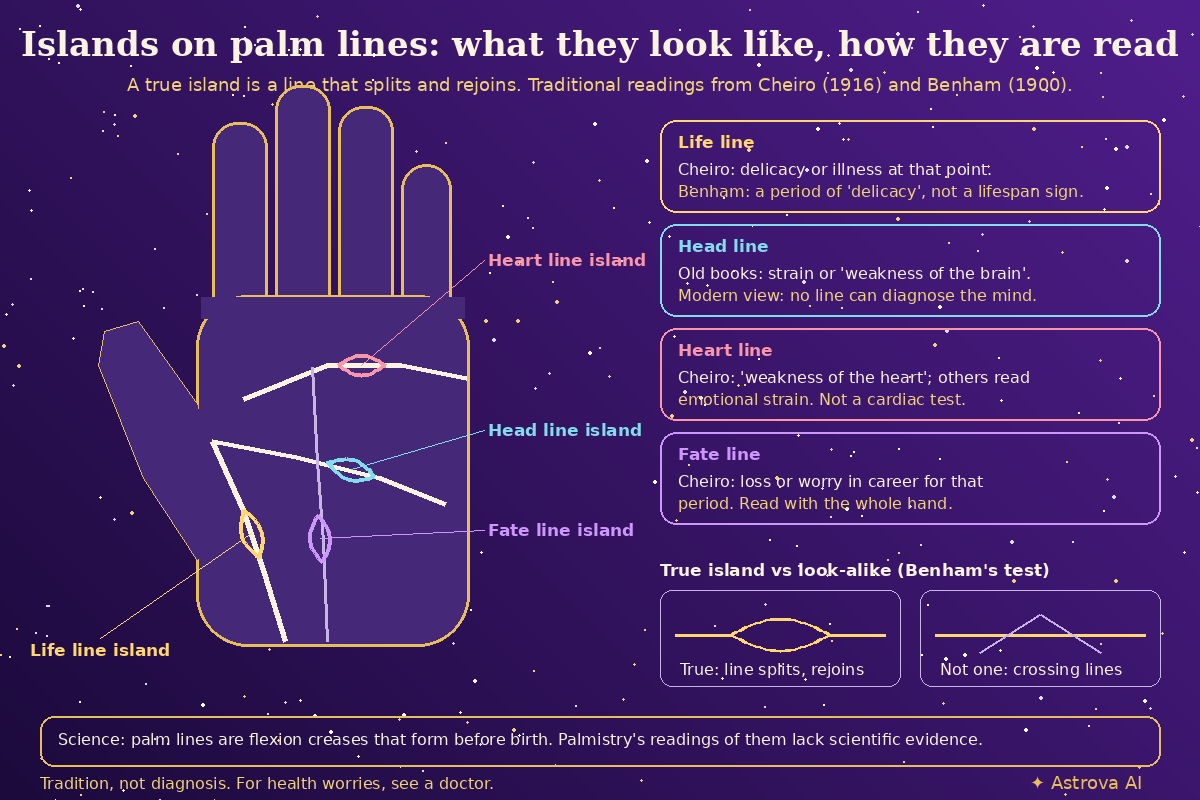
William Benham, whose 1900 textbook tried to put palmistry on a scientific footing, was strict about this. He wrote that “the island is not a single sign, but is produced by the splitting of a line and the return to the original line” of the part that broke away. If two stray lines cross each other, or a stray line crosses a main line at two points, the shape may look like an island, but he told students to “read the chance lines separately and not as an island” (The Laws of Scientific Hand Reading, 1900).
He also noted that islands come in every size, from dots seen only under a magnifying glass to wide loops that catch the eye at once. In his system, “the size and length of the island shows the extent of obstruction and its duration”.
What an island means on each line
Cheiro, one of the best-known palmists of the early 1900s, set out the general rule plainly: the island “is never a fortunate sign” and “reduces the promise of the Line or Mount on which it may be found” (Palmistry for All, 1916). The reading then depends on which line carries it.
| Line | What the classical books say | A careful modern reading |
|---|---|---|
| Life line | Cheiro: “delicacy or illness at that particular date where it appears”. Benham: “always indications of periods of delicacy” | A period of low energy or strain in the tradition. Not a lifespan sign or a diagnosis |
| Head line | Cheiro: “weakness of the brain, danger of brain illness”. Under the ring finger he even linked it to weak eyesight | Often read today as a spell of stress or scattered focus. No crease can assess mental health |
| Heart line | Cheiro: “weakness of the heart”, especially under the ring finger | Usually read as emotional strain. Not a test of the physical heart |
| Fate line | Cheiro: “heavy loss in worldly matters, worry, and anxiety” | A rough patch in work or direction, read alongside the rest of the hand |
| Sun line | Cheiro: “loss of position and generally by some scandal”, but only for the stretch the island covers | A dip in recognition for a time, in the tradition |
| Marriage line | Cheiro: at the start, a long-delayed marriage; in the middle, trouble and separation | Folklore about relationships. It cannot forecast a marriage |
Both classics also said an island on a mount weakens what that mount stands for. Our guide to the palm mounts explains what each one is said to rule.
How to check for an island: step by step
- Use side light. Daylight from a window, falling across the palm, shows fine lines better than a ceiling light.
- Relax the hand. Hold it slightly cupped, not stretched flat, so the lines stay sharp.
- Trace the line from end to end. Follow it with a fingertip and watch for a point where it opens into two strands.
- Apply Benham’s test. Do both strands come out of the line and go back into it? If one strand is really a separate line crossing over, it is not an island.
- Note its size and position. Palmists read a bigger island as a longer or stronger effect, and they read its place on the line as a rough time of life.
- Look at what follows. Benham paid close attention to the line after the island. A clear, deep line afterward was read as recovery.
- Read the whole hand. Benham told students to look at the other lines, the mounts, nails and colour before naming any cause. One mark is never the whole story.
Worked example (illustrative)
This is a made-up hand used only to show the method. It is not a real person or a real reading.
Suppose Arjun, 29, checks his right palm by a window. He finds a small, neat island on his life line about a third of the way down. His head line is long and clear. On his fate line there is a longer island near the middle of the palm, followed by a deeper line.
- Life line island: small and single. In Benham’s system a small island points to one passing spell of low health, not a lasting condition.
- Fate line island: a palmist would call it a stretch of worry or setbacks at work, and the deeper line after it a recovery.
- Clear head line: in the tradition this balances the picture, since palmists judge marks against the strength of the whole hand.
- What it does not tell him: that he will fall ill, lose a job, or when anything will happen. At most, the reading is a prompt to reflect on how he handles stress.
The parts of the tradition to let go
Some island readings in the old books are not just unproven but harmful. Cheiro wrote that an island at the very start of the fate line pointed to illegitimate birth, and that a particular island on a woman’s hand was “an almost certain indication of her seduction” (Cheiro). He also tied chains of islands on the head line to serious mental illness. Benham wrote that an island on a woman’s life line between the ages of 42 and 46 “should always be read” as the change of life (Benham).
None of these claims was tested, and they reflect the attitudes of their time. A responsible reading leaves them out. If you are worried about your health or your mental wellbeing, a doctor or counsellor can actually help, and a palm cannot.
Benham himself pushed back on one popular idea. Islands, he noted, had been “much used as denoting hereditary weakness”. They “sometimes do”, he wrote, “but they are not per se an indicator of heredity”.
Island, chain, break or cross?
| Mark | What it looks like | Traditional reading |
|---|---|---|
| Island | One oval where the line splits and rejoins | A weak period for that line, which ends when the island closes |
| Chain | A run of small loops along the line | Benham: a series of islands “operates like a chained line”, meaning a longer unsettled stretch |
| Break | A gap where the line stops and starts again | An interruption. Benham compared it to a cut telegraph wire |
| Star or cross | Small crossing lines | Read by position; see the mystic cross for one famous example |
What the science says
The lines are real anatomy. They are palmar flexion creases, which let the hand fold into a fist or grip without bunching up loose skin, and they develop before birth (BBC Science Focus). The same source adds that palmistry claims the lines reveal personality, “but there is no evidence for this”.
Palmistry is widely viewed as a pseudoscience, because its schools contradict each other and its predictions lack evidence (Palmistry, Wikipedia). Islands show this well: two of the best-known palmists of their era gave them confident medical meanings that were never tested. Enjoy the tradition for reflection, and read our honest look at whether AI palmistry really works.
Islands are one small part of the hand. To see how your lines fit together, start with the major palm lines, then look at marks such as the triangle or the bracelet lines on your wrist, or try an AI palm reading.
FAQs
Is an island on the palm a bad sign?
In classical palmistry, yes. Cheiro wrote that the island is never a fortunate sign and that it reduces the promise of the line it sits on. Benham called it a warning rather than a verdict. Neither reading has scientific support, so an island is not a reason to worry about your health, money or marriage.
What does an island on the life line mean?
Traditionally it marks a period of lowered strength. Cheiro read it as delicacy or illness at that point on the line, and Benham as a period of delicacy that ends where the island closes. It is not a sign of a short life, and it cannot diagnose anything. If you feel unwell, see a doctor.
What does an island on the heart line mean?
Cheiro read an island on the heart line as weakness of the heart, especially under the ring finger. Many modern palmists read it as a period of emotional strain instead. A skin crease cannot test your heart, so treat either reading as tradition, not medical information.
Can islands on palm lines disappear?
Many palmistry writers say lines and marks can change over the years, and Benham read an island as a period with a start and an end. That is a belief within the tradition. We could not find research that tracks islands on palm lines changing over time.
What is the difference between an island and a chain on a palm line?
An island is one oval gap where a line splits and joins again. A chain is a run of small loops along a stretch of line. Benham said a series of islands works like a chained line, so palmists read a chain as a longer stretch of the same kind of weakness.
Download Astrova AI on Google Play
AI palm reading, Kundli, daily Rashifal and 24/7 AI astrologer chat in 9 Indian languages. For entertainment and self-reflection.
Sources: Cheiro, Palmistry for All, 1916, chapters on the Line of Head, the Line of Destiny and the Island (Project Gutenberg) · William G. Benham, The Laws of Scientific Hand Reading, 1900, Defects and Repair, and The Line of Life (Internet Archive) · Why do we have lines on our palms? (BBC Science Focus) · Palmistry (Wikipedia)