🔮 Get Your FREE Kundli on Astrova AI — Download Now
What Is the Samudra Manthan and Why Does It Explain Every Eclipse in Your Sky?
Thousands of years before modern astronomy could explain why the Moon disappears during an eclipse, ancient Vedic seers encoded the answer inside one of Hinduism’s most dramatic stories — the Samudra Manthan, the churning of the cosmic ocean. This is not just a mythological tale of gods and demons fighting over immortality. It is the origin story of Rahu and Ketu, the two shadow planets that control every lunar and solar eclipse in Vedic astrology, and whose positions in your Kundli can shape the biggest turning points of your life.
If you have ever wondered why Rahu and Ketu have no physical form, why they are called “shadow planets,” or why eclipses are considered spiritually charged moments in Jyotish Shastra — the answer begins at the cosmic ocean, with a pot of Amrit, a serpent named Vasuki, and a single drop of immortality that changed the sky forever.
⭐ 100% FREE • No Credit Card
Discover What Rahu & Ketu Mean for YOUR Kundli
AI-powered Vedic astrology reading in 9 Indian languages
★★★★★ Rated by thousands of users
The Story Behind Rahu and Ketu: A Cosmic Betrayal
The Samudra Manthan is described in the Vishnu Purana, the Bhagavata Purana, and the Mahabharata. The story goes like this:
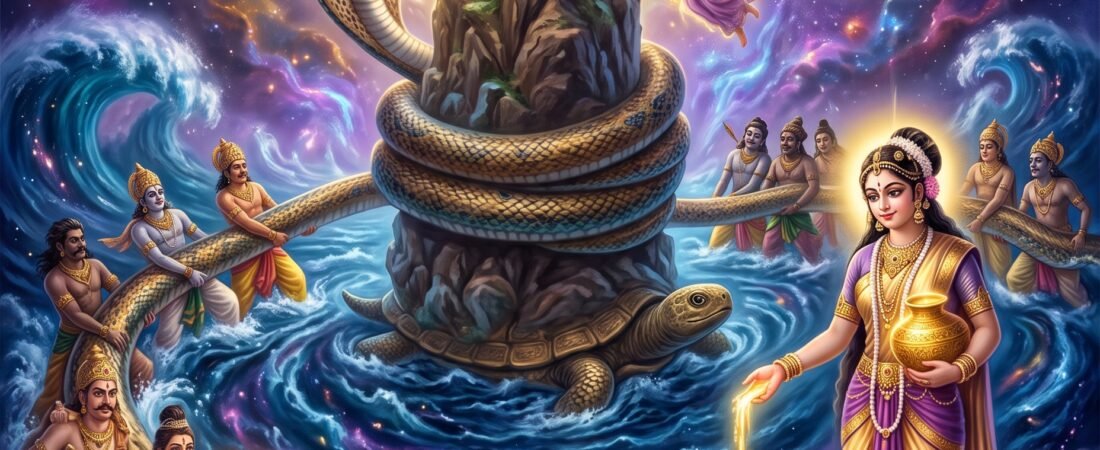
The Devas (gods) and Asuras (demons) agreed to an uneasy alliance. They would churn the cosmic ocean — the Kshira Sagara — using the serpent king Vasuki as the rope and Mandara Mountain as the churning rod. In return for their labour, both sides would share the 14 divine treasures (Chaturdasha Ratna) that would emerge from the depths, including Lakshmi, the goddess of prosperity; Dhanvantari, the divine physician with the pot of Amrit; and finally, the Amrit itself — the nectar of immortality.
Lord Vishnu took the form of Kurma (the cosmic tortoise) to stabilise the mountain on his back. The churning began — and from the ocean came poison, wealth, beauty, and finally, the Amrit.
But when the pot of immortality appeared, the Asuras grabbed it. Vishnu realised that if the demons became immortal, the cosmic balance would collapse. So he took the form of Mohini — an enchantress of impossible beauty — and offered to distribute the Amrit fairly between both sides. The Devas sat on one side, the Asuras on the other. Mohini began pouring the nectar, one cup at a time, to the Devas.
Then a single Asura — Svarbhanu — disguised himself as a Deva and sat between Chandra (the Moon god) and Surya (the Sun god). He raised the cup to his lips.
Surya and Chandra recognised the deception instantly and screamed to Mohini. In that fraction of a second, Vishnu’s Sudarshana Chakra severed Svarbhanu’s head from his body. But the Amrit had already touched his lips. His head became Rahu. His body became Ketu. Both were granted immortality — and both were cast into the sky as eternal enemies of the Sun and Moon.
Why Rahu and Ketu Are Called Shadow Planets
In Vedic astrology, Rahu and Ketu are not physical bodies. They are mathematical points — the North Lunar Node (Rahu) and the South Lunar Node (Ketu) — where the Moon’s orbit crosses the ecliptic plane. An eclipse occurs only when the Sun, Moon, and one of these nodes align.
| Feature | Rahu (North Node) | Ketu (South Node) |
|---|---|---|
| Mythological Form | Head of Svarbhanu (no body) | Body of Svarbhanu (no head) |
| Astronomical Identity | Ascending lunar node | Descending lunar node |
| Rules Over | Obsession, ambition, foreign lands, technology, illusion | Detachment, spirituality, past lives, moksha |
| Eclipse Role | Solar eclipse (swallows the Sun) | Lunar eclipse (swallows the Moon) |
| Transit Cycle | ~18 months per zodiac sign (~1.5 years) | ~18 months per zodiac sign (always opposite Rahu) |
| Spiritual Meaning | Unfulfilled desires driving this life’s karma | Past-life karma you must release |
Because Rahu and Ketu are always 180° apart in the zodiac, whenever one swallows the Sun or Moon, the other is automatically on the opposite side. This is why a solar eclipse (Rahu swallows Surya) always has a lunar eclipse (Ketu swallows Chandra) roughly two weeks before or after it — the geometry is locked.
What Rahu and Ketu in Your Kundli Actually Mean
In your birth chart, Rahu and Ketu form an axis — the Rahu-Ketu axis — that reveals the karmic tension of this lifetime. Where Rahu sits shows what your soul is hungry for in this incarnation. Where Ketu sits shows what you already mastered in a past life and must learn to release.
Rahu in your chart points to:
- The area of life where you feel an intense, almost obsessive pull
- Unconventional paths, foreign connections, and breakthrough thinking
- Worldly ambition — career, status, material growth
- Illusion and temptation — the things that look like fulfilment but may trap you
Ketu in your chart points to:
- Areas where you feel naturally detached or indifferent
- Talents you were “born with” but don’t value because they feel too easy
- Past-life mastery that now feels boring or irrelevant
- Spiritual liberation — the path to moksha
For example, if Rahu is in your 10th house (career) and Ketu is in your 4th house (home and emotional roots), this lifetime’s karmic pull is toward public achievement, professional recognition, and building a legacy — while your soul is asking you to release attachment to comfort, family expectations, and emotional security. This is the axis of the ambitious soul.
Conversely, if Rahu is in the 4th house and Ketu in the 10th, the pull reverses — your destiny is rooted in inner peace, home, and emotional depth, while you must release the need for external validation and career identity.
The Eclipse Window: Why Rahu-Ketu Transits Change Everything
Every 18 months, Rahu and Ketu shift into a new pair of zodiac signs. This transit window — lasting roughly 18 months — is considered one of the most transformative periods in Vedic astrology. The houses activated by Rahu and Ketu during a transit experience sudden changes, unexpected opportunities, and karmic reckonings.
During an actual eclipse (when Rahu or Ketu aligns with the Sun or Moon), the effect intensifies. Vedic tradition prescribes:
- Fasting or light eating during the eclipse hours
- Chanting mantras — the Rahu Beej Mantra (“Om Bhram Bhreem Bhraum Sah Rahave Namah”) and the Ketu Beej Mantra (“Om Sram Sreem Sraum Sah Ketave Namah”)
- Avoiding new beginnings — no muhurat ceremonies, no business launches, no travel
- Dan (charity) after the eclipse ends — donating black sesame seeds, blankets, or food to reduce Rahu-Ketu karmic debt
Modern practitioners also use the eclipse window for introspection, journaling, and releasing old patterns — aligning with Ketu’s spiritual nature.
How to Check Your Rahu-Ketu Axis in Your Kundli
Your Rahu-Ketu axis is calculated from your exact birth date, time, and place. To see where Rahu and Ketu sit in your birth chart:
- Open the Astrova AI app (free on Google Play)
- Enter your birth details — date, time, and city
- Generate your Janam Kundli — your full Vedic birth chart
- Look for the symbols ☊ (Rahu) and ☋ (Ketu) in your chart
- Note which houses they occupy — these are your karmic axis for this lifetime
Astrova AI also explains the meaning of your Rahu-Ketu placement in simple language, offers remedies based on classical texts, and lets you check compatibility with a partner through Kundli Milan.
Remedies for Rahu-Ketu Dosha: What the Texts Prescribe
When Rahu or Ketu is poorly placed — causing what is sometimes called Rahu Dosha or Ketu Dosha — classical Jyotish texts recommend specific remedies:
| Remedy | For Rahu | For Ketu |
|---|---|---|
| Mantra | Rahu Beej Mantra (18,000 repetitions over 40 days) | Ketu Beej Mantra (10,800 repetitions) |
| Gemstone | Hessonite (Gomed) — 2-5 carats, silver ring, Saturday | Cat’s Eye (Lehsunia) — consult astrologer first |
| Donation | Black sesame, blue cloth, iron on Saturdays | Multi-coloured grains, blankets on Tuesdays |
| Worship | Durga Saptashati, Rahu Stotram | Hanuman Chalisa, Ganesha worship |
| Fasting | Saturdays (avoid salt) | Tuesdays (single meal) |
Always consult a qualified Jyotish practitioner before wearing gemstones — Rahu and Ketu gemstones can amplify both positive and negative effects depending on your chart.
Frequently Asked Questions
Are Rahu and Ketu real planets?
No. Rahu and Ketu are not physical celestial bodies. They are the North and South Lunar Nodes — mathematical points where the Moon’s orbit intersects the ecliptic. In Vedic astrology, they are treated as “shadow planets” (Chhaya Graha) because of their powerful influence on human life, especially during eclipses.
Why do eclipses happen according to mythology?
According to the Samudra Manthan legend, Rahu (the head of the Asura Svarbhanu) periodically swallows the Sun or Moon in revenge for being beheaded. Because he has no body, the Sun or Moon re-emerges from his throat — which is why eclipses are temporary.
How long do Rahu and Ketu stay in one zodiac sign?
Rahu and Ketu spend approximately 18 months (1.5 years) in each zodiac sign before moving to the next. They always remain exactly 180° apart. A full cycle through all 12 signs takes about 18 years.
Is Rahu always negative in a Kundli?
No. While Rahu is classified as a malefic (Papa Graha), it can produce extraordinary results when well-placed — including sudden wealth, political power, technological innovation, and success in foreign lands. Many world leaders and tech founders have strong Rahu placements.
What is the difference between Rahu-Ketu Dosha and Sade Sati?
Rahu-Ketu Dosha refers to the challenging effects of Rahu or Ketu’s placement in your birth chart. Sade Sati is the 7.5-year transit of Saturn (Shani) over your Moon sign. Both are karmic periods, but they involve different planets and different remedial traditions.
Can Astrova AI tell me my Rahu-Ketu placement?
Yes. Astrova AI generates your full Vedic birth chart (Janam Kundli) from your birth details and explains your Rahu-Ketu axis, their house placement, and personalised remedies — all for free, in 9 Indian languages.
How Astrova AI Helps You Understand Rahu and Ketu
- 🔮 Full Janam Kundli — see exactly where Rahu and Ketu sit in your birth chart
- 📖 Plain-language explanations — no jargon, just clear insights about your karmic axis
- 🪐 Transit alerts — know when Rahu-Ketu shifts will affect your sign
- 🙏 Classical remedies — mantras, gemstones, and fasting guidance from Vedic texts
- 🌐 9 Indian languages — Hindi, Tamil, Telugu, Kannada, Malayalam, Marathi, Gujarati, Bengali, and English
- 🤖 24/7 AI Astrologer — ask questions about your Rahu-Ketu placement anytime
Explore More Astrova Guides
- Navagraha: The 9 Planetary Deities of Vedic Astrology
- Vedic Planetary Remedies — Navagraha Shanti Guide
- Planetary Transits (Gochar) in Vedic Astrology
- Sade Sati Explained — Powerful Remedies
- Vimshottari Dasha — How to Read Your Planetary Periods
- AI Astrology — Complete Guide
About the Astrova AI Editorial Team
This article was researched and written by the Astrova AI editorial team, drawing on classical Vedic texts including the Vishnu Purana, Bhagavata Purana, Brihat Parashara Hora Shastra, and Mahabharata. Our mission is to make the wisdom of Jyotish Shastra accessible to everyone through AI-powered astrology — free, accurate, and available in your language.
Have a correction or question? We welcome feedback. Reach us at support@theastrova.com.
🔮 Download Astrova AI — FREE Kundli Reading
Related posts:
 How to Read Palm Lines for Beginners – Step by Step Guide
 Why Do Hindu Festivals Fall on Specific Dates? The Astrological Science Behind Muhurat Timing
 What Your Finger Length Ratios Reveal About Your Personality — The Science of 2D:4D
 What Is the Bhrigu Samhita — The Ancient Palm Leaves That Predict Your Destiny?