What Is the Samudra Manthan — And How Did Rahu and Ketu Get Born From the Churning of the Cosmic Ocean?
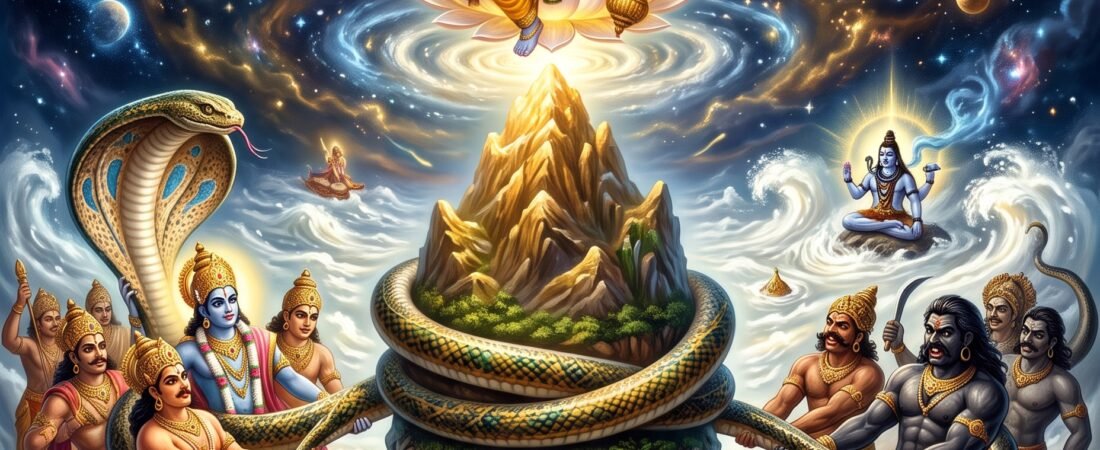
The Samudra Manthan, or the Churning of the Cosmic Ocean of Milk, is one of the most dramatic and consequential events in Hindu mythology. According to the Vishnu Purana, the Bhagavata Purana, and the Mahabharata (Adi Parva), the devas (gods) and asuras (demons) joined forces to churn the primordial ocean in search of Amrita, the nectar of immortality. From this cosmic event emerged fourteen precious treasures — including Dhanvantari with the Amrita Kalasha, the divine cow Kamadhenu, the wish-fulfilling tree Kalpavriksha, and the deadly poison Halahala, which Lord Shiva drank to save the universe. But the most astrologically significant outcome was the birth of Rahu and Ketu — the shadow planets (Chhaya Grahas) that govern eclipses, karmic obsession, and spiritual liberation in your birth chart.
If you have ever wondered why Rahu and Ketu have no physical bodies in astrology, why they cause eclipses, or why they are considered the most powerful karmic indicators in Vedic astrology — the answer lies in this one story. Let us walk through it.
Discover Your Rahu-Ketu Axis in Seconds
Get your complete Kundli with Rahu-Ketu placement, karmic analysis, and personalized remedies — powered by AI.
Available in 9 Indian languages • No credit card required
The Story Behind the Samudra Manthan — Why Did the Gods and Demons Unite?
The story begins with a curse. Durvasa Muni, the short-tempered sage, offered Lord Indra a garland of flowers. Indra placed it on his elephant Airavata, who crushed it underfoot. Durvasa cursed the entire deva realm: “You shall lose all your wealth, power, and glory.”
Stripped of their strength, the devas were defeated by the asuras led by Bali Chakravarti. Desperate, they approached Lord Vishnu, who devised a plan that would reshape the cosmos: churn the Cosmic Ocean of Milk (Ksheer Sagar) to recover the lost Amrita.
But the churning required an enormous effort. Vishnu instructed the devas to forge an alliance with their enemies — the asuras — because neither side could accomplish this alone. The mountain Mandara would serve as the churning rod, and the serpent king Vasuki would be the rope. Both sides held opposite ends of Vasuki’s body and began to pull.
The Fourteen Ratnas (Treasures) That Emerged From the Ocean
As the ocean was churned, it first released the deadly poison Halahala, whose fumes began to suffocate all of creation. Lord Shiva, in his compassion, drank the poison but held it in his throat — turning his neck blue and earning the name Neelkanth. This event is celebrated as the origin of Shiva’s connection to the Navagrahas.
Then, one by one, fourteen divine treasures (Chaturdasha Ratnas) emerged:
| # | Ratna (Treasure) | Received By | Astrological Significance |
|---|---|---|---|
| 1 | Halahala (Poison) | Lord Shiva | Shani’s karmic discipline |
| 2 | Kamadhenu (Divine Cow) | Saptarishis | Jupiter’s abundance |
| 3 | Uchchaihshravas (7-headed Horse) | Bali / Asuras | Sun’s royal authority |
| 4 | Airavata (White Elephant) | Lord Indra | Moon’s emotional power |
| 5 | Kalpavriksha (Wish Tree) | Devas | Jupiter’s wish fulfillment |
| 6 | Apsaras (Celestial Dancers) | Svarga | Venus’s beauty and art |
| 7 | Lakshmi (Goddess of Wealth) | Lord Vishnu | Venus’s material blessings |
| 8 | Varuni (Goddess of Wine) | Asuras | Rahu’s intoxication |
| 9 | Parijata (Celestial Flower) | Indra | Moon’s nurturing energy |
| 10 | Sharanga (Vishnu’s Bow) | Lord Vishnu | Mars’s warrior energy |
| 11 | Shankha (Conch Shell) | Lord Vishnu | Mercury’s communication |
| 12 | Amrita Kalasha (Nectar) | Lord Dhanvantari | Jupiter’s healing wisdom |
| 13 | Kaustubha Gem | Lord Vishnu | Sun’s radiant consciousness |
| 14 | Rahu & Ketu (Shadow Planets) | — | Karmic axis of destiny |
How Were Rahu and Ketu Born? The Beheading of Swarbhanu
When Dhanvantari finally emerged from the ocean carrying the Amrita Kalasha, both the devas and asuras rushed to claim it. Lord Vishnu, recognizing that the asuras would misuse the nectar, took the form of Mohini — an enchantingly beautiful woman — and distracted the asuras while she distributed the Amrita only to the devas.
But one asura saw through the disguise. Swarbhanu, a cunning asura who had sat between the Sun (Surya) and the Moon (Chandra) in the deva queue, disguised himself as a deva and sat in line. He received a portion of the Amrita and began to drink it.
Surya and Chandra immediately recognized the deception and complained to Lord Vishnu. In that instant, Vishnu hurled his Sudarshana Chakra and severed Swarbhanu’s head. But because the Amrita had already reached his throat, his head became immortal — even as his body fell.
The head became Rahu (the North Node) — the dragon’s head, associated with obsession, desire, illusion, and worldly attachment. The body became Ketu (the South Node) — the dragon’s tail, associated with detachment, spirituality, past-life karma, and moksha (liberation).
This is why Rahu and Ketu are called Chhaya Grahas (shadow planets) — they have no physical body of their own. They are the severed remnants of a single being, forever separated, forever seeking wholeness. And this is why they cause eclipses: Rahu “swallows” the Sun and Moon in eternal revenge against Surya and Chandra for exposing him.
The Astrological Significance of Rahu and Ketu in Your Kundli
In Vedic astrology, Rahu and Ketu are always 180 degrees apart in your birth chart, forming what is called the Rahu-Ketu axis. This axis is considered the most karmic indicator in your Vimshottari Dasha timeline.
Rahu represents:
- Unfulfilled desires from past lives that drive your ambitions in this life
- Obsession, addiction, and the tendency to chase illusions
- Foreign lands, unconventional paths, and sudden breakthroughs
- Material growth, technology, and mass influence
Ketu represents:
- Skills and mastery carried over from previous incarnations
- Detachment from material outcomes and spiritual awakening
- Sudden losses that redirect you toward your true purpose
- Moksha — the ultimate liberation from the cycle of birth and death
Where Rahu sits in your chart shows where you are headed. Where Ketu sits shows where you have already been. Together, they form the axis along which your soul evolves across lifetimes.
What Happens When Rahu or Ketu Transit Through Your Signs?
Rahu and Ketu spend approximately 18 months in each zodiac sign, completing a full cycle every 18 years. Their transits are among the most transformative periods in Vedic astrology. When Rahu enters a new sign, it triggers obsession, ambition, and growth in the houses it touches. When Ketu transits, it triggers detachment, loss, and spiritual reckoning.
This is closely related to Sade Sati — the 7.5-year transit of Saturn — because both Rahu-Ketu transits and Sade Sati are karmic correction periods. While Saturn teaches through discipline and hard work, Rahu and Ketu teach through sudden upheaval and revelation.
Understanding your personal Rahu-Ketu transit timing is essential for making major life decisions. Learn more about how planetary transits affect your horoscope.
How Astrova AI Helps You Understand Your Rahu-Ketu Axis
Astrova AI is India’s first AI-powered Vedic astrology app that gives you a complete analysis of your Rahu-Ketu placement — including which houses they occupy, which signs they influence, and what karmic lessons they carry for this lifetime.
- Instant Kundli Generation: Enter your birth details and get your full birth chart with Rahu-Ketu positions calculated using the Swiss Ephemeris.
- Karmic Axis Analysis: Understand what your Rahu desires and what your Ketu releases — in simple, practical language.
- Transit Alerts: Get notified when Rahu or Ketu change signs and how it affects your specific chart.
- 24/7 AI Astrologer: Ask any question about your Rahu-Ketu axis and get instant, personalized answers.
- Remedies & Rituals: Receive specific remedies for Rahu Dosha, Ketu Dosha, and eclipse-period precautions.
Frequently Asked Questions
1. Are Rahu and Ketu real planets?
No. Rahu and Ketu are mathematical points — the North and South Lunar Nodes where the Moon’s orbit crosses the ecliptic. In Vedic astrology, they are treated as “shadow planets” (Chhaya Grahas) because of their enormous influence on human destiny, even though they have no physical body.
2. Why do Rahu and Ketu cause eclipses?
According to mythology, Rahu seeks revenge against Surya (Sun) and Chandra (Moon) for exposing his deception during the Samudra Manthan. Astronomically, eclipses occur when the Sun and Moon align at the lunar nodes — the very points that Rahu and Ketu represent.
3. Is Rahu always bad in a Kundli?
No. Rahu is not inherently malefic. When well-placed, Rahu can give extraordinary material success, fame, technological talent, and foreign connections. Many billionaires and world leaders have strong Rahu placements. The key is understanding which house and sign Rahu occupies in your chart.
4. What is the difference between Rahu and Ketu?
Rahu (North Node) represents worldly desire, ambition, and attachment — what your soul wants to experience. Ketu (South Node) represents spiritual detachment, past-life mastery, and liberation — what your soul has already mastered and needs to release. They are two halves of the same karmic journey.
5. How can I reduce the negative effects of Rahu?
Traditional remedies include wearing a Hessonite gemstone (after consulting an astrologer), chanting the Rahu Beej Mantra (“Om Bhram Bhreem Bhraum Sah Rahave Namah”), donating black sesame seeds on Saturdays, and performing Rahu Shanti Puja. Explore complete Navagraha remedies.
6. Can Astrova AI predict when Rahu will change signs?
Yes. Astrova AI calculates precise Rahu and Ketu transit dates based on the Swiss Ephemeris and shows you exactly which houses and signs they will affect in your personal chart — so you can prepare for the shift in advance.
Quick Summary
- The Samudra Manthan is the cosmic churning of the Ocean of Milk by devas and asuras to obtain Amrita (nectar of immortality).
- Rahu and Ketu were born when Lord Vishnu beheaded the asura Swarbhanu, who had disguised himself to drink the Amrita.
- Rahu (head) governs obsession, desire, and worldly ambition. Ketu (body) governs detachment, spirituality, and moksha.
- Their transit through your chart triggers the most transformative periods of your life — karmic corrections that reshape your destiny.
- Astrova AI gives you a complete Rahu-Ketu analysis, transit alerts, and personalized remedies — all free on your phone.
Explore More Astrova Guides
- The Navagraha Deities: Who Are the Nine Planets in Vedic Astrology?
- Shiva and the Navagraha: The Cosmic Dance That Governs Your Destiny
- Why Lord Shiva Wears the Crescent Moon — The Astrological Secret
- Karma and Reincarnation in Vedic Astrology — How Your Birth Chart Reveals Past Lives
- Vedic Planetary Remedies: Navagraha Shanti for Every Dosha
- Sade Sati Explained — What It Is, How It Affects You, and Powerful Remedies
About the Author
Astrova AI Editorial Team
The Astrova AI Editorial team combines deep knowledge of classical Jyotish texts — including the Brihat Parashara Hora Shastra, Phaladeepika, Jataka Parijata, and the Vishnu Purana — with modern AI technology to make Vedic astrology accessible to everyone.
Our editors have studied under traditional Jyotish scholars and hold certifications in Vedic astrology. We believe that ancient wisdom and modern technology can work together to help you understand your destiny.
Have a correction or question? We welcome feedback. Reach us at support@theastrova.com.
Available on Android • 100% Free • No credit card required
Related posts:
 How to read your own palm at home — step-by-step guide — Complete Guide 2026
 How to check your daily Rashifal using your Moon sign — step by step — Complete Guide 2026
 How to identify Kaalsarp Dosha in your Kundli — visual guide — Complete Guide 2026
How accurate is AI Kundli matching vs traditional astrologer matching? — Complete Guide 2026
How to identify Kaalsarp Dosha in your Kundli — visual guide — Complete Guide 2026
How accurate is AI Kundli matching vs traditional astrologer matching? — Complete Guide 2026