Bracelet lines, or rascettes, are the creases that run across the inside of your wrist just below the palm. Palmistry tradition calls them the bracelets of health, wealth and happiness and reads clear ones as lucky. Anatomically they are wrist flexion creases, and they cannot predict lifespan or wealth.
Key takeaways
- Where: across the inside of the wrist, below the base of the palm. Count them from the palm downward.
- Names: rascettes, bracelets of life, or manibandh rekha in Indian hand reading.
- Old meaning: one bracelet each for health, wealth and happiness, a label Cheiro traced to the ancient Greeks.
- The classics are cautious: Benham found little use in any but the first bracelet and rejected the “thirty years per line” rule.
- The arched bracelet: old books linked it to fertility problems. That claim has no evidence and should not worry anyone.
- What they really are: folding points in the skin over the wrist joint, which hand surgeons use as landmarks.
Scan your palm free in Astrova AI
Turn your hand over and look where the palm meets the arm. Most people see two or three faint lines circling the wrist like thin bangles. Palmists have read them for centuries, and in India they are often called manibandh rekha, the wrist-band lines (Astroyogi). This guide shows how to find and count them, what the classical books actually say, the parts of the tradition that have not aged well, and what the creases are in plain anatomy.
Where are the bracelet lines?
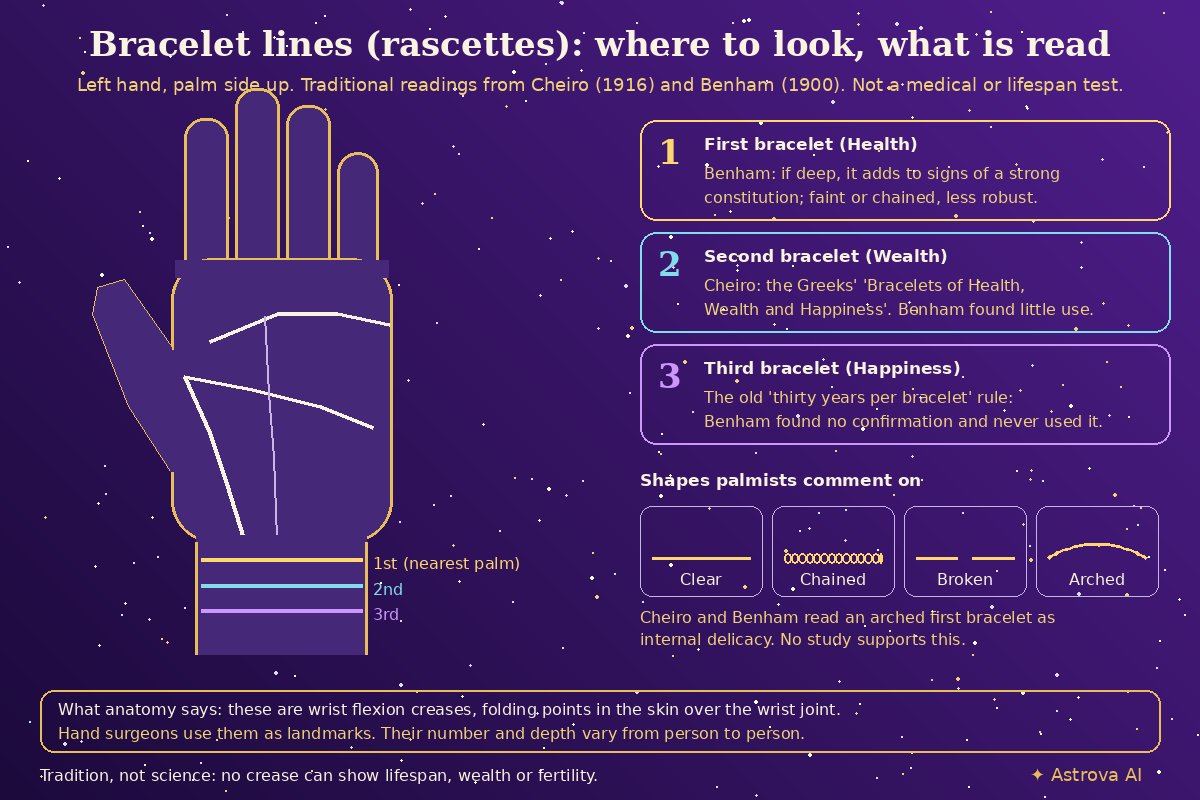
The bracelets sit just below the palm, on the inside of the wrist, below the base of the thumb pad and the outer pad palmists call the Mount of the Moon. William Benham described them simply as “the lines which cross the wrist at the base of the hand”, adding that “sometimes there are three, and there may be only one” (The Laws of Scientific Hand Reading, 1900).
The line closest to the palm is the first bracelet. The others are counted down the arm. They are not part of the palm’s main lines, which our guide to the major palm lines covers, and palmists treat them as minor lines.
What each bracelet means in tradition
Cheiro wrote that the bracelets “are of very little importance except to throw light on certain points of health”, and that the ancient Greeks called them the Bracelets of Health, Wealth, and Happiness. He then added, drily, that “it is certainly very seldom that they can be found together” (Palmistry for All, 1916). Modern readings usually follow that Greek order:
| Bracelet | Popular label | What the classical books say |
|---|---|---|
| First (nearest the palm) | Health | The only one Benham found useful. Deep and clear, it adds to other signs of a strong constitution; poorly marked, chained, or broad and shallow, the constitution is “not so strong” |
| Second | Wealth | Cheiro and Benham give it no separate reading. The wealth label is folklore |
| Third | Happiness | Also folklore. Benham said he found the bracelets “of little use, especially any save the first one” |
Benham read two more features from the first bracelet. Short branches rising from it showed, in his words, “a rising tendency in the life of the subject, ambitious efforts, and a desire to improve”. Long branches climbing into the Mount of the Moon are the classical travel lines, which he said “must be treated as a part of the Rascettes, for they rise from the first one” (Benham).
The parts of the tradition to let go
Thirty years per bracelet. An old rule added about thirty years of life for each bracelet, so three lines promised ninety years. Benham wrote: “I have failed to find any confirmations of such indications, and never use them as bearing upon longevity.” He added that other traditions about signs on the bracelets had been “proven fallacious” in his experience and refused to list them.
The arched first bracelet. Both classics claimed that a first bracelet bowing up into the palm meant internal delicacy, and in women trouble with childbirth. Cheiro repeated a legend that Greek priests barred such women from marriage (Cheiro). This is a story, not medicine. A wrist crease cannot show fertility, and nobody should feel judged by the shape of one. If you have a health or fertility concern, a doctor can give you a real answer.
How to read your bracelet lines: step by step
- Use good side light. Daylight from a window, falling across the wrist rather than straight on it, shows faint creases best.
- Bend the wrist slightly. Tip your hand back a little toward you. The creases deepen and become easy to count.
- Count from the palm down. The first bracelet is the one nearest the palm.
- Note the quality of the first one. Is it deep and even, or chained (a row of tiny loops), broken, or broad and shallow? Does it run straight or bow up at the centre?
- Look for branches. Short lines rising from the first bracelet, and any long line climbing into the outer pad of the palm.
- Compare both hands, and read the whole hand. Palmists never judge the bracelets alone. Benham used the first one only to confirm what the life line and other health signs already suggested.
Worked example (illustrative)
This is a made-up wrist used only to show the method. It is not a real person’s hand or a real reading.
Suppose Meera, 34, checks her left wrist in window light. She counts three bracelets. The first is deep and clear, the second is chained across most of its length, and the third is faint. Two short lines rise from the first bracelet toward the palm.
- First bracelet: deep and clear. In Benham’s system this adds a little weight to any other signs of a sturdy constitution in her hand, nothing more.
- Second and third: the folklore would call her “wealth” bracelet chained. Neither classic gives that a reading, so a careful palmist would not either.
- Short rising branches: Benham’s “ambitious efforts, and a desire to improve”. At most, a prompt to think about her goals.
- What it does not tell her: how long she will live, how much money she will make, or anything about having children.
What the science says
The creases themselves are real anatomy. Hand specialists call them wrist flexion creases: folding points in the skin near the joints, which TeachMe Orthopedics compares to the creases in a road map (TeachMe Orthopedics). The crease nearest the palm, the distal wrist crease, is the most consistent and lies over the first row of wrist bones, so surgeons use it as a landmark (Hand Surgery Resource). Palm creases in general form before birth, which BBC Science Focus explains in more detail (BBC Science Focus).
The meanings are another matter. Palmistry is widely viewed as a pseudoscience, because its schools contradict each other and its predictions lack evidence (Palmistry, Wikipedia). The bracelets are a good example: even the two best-known palmists of a century ago, Cheiro and Benham, said they meant very little. Enjoy them as part of a tradition, and see our honest look at whether AI palmistry really works. Another crease people often worry about is the Simian line.
The bracelets are a small part of the hand. For the full picture, read about the travel lines that rise from them, the palm mounts, or the Girdle of Venus, or try an AI palm reading to see how your lines fit together.
FAQs
What do three bracelet lines on the wrist mean?
In palmistry tradition, three clear bracelets are the classic lucky sign. Cheiro recorded that the ancient Greeks called them the Bracelets of Health, Wealth and Happiness. He also wrote that all three are seldom found together, and Benham found anything beyond the first bracelet of little use. It is a cultural reading, not a forecast.
What does it mean if I have only one or two bracelet lines?
Nothing to worry about. Benham wrote that there are sometimes three and may be only one, and he relied mainly on the first. Wrist creases vary from person to person, and faint ones are easy to miss in flat light. Having fewer lines does not mean less health, money or happiness.
Do bracelet lines show how long you will live?
No. An old rule added about thirty years of life for each bracelet, but Benham wrote that he failed to find any confirmation of it and never used the bracelets for longevity. No study links the number of wrist creases to lifespan. For health questions, a doctor is the right person to ask.
Is having four bracelet lines lucky?
Many modern palmistry sites call a fourth bracelet extra lucky or a sign of a very long life. The two classic manuals cited here, Cheiro and Benham, do not make that claim, and there is no evidence behind it. A fourth line is simply another skin crease.
What does a broken or chained bracelet line mean?
In Benham’s system, a first bracelet that is chained, broken, broad or shallow suggests a constitution that is not so strong, while a deep one adds to other signs of strength. It is a traditional reading only. Chains and breaks in skin creases are common and are not a sign of illness.
Download Astrova AI on Google Play
AI palm reading, Kundli, daily Rashifal and 24/7 AI astrologer chat in 9 Indian languages. For entertainment and self-reflection.
Sources: Cheiro, Palmistry for All, 1916, chapter on the Bracelets (Project Gutenberg) · William G. Benham, The Laws of Scientific Hand Reading, 1900, The Rascettes, and Lines of Travel (Internet Archive) · Surface anatomy: flexion creases (TeachMe Orthopedics) · Surface anatomy: skin crease landmarks (Hand Surgery Resource) · Why do we have lines on our palms? (BBC Science Focus) · Palmistry (Wikipedia) · Bracelet lines and manibandh rekha (Astroyogi)