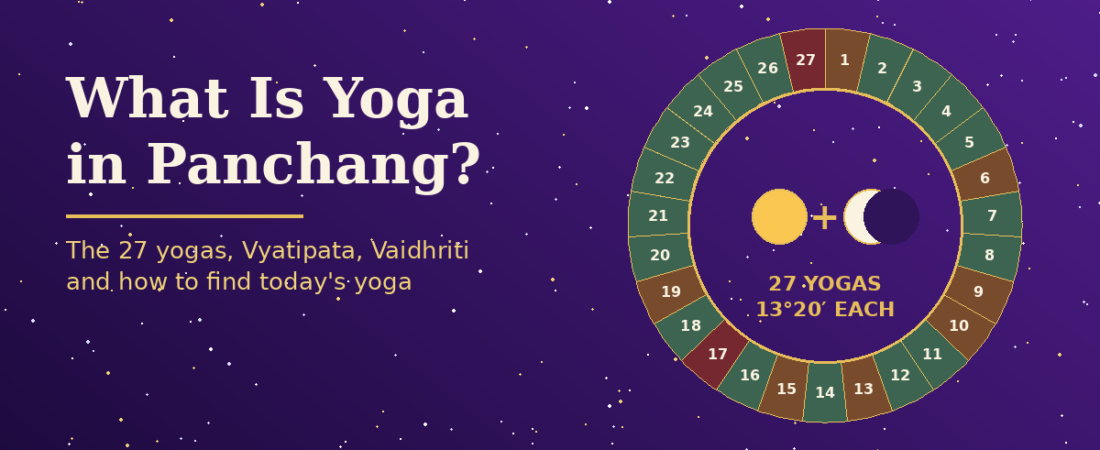
In the Panchang, yoga (also called nitya yoga) is the fourth limb: a time period found by adding the sidereal longitudes of the Sun and Moon and dividing the total into 27 equal parts of 13°20′. Each yoga lasts a little under a day. It is not yoga exercise or a kundli yoga like Raj Yoga.
Key takeaways
- What it measures: the Sun’s longitude plus the Moon’s, in 13°20′ steps. (Tithi uses Moon minus Sun.)
- How many: 27, from Vishkumbha to Vaidhriti, always in the same order.
- How long: about 22 hours 36 minutes on average, roughly 21 to 24.5 hours.
- The two to check: Vyatipata and Vaidhriti are avoided most firmly for new beginnings. Seven more are often avoided too.
- Not a chart yoga: Raj Yoga or Gajakesari are planet combinations in a kundli, a different idea with the same word.
- Tradition, not science: the arithmetic is exact; the good and bad labels are custom.
Check today’s yoga in Astrova AI
Every Panchang lists five things for the day: tithi, vaar (weekday), nakshatra, yoga and karana. Yoga is the one that confuses people most, partly because the same word is used for meditation and for kundli combinations. This guide explains what the Panchang yoga is, lists all 27, shows how to work one out by hand, and keeps the astronomy separate from the tradition.
What is yoga in Panchang?
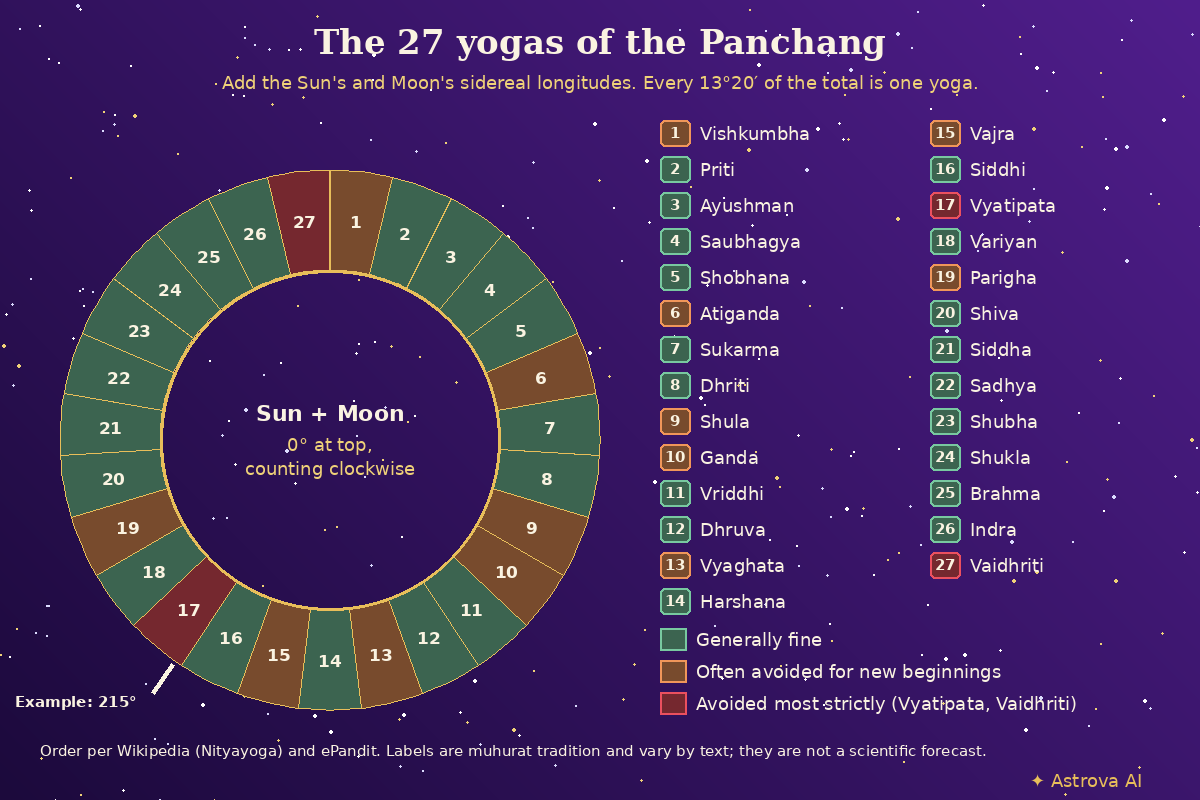
Take the Sun’s position along the sidereal zodiac and the Moon’s, and add them. Whenever the total grows by another 13°20′, a new yoga begins. Because 27 × 13°20′ is exactly 360°, there are 27 yogas, and the count starts again at Vishkumbha once the total passes 360° (Wikipedia: Nityayoga).
Compare that with the other Moon-based limbs. A tithi uses the difference between Moon and Sun; a yoga uses their sum (Wikipedia: Panchangam). The 13°20′ step is the same size as a nakshatra, but a nakshatra reads the Moon alone, so the yoga and the nakshatra change at different times of the day.
| Panchang limb | What is measured | Step size | How many |
|---|---|---|---|
| Tithi | Moon minus Sun | 12° | 30 a lunar month |
| Karana | Moon minus Sun | 6° (half a tithi) | 60 a month, 11 names |
| Nakshatra | Moon alone | 13°20′ | 27 |
| Yoga | Moon plus Sun | 13°20′ | 27 |
| Vaar | Sunrise to sunrise | 1 day | 7 |
The 27 yogas in order
The order and names below follow the standard list (Wikipedia; ePandit). The meaning column is a rough translation of each name, and the last column is a broad summary of how muhurat tradition treats it for starting important things. Spellings vary between calendars: Vishkambha, Shoola, Variyana, Aindra and Vaidhrita are the same yogas.
| # | Yoga | Rough meaning | Sun + Moon range | In muhurat |
|---|---|---|---|---|
| 1 | Vishkumbha | Support, or obstacle | 0°00′ to 13°20′ | Often avoided for beginnings |
| 2 | Priti | Fondness | 13°20′ to 26°40′ | Generally fine |
| 3 | Ayushman | Long-lived | 26°40′ to 40°00′ | Generally fine |
| 4 | Saubhagya | Good fortune | 40°00′ to 53°20′ | Generally fine |
| 5 | Shobhana | Splendour | 53°20′ to 66°40′ | Generally fine |
| 6 | Atiganda | Large cheeks (literal) | 66°40′ to 80°00′ | Often avoided for beginnings |
| 7 | Sukarma | Virtuous | 80°00′ to 93°20′ | Generally fine |
| 8 | Dhriti | Determination | 93°20′ to 106°40′ | Generally fine |
| 9 | Shula | Spear | 106°40′ to 120°00′ | Often avoided for beginnings |
| 10 | Ganda | Spot, mark | 120°00′ to 133°20′ | Often avoided for beginnings |
| 11 | Vriddhi | Growth | 133°20′ to 146°40′ | Generally fine |
| 12 | Dhruva | Constant | 146°40′ to 160°00′ | Generally fine |
| 13 | Vyaghata | Hindrance | 160°00′ to 173°20′ | Often avoided for beginnings |
| 14 | Harshana | Thrilling | 173°20′ to 186°40′ | Generally fine |
| 15 | Vajra | Thunderbolt | 186°40′ to 200°00′ | Often avoided for beginnings |
| 16 | Siddhi | Success | 200°00′ to 213°20′ | Generally fine |
| 17 | Vyatipata | Calamity | 213°20′ to 226°40′ | Avoided for beginnings (strictest) |
| 18 | Variyan | Very welcome | 226°40′ to 240°00′ | Generally fine |
| 19 | Parigha | Obstacle | 240°00′ to 253°20′ | Often avoided for beginnings |
| 20 | Shiva | Benign | 253°20′ to 266°40′ | Generally fine |
| 21 | Siddha | Accomplished | 266°40′ to 280°00′ | Generally fine |
| 22 | Sadhya | Amenable | 280°00′ to 293°20′ | Generally fine |
| 23 | Shubha | Auspicious | 293°20′ to 306°40′ | Generally fine |
| 24 | Shukla | White, bright | 306°40′ to 320°00′ | Generally fine |
| 25 | Brahma | Supreme spirit | 320°00′ to 333°20′ | Generally fine |
| 26 | Indra | Chief | 333°20′ to 346°40′ | Generally fine |
| 27 | Vaidhriti | Great calamity | 346°40′ to 360°00′ | Avoided for beginnings (strictest) |
Vyatipata and Vaidhriti: the two yogas to check
Most lists flag nine yogas as unfavourable for beginnings, but two stand apart. Vyatipata (17th) and Vaidhriti (27th) are the ones tradition does not choose for a wedding, griha pravesh, naming ceremony or the start of a business. ePandit notes that the Dharmasindhu names both as days to set aside when fixing a naamkaran (ePandit). In practice, when a pandit rejects an otherwise good date because of the yoga, it is usually one of these two.
The names are older than the 27-yoga list. In early astronomy texts, vyatipata and vaidhriti were the moments when the Sun and Moon have the same declination, which is found by adding their longitudes. Historians think this sum may be how the idea of 27 yogas grew, and the 27-yoga system itself seems to date from around 700 CE (Wikipedia, citing S. B. Dikshit).
Keep the rule in proportion. It is about starting special things. Office work, study, travel and daily puja go on as usual, and a child born in either yoga is not “unlucky”. Like Rahu Kaal, it is a window to plan around when you have a choice.
How to find the yoga yourself: step by step
- Get the sidereal (nirayana) longitudes of the Sun and Moon for your moment, from an ephemeris or a Panchang app.
- Add them. If the total is 360° or more, subtract 360°.
- Divide by 13.333 (that is 13°20′) and drop the decimals. This is the number of yogas already completed.
- Add 1 to get the running yoga’s number, from 1 to 27.
- Look it up in the table above. The decimal you dropped tells you how far through the yoga you are.
This is the same method ePandit and Wikipedia describe. Use sidereal positions, because a yoga adds two longitudes and so doubles any zodiac offset. The Lahiri ayanamsa is about 24° today, so tropical positions would push the sum about 48° too high, three or four yogas off. That is a common reason two apps disagree.
Worked examples (illustrative)
These are made-up positions used only to show the method, not a real date or a real chart.
Example 1. Suppose the Sun is at 205° and the Moon at 10°. The sum is 215°. 215 ÷ 13.333 = 16.1, so 16 yogas are complete and the 17th is running: Vyatipata. Someone planning a griha pravesh at that moment would, by tradition, wait for Variyan, which begins once the sum reaches 226°40′, roughly 20 hours later at average speeds.
Example 2. Now suppose the Sun is at 140° and the Moon at 310°. The sum is 450°, which is more than 360°, so subtract 360° to get 90°. 90 ÷ 13.333 = 6.75, so the 7th yoga is running: Sukarma, generally treated as fine.
Why sidereal matters. If you fed Example 1 tropical positions (each about 24° larger), you would get a sum near 263° and the 20th yoga, Shiva. Same moment, very different label. That is why the yoga in a proper Panchang is always calculated sidereally.
How long does a yoga last?
The Moon moves about 13° a day and the Sun about 1°, so their sum grows about 14° a day, a little more than one 13°20′ step. According to Sewell and Dikshit’s The Indian Calendar, a yoga averages 22 hours 35 minutes, with the longest about 24 hours 36 minutes and the shortest about 20 hours 53 minutes, because the Moon’s speed changes (Wikipedia: Nityayoga).
Two practical results follow. Panchangs print the yoga running at sunrise along with its end time, so one calendar day often shows two yogas. And because a yoga is usually shorter than a day, now and then one starts and ends between two sunrises and never appears as the “sunrise yoga”. All 27 come round roughly every 25 days.
Three different things called “yoga”
| Type | Based on | Examples | Used for |
|---|---|---|---|
| Panchang (nitya) yoga | Sun + Moon longitude | Siddhi, Vyatipata, Vaidhriti | Daily calendar, muhurat |
| Weekday yogas (Anandadi) | Weekday + nakshatra | Ananda, Kaladanda, Amrita | Some calendars, muhurat |
| Kundli yogas | Planet combinations in a birth chart | Raj Yoga, Gajakesari | Reading a person’s chart |
The weekday set has 28 names and follows a fixed table rather than the sky (Wikipedia). If your calendar shows a yoga like “Amrita” or “Kaladanda” next to Vishkumbha or Priti, it is printing both systems side by side.
Where the Panchang yoga is used
- Choosing a muhurat: the main use. The yoga is one filter among five, mostly checked to keep a start time out of Vyatipata or Vaidhriti. Our guide to choosing a muhurta covers the rest.
- The birth Panchang: your birth details include a janma yoga next to your tithi and nakshatra. Astrologers read it as a small detail that never overrides the full chart.
- Reading a printed Panchang: knowing that the yoga changes at its own time, separate from the tithi and nakshatra, makes the daily entries easier to follow.
Tradition vs science
The arithmetic is real. Adding two sidereal longitudes and dividing by 13°20′ gives an exact, repeatable answer, and Panchang makers can time it to the minute. But even traditional astronomy struggled to say what it stands for. The historian S. B. Dikshit wrote that it is not known what position in the sky a yoga indicates, and that it is useful only in astrology (quoted on Wikipedia). The labels for each yoga are tradition. There is no scientific evidence that work begun in Siddhi goes better than work begun in Vyatipata. Treat the yoga as a gentle guide for timing a start, not a reason to worry.
Get your free Kundli and daily Panchang
Yoga is one of five Panchang limbs. To read the whole day, see how to read a Panchang, how to find today’s tithi and what a karana is, then how muhurat is chosen for big events.
FAQs
How many yogas are there in Panchang?
There are 27 Panchang yogas, from Vishkumbha (1st) to Vaidhriti (27th). Each covers 13°20′ of the combined Sun and Moon longitude, so 27 of them make a full 360°. Some calendars also print a separate set of 28 weekday-based yogas (Ananda, Kaladanda and so on), which are worked out differently.
Which yoga is not good in Panchang?
Vyatipata (17th) and Vaidhriti (27th) are the two that muhurat tradition avoids most firmly for starting a wedding, griha pravesh, naming ceremony or new venture. Many lists add seven more as unfavourable for beginnings: Vishkumbha, Atiganda, Shula, Ganda, Vyaghata, Vajra and Parigha. Everyday work, study and puja carry on as normal.
Which yoga is the most auspicious in Panchang?
Texts differ, but Siddhi, Shubha, Siddha, Shiva, Brahma and Indra are among the yogas most often named as especially good for beginnings. A good yoga alone does not make a muhurat, though. Astrologers check it together with the tithi, nakshatra, weekday and karana, and the ascendant of the moment.
Is being born in Vaidhriti or Vyatipata yoga bad?
No. Avoiding these yogas is a rule for choosing when to start something, not a verdict on people born in them. Every yoga comes round about once every 25 days for everyone on earth, so many people share each one. The birth yoga is one small detail of the birth panchang, read along with the whole chart.
Is Panchang yoga the same as Raj Yoga or yoga exercise?
No. The word comes from the Sanskrit root yuj, to join, but here it means a time period from the sum of the Sun and Moon positions. Kundli yogas such as Raj Yoga or Gajakesari are planet combinations in a birth chart, and yoga exercise is a separate practice altogether.
Download Astrova AI on Google Play
Kundli, daily Rashifal and Panchang, AI palm reading and 24/7 AI astrologer chat in 9 Indian languages. For entertainment and self-reflection.
Sources: Nityayoga, Wikipedia (definition, names, history, lengths from Sewell & Dikshit, The Indian Calendar) · Panchangam, Wikipedia (the five limbs) · The 27 yogas of the Panchang, ePandit (calculation, Vyatipata and Vaidhriti)