
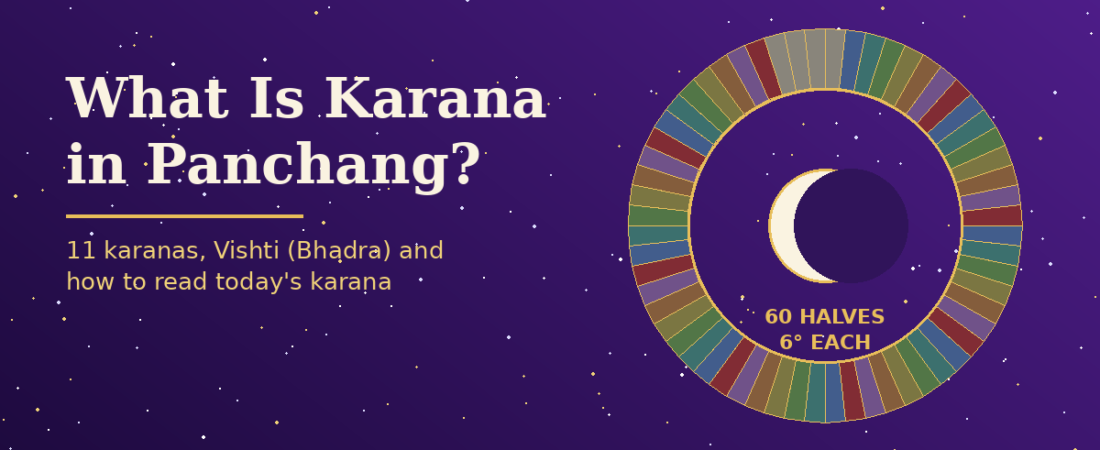
Karana is half of a tithi: the time the Moon takes to move another 6° ahead of the Sun. It is the fifth limb of the Panchang. There are 11 karanas, seven movable and four fixed, spread over 60 halves a month. Vishti, also called Bhadra, is the one tradition avoids for new beginnings.
Key takeaways
- What it measures: each 6° the Moon gains on the Sun, half of a 12° tithi.
- How many: 60 karana periods a month, but only 11 names.
- Movable (chara): Bava, Balava, Kaulava, Taitila, Gara, Vanija and Vishti, repeating eight times.
- Fixed (sthira): Shakuni, Chatushpada, Naga and Kimstughna, once each around Amavasya and the start of Shukla Pratipada.
- Bhadra: another name for Vishti, avoided in muhurat for weddings, griha pravesh and new ventures.
- Tradition, not science: the 6° steps are real astronomy; the good and bad labels are custom.
Check today’s Panchang in Astrova AI
Open any Indian calendar or Panchang and you will see five entries for the day: tithi, vaar (weekday), nakshatra, yoga and karana. Karana is the smallest of the five and the least explained, yet it is the one behind a word you hear every Raksha Bandhan and Holi: Bhadra. This guide explains what a karana is, lists all 11, shows how to work one out yourself, and is clear about what is tradition and what is astronomy.
What is a karana?
A tithi is the time the Moon takes to gain 12° on the Sun. A karana is half of that: the time the Moon takes to gain 6°. So every tithi has two karanas, one for its first half and one for its second, and a lunar month of 30 tithis has 60 karanas (Wikipedia).
The 60 halves are not given 60 names. Tradition uses just 11, which is why the same karana names keep coming back on your calendar every few days. The Sanskrit word karana has many other meanings (it can mean an instrument or a technical manual), but in the Panchang it only means this half-tithi (Wisdom Library).
The 11 karanas: movable and fixed
| Karana | Type | When it comes | Traditional use in muhurat |
|---|---|---|---|
| Bava | Movable | 8 times a month, in rotation | Generally favourable |
| Balava | Movable | 8 times a month | Generally favourable |
| Kaulava | Movable | 8 times a month | Generally favourable |
| Taitila | Movable | 8 times a month | Generally favourable |
| Gara | Movable | 8 times a month | Generally favourable |
| Vanija | Movable | 8 times a month | Generally favourable |
| Vishti (Bhadra) | Movable | 8 times a month | Avoided for auspicious beginnings |
| Shakuni | Fixed | Second half of Krishna Chaturdashi | Usually not chosen for celebrations |
| Chatushpada | Fixed | First half of Amavasya | Usually not chosen for celebrations |
| Naga | Fixed | Second half of Amavasya | Usually not chosen for celebrations |
| Kimstughna | Fixed | First half of Shukla Pratipada | Often treated as mild or favourable |
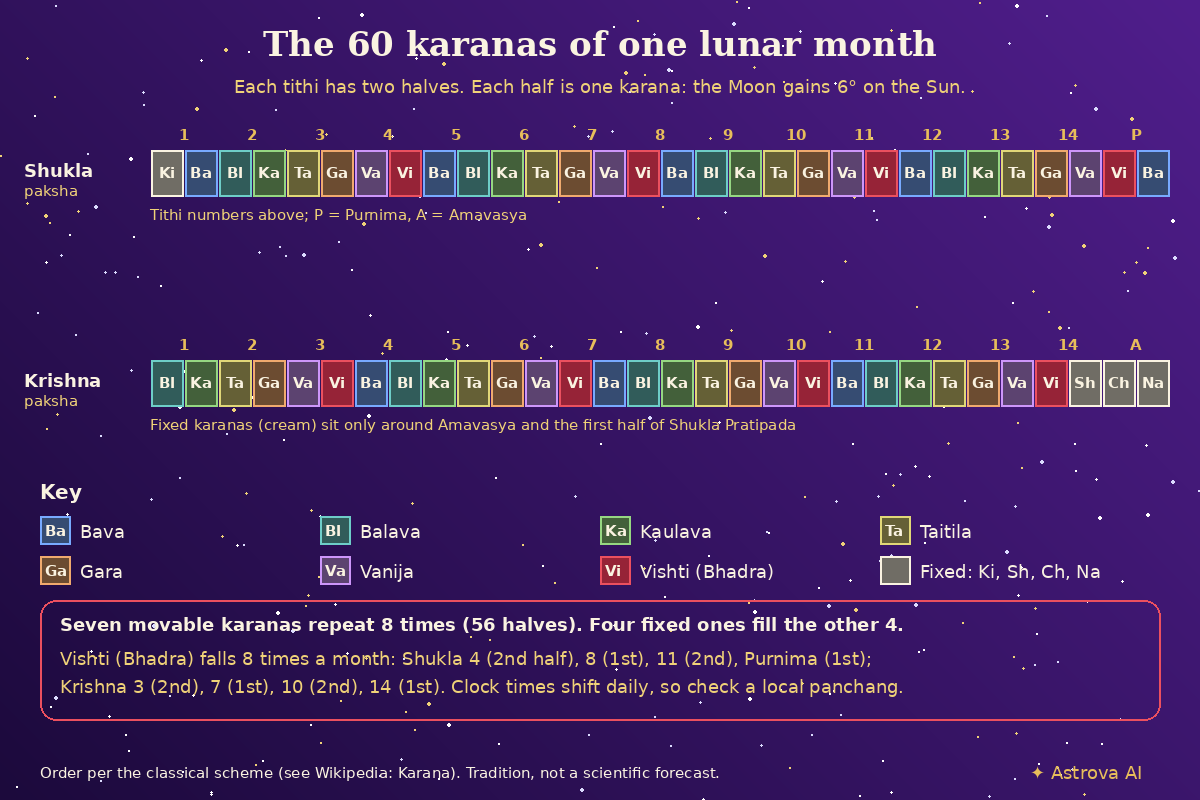
The order comes from the classical scheme: Kimstughna opens the month in the first half of Shukla Pratipada, then the seven movable karanas run from Bava to Vishti eight times (56 halves), and Shakuni, Chatushpada and Naga close the month (Wikipedia; ePandit, citing B. V. Raman). The muhurat column is a broad summary. Individual texts and family traditions add exceptions for particular kinds of work.
Vishti karana: what Bhadra really means
Vishti is the seventh movable karana, and Bhadra is its popular name. Muhurat tradition does not start auspicious things in it: a wedding, griha pravesh, a samskara such as naming, or a new business. That is why Panchangs publish Bhadra start and end times before Raksha Bandhan and Holika Dahan, and many families wait for Bhadra to pass before tying rakhi or lighting the Holika fire (ePandit).
Because it follows the cycle, Vishti falls eight times every lunar month, always in the same places:
- Shukla paksha: second half of Chaturthi, first half of Ashtami, second half of Ekadashi, first half of Purnima.
- Krishna paksha: second half of Tritiya, first half of Saptami, second half of Dashami, first half of Chaturdashi.
Two things are worth keeping in mind. First, Bhadra is about starting special things. Meals, office work, study, travel and daily puja go on as usual. Second, some traditions refine the rule further, for example by where Bhadra is said to reside (its vaas), so for a festival time it is best to follow your local Panchang or family pandit rather than the karana name alone. Like Rahu Kaal, it is a window to work around, not something to fear.
How to find the karana yourself: step by step
- Get the Sun’s and Moon’s sidereal longitudes for the moment you care about, from an ephemeris or a Panchang app.
- Subtract: Moon minus Sun. If the answer is negative, add 360°. This gap is the elongation.
- Divide by 6 and drop the decimals. Call the result K (0 to 59).
- Check the fixed ones: K = 0 is Kimstughna; 57, 58 and 59 are Shakuni, Chatushpada and Naga.
- Otherwise count the movable cycle: work out the remainder of K divided by 7. A remainder of 1 is Bava, 2 Balava, 3 Kaulava, 4 Taitila, 5 Gara, 6 Vanija, and 0 is Vishti.
This is the standard method given on Wikipedia’s karana page. In practice, almost everyone reads the karana straight off a Panchang, which also gives its end time for your city.
Worked example (illustrative)
These are made-up positions used only to show the method, not a real date or a real chart.
Example 1. Suppose the Moon is at 145° and the Sun at 45°. The gap is 100°. 100 ÷ 6 = 16.7, so K = 16. That is not a fixed karana, and 16 ÷ 7 leaves a remainder of 2, so the karana is Balava. As a check, 100° falls between 96° and 108°, which is the ninth tithi (Shukla Navami), and since 100° is in the first 6° of that tithi, it is its first half.
Example 2. Now suppose the Moon is at 262° and the Sun at 50°. The gap is 212°, so K = 35. 35 ÷ 7 leaves 0, which is Vishti (Bhadra). 212° is in the second half of Krishna Tritiya, one of the eight Bhadra slots listed above. Someone planning a griha pravesh at that moment would, by tradition, wait for the next karana, Bava, about half a day later.
How long does a karana last, and why does it change?
A tithi averages about 23 hours 37 minutes but can run from roughly 20 to 27 hours, because the Moon moves faster at some points of its orbit than others (Wikipedia: Tithi). A karana is half a tithi, so it lasts roughly 10 to 13.5 hours. That is why a karana can start in the middle of the night or end before lunch, and why two Panchangs may differ by a few minutes depending on how they calculate.
Panchangs usually name the karana running at sunrise and give its end time, then the next one. So one calendar day always touches at least two karanas, and usually three.
Where karana is used
- Choosing a muhurat: the main use. Muhurat is judged from all five limbs together, and karana is mostly checked to make sure the start time is not in Vishti. Our guide to choosing a muhurta covers the other four limbs.
- The birth Panchang: your birth details include a janma karana, alongside your nakshatra. Astrologers read it as one small detail. It does not override the rest of the chart.
- Festivals: mainly the Bhadra check for Raksha Bandhan and Holika Dahan.
Tradition vs science
The astronomy here is real and precise. The Moon really does gain about 12° a day on the Sun on average, and the 6° steps can be calculated to the minute. What is tradition is the meaning attached to each step: that Vishti is unsuitable for a wedding, or that a birth karana shapes temperament. There is no scientific evidence that work begun in one karana turns out better than work begun in another. Use karana the way many families do, as a respectful way to pick a start time when you have a choice, not as a reason to panic or cancel plans.
Get your Kundli and daily Panchang free
Karana is one piece of the Panchang. To read the whole day, start with how to read a Panchang and how to find today’s tithi, then see how muhurat is chosen for big events. If you are planning around inauspicious windows, our explainer on Gulika Kaal vs Rahu Kaal helps too.
FAQs
How many karanas are there in Panchang?
There are 11 karana names: seven movable ones (Bava, Balava, Kaulava, Taitila, Gara, Vanija and Vishti) and four fixed ones (Shakuni, Chatushpada, Naga and Kimstughna). A lunar month has 60 karana periods, because each of its 30 tithis is split into two halves.
Which karana is not good for auspicious work?
Vishti, popularly called Bhadra, is the karana muhurat tradition avoids for beginnings such as a wedding, griha pravesh or a new venture. Many traditions are also careful with the fixed karanas Shakuni, Chatushpada and Naga, which fall around Amavasya. Everyday work, study, travel and daily puja carry on as normal.
How long does one karana last?
About half a day, but not a fixed length. A karana is half a tithi, and a tithi runs roughly 20 to 27 hours because the Moon’s speed changes, so a karana is roughly 10 to 13.5 hours. Its start and end times also differ slightly between cities, so read them from a local panchang.
Is being born in Vishti (Bhadra) karana bad?
No. Avoiding Vishti is a rule for choosing a start time, not a judgement on people born in it. Eight of the month’s 60 karanas are Vishti, so many people share it. Astrologers treat the birth karana as one small detail of the birth panchang, read along with the whole chart.
Is karana the same as yoga in Panchang?
No. Both come from the Sun and Moon, but differently. Karana measures the gap between them in 6° steps (half a tithi). The panchang yoga adds their longitudes together and divides the total into 27 parts. They are two separate limbs of the five-limbed panchang. See all 27 Panchang yogas.
Download Astrova AI on Google Play
Kundli, daily Rashifal and Panchang, AI palm reading and 24/7 AI astrologer chat in 9 Indian languages. For entertainment and self-reflection.
Sources: Karaṇa (pañcāṅga), Wikipedia · Tithi, Wikipedia (duration and variability) · Karana: the half-tithi limb of the Panchang, ePandit (citing B. V. Raman, A Manual of Hindu Astrology) · Karana, Wisdom Library (Jyotisha definition)