
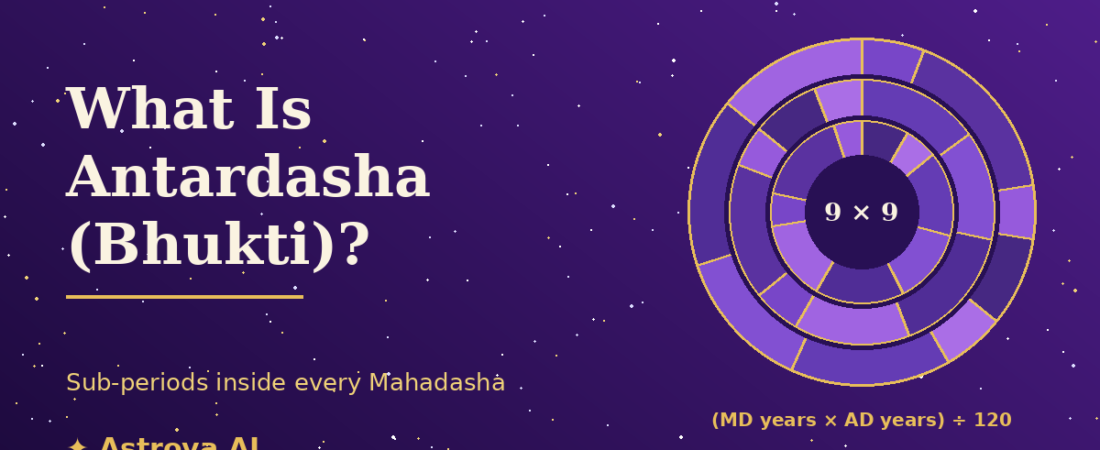
Antardasha, also called bhukti, is a sub-period inside a Mahadasha in the Vimshottari Dasha system. Every Mahadasha splits into nine antardashas, one per planet, starting with the Mahadasha planet itself. Each lasts (Mahadasha years × Antardasha planet’s years) ÷ 120, so it runs from about three months to just over three years.
Key takeaways
- What it is: the second level of your dasha timeline. Mahadasha → Antardasha (bhukti) → Pratyantardasha.
- Order: the first antardasha belongs to the Mahadasha planet. The rest follow the fixed order Ketu, Venus, Sun, Moon, Mars, Rahu, Jupiter, Saturn, Mercury.
- Formula: Mahadasha years × Antardasha planet’s years ÷ 120. Rahu–Moon = 18 × 10 ÷ 120 = 1.5 years.
- Range: shortest Sun–Sun (about 3 months 18 days), longest Venus–Venus (3 years 4 months).
- How it is read: a blend of two planets. The antardasha planet’s own placement, and where it sits from the Mahadasha planet, shape the reading.
- Not science: the arithmetic is fixed, but the predictions are traditional readings, not tested facts.
See your current Mahadasha and Antardasha free in Astrova AI
If someone has told you that you are “in Rahu–Saturn” or “Rahu ki mahadasha mein Shani ki antardasha”, they were naming two planets: the Mahadasha and the Antardasha running inside it. A Mahadasha can last up to 20 years, which is too long to explain why one year feels so different from the next. The antardasha is the part of the system that answers that question. This guide explains what an antardasha is, how its length is worked out, the full table of all 81 combinations, how to find yours, a worked example, and how astrologers read it.
Mahadasha, Antardasha and Pratyantardasha: the three levels
Vimshottari Dasha is the 120-year planetary timeline used in most Vedic astrology. It nests like boxes inside boxes. Wikipedia’s summary puts it simply: each mahadasha is divided into antar-dashas or bhuktis, and each of those into pratyantar-dashas, in the same order and with the same proportions (Dasha (astrology), Wikipedia). For the big picture first, read what Vimshottari Dasha is and how to read it.
| Mahadasha | Antardasha (bhukti) | Pratyantardasha | |
|---|---|---|---|
| Level | Main period | Sub-period | Sub-sub-period |
| How many | 9 in the 120-year cycle | 9 inside each Mahadasha (81 in all) | 9 inside each Antardasha |
| Typical length | 6 to 20 years | About 3 months to 3 years 4 months | About 5 days to about 6½ months |
| What astrologers use it for | The broad theme of a stretch of life | Which planet is “active” this year | Narrowing a timing window to weeks or months |
Below the pratyantardasha, tradition also defines sookshma and prana dashas, but these depend on an extremely accurate birth time and are rarely used in everyday readings.
How antardasha length is calculated
Brihat Parashara Hora Shastra (BPHS), the main classical text on dashas, gives the rule in one verse: multiply the dasha’s years by each planet’s own years and divide by the total of the full cycle (BPHS 51.1, VedicPupil). The next verse says the dasha lord’s own sub-period comes first and the others follow in order (BPHS 51.2, VedicPupil). In plain terms:
Antardasha length = Mahadasha planet’s years × Antardasha planet’s years ÷ 120
The nine full periods are fixed: Ketu 7, Venus 20, Sun 6, Moon 10, Mars 7, Rahu 18, Jupiter 16, Saturn 19 and Mercury 17 years, 120 in all. Three quick examples:
- Jupiter–Saturn: 16 × 19 ÷ 120 = 2.533 years, about 2 years 6 months 12 days.
- Saturn–Moon: 19 × 10 ÷ 120 = 1.583 years, about 1 year 7 months.
- Venus–Rahu: 20 × 18 ÷ 120 = exactly 3 years.
The nine antardashas always add back up to the full Mahadasha. A pratyantardasha uses the same idea one level down: Mahadasha years × Antardasha years × Pratyantardasha planet’s years ÷ 14,400 (that is, 120 × 120).
One thing confuses many people: classical tables use a 360-day year (12 months of 30 days), while many apps use a calendar year of about 365.25 days. Both give the same proportions, but the exact dates can drift apart by days or weeks.
Full antardasha table: all 81 sub-periods
Find your Mahadasha in the left column. Read across for each antardasha’s length. Inside any Mahadasha, start with that planet’s own column, then continue in the order of the columns, wrapping back to Ketu. Lengths use the traditional 360-day year (y = years, m = months, d = days).
| Mahadasha ↓ / Antardasha → | Ketu | Venus | Sun | Moon | Mars | Rahu | Jupiter | Saturn | Mercury |
|---|---|---|---|---|---|---|---|---|---|
| Ketu (7 y) | 4m 27d | 1y 2m | 4m 6d | 7m | 4m 27d | 1y 18d | 11m 6d | 1y 1m 9d | 11m 27d |
| Venus (20 y) | 1y 2m | 3y 4m | 1y | 1y 8m | 1y 2m | 3y | 2y 8m | 3y 2m | 2y 10m |
| Sun (6 y) | 4m 6d | 1y | 3m 18d | 6m | 4m 6d | 10m 24d | 9m 18d | 11m 12d | 10m 6d |
| Moon (10 y) | 7m | 1y 8m | 6m | 10m | 7m | 1y 6m | 1y 4m | 1y 7m | 1y 5m |
| Mars (7 y) | 4m 27d | 1y 2m | 4m 6d | 7m | 4m 27d | 1y 18d | 11m 6d | 1y 1m 9d | 11m 27d |
| Rahu (18 y) | 1y 18d | 3y | 10m 24d | 1y 6m | 1y 18d | 2y 8m 12d | 2y 4m 24d | 2y 10m 6d | 2y 6m 18d |
| Jupiter (16 y) | 11m 6d | 2y 8m | 9m 18d | 1y 4m | 11m 6d | 2y 4m 24d | 2y 1m 18d | 2y 6m 12d | 2y 3m 6d |
| Saturn (19 y) | 1y 1m 9d | 3y 2m | 11m 12d | 1y 7m | 1y 1m 9d | 2y 10m 6d | 2y 6m 12d | 3y 3d | 2y 8m 9d |
| Mercury (17 y) | 11m 27d | 2y 10m | 10m 6d | 1y 5m | 11m 27d | 2y 6m 18d | 2y 3m 6d | 2y 8m 9d | 2y 4m 27d |
For what tradition says about each Mahadasha and its sub-periods, see Ketu, Venus (Shukra), Sun, Moon, Mars, Rahu, Jupiter, Saturn (Shani) and Mercury.
How to find your current antardasha
- Get exact birth details: date, time and place. The Moon moves about half a degree an hour, so the time matters.
- Find the Moon’s nakshatra. Its ruling planet gives your first Mahadasha. See the 27 nakshatras.
- Work out the balance at birth. Each nakshatra spans 13°20′. The share of it the Moon still had to cross, times the planet’s years, is how much of the first Mahadasha was left.
- Lay out the Mahadashas in order from that point, then split the one running today into its nine antardashas with the formula.
- Or skip the maths: a free Kundli calculator does steps 2 to 4 in seconds and shows dates for every level.
Worked example (illustrative)
This chart is made up to show the method. It is not a real person and not a prediction.
Say someone was born on 15 January 1999 with the Moon at 16°40′ Taurus. That is the exact middle of Rohini nakshatra (10°00′ to 23°20′ Taurus), which is ruled by the Moon. Half of Rohini was still ahead, so half of the Moon’s 10 years, 5 years, was left at birth.
- Mahadashas: Moon to age 5, Mars 5 to 12, then Rahu from age 12 to 30, then Jupiter from 30.
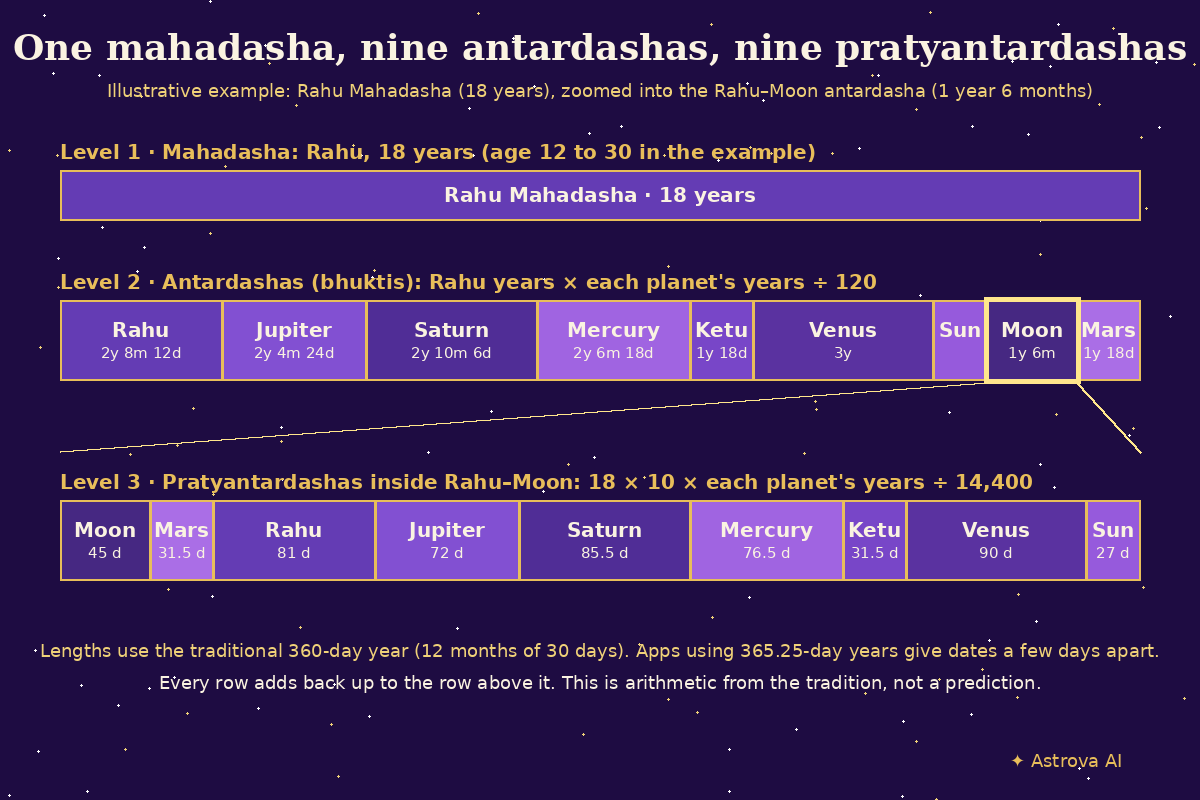
- Antardashas inside Rahu: starting with Rahu itself, in the fixed order.
| Antardasha | Length | Age | Approx. dates (365.25-day years) |
|---|---|---|---|
| Rahu–Rahu | 2 years 8 months 12 days | 12 to 14 y 8 m | Jan 2011 to Sep 2013 |
| Rahu–Jupiter | 2 years 4 months 24 days | 14 y 8 m to 17 y 1 m | Sep 2013 to Feb 2016 |
| Rahu–Saturn | 2 years 10 months 6 days | 17 y 1 m to 19 y 11 m | Feb 2016 to Dec 2018 |
| Rahu–Mercury | 2 years 6 months 18 days | 19 y 11 m to 22 y 6 m | Dec 2018 to Jul 2021 |
| Rahu–Ketu | 1 year 18 days | 22 y 6 m to 23 y 7 m | Jul 2021 to Aug 2022 |
| Rahu–Venus | 3 years | 23 y 7 m to 26 y 7 m | Aug 2022 to Aug 2025 |
| Rahu–Sun | 10 months 24 days | 26 y 7 m to 27 y 5 m | Aug 2025 to Jun 2026 |
| Rahu–Moon (running on 28 Oct 2026) | 1 year 6 months | 27 y 5 m to 28 y 11 m | Jun 2026 to Dec 2027 |
| Rahu–Mars | 1 year 18 days | 28 y 11 m to 30 | Dec 2027 to Jan 2029 |
So on 28 October 2026, at age 27, this person would be in Rahu Mahadasha, Moon Antardasha. Splitting Rahu–Moon once more gives its pratyantardashas: Moon 45 days, Mars 31.5 days, Rahu 81 days, Jupiter 72 days, Saturn 85.5 days, Mercury 76.5 days, Ketu 31.5 days, Venus 90 days, Sun 27 days. On that date the Rahu pratyantardasha would be running (about 14 Sep 2026 to 5 Dec 2026), so a full label would be Rahu–Moon–Rahu.
Now the reading part. Say this chart has a Virgo ascendant, so the Moon in Taurus sits in the 9th house and rules the 11th (Cancer), and Rahu is in Sagittarius, the 4th house.
- The Moon’s own condition: Taurus is the Moon’s sign of exaltation, and the 9th is a trikona (one of the most favourable houses). Taken alone, that points to a supportive sub-period for learning, travel, gains and a calmer mind.
- The Moon’s position from Rahu: counting from Sagittarius, Taurus is the 6th sign. In its Rahu-dasha chapter, BPHS says a sub-period planet in the 6th, 8th or 12th from the dasha lord and joined with malefics brings loss of money and bodily trouble (BPHS 55.18, VedicPupil). In this example the Moon is not with any malefic, which many astrologers would count as softening the warning.
- The blend: an astrologer would weigh both. A common reading: good results through the 9th and 11th house themes, with extra care for health, routine and stress. That is a mixed period, not a “good” or “bad” label.
The point: the formula gives everyone the same dates, but the meaning depends on the whole chart. A generic list of good and bad antardashas cannot do that.
Get your full dasha timeline with dates in Astrova AI
How astrologers read an antardasha
Different schools add their own methods, but these classical principles come up again and again:
- The Mahadasha sets the stage. The antardasha planet works inside the Mahadasha planet’s theme, never on its own.
- The antardasha planet’s own chart condition: its sign, house, strength, and which houses it rules for your ascendant. A yogakaraka planet is usually read as helpful in its sub-periods.
- Where it sits from the Mahadasha planet. Kendras (1, 4, 7, 10) and trikonas (1, 5, 9) from the dasha lord are read as supportive. The 6th, 8th and 12th from it are read as hard, especially with malefics, a theme BPHS repeats across its antardasha chapters (BPHS 54.61, VedicPupil).
- The relationship between the two planets: natural friends, such as Jupiter and the Sun, are read as working together more easily than enemies, such as Saturn and the Sun.
- Transits as a trigger: many astrologers check whether slow planets like Saturn and Jupiter are touching the antardasha planet at the same time. See how transits affect your horoscope.
For a practical use of these rules, the 7th house marriage timing guide shows how the antardasha of the 7th lord is used to look for marriage windows.
Tradition vs science
The system is consistent as a tradition. The order of planets, the 120-year cycle and the antardasha formula come from classical texts and are pure arithmetic. Two correct calculators fed the same birth details, year length and ayanamsa will give the same sub-periods.
The predictions are not proven. Whether a Rahu–Moon or Saturn–Venus sub-period actually brings a job change, a move or a marriage is a different question. Astrology has not shown predictive power in controlled tests and is generally considered a pseudoscience by scientists (Astrology and science, Wikipedia). Use your dasha timeline for reflection and planning, not as a reason to fear a period, and not in place of medical, financial or legal advice.
If you want to see your own Mahadasha, Antardasha and Pratyantardasha dates, Astrova AI’s free Janam Kundli shows them with your Lagna, Rashi and Nakshatra, and you can ask follow-up questions in the AI astrologer chat.
FAQs
What is the difference between Mahadasha and Antardasha?
A Mahadasha is the main planetary period, lasting 6 to 20 years depending on the planet. An Antardasha (also called bhukti) is one of the nine sub-periods inside it. Astrologers read the Mahadasha as the broad theme of those years and the Antardasha as the part of that theme that is most active for the next few months or years.
Which is more important, Mahadasha or Antardasha?
Tradition reads them together. The Mahadasha sets the overall direction, so it carries more weight over a long stretch of life. The Antardasha decides which planet is shaping things right now, so it often matters more for a specific question this year. An Antardasha is never read on its own, without its Mahadasha.
How long does an Antardasha last?
It depends on the two planets. The length is the Mahadasha planet’s years times the Antardasha planet’s years, divided by 120. The shortest is Sun–Sun at about 3 months 18 days. The longest is Venus–Venus at 3 years 4 months. Most last between a few months and about three years.
How do I find my current Antardasha?
You need your date, exact time and place of birth. These fix the Moon’s nakshatra and how far it had moved through it, which sets your dasha balance at birth. A free Kundli app such as Astrova AI then lists every Mahadasha and Antardasha with start and end dates, so you can see which pair is running today.
Why do different apps show different Antardasha dates?
Usually because of the year length (360 days or about 365.25 days), the ayanamsa (Lahiri is the most widely used in India), or a slightly different birth time. The Moon moves about half a degree an hour, so a small time error moves every date. A difference of a few days to a few weeks between apps is normal.
Download Astrova AI on Google Play
Free Janam Kundli with Vimshottari Dasha, daily Rashifal and 24/7 AI astrologer chat in 9 Indian languages. For entertainment and self-reflection.
Sources and further reading: BPHS 51.1, antardasha formula (VedicPupil) · BPHS 51.2, antardasha order (VedicPupil) · BPHS 55.18 (VedicPupil) · BPHS 54.61 (VedicPupil) · Dasha (astrology) (Wikipedia) · Astrology and science (Wikipedia)