What Is Budhaditya Yoga in Your Kundli — and Why Does the Union of Sun and Mercury Create One of the Most Powerful Intelligence Combinations in Vedic Astrology?
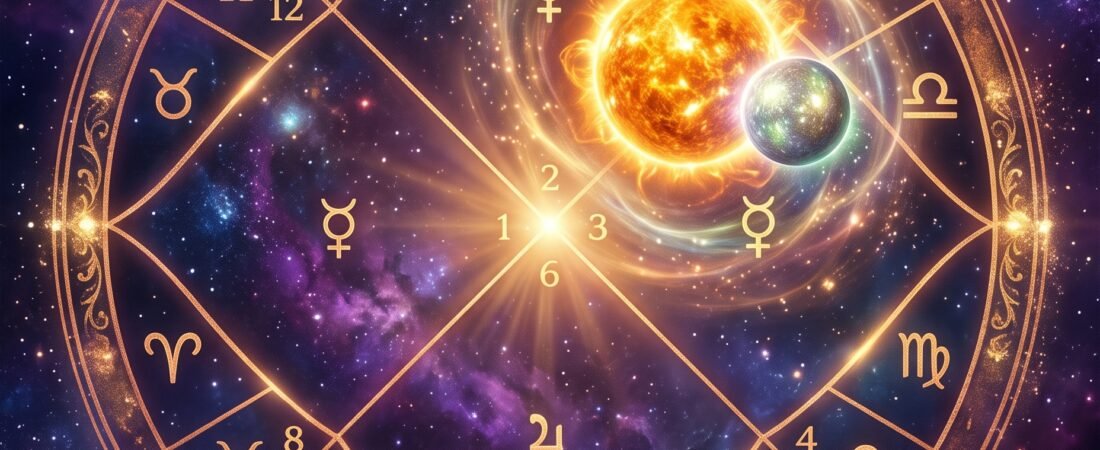
If you have ever wondered why some people seem to think faster, speak more persuasively, and learn any skill with unusual ease — Vedic astrology has a specific answer. It is called Budhaditya Yoga (बुधादित्य योग), and it forms when the Sun (Surya) and Mercury (Budha) converge in the same house of your birth chart. This conjunction is also known as Buddhi Yoga — the yoga of intelligence — and it is considered one of the most auspicious planetary combinations for academic success, sharp communication, and analytical brilliance.
🔮 Discover Your Budhaditya Yoga — 100% FREE
AI-powered Kundli analysis in 9 Indian languages
⭐ 4.5 rated · 100% FREE · No credit card
In this guide, we break down exactly what Budhaditya Yoga means, how to identify it in your Kundli, what effects it produces across different houses, and the classical textual sources that have described this yoga for thousands of years. Whether you are a beginner exploring Vedic astrology or someone who already has a Janam Kundli and wants to understand a specific planetary combination, this article will give you a clear, practical answer.
What Exactly Is Budhaditya Yoga?
Budhaditya Yoga is a Graha Yoga (planetary combination) that forms when Surya (the Sun) and Budha (Mercury) occupy the same zodiac sign and house in a person’s Janam Kundli (birth chart). The name itself tells you what it is: Budha means Mercury, and Aditya means the Sun. When these two celestial bodies come together in your chart, they create a fusion of the Sun’s soul, authority and leadership with Mercury’s intelligence, communication and analytical ability.
According to the Brihat Parashara Hora Shastra (BPHS), one of the foundational texts of Vedic astrology composed by Sage Parashara, this yoga is classified among the Mahapurusha-adjacent yogas because of its capacity to produce exceptional intellectual ability. Parashara notes that Mercury, being a neutral and adaptable planet, takes on the qualities of whichever planet it conjoins with — but when it joins the Sun, the result is particularly auspicious because the Sun’s royal dignity elevates Mercury’s intellectual gifts rather than overpowering them.
The Astrological Logic: Why Sun + Mercury = Intelligence
To understand why this conjunction is so powerful, you need to understand what each planet represents in Vedic astrology:
| Planet | Represents | Body Part | Key Quality |
|---|---|---|---|
| Sun (Surya) | Soul, authority, father, government, confidence | Heart, bones, right eye | Leadership, willpower, fame |
| Mercury (Budha) | Intelligence, speech, mathematics, commerce, learning | Nervous system, skin, arms | Quick thinking, adaptability, wit |
| Combined (Budhaditya) | Brilliant intellect + authoritative expression | Enhanced nervous + cardiovascular vitality | Genius-level learning, persuasive speech, fame through knowledge |
Think of it this way: the Sun is the king who commands, and Mercury is the minister who advises. When they work together in the same house, you get a mind that is both sharp enough to analyse any problem and confident enough to present its conclusions with authority. This is why people with Budhaditya Yoga often excel in fields that require both deep knowledge and public communication — teaching, law, journalism, science, writing, and leadership roles.
How to Check If You Have Budhaditya Yoga in Your Kundli
Identifying this yoga is straightforward once you have your Janam Kundli. Here is the step-by-step process:
Step 1: Generate your Kundli. You need your exact date of birth, time of birth, and place of birth. These three data points determine the positions of all planets at the moment you were born. You can generate a free Janam Kundli using the Astrova AI app in under 60 seconds.
Step 2: Locate the Sun and Mercury. In your Kundli chart (the North Indian diamond or South Indian box format), find where the Sun (☉) and Mercury (☿) are placed. If they are in the same house — meaning the same zodiac sign — the conjunction exists.
Step 3: Check the degree of closeness. The yoga is strongest when the two planets are within a few degrees of each other (called exact conjunction). If they are in the same sign but many degrees apart, the effect is milder but still present.
Step 4: Note which house the conjunction falls in. This is critical — the house determines where in your life the intelligence and success will manifest. A Budhaditya Yoga in the 2nd house affects speech and wealth; in the 5th house, it affects creativity and children; in the 10th house, it affects career and public reputation.
Step 5: Check for combustion (Astangata). There is an important exception. If Mercury is too close to the Sun (within about 14 degrees, according to classical texts), Mercury can become combust — its qualities get overshadowed by the Sun’s intensity. In that case, the yoga weakens significantly. The ideal Budhaditya Yoga has Mercury close enough to conjoin but far enough to remain uncombust.
Budhaditya Yoga in the 12 Houses: What Each Placement Means
The house placement of Budhaditya Yoga determines how its intelligence manifests in your life. Here is a concise reference:
| House | Area of Life | Effect of Budhaditya Yoga |
|---|---|---|
| 1st House | Personality, self | Brilliant personality, magnetic speaker, quick learner, natural leader |
| 2nd House | Wealth, speech, family | Eloquence brings wealth, persuasive in business, financial intelligence |
| 3rd House | Courage, communication, siblings | Bold communicator, success through writing or media, strategic thinking |
| 4th House | Home, mother, emotional foundation | Intelligent decisions about property and home life, scholarly mother |
| 5th House | Creativity, education, children | Exceptional academic success, creative genius, brilliant children |
| 6th House | Service, health, enemies | Analytical problem-solver, wins disputes through intelligence, healing knowledge |
| 7th House | Partnership, marriage, business | Intelligent partner choices, success through business partnerships, diplomatic |
| 8th House | Transformation, research, occult | Deep research ability, interest in hidden knowledge, investigative mind |
| 9th House | Fortune, dharma, higher learning | Spiritual intelligence, success in law and philosophy, fortunate through knowledge |
| 10th House | Career, reputation, public life | Fame through intellect, leadership in knowledge-based fields, respected authority |
| 11th House | Gains, social network, aspirations | Intelligent social connections, wealth through communication, goal achievement |
| 12th House | Spirituality, foreign lands, liberation | Scholarly spiritual pursuits, success in foreign lands, contemplative intelligence |
Classical Sources and Textual References
Budhaditya Yoga is not a modern invention. It appears in several classical Jyotish texts that have been studied for centuries:
- Brihat Parashara Hora Shastra (BPHS) — Chapter 47, where Parashara describes various planetary yogas including combinations involving the Sun and Mercury. The text states that this yoga produces a person who is “learned, wise, and honoured by the king.”
- Phaladeepika by Mantreswara — A later classical text that elaborates on the effects of planetary conjunctions and confirms the auspicious nature of the Sun-Mercury union when Mercury is not combust.
- Saravali by Kalyana Varman — Describes the nuanced effects of Budhaditya Yoga across different signs and houses, noting that the results vary based on the zodiac sign in which the conjunction occurs.
- Jataka Parijata by Vaidyanatha Dikshita — Another authoritative commentary that discusses the conditions under which this yoga reaches its full expression.
These texts are available through the Internet Archive and through published translations by scholars such as N.N. Krishna Rau and V. Sesha Iyer (BPHS, 1982 edition).
Important Conditions That Strengthen or Weaken Budhaditya Yoga
Not every Sun-Mercury conjunction produces the same result. Several conditions modify the yoga’s strength:
Strengthening conditions:
- Mercury is in its own sign (Gemini or Virgo) during the conjunction — especially powerful in Virgo, Mercury’s exaltation sign
- The conjunction is aspected by Jupiter (the planet of wisdom), which adds depth to the intellectual gifts
- The yoga falls in a Kendra house (1st, 4th, 7th, or 10th) or Trikona house (1st, 5th, or 9th)
>The Sun is strong (in Aries, Leo, or Scorpio) and not debilitated in Libra
Weakening conditions:
- Mercury is combust (within ~14 degrees of the Sun) — its intelligence gets “burned” by the Sun’s heat
- The conjunction falls in the 6th, 8th, or 12th house (dusthana houses) without benefic aspects
- Saturn or Rahu aspects the conjunction, introducing delay, obstruction, or unconventional thinking
- The Sun is debilitated in Libra, reducing the authority component of the yoga
How Astrova AI Helps You Understand Budhaditya Yoga in Your Chart
Reading a Kundli manually can be overwhelming if you are new to Vedic astrology. Here is how Astrova AI simplifies the process:
- Instant Kundli generation: Enter your birth details and get your complete Janam Kundli in under 60 seconds, with all planetary positions calculated using the Swiss Ephemeris
- AI-powered yoga detection: The Astrova AI astrologer can identify Budhaditya Yoga in your chart and explain what it means for your specific life areas, in plain language
- 9 Indian languages: Read your analysis in Hindi, Tamil, Telugu, Kannada, Malayalam, Bengali, Marathi, Gujarati, or English
- 24/7 AI astrologer chat: Ask follow-up questions like “What does my Budhaditya Yoga in the 10th house mean for my career?” and get instant, personalized answers
- 100% free core features: Kundli generation, daily Rashifal, and basic yoga identification are all available at no cost
🔮 Get Your Free Kundli Analysis Now
Find out if you have Budhaditya Yoga — and what it means for you
⭐ 4.5 rated · 100% FREE · No credit card
Frequently Asked Questions About Budhaditya Yoga
1. How common is Budhaditya Yoga?
The Sun and Mercury are relatively close in the sky (Mercury never strays more than about 28 degrees from the Sun), so they do conjoin frequently. However, the yoga is considered fully effective only when Mercury is not combust, which narrows the window. Roughly 15-20% of charts may have a functional Budhaditya Yoga, depending on the orb used.
2. Can Budhaditya Yoga form if Mercury is retrograde?
Yes, but classical texts suggest that a retrograde Mercury in conjunction with the Sun produces mixed results. The intelligence is still sharp, but the person may overthink or struggle to express their ideas confidently. The combustion rules still apply.
3. What is the difference between Budhaditya Yoga and Buddha-Aditya Yoga?
They are the same yoga. “Budhaditya” is simply a compound of “Budha” (Mercury) and “Aditya” (Sun). Some texts write it as two words (Buddha Aditya), others as one (Budhaditya). The meaning is identical.
4. Does Budhaditya Yoga guarantee success?
No yoga in Vedic astrology works in isolation. Budhaditya Yoga gives strong intellectual potential, but its results depend on the overall chart strength, the house placement, dasha periods running, and the person’s efforts. Think of it as a powerful tool — you still need to use it.
5. What remedies can strengthen a weak Budhaditya Yoga?
If Mercury is combust or the yoga is weakened, traditional remedies include wearing a green emerald (Panna) on the right hand’s little finger on a Wednesday morning, reciting the Mercury Beej Mantra (“Om Bram Breem Broum Sah Budhaya Namah”) 108 times, and donating green moong dal on Wednesdays. However, consult a qualified astrologer before wearing any gemstone.
6. How is Budhaditya Yoga different from other intelligence yogas?
Saraswati Yoga is another intelligence yoga, but it involves Jupiter, Venus, and Mercury in specific kendras and trikonas. Budhaditya Yoga is simpler — it only requires two planets (Sun and Mercury) in conjunction — but it is more focused on analytical intelligence and communication, while Saraswati Yoga leans toward artistic and scholarly brilliance.
Quick Summary
- Budhaditya Yoga forms when the Sun and Mercury conjoin in the same house of your Kundli
- It is one of the most auspicious yogas for intelligence, communication, and analytical ability
- The house placement determines where in your life the intelligence manifests
- Mercury must not be combust for the yoga to reach full strength
- Classical texts including BPHS, Phaladeepika, and Saravali confirm its effects
- You can check your chart for this yoga instantly using the free Astrova AI app
Explore More Astrova Guides
Continue your Vedic astrology journey with these in-depth guides:
- What Is Raj Yoga in Your Kundli — and How to Know If You Have It
- What Is Vimshottari Dasha — and How to Read Your Planetary Periods
- Planetary Transits (Gochar) in Vedic Astrology — Complete Guide
- Navagraha: The 9 Planetary Deities of Vedic Astrology
- Kundli Milan — Marriage Compatibility Guide
- AI Astrology — Complete Guide to How It Works
📲 Download Astrova AI — 100% FREE
Kundli, Rashifal, Palm Reading, AI Astrologer — all in one app
Download Free on Google Play →
Available in 9 Indian languages · No credit card required
About the Author
Astrova AI Editorial Team — This article was researched and written by the Astrova AI editorial team, drawing on classical Vedic astrology texts including the Brihat Parashara Hora Shastra, Phaladeepika by Mantreswara, Saravali by Kalyana Varman, and Jataka Parijata by Vaidyanatha Dikshita. Our team combines traditional Jyotish scholarship with modern AI technology to make Vedic astrology accessible to everyone. Astrova AI is available free on Google Play in 9 Indian languages.
Have a correction or question? We welcome feedback. Reach us at support@theastrova.com
Related posts:
 How to read your own palm at home — step-by-step guide — Complete Guide 2026
 How to check your daily Rashifal using your Moon sign — step by step — Complete Guide 2026
 How to identify Kaalsarp Dosha in your Kundli — visual guide — Complete Guide 2026
How accurate is AI Kundli matching vs traditional astrologer matching? — Complete Guide 2026
How to identify Kaalsarp Dosha in your Kundli — visual guide — Complete Guide 2026
How accurate is AI Kundli matching vs traditional astrologer matching? — Complete Guide 2026