🔮 FREE AI ASTROLOGY READING
Discover What the Stars Have Written for You
Kundli • Palm Reading • Daily Rashifal • AI Astrologer — All Free
⭐⭐⭐⭐⭐ 100% FREE • No Credit Card
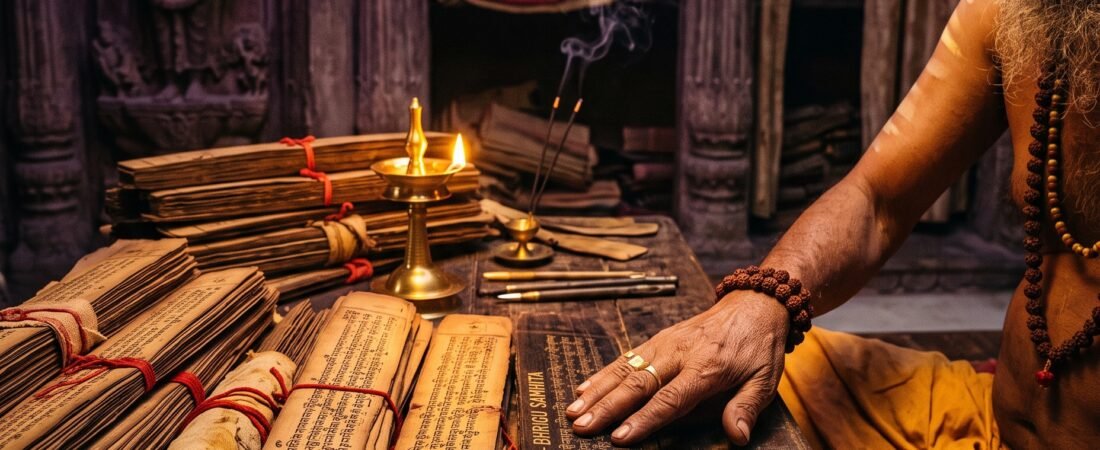
Thousands of years before computers existed, a Sage in ancient India wrote down the destinies of every person who would ever be born — on palm leaves. These leaves, called the Bhrigu Samhita, are among the most extraordinary and mysterious documents in the history of astrology. Some say they contain your life story, waiting to be found. But what exactly is the Bhrigu Samhita? How did one man write the futures of billions? And can these ancient predictions still be read today?
Who Was Sage Bhrigu and Why Did He Write the Future?
In Vedic tradition, Sage Bhrigu holds a position almost unique among the ancient Rishis. He is called the “Father of Hindu Astrology” — not because he invented it, but because he systematised it into a form that ordinary people could use. The Brihat Parashara Hora Shastra, one of the foundational texts of Jyotish (Vedic astrology), credits Bhrigu as the first to compile predictive techniques into a structured discipline.
But Bhrigu’s most legendary work goes far beyond a textbook. According to tradition, he performed intense tapasya (meditative austerity) and, through his yogic vision, perceived the past, present, and future of every soul that would take birth on Earth. He then wrote these destinies — birth details, life events, marriage, career, health, spiritual path — onto palm leaf manuscripts in the ancient Grantha script.
These manuscripts collectively became known as the Bhrigu Samhita.
The scale of this claim is staggering. If even partially true, it would represent the largest single act of astrological prediction in human history — a library of individualised horoscopes written centuries before the concept of a “birth chart” existed in the form we know today.
How Were the Bhrigu Samhita Palm Leaves Created?
The story of how these leaves came into existence varies across different traditions, but the most widely told version runs like this:
Bhrigu, after his great meditation, realised that humanity in the Kali Yuga (the current age, according to Hindu cosmology) would face increasing confusion, suffering, and spiritual disconnection. He foresaw that people would need guidance — not abstract philosophy, but specific, personal direction about their lives.
So he wrote. For what tradition describes as an extraordinarily long period, Bhrigu inscribed leaf after leaf with the life stories of individuals yet to be born. Each leaf contained:
- The person’s name, parents’ names, and place of birth
- Key life events — education, marriage, career milestones, children
- Periods of difficulty and their remedies
- Health tendencies and lifespan indicators
- Spiritual inclinations and karmic patterns
- The planetary periods (Dashas) governing each phase of life
When Bhrigu completed this monumental task, tradition says he entrusted the manuscripts to the Siddha community — a lineage of spiritually advanced seekers in South India, particularly in Tamil Nadu — who became the guardians and readers of these leaves across generations.
Where Are the Bhrigu Samhita Leaves Today?
The most famous collection of Bhrigu Samhita palm leaves is held in Vaitheeswaran Koil, a temple town in Tamil Nadu, India. This small town, whose name means “Temple of the God Who Heals,” has been the centre of Nadi astrology (palm leaf reading) for centuries.
Other collections are said to exist in:
- Thanjavur — the Saraswathi Mahal Library holds ancient manuscripts
- Chennai — private collectors and family lineages of Nadi readers
- Tiruvannamalai — near the Arunachaleshwara Temple
- Bali, Indonesia — a tradition of Bhrigu-based palm leaf reading exists there too
The exact number of surviving leaves is unknown. Some estimates suggest hundreds of thousands; others claim millions were originally written. Many were destroyed over centuries by war, humidity, insects, and colonial-era indifference to indigenous knowledge systems. What survives is a fraction of the original corpus.
How Does a Bhrigu Samhita Reading Actually Work?
The process of receiving a Bhrigu Samhita (or Nadi) reading follows a specific ritual that has barely changed in centuries:
| Step | What Happens |
|---|---|
| 1. Thumb impression | You provide a right-thumb impression (for men) or left-thumb impression (for women) on a piece of paper |
| 2. Bundle search | The Nadi reader bundles your thumb print with hundreds of others and uses it to narrow down which palm leaf bundle might contain your story |
| 3. Verification | The reader reads out general statements from the leaf — parents’ names, birth details, key life events — and you confirm or deny each one |
| 4. Full reading | Once enough details match, the reader goes through the entire leaf, covering your past, present, and predicted future |
| 5. Remedies | The leaf usually prescribes specific remedies — mantras, temple visits, charitable acts — to mitigate difficult planetary periods |
The verification step is crucial. If the reader cannot match enough personal details, they move on to another bundle. This process can take hours — and in some cases, people travel to Vaitheeswaran Koil multiple times before their leaf is found.
Is the Bhrigu Samhita Scientifically Valid?
This is where the honest answer gets complicated.
What is verifiable: The palm leaves are genuinely ancient. Carbon dating and palaeographic analysis of manuscripts in Tamil Nadu libraries confirm that many date back several centuries. The Grantha script used is consistent with South Indian manuscript traditions from the medieval period. The astrological techniques referenced in the leaves — Vimshottari Dasha, planetary transits, house analysis — are real Jyotish methods documented in texts like the Brihat Parashara Hora Shastra and the Phaladeepika.
What is contested: The claim that Bhrigu literally wrote the destinies of every person who would ever live is, from a scientific standpoint, untestable. No controlled study has verified that a Nadi reader can identify a stranger’s life details from a thumb impression at rates above chance. Skeptics point out that the verification process involves enough general statements and cold-reading techniques that confirmation bias can explain many “hits.”
What practitioners say: Thousands of people across India and the diaspora report experiences where the reader knew details they had never shared — a deceased parent’s name, a specific medical condition, the timing of a marriage. These anecdotal reports are numerous enough that the phenomenon cannot be dismissed as pure fabrication, even if individual cases may involve a mix of genuine insight, tradition, and suggestion.
The most intellectually honest position is that the Bhrigu Samhita tradition represents a genuine cultural and astrological heritage whose mechanisms are not fully explained by current science — and whose accuracy claims remain a matter of personal experience rather than laboratory proof.
What Can Modern Astrology Learn from the Bhrigu Samhita?
Whether or not you believe in the literal predictions on the palm leaves, the Bhrigu Samhita tradition offers several insights that remain relevant:
1. Astrology as Personal Guidance, Not Entertainment
Modern sun-sign horoscopes in newspapers and apps treat astrology as light entertainment. The Bhrigu tradition treats it as something far more serious — a map of your specific karmic journey. This framing reminds us that Vedic astrology was originally designed as a tool for self-understanding and spiritual growth, not daily amusement.
2. The Importance of Remedies
Every Bhrigu leaf includes remedies — not as superstition, but as practical actions aligned with planetary energies. Mantras for Saturn, charitable acts for Rahu, temple visits for Mars. Modern astrology often skips this dimension, but the remedial framework is an integral part of the Jyotish system.
3. Individualised Prediction Over Generalisation
The Bhrigu approach is the opposite of “all Scorpios will have a good month.” Each leaf is written for one specific person, with their specific birth data and life circumstances. This is the same principle behind a proper Kundli reading — your chart is yours alone, and no generic forecast can replace it.
4. The Intersection of Karma and Free Will
Perhaps the most profound teaching embedded in the Bhrigu Samhita is this: the leaves describe what will happen, but they also prescribe what you can do about it. The destiny is written, but the remedies suggest that human effort and spiritual practice can modify the expression of karmic patterns. This balance between fate and free will is central to Hindu philosophy.
How to Explore Your Own Astrological Path Today
You do not need to travel to Tamil Nadu or find a Nadi reader to begin understanding your astrological blueprint. The same Vedic principles that the Bhrigu Samhita is built on — planetary positions, house analysis, Dasha periods, transit effects — are available to you right now through modern tools.
What has changed is accessibility. Where once you needed a family priest or a village astrologer, today you can generate your complete Kundli, check your Dasha periods, read your daily Rashifal based on your Moon sign, and even consult an AI astrologer — all from your phone, for free.
The Bhrigu Samhita reminds us that astrology is ancient, deep, and personal. But you do not need a palm leaf to start your journey. You need your birth details and the willingness to look.
✨ ASTROVA AI — YOUR PERSONAL ASTROLOGER
Generate your Kundli, check your Dasha periods, and get personalised readings — all free
Frequently Asked Questions
Is the Bhrigu Samhita the same as Nadi astrology?
They are closely related but not identical. The Bhrigu Samhita refers specifically to the collection of palm leaves attributed to Sage Bhrigu. Nadi astrology is the broader tradition of palm leaf reading in South India, which includes leaves attributed to other Rishis as well — such as Agastya, Korakkar, and Bogar. In practice, most readers use the terms interchangeably.
Can anyone find their Bhrigu Samhita leaf?
Tradition says that not everyone’s leaf survives — many were lost or destroyed over centuries. Practitioners also believe that you can only find your leaf when you are karmically ready to receive the guidance. Whether this is a spiritual truth or a practical limitation of the surviving manuscript corpus, the result is the same: not everyone who seeks a reading will find their leaf.
How much does a Bhrigu Samhita reading cost?
Readers in Vaitheeswaran Koil typically charge between ₹500 and ₹5,000 depending on the depth of reading and whether additional leaves (covering specific topics like marriage or career) are retrieved. Some readers charge per bundle searched. Always clarify the fee structure before beginning.
Is Bhrigu Samhita astrology the same as the Kundli system?
The underlying astrological science is the same — both use Vedic (sidereal) astrology with planetary positions, houses, and Dasha periods. The difference is in delivery: a Kundli is calculated from your birth data using established texts and software, while a Bhrigu reading claims to read a pre-written leaf specific to you. Both are valid approaches within the Jyotish tradition.
Can AI astrology replace a Bhrigu Samhita reading?
AI astrology and Nadi readings serve different needs. AI tools like Astrova can instantly generate your Kundli, calculate your Dasha periods, analyse planetary transits, and provide personalised readings based on classical Vedic principles — all with the precision of astronomical calculations. A Nadi reading offers something different: the experience of a human reader interpreting an ancient manuscript. They complement rather than replace each other.
Explore More Astrova Guides
- What Is Vimshottari Dasha and How to Read Your Planetary Periods
- Kundli Milan — The Complete Marriage Compatibility Guide
- Sade Sati Explained — What It Is and Powerful Remedies
- Navagraha — The 9 Planetary Deities of Vedic Astrology
- AI Palm Reading — The Complete Guide
- AI Astrology — The Complete Guide
About the Author
Astrova AI Editorial
The Astrova AI Editorial team combines expertise in Vedic astrology (Jyotish), classical texts including the Brihat Parashara Hora Shastra and Phaladeepika, and modern AI technology to make authentic astrological guidance accessible to everyone. Our content is reviewed against traditional sources including the Bhrigu Samhita tradition, the Jataka Parijata, and the Surya Siddhanta.
Have a correction or question? We welcome feedback. Reach us at support@theastrova.com
🔮 START YOUR ASTROLOGICAL JOURNEY TODAY
Astrova AI — Free Kundli, Rashifal & AI Astrologer
Available in 9 Indian languages • 100% Free • No Credit Card Required
Related posts:
 How to Read Palm Lines for Beginners – Step by Step Guide
 Why Do Hindu Festivals Fall on Specific Dates? The Astrological Science Behind Muhurat Timing
 What Do the Mounts on Your Palm Reveal About Your Personality? Complete Guide
 What Your Finger Length Ratios Reveal About Your Personality — The Science of 2D:4D