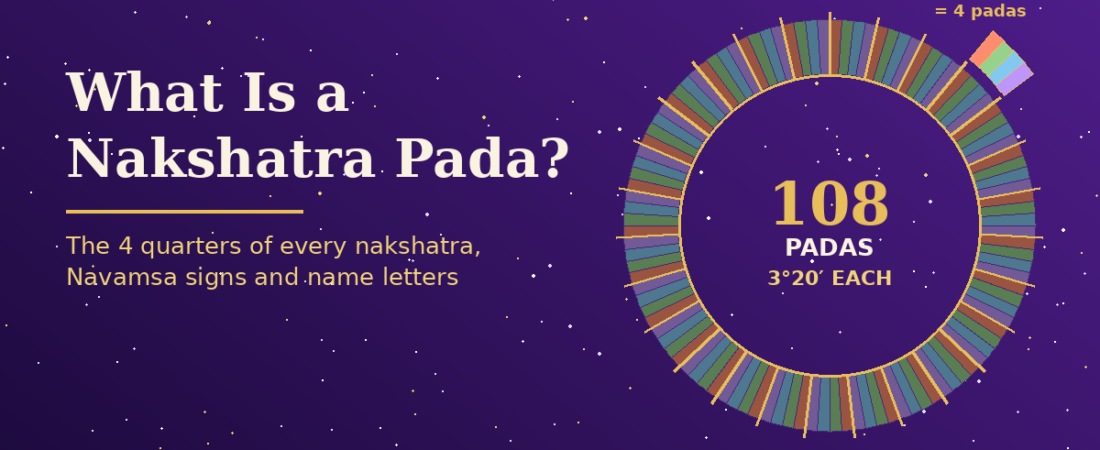
A nakshatra pada (also called a charan) is one quarter of a nakshatra. Each of the 27 nakshatras spans 13°20′ of the sidereal zodiac, so each pada is 3°20′ wide, making 108 padas in all. Your birth pada is the quarter the Moon was in when you were born.
Key takeaways
- Size: 1 nakshatra = 13°20′ = 4 padas of 3°20′. 27 × 4 = 108 padas around the zodiac.
- Navamsa link: 3°20′ is also one ninth of a sign, so each pada is exactly one Navamsa (D9) division.
- Name letter: tradition gives every pada a syllable, used for the first sound of a baby’s name.
- Time-sensitive: the Moon stays in a pada for only about 5 to 7 hours, so birth time matters.
- No “best” pada: a pada colours the reading of a nakshatra; it is not a luck score.
- Tradition, not science: the degrees are exact astronomy; the meanings are Jyotish custom.
Find your nakshatra and pada in Astrova AI
Your kundli might say “Rohini, pada 3” or “Ashwini charan 2”. The nakshatra part is familiar to most people, but the pada number is often skipped. It matters more than it looks. It decides your Navamsa sign, the syllable suggested for your name, and sometimes even your Moon sign. This guide explains what a pada is, how to work it out, and where it is used.
What is a nakshatra pada?
The zodiac is a 360° circle. Jyotish divides it into 27 equal nakshatras of 13°20′ each, and each nakshatra into four quarters called padas of 3°20′ (Wikipedia: Nakshatra; Wikipedia: Hindu astrology). Pada is Sanskrit for “foot” or “step”, and Britannica notes that the padas are thought to add astrological specificity, giving 27 × 4 = 108 divisions (Britannica). That is one reason the number 108 is treated as sacred.
When people say “my pada” they nearly always mean the pada of the Moon at birth, the same point that gives the birth nakshatra. But every planet and the Lagna (ascendant) also sits in some pada, and astrologers use those too.
| Pada | Degrees inside the nakshatra | Navamsa sign falls in | Popular reading (one school) |
|---|---|---|---|
| 1 | 0° to 3°20′ | A fire sign (Aries, Leo or Sagittarius) | Dharma: purpose, initiative |
| 2 | 3°20′ to 6°40′ | An earth sign (Taurus, Virgo or Capricorn) | Artha: work, resources |
| 3 | 6°40′ to 10° | An air sign (Gemini, Libra or Aquarius) | Kama: desire, relationships |
| 4 | 10° to 13°20′ | A water sign (Cancer, Scorpio or Pisces) | Moksha: the inner life, letting go |
The third column is plain arithmetic: because 108 padas run through the 12 signs nine times, pada 1 always lands in a fire sign, pada 2 in earth, and so on. The last column is an interpretive layer that many modern teachers use. It follows from the element pattern, but it is not a rule every astrologer applies.
Why a pada is the same as a Navamsa
The Navamsa (D9) chart splits each 30° sign into nine parts of 3°20′. A pada is also 3°20′, and the boundaries line up, so each of the 108 padas is one Navamsa division. The Navamsa signs simply run in zodiac order, Aries to Pisces and round again: Ashwini’s four padas are Aries, Taurus, Gemini and Cancer; Bharani’s start again at Leo; and Krittika’s first pada is Sagittarius.
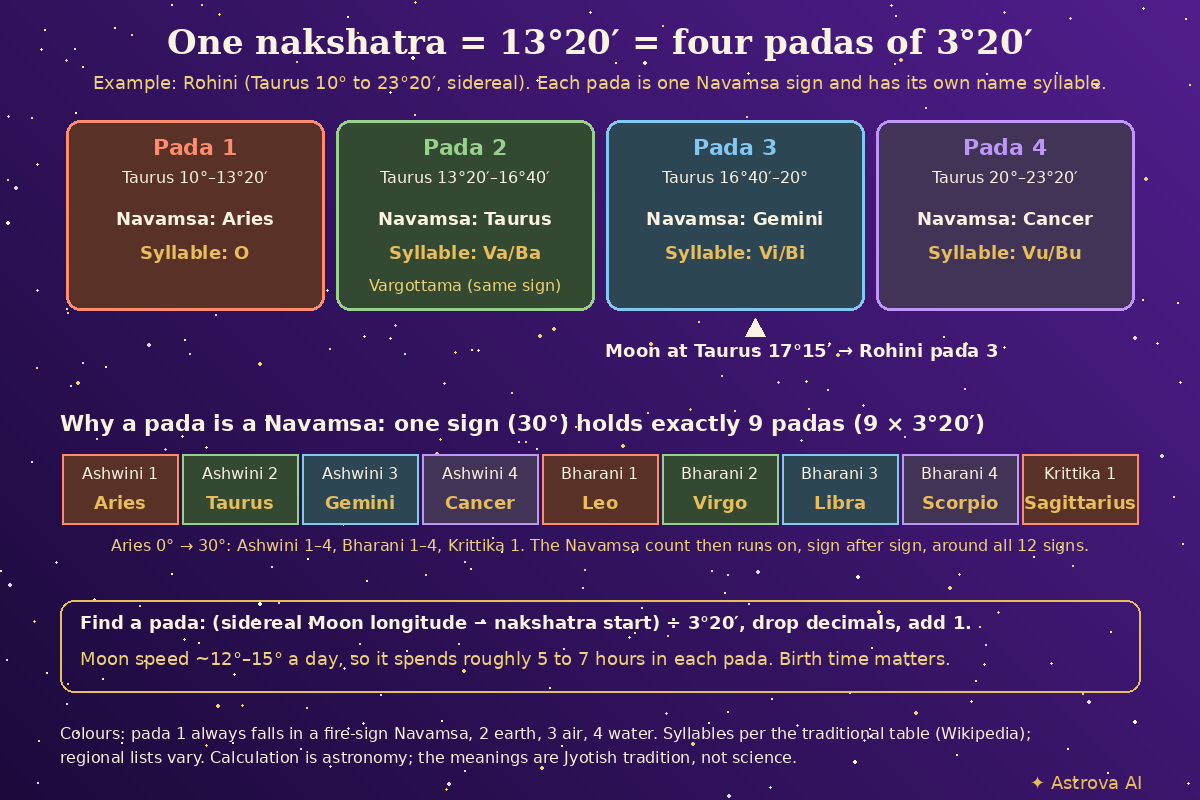
Two useful results follow. First, when a pada’s Navamsa sign is the same as its rashi sign, the planet there is called vargottama, which tradition treats as a steadier placement. That happens in 12 of the 108 padas, for example Ashwini pada 1 (Aries in Aries) and Rohini pada 2 (Taurus in Taurus). Second, nine nakshatras straddle two signs: Krittika, Mrigashira, Punarvasu, Uttara Phalguni, Chitra, Vishakha, Uttara Ashadha, Dhanishta and Purva Bhadrapada. For these, the pada also tells you which sign the Moon is in.
How to find your nakshatra pada: step by step
- Get the Moon’s sidereal longitude from a Vedic kundli, using your exact birth date, time and place. Write it as 0° to 360° (Taurus 17° = 30° + 17° = 47°).
- Find the nakshatra: divide by 13.333 (13°20′), drop the decimals and add 1. Look the number up in the table below.
- Find how far into the nakshatra you are: subtract the nakshatra’s starting degree.
- Find the pada: divide that remainder by 3.333 (3°20′), drop the decimals and add 1. The answer is 1, 2, 3 or 4.
- Read the row: the table gives the Navamsa sign and the traditional name syllable for that pada.
Use sidereal (nirayana) positions, as every Vedic Panchang does. Western tropical positions sit roughly 24° further along today, which is more than seven padas away.
Worked examples (illustrative)
These are made-up Moon positions chosen to show the method. They are not anyone’s real chart.
Example 1: Moon at Taurus 17°15′. That is 30° + 17°15′ = 47°15′. 47.25 ÷ 13.333 = 3.5, so three nakshatras are complete and the 4th, Rohini, is running. Rohini starts at 40°, so the Moon is 7°15′ in. 7.25 ÷ 3.333 = 2.2, so the pada is 3 (6°40′ to 10°). The table gives Gemini Navamsa and the syllable Vi (or Bi), so a family following the custom might pick a name such as Vikram or Vidya.
Example 2: a boundary birth. Suppose a Moon at Cancer 29° (119°). It is in Ashlesha pada 4: Pisces Navamsa, syllable Do. Move the Moon just 2° on to Leo 1° (121°) and it is in Magha pada 1: Aries Navamsa, syllable Ma, and a different Moon sign as well. At an average speed of about 13° a day, those 2° take under four hours. This junction is also one of the three gandanta points, which is why astrologers double-check the birth time for anyone born near it.
Where the pada is used
- Naming (naam akshar): each pada has a syllable, and the Moon’s pada at birth suggests the first sound of the child’s name (Wikipedia). The same table lets astrologers guess a nakshatra from a name when the birth time is unknown.
- The Navamsa chart: a planet’s pada gives its D9 sign directly. The Navamsa is read for marriage and for the deeper strength of planets.
- Kundli Milan: in the Ashtakoot system, the kootas come from the Moon’s nakshatra and sign. For the nine split nakshatras, the pada decides the sign and so can change the score. Some traditions also ease Nadi dosha when two people share a nakshatra but not a pada.
- Finer reading: two people born under the same nakshatra can have different padas, and astrologers read them a little differently because the Navamsa sign changes.
Nakshatra pada table: all 108 padas
Each cell shows the pada’s Navamsa sign and its traditional name syllable. Degrees are sidereal. Syllables follow the standard table on Wikipedia; regional panchangs spell some of them differently (Va or Ba, Kha or Ja).
| # | Nakshatra | Span (sidereal) | Pada 1 | Pada 2 | Pada 3 | Pada 4 |
|---|---|---|---|---|---|---|
| 1 | Ashwini | Aries 0° to Aries 13°20′ | Aries · Chu | Taurus · Che | Gemini · Cho | Cancer · La |
| 2 | Bharani | Aries 13°20′ to Aries 26°40′ | Leo · Li | Virgo · Lu | Libra · Le | Scorpio · Lo |
| 3 | Krittika | Aries 26°40′ to Taurus 10° | Sagittarius · A | Capricorn · I | Aquarius · U | Pisces · E |
| 4 | Rohini | Taurus 10° to Taurus 23°20′ | Aries · O | Taurus · Va/Ba | Gemini · Vi/Bi | Cancer · Vu/Bu |
| 5 | Mrigashira | Taurus 23°20′ to Gemini 6°40′ | Leo · Ve/Be | Virgo · Vo/Bo | Libra · Ka | Scorpio · Ke |
| 6 | Ardra | Gemini 6°40′ to Gemini 20° | Sagittarius · Ku | Capricorn · Gha | Aquarius · Ng/Na | Pisces · Chha |
| 7 | Punarvasu | Gemini 20° to Cancer 3°20′ | Aries · Ke | Taurus · Ko | Gemini · Ha | Cancer · Hi |
| 8 | Pushya | Cancer 3°20′ to Cancer 16°40′ | Leo · Hu | Virgo · He | Libra · Ho | Scorpio · Da |
| 9 | Ashlesha | Cancer 16°40′ to Cancer 30° | Sagittarius · Di | Capricorn · Du | Aquarius · De | Pisces · Do |
| 10 | Magha | Leo 0° to Leo 13°20′ | Aries · Ma | Taurus · Mi | Gemini · Mu | Cancer · Me |
| 11 | Purva Phalguni | Leo 13°20′ to Leo 26°40′ | Leo · No | Virgo · Ta | Libra · Ti | Scorpio · Tu |
| 12 | Uttara Phalguni | Leo 26°40′ to Virgo 10° | Sagittarius · Te | Capricorn · To | Aquarius · Pa | Pisces · Pi |
| 13 | Hasta | Virgo 10° to Virgo 23°20′ | Aries · Pu | Taurus · Sha | Gemini · Na | Cancer · Tha |
| 14 | Chitra | Virgo 23°20′ to Libra 6°40′ | Leo · Pe | Virgo · Po | Libra · Ra | Scorpio · Ri |
| 15 | Swati | Libra 6°40′ to Libra 20° | Sagittarius · Ru | Capricorn · Re | Aquarius · Ro | Pisces · Ta |
| 16 | Vishakha | Libra 20° to Scorpio 3°20′ | Aries · Ti | Taurus · Tu | Gemini · Te | Cancer · To |
| 17 | Anuradha | Scorpio 3°20′ to Scorpio 16°40′ | Leo · Na | Virgo · Ni | Libra · Nu | Scorpio · Ne |
| 18 | Jyeshtha | Scorpio 16°40′ to Scorpio 30° | Sagittarius · No | Capricorn · Ya | Aquarius · Yi | Pisces · Yu |
| 19 | Mula | Sagittarius 0° to Sagittarius 13°20′ | Aries · Ye | Taurus · Yo | Gemini · Bha | Cancer · Bhi |
| 20 | Purva Ashadha | Sagittarius 13°20′ to Sagittarius 26°40′ | Leo · Bhu | Virgo · Dha | Libra · Bha/Pha | Scorpio · Dha |
| 21 | Uttara Ashadha | Sagittarius 26°40′ to Capricorn 10° | Sagittarius · Bhe | Capricorn · Bho | Aquarius · Ja | Pisces · Ji |
| 22 | Shravana | Capricorn 10° to Capricorn 23°20′ | Aries · Ju/Khi | Taurus · Je/Khu | Gemini · Jo/Khe | Cancer · Gha/Kho |
| 23 | Dhanishta | Capricorn 23°20′ to Aquarius 6°40′ | Leo · Ga | Virgo · Gi | Libra · Gu | Scorpio · Ge |
| 24 | Shatabhisha | Aquarius 6°40′ to Aquarius 20° | Sagittarius · Go | Capricorn · Sa | Aquarius · Si | Pisces · Su |
| 25 | Purva Bhadrapada | Aquarius 20° to Pisces 3°20′ | Aries · Se | Taurus · So | Gemini · Da | Cancer · Di |
| 26 | Uttara Bhadrapada | Pisces 3°20′ to Pisces 16°40′ | Leo · Du | Virgo · Tha | Libra · Jha | Scorpio · Da/Tra |
| 27 | Revati | Pisces 16°40′ to Pisces 30° | Sagittarius · De | Capricorn · Do | Aquarius · Cha | Pisces · Chi |
Rashi, nakshatra, pada and Navamsa compared
| Division | Size | How many | What it tells you |
|---|---|---|---|
| Rashi (sign) | 30° | 12 | Your Moon sign, used for Rashifal |
| Nakshatra | 13°20′ | 27 | Birth star, dasha start, most Kundli Milan kootas |
| Pada | 3°20′ | 108 | Navamsa sign, name syllable, finer reading |
| Navamsa | 3°20′ | 108 (9 per sign) | The D9 chart, the same divisions seen sign by sign |
Why two apps can show different padas
Because a pada is only 3°20′ wide and the Moon crosses it in roughly five to seven hours, small differences show up here first. The usual causes are a birth time that is rounded or recorded in the wrong time zone, a different ayanamsa (the sidereal correction) between apps, and births right on a boundary. If two results disagree, check the Moon’s exact degree in both. If it sits within a fraction of a degree of a pada line, the honest answer is that the pada depends on the precise birth time.
Tradition vs science
The arithmetic of padas is exact: anyone with an ephemeris will get the same pada for the same moment and ayanamsa. What a pada is said to mean is tradition. The scientific consensus is that astrology has no demonstrated effect on personality or events, and tests have found no evidence for its claims (Wikipedia: Hindu astrology, scientific status). Use the pada as Jyotish uses it, to choose a name syllable or to read a Navamsa, and treat personality descriptions as reflection rather than fact.
Get your free Kundli with nakshatra pada
To go further, read about the 27 nakshatras, the Navamsa (D9) chart, vargottama planets and how to read a Panchang.
FAQs
How many padas are there in a nakshatra?
Every nakshatra has four padas, each 3°20′ wide, so the 27 nakshatras contain 108 padas in all. Pada and charan (or charana) mean the same thing: a quarter, or literally a foot or step, of the nakshatra.
Which nakshatra pada is the best?
No pada is best or worst on its own. Each pada falls in a different Navamsa sign, so it changes how the nakshatra is read rather than making it lucky or unlucky. Astrologers read it together with the Moon’s sign, the nakshatra lord and the whole chart.
How do I know my nakshatra pada?
You need your exact birth date, time and place. A Vedic (sidereal) kundli shows the Moon’s degree; subtract the start of its nakshatra, divide by 3°20′, drop the decimals and add 1. Most kundli apps print the pada next to the nakshatra name.
Does the nakshatra pada decide the first letter of a baby’s name?
In the Hindu naming tradition, yes. Each of the 108 padas has a syllable, such as Chu, Che, Cho and La for the four padas of Ashwini, and the Moon’s pada at birth suggests the first sound of the name. Many families now treat it as a guide rather than a rule.
Can two people with the same nakshatra but different padas marry?
Same-nakshatra couples usually share the same nadi, which Kundli Milan scores as Nadi dosha. Some traditions relax or cancel the dosha when the padas differ, but the rules vary between texts and families, so astrologers check the full match rather than the pada alone.
Download Astrova AI on Google Play
Kundli, daily Rashifal and Panchang, AI palm reading and 24/7 AI astrologer chat in 9 Indian languages. For entertainment and self-reflection.
Sources: Nakshatra, Wikipedia (13°20′ nakshatras, 3°20′ padas, 108, name syllables) · Nakshatra, Britannica (padas as “feet”, 108 divisions) · Hindu astrology, Wikipedia (padas; scientific status)