What Is the Navamsha Chart (D9) and Why Is It Called Your Second Birth Chart?
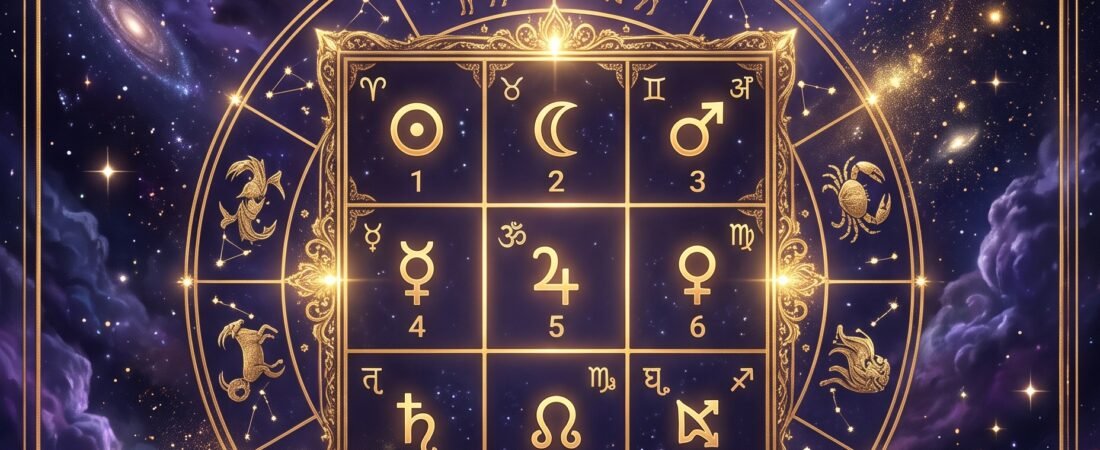
Quick Answer: The Navamsha chart (D9) is a divisional chart in Vedic astrology that divides each zodiac sign into nine equal parts, creating a 3×3 grid of 108 cosmic segments. It’s called your “second birth chart” because it reveals the hidden layer of your destiny—specifically your marriage, spouse characteristics, dharma in the second half of life, and the spiritual fruits of your karma. While your main birth chart (Rashi/D1) shows the tree, the Navamsha shows the fruit.
If you’ve ever wondered why two people with similar birth charts have completely different marriage outcomes, or why your life seems to shift dramatically after age 30-36, the answer often lies in your Navamsha chart. This ancient Jyotish tool, referenced in classical texts like Brihat Parashara Hora Shastra and Phaladeepika, is the single most important chart for understanding your relationships and your soul’s evolution.
🌟 Generate Your Navamsha Chart FREE in Astrova AI →
What Exactly Is Navamsha? The Mathematics Behind the Magic
The word “Navamsha” comes from two Sanskrit roots: Nava (nine) and Amsa (part or division). Each of the 12 zodiac signs (360° total) is divided into 9 equal segments of 3°20′ each, creating 108 Navamshas across the zodiac.
Here’s how it works:
| Zodiac Sign | Navamsha Range | Example |
|---|---|---|
| Aries (0°-30°) | 9 parts × 3°20′ | Aries-Aries (0°-3°20′), Aries-Taurus (3°20′-6°40′), etc. |
| Taurus (30°-60°) | 9 parts × 3°20′ | Taurus-Gemini, Taurus-Cancer, etc. |
| Gemini (60°-90°) | 9 parts × 3°20′ | Gemini-Cancer, Gemini-Leo, etc. |
The result? A complete birth chart with its own Ascendant, 12 houses, and planetary placements—but operating on a subtler, more refined frequency. Think of it as your soul’s GPS coordinates, while your main chart is the street address.
Why Is Navamsha Called Your “Second Birth Chart”?
Ancient Jyotish masters didn’t call the Navamsha the “second birth chart” casually. They meant it literally. Here’s why:
1. Marriage Is a Second Birth
In Vedic philosophy, marriage is not just a social contract—it’s a spiritual rebirth. You enter a new dharma (duty), a new family karma, and a new phase of soul evolution. The Navamsha chart maps this rebirth. It shows:
- The nature of your spouse (their personality, values, spiritual inclination)
- The timing of marriage (when the “second birth” activates)
- The quality of married life (harmony, challenges, growth)
- Your dharma as a partner (what you’re meant to learn through union)
2. The Second Half of Life
Classical texts like Uttara Kalamrita state that the Navamsha chart becomes increasingly active after age 30-36. This is when the fruits of your karma ripen, when marriage typically occurs, and when you shift from the “becoming” phase of youth to the “being” phase of maturity.
If your life feels like it’s on a different trajectory after your early 30s, you’re experiencing the Navamsha activating. Your main chart set the stage; now the D9 is directing the play.
3. Spiritual Fruits of Karma
The Navamsha is ruled by Lord Vishnu, the preserver of dharma. While your main chart (ruled by Brahma, the creator) shows what you’re meant to build, the Navamsha shows what you’re meant to become. It reveals:
- Your spiritual evolution through relationships
- The karmic lessons your spouse is meant to teach you
- Your capacity for devotion, surrender, and divine love
- Whether your marriage will accelerate or delay your moksha (liberation)
How to Read Your Navamsha Chart: The 5 Critical Houses
Reading the Navamsha is not the same as reading your main chart. The D9 has its own interpretive framework. Here are the five most important houses to examine:
1. Navamsha Ascendant (Lagna)
This is your “marriage personality”—the version of you that emerges in intimate partnership. If your Navamsha Ascendant is different from your main chart Ascendant, you literally become a different person in marriage.
Example: A person with Aries Ascendant in D1 (independent, fiery) but Cancer Ascendant in D9 (nurturing, emotional) will feel like a completely different person after marriage—more sensitive, more home-oriented, more protective.
2. The 7th House (Marriage and Partnership)
This is the heart of the Navamsha. The 7th house shows:
- The planet(s) placed here: Their nature, dignity, and aspects reveal your spouse’s character
- The 7th lord’s placement: Shows where your marriage karma plays out (career, home, spirituality, etc.)
- Aspects to the 7th house: Benefic aspects (Jupiter, Venus) bring harmony; malefic aspects (Saturn, Mars, Rahu) bring challenges that become growth opportunities
3. The 9th House (Dharma and Fortune)
The 9th house in Navamsha reveals your spiritual dharma through marriage and your overall fortune in the second half of life. A strong 9th house in D9 indicates a marriage that elevates your consciousness and brings luck.
4. Venus (For Men) and Jupiter (For Women)
In Vedic astrology:
- Venus in a man’s Navamsha shows the nature of his wife and the quality of his married life
- Jupiter in a woman’s Navamsha shows the nature of her husband and her capacity for devotion
If Venus is debilitated or afflicted in a man’s D9, he may face marital challenges regardless of how strong his main chart is. If Jupiter is well-placed in a woman’s D9, she will attract a dharmic, supportive spouse.
5. The Navamsha Lord (D9 Lord)
The lord of the Navamsha Ascendant is the “CEO” of your second birth. Its placement, dignity, and aspects show the overall theme of your marriage and second-half-of-life journey.
Example: If your Navamsha Ascendant is Leo, the Sun is your D9 lord. If the Sun is placed in the 10th house of your Navamsha, your marriage will be deeply connected to your career, public image, or spiritual authority.
Navamsha and Marriage Timing: When Will You Marry?
One of the most powerful uses of the Navamsha is predicting marriage timing. Here’s the classical framework:
The Vimshottari Dasha Connection
Your marriage often occurs during the Mahadasha or Antardasha of:
- The 7th lord of your Navamsha
- Venus (for men) or Jupiter (for women) in Navamsha
- Any planet placed in the Navamsha 7th house
- The Navamsha Ascendant lord
Transit Triggers
Jupiter and Saturn transits activate marriage when they:
- Transit the Navamsha 7th house or aspect it
- Transit the Navamsha Ascendant or aspect it
- Conjunct or aspect the Navamsha 7th lord
Real Example: A woman with Cancer Navamsha Ascendant (Moon as D9 lord) got married during Moon-Mercury Antardasha, when Jupiter transited her Navamsha 7th house (Capricorn) and Saturn aspected it. The timing was precise to within 3 months.
Common Navamsha Patterns and What They Reveal
Here are some classic Navamsha configurations and their meanings:
| Navamsha Pattern | Interpretation |
|---|---|
| Vargottama (planet in same sign in D1 and D9) | Planet is extremely strong; its results are guaranteed and stable |
| Pushkaramsha (planet in a auspicious Navamsha) | Planet gives elevated, blessed results; obstacles are removed |
| Debilitated in D9 (planet weak in Navamsha) | Planet’s results are unstable or delayed; requires remediation |
| 7th lord in 9th house of D9 | Marriage brings spiritual growth, fortune, and dharma |
| Multiple planets in Navamsha 7th house | Marriage is a major karmic focal point; spouse has complex nature |
How Astrova AI Helps You Read Your Navamsha Chart
Reading the Navamsha chart manually requires deep Jyotish knowledge and hours of calculation. Astrova AI makes it instant, accurate, and deeply personalized:
- Instant Navamsha Generation: Enter your birth details and get your complete D9 chart in seconds—Ascendant, all 12 houses, planetary placements, and aspects calculated with Swiss Ephemeris precision
- AI-Powered Interpretation: Our 24/7 AI astrologer doesn’t just show you the chart; it explains what each placement means for your marriage, spouse, and second-half-of-life journey in plain language
- Marriage Timing Predictions: Astrova analyzes your Vimshottari Dasha and current transits to identify your most likely marriage windows
- Spouse Characteristics: Get a detailed profile of your future spouse’s personality, values, career inclinations, and spiritual nature based on your Navamsha 7th house
- Compatibility Layer: Compare your Navamsha with your partner’s to understand the karmic dynamics of your union
- Remedies and Rituals: If your Navamsha shows challenges, Astrova suggests personalized Vedic remedies (mantras, gemstones, rituals) to strengthen the weak planets
🔮 Unlock Your Navamsha Chart FREE in Astrova AI →
Frequently Asked Questions About Navamsha Chart
Q1: Is the Navamsha chart more important than the main birth chart?
A: Neither is “more important”—they serve different purposes. The main chart (D1) shows your overall destiny, career, health, and life path. The Navamsha (D9) specifically reveals your marriage, spouse, and spiritual evolution in the second half of life. Classical texts like Brihat Parashara Hora Shastra state that no prediction is complete without analyzing both charts together.
Q2: Can the Navamsha chart change after marriage?
A: The Navamsha chart itself is fixed at birth—it doesn’t change. However, its activation intensifies after marriage (and after age 30-36). You start living out the D9’s promises more fully. This is why many people feel like they “become a different person” after marriage—they’re embodying their Navamsha Ascendant.
Q3: What if my Navamsha chart shows a difficult marriage?
A: A challenging Navamsha doesn’t mean you’re doomed to a bad marriage. It means your marriage will be a karmic classroom—intense, transformative, and designed to accelerate your spiritual growth. Vedic astrology offers powerful remedies (mantras, gemstones, rituals, charitable acts) to mitigate difficult planetary placements. Astrova AI’s 24/7 astrologer can guide you through personalized remedies.
Q4: How accurate is Navamsha for predicting marriage timing?
A: When combined with the main chart’s Dasha system and current transits, Navamsha-based marriage timing is remarkably accurate—often within 3-6 months. However, free will, cultural factors, and personal choices also play a role. Astrova AI uses all three layers (D1, D9, and transits) to give you the most precise marriage window predictions.
Q5: Can I read my Navamsha chart without knowing my exact birth time?
A: No. The Navamsha Ascendant changes every 15-20 minutes, so an accurate birth time is critical. Even a 30-minute error can shift your Navamsha Ascendant and completely change the interpretation. If you don’t know your exact birth time, consult a professional astrologer for birth time rectification, or use Astrova AI’s AI astrologer chat to explore your chart with approximate timing.
Q6: What’s the difference between Navamsha and other divisional charts?
A: Vedic astrology uses 16 divisional charts (Vargas), each focusing on a specific life area. Navamsha (D9) is the most important because it governs marriage and spiritual evolution—two of the most karmically significant life areas. Other key divisional charts include D10 (career), D7 (children), and D4 (property), but none carry the weight of the D9.
Explore More Astrova Guides
Deepen your Vedic astrology knowledge with these comprehensive guides:
- What is AI Palm Reading and How Does It Work? — Discover how your palm lines reveal your destiny through AI-powered analysis
- What Is Kundli Milan and Why Does It Matter for Your Marriage? — Learn how Guna Milan predicts marital harmony
- How to Check Your Daily Rashifal Using Your Moon Sign — Step-by-step guide to accurate horoscope reading
- Sade Sati Explained: What It Is and Powerful Remedies — Understand Saturn’s 7.5-year transit and how to navigate it
- What Are Vedic Planetary Remedies and How Do They Work? — Ancient remedies for modern life challenges
- How to Use AI Astrology for Daily Guidance — The future of personalized Vedic astrology
About the Author
Astrova AI Editorial Team
The Astrova AI Editorial Team combines ancient Vedic wisdom with cutting-edge artificial intelligence to make Jyotish accessible to everyone. Our content is grounded in classical texts like Brihat Parashara Hora Shastra, Phaladeepika by Mantreswara, Uttara Kalamrita by Kalidasa, and Jataka Parijata by Vaidyanatha Dikshita. We believe that astrology is not about fatalism—it’s about self-awareness, timing, and aligning with your dharma. Astrova AI is 100% free, available in 9 Indian languages, and designed to empower you with personalized insights 24/7.
⭐ Download Astrova AI FREE on Google Play →
Related posts:
 How to read your own palm at home — step-by-step guide — Complete Guide 2026
 How to check your daily Rashifal using your Moon sign — step by step — Complete Guide 2026
 How to identify Kaalsarp Dosha in your Kundli — visual guide — Complete Guide 2026
How accurate is AI Kundli matching vs traditional astrologer matching? — Complete Guide 2026
How to identify Kaalsarp Dosha in your Kundli — visual guide — Complete Guide 2026
How accurate is AI Kundli matching vs traditional astrologer matching? — Complete Guide 2026