
Dasha Sandhi is the junction where one Mahadasha ends and the next begins in the Vimshottari Dasha system. Astrologers read it as a handover: the old planet’s themes wind down while the new planet’s themes start to show. There is no fixed classical length. Common methods range from a few months to over three years.
Key takeaways
- What it is: the changeover between two Mahadashas, for example Rahu ending and Jupiter beginning. “Sandhi” is Sanskrit for a joint or junction.
- Exact date, fuzzy window: the change date is fixed by your dasha table. How many months around it count as “sandhi” depends on the astrologer’s method.
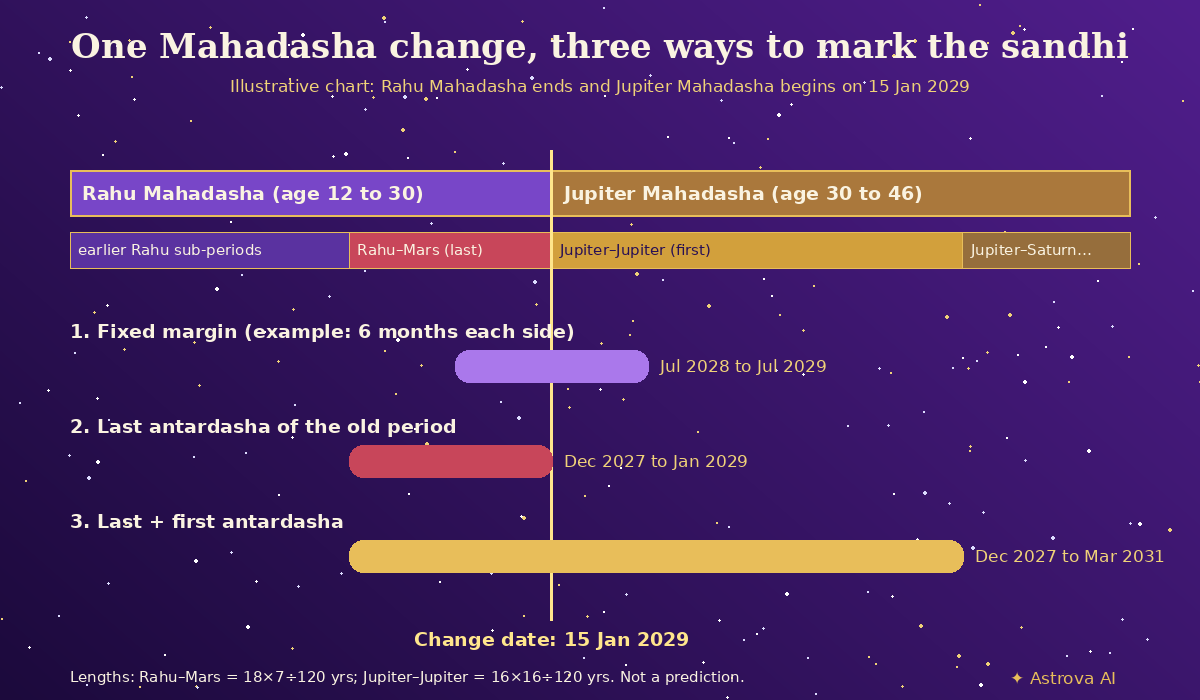
- Three common methods: a fixed margin either side, the outgoing Mahadasha’s last antardasha, or that plus the new Mahadasha’s first antardasha.
- Classical basis: classical texts tell you to judge a dasha at its start and its end, but we did not find a verse in BPHS or Phaladeepika that fixes a sandhi window for Vimshottari.
- How it is read: by comparing the two planets: their strength, houses, and relationship in your chart.
- Not a verdict: it is a traditional idea for planning and reflection, not a proven effect.
Check when your next Mahadasha begins, free in Astrova AI
If an astrologer has told you “you are in dasha sandhi” or “wait until the sandhi is over”, they are pointing at the changeover between two of your long planetary periods. It is one of the most quoted ideas in dasha timing, and one of the least clearly defined. This guide explains what a dasha sandhi is, what the classical texts do and do not say, how long it lasts under each common method, all nine junctions in one table, a worked example, and how to use it sensibly.
What a Mahadasha change actually is
Vimshottari Dasha is the 120-year planetary timeline used in most Vedic astrology. It runs through nine Mahadashas in a fixed order: Ketu 7 years, Venus 20, Sun 6, Moon 10, Mars 7, Rahu 18, Jupiter 16, Saturn 19 and Mercury 17 (Dasha (astrology), Wikipedia). Your Moon’s nakshatra at birth decides where in that cycle you start. If this is new to you, begin with what Vimshottari Dasha is and how to read it.
Each Mahadasha splits into nine antardashas (sub-periods). The first antardasha always belongs to the Mahadasha planet itself, and the rest follow the same fixed order (BPHS 51.2, VedicPupil; Phaladeepika 21.2, Wisdom Library). That rule has a neat consequence for every changeover:
- The last antardasha of any Mahadasha belongs to the planet just before it in the cycle. Rahu Mahadasha always ends with Rahu–Mars.
- The first antardasha of the next Mahadasha belongs to the new planet. Jupiter Mahadasha always opens with Jupiter–Jupiter.
So at every Mahadasha change, three planets meet: the outgoing Mahadasha lord, the planet of its last sub-period, and the incoming lord. That is the raw material of a sandhi reading.
What the classical texts say, and what they don’t
The idea of judging a dasha at both ends is classical. In its chapter on the results of Chara and other dashas, Brihat Parashara Hora Shastra (BPHS) says that when the signs at the beginning and end of a period are friendly and benefic, the result is good (BPHS 50.36, VedicPupil). So the start and finish of a period clearly mattered to the tradition.
A fixed sandhi window is not. We did not find a verse in BPHS or in Phaladeepika (a widely used later manual) that defines a Vimshottari dasha sandhi or gives it a length in months. The windows you will hear about are working conventions of particular schools and practitioners. That does not make them useless, but it does mean two astrologers can honestly give you different sandhi dates for the same chart.
You may also hear the last antardasha of a Mahadasha called a “chhidra” (literally “hole” or “gap”) period. That label is used by some practitioners; treat it as one school’s term rather than a universal rule.
How long does Dasha Sandhi last? Three common methods
| Method | Window | Length | Good for |
|---|---|---|---|
| 1. Fixed margin | A set number of months before and after the change date | Usually a few months each side (practitioners differ) | A quick, simple flag on the calendar |
| 2. Last antardasha | The whole final sub-period of the outgoing Mahadasha | 6 months to 2 years 8 months 9 days, depending on the planets | Reading how the old period closes |
| 3. Last + first antardasha | The outgoing period’s last sub-period plus the new period’s first | 10 months 27 days to 5 years 4 months 27 days | Following the full handover, old to new |
Methods 2 and 3 come straight from the antardasha formula: Mahadasha years × antardasha planet’s years ÷ 120. Here is every junction in the cycle, using the traditional 360-day year.
| Mahadasha change | Last antardasha of the old period | First antardasha of the new period | Both together |
|---|---|---|---|
| Ketu → Venus | Ketu–Mercury: 11 months 27 days | Venus–Venus: 3 years 4 months | 4 years 3 months 27 days |
| Venus → Sun | Venus–Ketu: 1 year 2 months | Sun–Sun: 3 months 18 days | 1 year 5 months 18 days |
| Sun → Moon | Sun–Venus: 1 year | Moon–Moon: 10 months | 1 year 10 months |
| Moon → Mars | Moon–Sun: 6 months | Mars–Mars: 4 months 27 days | 10 months 27 days |
| Mars → Rahu | Mars–Moon: 7 months | Rahu–Rahu: 2 years 8 months 12 days | 3 years 3 months 12 days |
| Rahu → Jupiter | Rahu–Mars: 1 year 18 days | Jupiter–Jupiter: 2 years 1 month 18 days | 3 years 2 months 6 days |
| Jupiter → Saturn | Jupiter–Rahu: 2 years 4 months 24 days | Saturn–Saturn: 3 years 3 days | 5 years 4 months 27 days |
| Saturn → Mercury | Saturn–Jupiter: 2 years 6 months 12 days | Mercury–Mercury: 2 years 4 months 27 days | 4 years 11 months 9 days |
| Mercury → Ketu | Mercury–Saturn: 2 years 8 months 9 days | Ketu–Ketu: 4 months 27 days | 3 years 1 month 6 days |
Two things jump out. The end of Moon Mahadasha has the shortest closing sub-period (Moon–Sun, 6 months), while Mercury Mahadasha closes with the longest (Mercury–Saturn, 2 years 8 months 9 days). And some changes are lopsided: Mars hands over to Rahu after a 7-month Mars–Moon, but Rahu’s own opening sub-period runs 2 years 8 months 12 days. Apps that use 365.25-day years will show dates a few days to weeks apart from these.
Worked example (illustrative)
This is a made-up chart for teaching, the same one used in our antardasha guide. It is not a real person or a prediction.
Someone born on 15 January 1999 with the Moon in the middle of Rohini nakshatra starts life with 5 years of Moon Mahadasha left. Then Mars runs to age 12, Rahu from age 12 to 30, and Jupiter from age 30. Using calendar years, the Rahu → Jupiter change falls on 15 Jan 2029.
| Method | Sandhi window in this example |
|---|---|
| Fixed margin (6 months each side, as an example width) | 16 Jul 2028 to 16 Jul 2029 |
| Last antardasha (Rahu–Mars, 1 year 18 days) | 28 Dec 2027 to 15 Jan 2029 |
| Last + first (Rahu–Mars, then Jupiter–Jupiter, 2 years 1 month 18 days) | 28 Dec 2027 to 5 Mar 2031 |
Now the reading. Say the chart has a Virgo ascendant, with Rahu in Sagittarius (the 4th house) and Jupiter in Pisces (the 7th house, its own sign). For Virgo, Mars rules the 3rd and 8th houses, and Jupiter rules the 4th and 7th.
- How the old period closes: Rahu–Mars mixes two restless, action-driven planets, with Mars ruling the 8th (sudden changes) for this ascendant. A traditional astrologer would read it as a busy, possibly unsettled year for finishing what Rahu started, not a time to pile on new commitments.
- How the new period opens: Jupiter in its own sign in the 7th, ruling the 7th and 4th, would usually be read as a supportive start, with themes of partnership, marriage, home and guidance. See what tradition says about Jupiter Mahadasha.
- The blend: a common reading would be “close loose ends during Rahu–Mars, and expect Jupiter’s themes to build gradually after January 2029”, not “everything changes overnight on 15 January”.
The arithmetic is the same for everyone with this birth data. The interpretation depends on the whole chart, which is why a generic “sandhi is bad” warning says very little.
See your Mahadasha and Antardasha dates in Astrova AI
How astrologers read a Dasha Sandhi
Schools differ, but these points come up again and again:
- Strength of both lords. A strong incoming planet is read as a smoother handover than a weak or afflicted one.
- Houses each planet rules for your ascendant. A change from the lord of a hard house (6th, 8th or 12th) to the lord of a good one (such as the 5th or 9th) is read differently from the reverse.
- How the two planets relate. Natural friends, such as the Sun and Jupiter, are read as an easier handover than natural enemies, such as the Sun and Saturn.
- The last antardasha’s own story. Its planet’s placement colours how the old period winds down.
- Transits as a trigger. Many astrologers check whether slow planets like Saturn and Jupiter are touching either dasha lord around the change. See how transits affect your horoscope.
Dasha Sandhi is one of several “junction” ideas in Jyotish. Another is Gandanta, the junction between water and fire signs in the zodiac, which is about the sky rather than time periods.
How to use your Dasha Sandhi sensibly
- Find the change date in your Vimshottari Dasha table (it needs your exact birth time, date and place).
- Note the last and first antardashas around it, so you know which planets are involved.
- Ask which method any astrologer is using before you accept a sandhi window.
- Use it for planning, not fear: it can be a useful prompt to finish old projects and review goals before a new chapter.
- Don’t postpone essentials. Medical, financial and legal decisions should follow real-world advice, not a dasha date.
Tradition vs science
The dates are arithmetic. Given the same birth details, year length and ayanamsa, any correct calculator gives the same Mahadasha change date and the same antardasha lengths. That part is consistent.
The effects are not proven. The idea that a changeover brings turbulence is a traditional reading. Astrology has not shown predictive power in controlled tests and is generally considered a pseudoscience by scientists (Astrology and science, Wikipedia). Life transitions often feel unsettled for ordinary reasons, so it is worth keeping the two apart. Treat a dasha sandhi as a time to reflect and plan, not as a reason to worry.
If you want to see your own Mahadasha change dates, Astrova AI’s free Janam Kundli lists every Mahadasha and Antardasha with dates, and you can ask follow-up questions in the AI astrologer chat.
FAQs
How long does Dasha Sandhi last?
There is no single agreed length. Some astrologers use a fixed window of a few months on each side of the change date. Others take the whole last antardasha of the outgoing Mahadasha, which runs from 6 months (end of Moon Mahadasha) to 2 years 8 months 9 days (end of Mercury Mahadasha). Ask any astrologer which method they are using.
Is Dasha Sandhi bad?
Not automatically. Tradition describes it as an unsettled handover, where the old planet’s themes close and the new planet’s themes have not fully started. Whether it feels hard depends, in astrology’s own terms, on the condition of both planets in your chart. There is no scientific evidence that it causes anything.
Should I avoid marriage or big decisions during Dasha Sandhi?
Some families and astrologers prefer to wait until a new Mahadasha has settled before starting something big. That is a custom, not a rule we could find fixed in the main classical texts. Do not delay a decision that matters for your health, money or safety because of a dasha change.
Is there a sandhi between antardashas too?
Yes, many astrologers apply the same idea one level down, to the change from one antardasha (sub-period) to the next. Those junctions are much shorter and are usually treated as minor compared with a Mahadasha change.
How do I find my Dasha Sandhi dates?
Get your Vimshottari Dasha table from your exact date, time and place of birth. Find the date your current Mahadasha ends, then note the last antardasha before it and the first antardasha after it. A free Kundli app such as Astrova AI lists these dates for you.
Download Astrova AI on Google Play
Free Janam Kundli with Vimshottari Dasha dates, daily Rashifal and 24/7 AI astrologer chat in 9 Indian languages. For entertainment and self-reflection.
Sources and further reading: BPHS 51.2, antardasha order (VedicPupil) · BPHS 50.36, start and end of a dasha (VedicPupil) · Phaladeepika ch. 21, sub-periods (Wisdom Library) · Dasha (astrology) (Wikipedia) · Astrology and science (Wikipedia)