Mars (Mangal) Mahadasha is the 7-year period of Mars in the Vimshottari Dasha system. Tradition links it with energy, courage, competition, land and property, siblings and fast decisions, along with a risk of anger, disputes and accidents. It is not automatically good or bad. Astrologers judge it by Mars’s strength and placement in your Kundli.
Key takeaways
- Length: 7 years, after the Moon’s 10 years and before Rahu’s 18 years.
- Who starts life in it: people whose Moon was in Mrigashira, Chitra or Dhanishta nakshatra at birth.
- Traditional themes: drive and courage, career through effort, land, property and vehicles, siblings, sport and competition.
- What decides it: Mars’s sign, house, aspects and the houses it rules for your ascendant. For Cancer and Leo ascendants Mars is a yogakaraka (a very helpful planet).
- Not the same as Manglik: a Mars period and Mangal Dosha are two different ideas. Having one does not mean you have the other.
- Not science: these are traditional readings, not tested predictions.
Check your dasha timeline free in Astrova AI
After ten soft, home-focused years of the Moon, the Mars period is usually described as a change of gear. The words astrologers use are action, effort, property, competition and courage, and also temper, arguments and haste. That mix is why people search for it with some worry, often because a family astrologer said “Mangal ki dasha” in the same breath as “Manglik”. This guide explains what Mars Mahadasha is, when it comes, what tradition says it brings, how it differs from Mangal Dosha, its nine sub-periods with a worked example, and where tradition ends and evidence begins.
Who Mars (Mangal) is in Jyotish
In Hindu tradition, Mangala, also called Lohita (“the red one”) and Angaraka, is the god of the planet Mars and one of the Navagraha, the nine planetary deities. In the Vaishnava story he is the son of Bhumi, the Earth goddess. Tuesday (Mangalavara) is his day, red is his colour and a ram is his mount (Mangala, Wikipedia). Many families pray to Lord Hanuman on Tuesdays, which is why Hanuman worship is such a common Mars remedy.
In Jyotish, Mars is the karaka (indicator) of energy, courage, younger siblings, land and property (it is called bhumi karaka), blood, sport, the police and army, engineering and surgery. It rules Aries (Mesha) and Scorpio (Vrishchika), is exalted in Capricorn and debilitated in Cancer, and rules three nakshatras: Mrigashira, Chitra and Dhanishta. In the classical friendship tables its friends are the Sun, Moon and Jupiter, Venus and Saturn are neutral, and Mercury is an enemy. Mars also has special aspects on the 4th, 7th and 8th houses from where it sits, and it gets its directional strength (dig bala) in the 10th house of career. For Mars in each house of a birth chart, read what Mangal in your Kundli reveals.
When does Mars Mahadasha start?
Your dasha order is fixed at birth by the nakshatra the Moon was in (your janma nakshatra). Life starts in the dasha of that nakshatra’s ruler, and the rest follow in a fixed order: Ketu 7, Venus 20, Sun 6, Moon 10, Mars 7, Rahu 18, Jupiter 16, Saturn 19 and Mercury 17 years (Dasha (astrology), Wikipedia). For the full system, see what Vimshottari Dasha is and how to read it.
Because only part of the first dasha is left at birth, the start of the Mars period falls in a range. This table adds up the years in the sequence:
| Moon’s birth nakshatra | First dasha | Mars Mahadasha begins at about age |
|---|---|---|
| Mrigashira, Chitra, Dhanishta | Mars | Running at birth (0–7 years left) |
| Rohini, Hasta, Shravana | Moon | 0–10 |
| Krittika, Uttara Phalguni, Uttara Ashadha | Sun | 10–16 |
| Bharani, Purva Phalguni, Purva Ashadha | Venus | 16–36 |
| Ashwini, Magha, Mula | Ketu | 36–43 |
| Ashlesha, Jyeshtha, Revati | Mercury | 43–60 |
| Pushya, Anuradha, Uttara Bhadrapada | Saturn | 60–79 |
| Punarvasu, Vishakha, Purva Bhadrapada | Jupiter | 79–95 |
| Ardra, Swati, Shatabhisha | Rahu | 95–113 |
The full cycle is 120 years, so most people meet the Mars period once, and some people not at all. Exact dates depend on how far the Moon had moved through its nakshatra at birth, so an accurate birth time matters. Not sure of your nakshatra? Start with the 27 nakshatras or make a free Kundli.
Traditional themes: career, property, money, relationships, health
Classical texts describe the Mars period in two voices. Brihat Parashara Hora Shastra (BPHS) links a strong Mars period with land, courage and victory (BPHS chapter 47, VedicPupil). For an afflicted Mars, its sub-period chapter speaks of setbacks, disputes and health concerns (BPHS chapter 54, VedicPupil). Modern readings usually describe each area like this. These are tendencies astrologers look for, not events that will happen.
- Career: progress through effort, skill and competition rather than luck. Readings link it with engineering, technical work, the police and army, sport, surgery, construction, real estate and starting a business. Office politics and clashes with bosses are the usual warning.
- Land, property and vehicles: buying, building or fighting over property is a classic Mars theme, because Mars signifies both land and conflict.
- Money: money is earned through hard work and bold moves. The traditional caution is impulsive spending and risky bets.
- Siblings and relationships: brothers and sisters, especially younger ones, come into focus. In relationships the period is described as passionate and direct, with the risk of ego clashes.
- Energy and temperament: more drive, less patience. Many astrologers say the best use of Mars is a physical outlet, such as sport or training, and a clear goal.
- Health: tradition links Mars with blood, heat, inflammation, cuts, burns and surgery. Treat this as old symbolism. For any real symptom, see a doctor; a dasha is not a diagnosis.
What decides how your Mars period feels
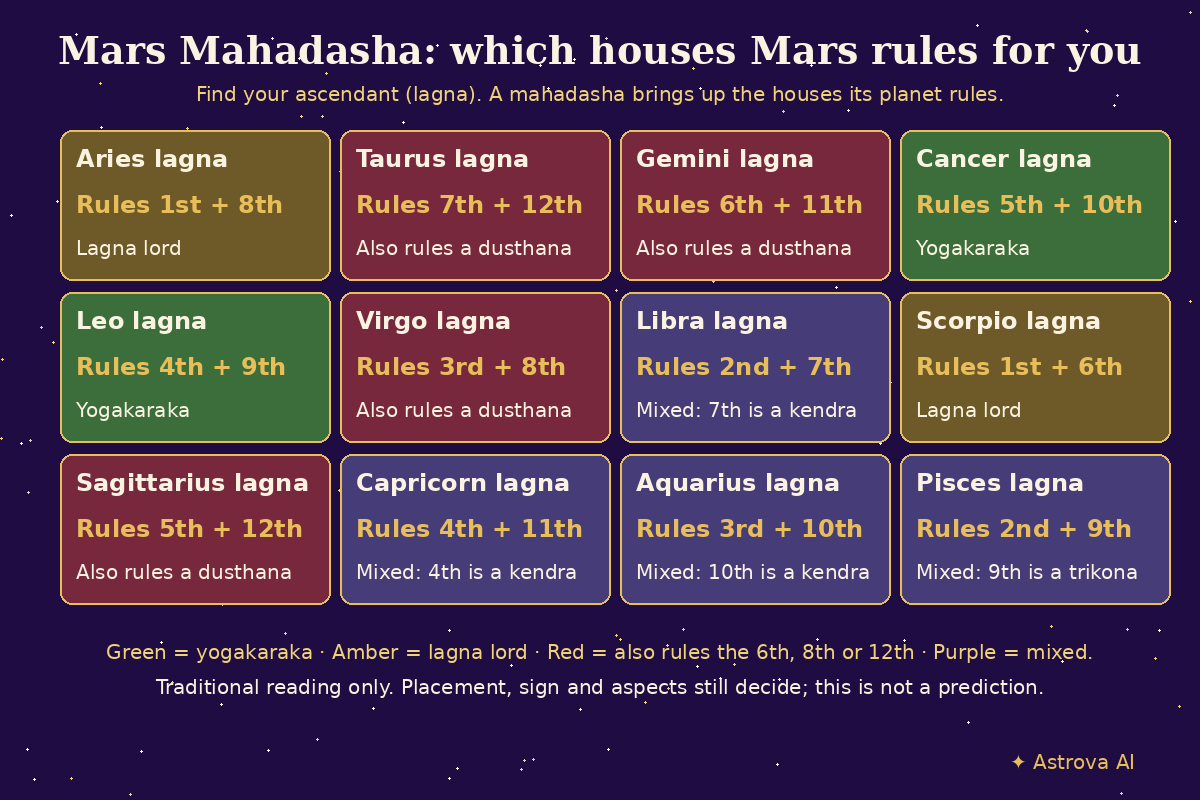
The houses Mars rules for your ascendant
A mahadasha brings up the matters of the houses its planet rules, so the same Mars period can read very differently for two people. For Cancer and Leo ascendants, Mars rules both a kendra and a trikona and is called a yogakaraka, so tradition often counts its period among the best in those charts. For Aries and Scorpio it is the lagna lord. Where it also rules the 6th, 8th or 12th house, results are said to come through more effort.
Sign
Mars in Aries or Scorpio (own signs) or Capricorn (exalted) is read as strong. In one of these signs in a kendra (1st, 4th, 7th or 10th house), it forms Ruchaka Yoga, one of the five Pancha Mahapurusha yogas. Mars in Cancer is debilitated, although cancellation rules are checked before assuming the worst; see Neecha Bhanga Raj Yoga.
House placement
Mars is a natural malefic, and tradition says malefics do well in the upachaya (growth) houses: the 3rd, 6th, 10th and 11th. Mars in the 10th, where it has directional strength, is often linked with peak career years. Mars in the 4th, 7th, 8th or 12th asks for more care with home, partnerships and accidents.
Company and aspects
Mars with the Moon forms Chandra-Mangala Yoga, traditionally linked with earning money. Mars with Saturn or Rahu is usually read as more intense and harder to handle. Jupiter’s aspect on Mars is read as calming it.
See where Mars sits in your Kundli with Astrova AI
Mars Mahadasha vs Manglik (Mangal) Dosha
These two ideas are often mixed up, so here they are side by side.
| Mars Mahadasha | Mangal (Manglik) Dosha | |
|---|---|---|
| What it is | A 7-year time period in your dasha timeline | A birth-chart placement of Mars |
| Who has it | Anyone whose timeline reaches it (most people) | Mars in the 1st, 4th, 7th, 8th or 12th house (some systems add the 2nd), checked from the ascendant and often from the Moon and Venus |
| When it matters | Only during those 7 years | Read for the whole life, mainly in marriage matching |
| Can it be cancelled? | No; it is a time period, so it simply runs and ends | Yes; tradition lists many cancellation rules |
| How they connect | If you are Manglik, many astrologers say its themes show up most during Mars periods. If you are not, a Mars period does not make you Manglik. | |
To check your own chart, read what Manglik Dosha is and whether it really affects marriage and how to identify Manglik Dosha.
The 9 antardashas inside Mars Mahadasha
Each mahadasha is split into nine sub-periods (antardashas) in a fixed order, starting with its own planet. Each one’s length is 7 years × that planet’s years ÷ 120. The table uses the common 12-months-of-30-days convention, so calculators may differ by a few days.
| No. | Antardasha | Approximate length | Common traditional reading |
|---|---|---|---|
| 1 | Mars–Mars | 4 months 27 days | Pure Mars: drive, property and quick decisions, but also haste |
| 2 | Mars–Rahu | 1 year 18 days | Often read as restless: bold risks, disputes and sudden moves |
| 3 | Mars–Jupiter | 11 months 6 days | Often read as supportive; Jupiter is Mars’s friend |
| 4 | Mars–Saturn | 1 year 1 month 9 days | Often read as the hardest: Mars pushes, Saturn holds back |
| 5 | Mars–Mercury | 11 months 27 days | Skills, trade and study; Mars treats Mercury as an enemy |
| 6 | Mars–Ketu | 4 months 27 days | Short; tradition says Ketu acts like Mars, so care with injuries |
| 7 | Mars–Venus | 1 year 2 months | The longest; relationships, comforts and vehicles |
| 8 | Mars–Sun | 4 months 6 days | Mars’s friend; authority, government and recognition |
| 9 | Mars–Moon | 7 months | Mars’s friend; money, property and family; bridge to Rahu |
Mars–Rahu, which comes second and lasts just over a year, is the sub-period people worry about most. The Mars and Rahu pair is often called Angarak Yoga when the two sit together in a chart. Mars–Saturn is the other one with a hard reputation. Mars–Venus is the longest, at 1 year 2 months, and is the sub-period most often linked with marriage and comfort. Each still depends on where that planet sits in your own chart. To compare with other periods, read Moon (Chandra) Mahadasha, Rahu Mahadasha, Sun (Surya) Mahadasha, Jupiter (Guru) Mahadasha, Shani Mahadasha, Mercury (Budh) Mahadasha and Ketu Mahadasha.
Worked example (illustrative)
This chart is made up to show the method. It is not a real person and not a prediction.
Say someone has a Leo ascendant, their Moon is in Bharani nakshatra in Aries (the 9th house), and Mars is in Taurus in the 10th house. Bharani is ruled by Venus, and say 10 years of Venus’s dasha were left at birth.
- Timeline: Venus runs to age 10, Sun 10 to 16, Moon 16 to 26, so Mars Mahadasha runs from age 26 to 33.
- What Mars rules: for Leo, Mars rules Scorpio (4th house: home, property, mother) and Aries (9th house: luck, father, higher learning). Ruling a kendra and a trikona makes it a yogakaraka.
- Where it sits: the 10th house of career, where Mars has directional strength. Taurus is a neutral sign for Mars. A traditional reading would link these years with career growth through effort, and with buying property, since the 4th lord sits in the 10th.
- Its aspects: from the 10th, Mars’s 4th, 7th and 8th aspects fall on the 1st, 4th and 5th houses. A reading would add energy and drive to the person (1st), activity around home (4th) and a competitive streak in studies or children’s matters (5th).
- Manglik? No. The 10th is not a Mangal Dosha house in any common list, which shows how a strong Mars period and Mangal Dosha are separate questions.
- Sub-periods: Mars–Saturn would run from about age 28 years 5 months to 29 years 6 months. Saturn rules the 6th and 7th for Leo, so a reading would flag work pressure and friction in partnerships. Mars–Venus (age 30 years 11 months to 32 years 1 month) is interesting here: Venus rules the 10th for Leo and also owns Taurus, the sign Mars sits in, so many astrologers would pick it as a career high point.
The lesson: generic lists of good and bad antardashas are a starting point only. The houses each planet rules for your ascendant can change the reading, which is why a calculated chart matters more than a blog table.
Traditional remedies, kept simple
Tradition suggests simple Mars practices, for example:
- Reciting the Hanuman Chalisa, or visiting a Hanuman temple, on Tuesdays.
- Chanting “Om Angarakaya Namah” or the Mangal beej mantra “Om Kraam Kreem Kraum Sah Bhaumaya Namah”, often 108 times on Tuesdays.
- Giving red lentils (masoor dal), jaggery or red cloth to people in need on Tuesdays.
- Keeping good relations with brothers and sisters, and settling property matters calmly rather than in anger.
- Giving the energy somewhere to go: regular exercise or a sport, a clear goal at work, and extra care when driving or working with tools, fire and machines.
Be careful with fear-based selling. Red coral (moonga) is Mars’s traditional gem, but even within astrology it is advised only after a careful chart check, and there is no scientific evidence that a gemstone changes events. See which gemstone suits your Kundli and whether Vedic remedies actually work.
Tradition vs science
The system is real as a tradition. The 7-year length, the order of the dashas and the antardasha maths come from a consistent system described in classical Jyotish texts. Any good calculator will give the same dates for the same birth details.
The predictions are not proven. Whether a Mars period actually brings a promotion, a house or a quarrel is a separate question. Astrology has not shown predictive power in controlled tests and is generally considered a pseudoscience (Astrology and science, Wikipedia). The best-known attempt to link Mars with human traits was the “Mars effect” claim of the 1950s, that sports champions were born more often just after Mars rose or reached its highest point. Later attempts to repeat it gave uneven results, and later research attributes it to selection bias in how the data was chosen (Mars effect, Wikipedia). Use a dasha reading for reflection and planning, not as a reason to fear a period or as a replacement for medical, financial or legal advice.
If you want to see your own dates, Astrova AI’s free Janam Kundli shows your Lagna, Rashi, Nakshatra and Vimshottari Dasha, and you can ask follow-up questions in the AI astrologer chat.
FAQs
How long does Mars Mahadasha last?
Mars (Mangal) Mahadasha lasts 7 years in the 120-year Vimshottari Dasha cycle. It comes after the Moon’s 10 years and before Rahu’s 18 years. If your Moon was in Mrigashira, Chitra or Dhanishta nakshatra at birth, you start life in it and only live through the part that was left.
Is Mars Mahadasha good or bad?
Neither by default. Astrologers judge it by Mars’s sign, house, aspects and the houses it rules for your ascendant. A strong, well-placed Mars is read as a time of drive, courage, property and wins in competition. An afflicted Mars is read as a time of anger, disputes and haste. None of this is a fixed prediction.
Is Mars Mahadasha good for marriage?
Mars is not the main marriage planet, so tradition looks at the 7th house, Venus and the sub-periods. Mars–Venus and Mars–Jupiter are the sub-periods most often linked with marriage. If your chart has Mangal Dosha, many astrologers say its themes show up more in Mars periods, but Mangal Dosha has many cancellation rules and is not a reason to fear marriage.
Which antardasha is hardest in Mars Mahadasha?
Mars–Saturn and Mars–Rahu are the sub-periods most often described as hard, because they pair Mars’s push with Saturn’s brake or Rahu’s restlessness. Mars–Ketu is short but is linked with caution around injuries. Mars–Jupiter and Mars–Venus are usually read as easier. Your own chart can change all of these readings.
What happens after Mars Mahadasha ends?
Rahu Mahadasha begins and runs for 18 years. The last sub-period of the Mars dasha is Mars–Moon, about 7 months. Tradition reads the change as a move from direct effort and action to Rahu’s ambition, change and unusual paths, so many people use the final months to settle disputes and finish what they started.
Download Astrova AI on Google Play
Free Janam Kundli with Vimshottari Dasha, daily Rashifal and 24/7 AI astrologer chat in 9 Indian languages. For entertainment and self-reflection.
Sources and further reading: Dasha (astrology) (Wikipedia) · Mangala (Wikipedia) · BPHS chapter 47, mahadasha results (VedicPupil) · BPHS chapter 54, Mars antardashas (VedicPupil) · Mars effect (Wikipedia)