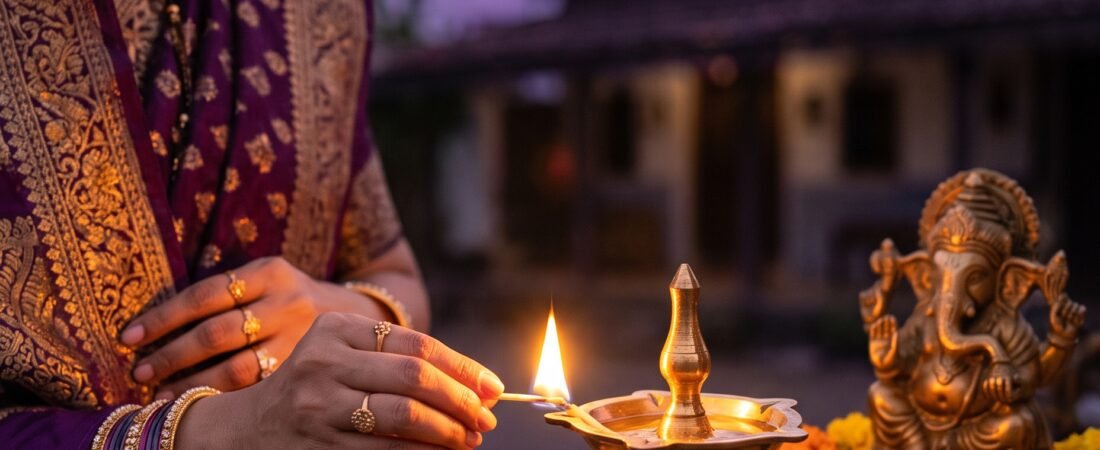
Every evening across millions of Hindu households, a simple ritual unfolds: a brass diya is lit, a prayer is offered, and the day transitions into night with sacred intention. But have you ever wondered why this ritual is performed at twilight specifically, and what planetary forces make this timing so powerful? The answer lies deep within Vedic astrology and ancient spiritual science.
Why Do Hindus Light a Diya Every Evening? The Vedic Astrology Behind the Daily Lamp Ritual
The evening diya ritual, known as Sandhya Vandanam or twilight worship, is one of Hinduism’s most enduring daily practices. But this isn’t merely cultural tradition—it’s a sophisticated astrological technology that aligns human consciousness with planetary rhythms.
According to Vedic astrology, the transition period between day and night (twilight) is when planetary energies shift most dramatically. The Sun’s vital force (Prana) withdraws, and the Moon’s receptive energy begins to dominate. Lighting a diya during this Sandhya kala (twilight hour) creates a protective energetic boundary that shields the household from negative planetary influences while inviting auspicious cosmic forces.
The Mythological Origin: When Lord Vishnu Established the Eternal Flame
The practice traces back to the Vishnu Purana, where Lord Vishnu instructed humanity to maintain a perpetual flame during the twilight hours. The story recounts how during the churning of the ocean (Samudra Manthan), a deadly poison called Halahala emerged, threatening to destroy creation. Lord Shiva consumed the poison to save the universe, but the intense heat caused him to burn with fever.
To cool the divine fever, devotees began lighting lamps and offering prayers during twilight—the precise moment when Shiva’s cosmic dance (Tandava) reaches its peak. This act of devotion not only cooled Shiva’s fever but established the evening diya as a universal practice for invoking divine protection and planetary harmony.
The Astrological Significance: Which Planets Govern the Evening Lamp
Vedic astrology assigns specific planetary rulers to different times of day. The evening twilight (6:00 PM to 7:30 PM) falls under the combined influence of three powerful celestial bodies:
| Planet | Energy | Effect of Diya Lighting |
|---|---|---|
| Sun (Surya) | Vitality, soul, authority | The diya’s flame honors Surya’s departing energy, ensuring his blessings return at dawn |
| Moon (Chandra) | Emotions, mind, intuition | The lamp’s steady flame stabilizes lunar energy, preventing emotional turbulence at night |
| Venus (Shukra) | Love, beauty, harmony | Evening is Venus’s hour; the diya amplifies domestic harmony and marital bliss |
The fire element (Agni) in the diya acts as a planetary balancer. When Saturn’s restrictive energy or Rahu’s confusing influence dominates a household, the pure flame neutralizes these malefic effects and strengthens benefic planets like Jupiter and Venus.
The Scientific Wisdom: Why Twilight Timing Matters
Modern chronobiology confirms what Vedic sages knew millennia ago: the twilight hour triggers a neurochemical shift in the human brain. As natural light fades, melatonin production begins, and the nervous system transitions from sympathetic (active) to parasympathetic (restorative) dominance.
Lighting a diya during this transition creates a focal point for consciousness, preventing the mental scatter that often accompanies the day-to-night shift. The flame’s steady glow stimulates the pineal gland (associated with the Third Eye chakra and astrological Ketu), enhancing intuition and spiritual receptivity during the most psychically sensitive time of day.
Research published in the Journal of Environmental Psychology (2019) found that households with consistent evening rituals reported 34% lower stress levels and 28% better sleep quality—validating the neurological benefits of the diya practice.
How to Perform the Evening Diya Ritual: Step-by-Step Guide
For maximum astrological benefit, follow these traditional guidelines:
- Timing: Light the diya during Sandhya kala (15-30 minutes after sunset). Use a panchang or Astrova AI’s free Muhurat feature to find the exact twilight window for your location.
- Direction: Face east while lighting (for spiritual growth) or north (for material prosperity). Never face south, as this direction is governed by Yama (death) and can invite inauspicious energies.
- Oil Selection: Ghee (clarified butter) amplifies Jupiter’s beneficence. Sesame oil pacifies Saturn. Mustard oil strengthens Mars. For general harmony, use pure ghee or a ghee-sesame blend.
- Wick Material: Cotton wicks represent purity and sattvic energy. Avoid synthetic materials, which disrupt the energetic frequency.
- Mantra: Chant the Agni mantra: “Om Agnaye Namah” (I bow to the fire deity) or the Gayatri Mantra for solar blessing. This activates the flame’s planetary healing properties.
- Placement: Position the diya in your puja room, entrance, or kitchen—never in the bedroom or bathroom. The flame should be at heart level or higher.
- Duration: Let the diya burn for at least 15-20 minutes. If possible, maintain it throughout the evening until it naturally extinguishes.
Which Deities Are Invoked Through the Evening Lamp
The diya ritual invokes a trinity of divine energies:
- Lord Ganesha: The remover of obstacles is worshipped first. Lighting the diya in his name clears the evening of any blocked planetary energies.
- Goddess Lakshmi: The deity of prosperity enters homes where the evening lamp burns brightly. A dim or extinguished diya is considered inauspicious for wealth.
- Lord Vishnu: The preserver of cosmic order. The flame represents Vishnu’s eternal light that maintains universal balance during the vulnerable twilight hour.
In South Indian tradition, the diya is also offered to family deities (Kula Devata) and ancestors (Pitru), strengthening lineage blessings and pacifying any ancestral doshas in your kundli.
Astrological Remedies Enhanced by the Evening Diya
The daily lamp ritual becomes a powerful planetary remedy when performed with specific intentions:
| Planetary Problem | Diya Remedy |
|---|---|
| Weak Sun (low confidence, authority issues) | Offer water to the diya flame while chanting Surya mantra |
| Afflicted Moon (anxiety, emotional instability) | Use ghee wick and chant Chandra mantra 108 times |
| Malefic Saturn (delays, hardships) | Light sesame oil diya under a Peepal tree on Saturday evening |
| Rahu-Ketu affliction (sudden losses, confusion) | Light the diya with camphor and chant Rahu-Ketu beeja mantras |
| Weak Venus (relationship discord) | Place the diya near a mirror and offer white flowers on Friday evening |
Common Mistakes That Reduce the Diya’s Astrological Power
To ensure your evening lamp ritual delivers maximum planetary benefit, avoid these errors:
- Lighting after complete darkness: The Sandhya window closes 45 minutes after sunset. Lighting beyond this misses the planetary transition energy.
- Using broken or cracked diyas: A damaged vessel represents broken planetary energy. Always use intact brass or clay lamps.
- Extinguishing by blowing: Never blow out the diya—this scatters the accumulated positive energy. Use a wick snuffer or let it burn out naturally.
- Lighting in inauspicious locations: Bathrooms, bedrooms, and spaces below the waist level (floor-level placement) diminish the flame’s spiritual frequency.
- Neglecting the diya during eclipse periods: During lunar or solar eclipses, the diya ritual becomes even more critical for protection. Light additional lamps and chant protective mantras.
How Astrova AI Enhances Your Evening Diya Practice
The Astrova AI app integrates ancient diya wisdom with modern astrological precision:
- Accurate Sandhya Timing: Get real-time twilight calculations for your exact location, ensuring you light the diya during the optimal planetary window.
- Personalized Planetary Remedies: Based on your kundli, Astrova AI recommends specific oils, mantras, and directions for your evening lamp to address your unique planetary afflictions.
- Muhurat Alerts: Receive notifications for auspicious evening windows, especially during festivals, eclipses, and planetary transits.
- Daily Rashifal Integration: Combine your diya ritual with personalized daily horoscope readings in 9 Indian languages, aligning your spiritual practice with cosmic forecasts.
- AI Astrologer Chat: Ask questions about diya symbolism, planetary remedies, or ritual timing anytime—get instant answers rooted in Vedic astrology.
FAQ: Your Questions About the Evening Diya Ritual Answered
Q: Can I light the diya if I follow a different religion?
A: Absolutely. The planetary science behind the diya transcends religious boundaries. Anyone seeking to harmonize with cosmic rhythms can benefit from this practice.
Q: What if I travel and can’t light the diya at the exact twilight time?
A: Use Astrova AI’s location-based panchang to calculate the correct Sandhya kala for your current city. The planetary window shifts with geography, so always use local sunset times.
Q: Is it necessary to light the diya every single day?
A: Consistency amplifies planetary benefits. Missing occasional days is acceptable, but regular practice creates a cumulative energetic shield that strengthens over time.
Q: Can multiple family members light the diya, or should only one person do it?
A: Traditionally, the household head or eldest member lights the main diya. Others can light additional lamps in their personal spaces, but the central diya should have a single lighter to maintain energetic coherence.
Q: What should I do if the diya extinguishes prematurely?
A: This indicates strong negative planetary influence in the household. Relight the diya immediately, chant protective mantras, and consider performing a Saturn or Rahu remedy that evening.
Quick Summary: The Evening Diya’s Astrological Power
The daily diya ritual is far more than cultural tradition—it’s a Vedic astrological technology that:
- Aligns human consciousness with planetary transitions during twilight
- Strengthens benefic planets (Sun, Moon, Venus) while pacifying malefics (Saturn, Rahu)
- Creates a protective energetic boundary during the psychically vulnerable Sandhya hour
- Enhances intuition and spiritual receptivity through pineal gland stimulation
- Serves as a customizable planetary remedy for specific kundli afflictions
By understanding the astrological science behind this ancient practice, you transform a simple ritual into a powerful tool for cosmic harmony. And with Astrova AI’s free features—from accurate Sandhya timing to personalized planetary remedies—you can optimize your evening diya practice for maximum spiritual and material benefit.
Explore More Astrova Guides
- Complete Guide to AI Palm Reading — Discover what your palm lines reveal about your destiny
- Kundli Milan Marriage Compatibility Guide — Learn how planetary matching ensures marital harmony
- Vedic Planetary Remedies Navagraha Guide — Powerful remedies for all nine planetary deities
- Planetary Transits Gochar Vedic Astrology Guide — How current planetary movements affect your horoscope
- Sade Sati Explained with Powerful Remedies — Navigate Saturn’s 7.5-year cycle with confidence
- AI Astrology Complete Guide — How artificial intelligence is revolutionizing Vedic predictions
About the Author
Astrova AI Editorial Team
The Astrova AI Editorial Team combines traditional Vedic scholarship with cutting-edge artificial intelligence to make ancient astrological wisdom accessible to modern seekers. Our content is rooted in classical Jyotish texts including the Brihat Parashara Hora Shastra, Phaladeepika, and Muhurta Chintamani, while leveraging AI to provide personalized, accurate astrological guidance.
Every article is reviewed by experienced Jyotish practitioners and astrological researchers to ensure authenticity and practical applicability. Our mission is to bridge millennia of Vedic wisdom with contemporary life, empowering you to make informed decisions aligned with cosmic rhythms.
Have a correction or question? We welcome feedback. Reach us at support@theastrova.com
Related posts:
 How to read your own palm at home — step-by-step guide — Complete Guide 2026
 How to check your daily Rashifal using your Moon sign — step by step — Complete Guide 2026
 How to identify Kaalsarp Dosha in your Kundli — visual guide — Complete Guide 2026
How accurate is AI Kundli matching vs traditional astrologer matching? — Complete Guide 2026
How to identify Kaalsarp Dosha in your Kundli — visual guide — Complete Guide 2026
How accurate is AI Kundli matching vs traditional astrologer matching? — Complete Guide 2026