
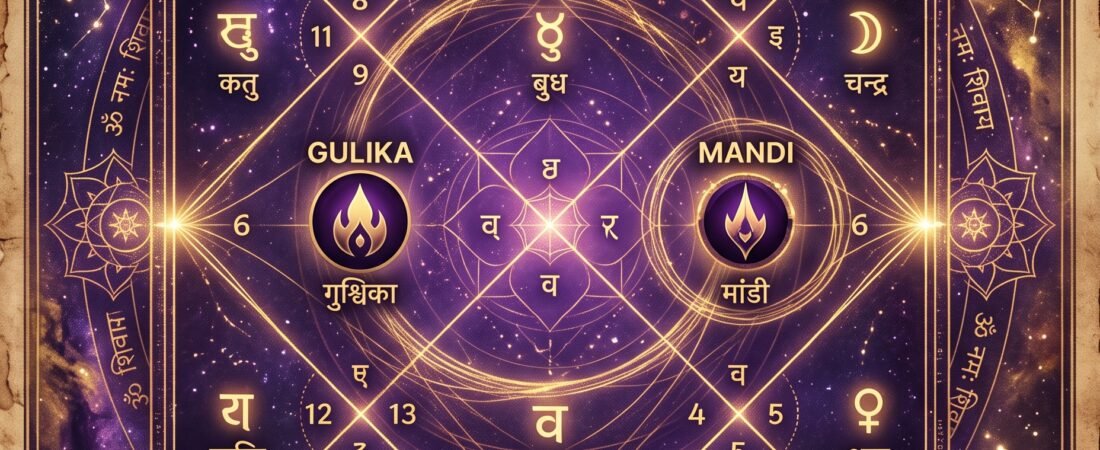
What Is Gulika (Mandi) in Your Kundli and Why Does It Matter for Your Life?
Quick Answer: Gulika — also known as Mandi — is a mathematical shadow point in Vedic astrology derived from Saturn’s daily motion. Unlike Rahu and Ketu, Gulika has no physical celestial body. It is calculated based on the portion of the zodiac Saturn rules during a specific time of day. In your kundli, Gulika’s house and sign placement reveals areas of life where you face repeated tests, develop discipline, and ultimately build resilience.
100% FREE • AI Astrology
Get Your Free Reading Now
Palm Reading • Kundli • Rashifal • Kundli Milan • AI Astrologer
Most astrology beginners learn about Rahu, Ketu and the nine planets — but Gulika is rarely discussed in popular astrology content. Yet classical Jyotish texts, including the Brihat Parashara Hora Shastra, assign Gulika significant predictive weight. Understanding where Gulika sits in your birth chart can explain why certain life areas feel like constant uphill battles — and why those same areas become your greatest strengths over time.
What Exactly Is Gulika?
Gulika is what Vedic astrologers call a upa-graha (sub-planet). It is not a physical object in the sky. Instead, it is a calculated point based on the time of day and the day of the week.
Here is how it works: each day of the week is ruled by a planet (Sunday = Sun, Monday = Moon, Tuesday = Mars, and so on). Saturn’s portion of that day is divided, and the zodiac sign rising during Saturn’s segment becomes Gulika’s position. Because Saturn rules discipline, karma and structure, Gulika inherits those themes.
Mandi is essentially the same point calculated using a slightly different method — some astrologers treat them as identical, others as distinct. In practice, most South Indian Jyotish practitioners use both terms interchangeably.
How to Find Gulika in Your Kundli
Finding Gulika requires two pieces of information: your exact birth time and the day of the week you were born on. Here is a simplified reference:
| Day Born | Saturn’s Segment | Gulika Calculation Basis |
|---|---|---|
| Sunday | Last 1/7 of daytime | Sign rising in Saturn’s final segment |
| Monday | 2nd 1/7 of daytime | Sign rising during Saturn’s 2nd segment |
| Tuesday | 6th 1/7 of daytime | Sign rising during Saturn’s 6th segment |
| Wednesday | 5th 1/7 of daytime | Sign rising during Saturn’s 5th segment |
| Thursday | 4th 1/7 of daytime | Sign rising during Saturn’s 4th segment |
| Friday | 3rd 1/7 of daytime | Sign rising during Saturn’s 3rd segment |
| Saturday | 1st 1/7 of daytime | Sign rising during Saturn’s 1st segment |
Because this calculation depends on sunrise time at your birthplace, you need accurate birth data. Tools like Astrova’s free Janam Kundli generator compute your full chart including shadow points.
What Gulika Reveals in Each House
Gulika’s placement shows where life tests you most. Here is a quick reference for key houses:
| Gulika House | Life Area Tested | Potential Strength Built |
|---|---|---|
| 1st House | Identity, health, self-image | Resilience, self-discipline |
| 2nd House | Finances, family speech | Financial prudence, careful communication |
| 4th House | Home, mother, emotional peace | Emotional independence |
| 7th House | Marriage, partnerships | Mature relationship skills |
| 10th House | Career, public reputation | Professional endurance |
| 12th House | Losses, isolation, spirituality | Spiritual depth, detachment wisdom |
A Practical Example: Gulika in the 7th House
Consider someone born on a Thursday with Gulika calculated to fall in their 7th house. This person might notice a pattern: relationships feel like hard work from the start. Partners may be demanding, or the person themselves may set impossibly high standards.
But here is what classical astrology teaches — Gulika does not destroy; it disciplines. The same 7th-house Gulika that creates early relationship struggles also builds the person into someone who takes commitment seriously, communicates clearly under pressure, and ultimately forms partnerships that are tested but unbreakable.
The key insight: Gulika’s challenges are not punishments. They are the areas where Saturn asks you to do the work — and rewards you permanently once you do.
Gulika vs. Rahu-Ketu: What Is the Difference?
Both Gulika and the Rahu-Ketu axis are shadow points, but they operate differently:
- Rahu-Ketu represent karmic desires (Rahu) and karmic release (Ketu). They show obsession and detachment across lifetimes.
- Gulika/Mandi represent Saturn’s disciplinary energy localized to a specific house. They show where you are tested in this lifetime.
- Rahu-Ketu transits affect everyone simultaneously. Gulika is personal — it is fixed in your birth chart based on your exact birth time.
Understanding both systems together gives a more complete picture of your karmic landscape. If you are exploring how AI can help decode these placements, Astrova’s AI astrology tool can analyze your full chart including shadow points.
100% FREE • AI Astrology
Get Your Free Reading Now
Palm Reading • Kundli • Rashifal • Kundli Milan • AI Astrologer
Frequently Asked Questions
1. Is Gulika always malefic?
In classical Vedic astrology, Gulika is generally considered malefic — meaning it indicates areas of challenge and testing. However, “malefic” does not mean “bad.” Gulika’s tests build discipline, resilience and long-term strength. Many successful people have strong Gulika placements that forged their character.
2. Can Gulika change houses over time?
Your birth-chart Gulika is fixed based on your birth time and day. However, Gulika also has a transit component — some astrologers calculate daily Mandi periods (Mandi Kalam) that shift throughout the day. The birth-chart placement is what matters for personality and life-pattern analysis.
3. How is Mandi different from Gulika?
Most South Indian astrology traditions treat Mandi and Gulika as the same point. Some North Indian texts calculate them slightly differently — Mandi using the day-lord’s segment and Gulika using Saturn’s segment. In modern practice, most astrologers use the terms interchangeably.
4. What remedies work for a strong Gulika?
Since Gulika carries Saturn’s energy, traditional remedies include wearing a blue sapphire or iron ring (after consulting an astrologer), donating to the elderly or disabled on Saturdays, reciting the Shani Beej Mantra, and performing disciplined service (seva) in areas Gulika touches in your chart.
5. Can Astrova AI show my Gulika placement?
Yes. Astrova AI’s free kundli generator calculates your full birth chart including shadow points. You can see your Gulika/Mandi house and sign placement alongside your planetary positions, Dasha periods and yoga analysis.
Explore More Astrova Guides
About the Astrova AI Editorial Team
The Astrova AI Editorial Team combines traditional Vedic astrology knowledge with modern AI technology to create accessible, practical astrology content. Our goal is to help you understand your chart and make informed decisions.
Related posts:
 How to read your own palm at home — step-by-step guide — Complete Guide 2026
 How to check your daily Rashifal using your Moon sign — step by step — Complete Guide 2026
 How to identify Kaalsarp Dosha in your Kundli — visual guide — Complete Guide 2026
How accurate is AI Kundli matching vs traditional astrologer matching? — Complete Guide 2026
How to identify Kaalsarp Dosha in your Kundli — visual guide — Complete Guide 2026
How accurate is AI Kundli matching vs traditional astrologer matching? — Complete Guide 2026