
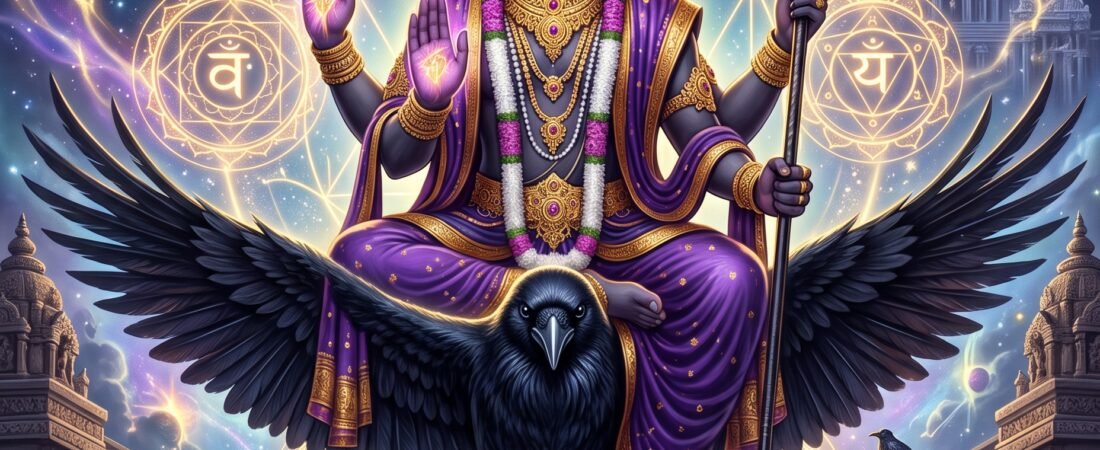
What Does Shani Dev Teach Us About Karma and Justice in Vedic Astrology?
Quick Answer: Shani Dev, the deity of Saturn, represents the cosmic law of karma and divine justice in Vedic astrology. He teaches that every action has consequences, and his 7.5-year Sade Sati cycle is not punishment but purification — a transformative period that burns away negative karma and rewards righteous living. Understanding Shani’s mythology reveals why he is feared yet revered as the ultimate teacher of life’s hardest lessons.
⭐ 4.8/5 rating
Discover Your Karma with Astrova AI
Get your complete Saturn transit analysis, Sade Sati predictions, and personalized karma remedies
✓ Karma Remedies
✓ Saturn Transit Reports
The Mythology of Shani Dev: Born from the Sun God’s Shadow
In Hindu mythology, Shani Dev’s origin story reveals his divine purpose. He is the son of Surya Dev (the Sun God) and his shadow consort Chhaya. According to the Brahma Vaivarta Purana, when Chhaya replaced Surya’s first wife Sanjna, she gave birth to Shani — a child so dark and intense that when he opened his eyes as a newborn, the Sun God himself was eclipsed.
Enraged by this perceived insult, Surya cursed Shani to be dark and feared by all. But Shani responded with a profound truth: “Father, I am not darkness — I am the consequence of light. Every action casts a shadow, and I am the keeper of those shadows.”
This mythological exchange establishes Shani’s cosmic role: he is not evil, but the embodiment of karmic accountability. Where the Sun represents the self and ego, Saturn represents the consequences of how that self acts in the world.
Shani as the Lord of Karma: The Cosmic Accountant
Vedic astrology calls Shani Dev “Karmaphal Daata” — the giver of karma’s fruits. This title is not metaphorical; it describes his literal function in the cosmic order. Every thought, word, and deed creates karmic seeds, and Shani is the divine accountant who ensures every seed ripens into its appropriate fruit.
The Brihat Parashara Hora Shastra, one of the foundational texts of Jyotish (Vedic astrology), states: “As the Sun is the soul of the kalpurush (cosmic being), so is Saturn the instrument of his karma.” This means Shani does not create your destiny — he executes it, based on the choices you have made.
This is why Shani is both feared and revered. He cannot be bribed, flattered, or deceived. Unlike other planetary deities who may show mercy, Shani delivers exact consequences — positive for righteous living, challenging for harmful actions.
The Sade Sati Cycle: 7.5 Years of Transformation, Not Punishment
The most misunderstood aspect of Shani Dev is the Sade Sati period — the 7.5-year cycle when Saturn transits through the 12th, 1st, and 2nd houses from your Moon sign. Popular culture treats Sade Sati as a curse, but this is a fundamental misreading of Shani’s purpose.
| Sade Sati Phase | Duration | Karmic Purpose |
|---|---|---|
| First Phase (12th House) | 2.5 years | Releasing past attachments, clearing debts (karmic and material) |
| Second Phase (1st House) | 2.5 years | Identity transformation, health recalibration, self-reckoning |
| Third Phase (2nd House) | 2.5 years | Rebuilding values, family realignment, financial restructuring |
Think of Sade Sati as a spiritual audit. If you have lived ethically, Sade Sati brings unexpected rewards, promotions, and spiritual growth. If you have accumulated negative karma, Sade Sati forces you to confront it — not to punish you, but to give you the chance to correct it.
The Garuda Purana explains: “Shani’s pressure is the pressure of a diamond cutter — it removes flaws to reveal the gem within.”
Shani’s Mythological Lessons: Three Stories That Reveal His Nature
1. King Harishchandra and the Test of Truth
King Harishchandra’s legend demonstrates Shani’s role as the tester of dharma (righteousness). When the sage Vishwamitra cursed the king to lose his kingdom, family, and status, Harishchandra never abandoned truth — even when working as a cremation ground worker. Shani, pleased with his unwavering integrity, orchestrated his restoration. The lesson: Shani tests those he intends to elevate.
2. The Story of Shani and Ravana
In the Ramayana, Ravana once imprisoned Shani Dev to prevent any karmic consequences for his actions. Without Shani’s influence, Ravana’s arrogance grew unchecked — until the cosmic balance demanded his destruction. When Shani was finally released, he ensured Ravana faced the consequences of his adharma (unrighteousness). The lesson: You cannot escape karma; you can only delay it.
3. Shani and the Devotee Who Sang Bhajans
A poor devotee of Lord Rama faced relentless hardships during Sade Sati. Instead of cursing Shani, he continued singing Rama bhajans daily. Shani appeared in his dream and said: “I am bound to give you the fruits of your past karma, but your devotion is creating new, positive karma that will outlast this cycle.” Within a year, the devotee’s fortunes reversed. The lesson: Devotion and righteous action can accelerate karmic correction.
How Shani’s Justice Differs from Human Justice
Human justice systems are flawed — they punish the innocent, let the guilty escape, and operate on incomplete information. Shani’s justice is perfect because:
- It is omniscient: Shani sees every thought, intention, and action — not just the visible ones.
- It is patient: Karma may ripen across lifetimes, but it always ripens.
- It is proportional: The consequence always matches the action — no more, no less.
- It is educational: Shani’s goal is not revenge but correction. Every hardship carries a lesson.
This is why Vedic texts call Shani “the great teacher” (Mahaguru). He does not destroy — he refines.
Practical Remedies: Working with Shani’s Energy, Not Against It
The mistake most people make is trying to appease Shani through rituals alone. Shani is not impressed by empty gestures. He responds to genuine behavioral change.
Effective Shani remedies include:
- Serving the elderly and disabled: Shani represents old age and physical limitations. Volunteering at old-age homes or helping disabled individuals directly addresses his karmic domain.
- Practicing honesty in business: Shani punishes fraud and exploitation. If you are in business, ensure your practices are transparent and ethical.
- Donating black items on Saturdays: Black sesame seeds, black urad dal, or iron items donated to the needy on Saturdays (Shani’s day) create positive karma.
- Chanting the Shani Beej Mantra: “Om Pram Preem Saum Namah” — 108 repetitions daily with a rudraksha mala.
- Avoiding alcohol and non-vegetarian food on Saturdays: These violate Shani’s principle of discipline and purity.
But the most powerful remedy is simple: live with integrity. If your actions are dharmic (righteous), Shani becomes your greatest benefactor, not your tormentor.
How Astrova AI Helps You Understand Your Saturn Cycle
Knowing when your Sade Sati or Shani Dhaiya (small Panoti) periods occur allows you to prepare — not with fear, but with awareness. Astrova AI’s Kundli analysis provides:
- Exact Sade Sati dates: When it starts, which phase you are in, and when it ends.
- House-by-house impact: How Saturn’s transit affects your career, relationships, health, and finances.
- Personalized remedies: Based on your Moon sign and ascendant, not generic advice.
- Positive potential: Saturn’s transit can bring massive growth if you are aligned with dharma — we show you where.
Download Astrova AI — 100% Free
Frequently Asked Questions
1. Is Shani Dev good or bad?
Shani Dev is neither good nor bad — he is just. He rewards righteousness and challenges unrighteousness. If you live ethically, Shani brings success and spiritual growth. If you accumulate negative karma, Shani forces you to confront it.
2. Can Sade Sati be avoided?
No. Sade Sati is a natural transit that occurs every 30 years for every person. It cannot be avoided, but its impact can be mitigated through righteous living, devotion, and service.
3. Why do good people suffer during Sade Sati?
Sade Sati does not only punish — it also tests and purifies. For righteous individuals, Sade Sati often brings spiritual awakening, detachment from material illusions, and preparation for higher responsibilities. The “suffering” is often the shedding of ego and attachments.
4. How do I know if I am in Sade Sati?
Sade Sati occurs when Saturn transits the 12th, 1st, and 2nd houses from your Moon sign. Astrova AI’s free Kundli generator shows your exact Sade Sati dates based on your birth chart.
5. What is the difference between Sade Sati and Shani Dhaiya?
Sade Sati is a 7.5-year cycle affecting everyone. Shani Dhaiya (also called Small Panoti) is a 2.5-year period when Saturn transits the 4th or 8th house from your Moon sign — less intense than Sade Sati but still karmically significant.
Explore More Astrova Guides
- AI Palm Reading: Complete Guide to Hasta Samudrika Shastra
- How to Generate Your Janam Kundli — Step-by-Step Guide
- Daily Rashifal: How to Read Your Moon Sign Horoscope
- Kundli Milan: The Complete Marriage Compatibility Guide
- Sade Sati: How to Check and Navigate Saturn’s 7.5-Year Cycle
- How to Use AI Astrology for Daily Life Guidance
About the Astrova AI Editorial Team
The Astrova AI Editorial Team combines traditional Jyotish scholarship with modern AI technology. Our content is reviewed by Vedic astrology practitioners trained in classical texts including the Brihat Parashara Hora Shastra, Phaladeepika, and Jataka Parijata. We believe astrology should be accessible, accurate, and empowering — not fear-based. Astrova AI’s free tools help you understand your chart, your karma, and your path forward.
Get Your Free Kundli on Astrova AI
Related posts:
 How to read your own palm at home — step-by-step guide — Complete Guide 2026
 How to check your daily Rashifal using your Moon sign — step by step — Complete Guide 2026
 How to identify Kaalsarp Dosha in your Kundli — visual guide — Complete Guide 2026
How accurate is AI Kundli matching vs traditional astrologer matching? — Complete Guide 2026
How to identify Kaalsarp Dosha in your Kundli — visual guide — Complete Guide 2026
How accurate is AI Kundli matching vs traditional astrologer matching? — Complete Guide 2026