What Are the 12 Rashis in Vedic Astrology — and Who Created Them?
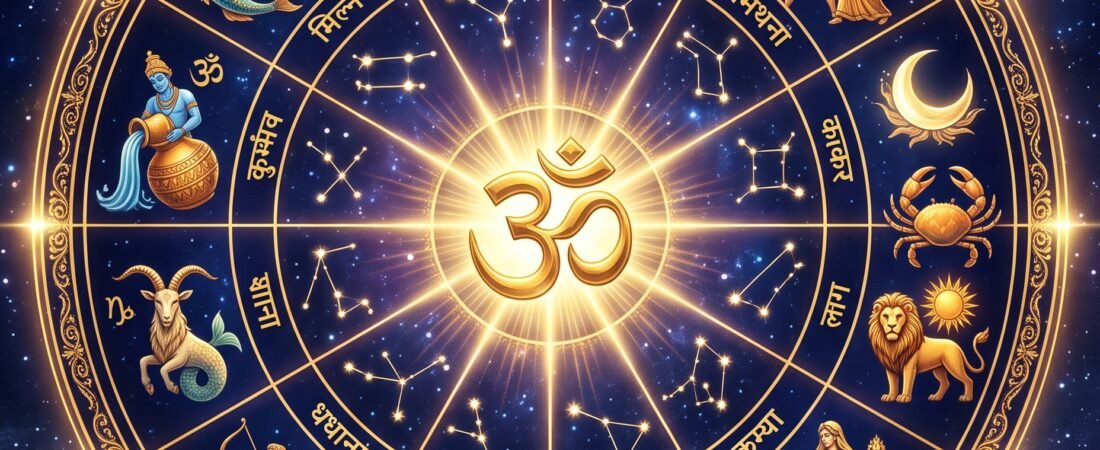
The 12 Rashis (zodiac signs) in Vedic astrology are not arbitrary divisions of the sky — they are rooted in Hindu mythology, where each sign is linked to a divine story, a presiding deity, and a cosmic purpose. From Mesha (Aries) representing the ram form of Lord Brahma to Meena (Pisces) embodying Lord Vishnu’s Matsya avatar, every Rashi carries a mythological origin that reveals why it influences your personality, karma, and life path the way it does.
Understanding the divine stories behind your Rashi transforms your horoscope from a generic prediction into a deeply personal spiritual map — one that connects your birth chart to the same cosmic forces described in the Brihat Parashara Hora Shastra, the Vishnu Purana, and the Bhagavata Purana.
✨ ASTROVA AI — FREE ASTROLOGY APP
Discover your Rashi, your deity connection, and your cosmic purpose
⭐⭐⭐⭐⭐ Free Kundli • Rashifal • AI Astrologer • 9 Languages
100% FREE • No Credit Card Required
How Were the 12 Rashis Created? The Cosmic Origin Story
According to Vedic tradition, the zodiac was established by Lord Brahma at the beginning of creation. The Surya Siddhanta — one of the oldest astronomical texts in Sanskrit — describes how the Sun God (Surya) taught the science of time and planetary motion to the sage Asura Maya, and from this knowledge the 12-sign zodiac was mapped onto the ecliptic path.
The word “Rashi” (राशि) literally means “heap” or “collection” in Sanskrit. Each Rashi represents a collection of cosmic energy governed by a specific planet, element, and divine force. The 12 signs divide the 360-degree zodiac belt into equal 30-degree segments, and each segment carries the mythological imprint of the deity and story associated with it.
What makes Vedic astrology (Jyotish) unique from Western astrology is that it uses the sidereal zodiac — which accounts for the precession of the equinoxes through the ayanamsa correction. This means your Vedic Rashi is calculated against the actual fixed positions of the constellations, not the tropical approximation used in Western sun-sign astrology.
The Divine Story Behind Each of the 12 Rashis
1. Mesha (Aries) — The Divine Ram of Lord Brahma
Element: Fire | Ruling Planet: Mars (Mangal) | Deity: Lord Brahma (Prajapati)
In the Bhagavata Purana, the first being to emerge from the cosmic egg (Brahmanda) was a golden ram — the symbol of pure creative impulse and unstoppable forward motion. Lord Brahma, the creator, took this form to begin the work of creation. People born under Mesha carry this primordial creative fire — they are initiators, leaders, and first movers who embody the divine urge to begin something new.
2. Vrishabha (Taurus) — The Sacred Bull of Lord Shiva
Element: Earth | Ruling Planet: Venus (Shukra) | Deity: Lord Shiva (as Nandi’s master) / Goddess Lakshmi
Nandi, the sacred bull, is Lord Shiva’s vahana and the gatekeeper of Kailash. The bull represents dharma (righteousness), stability, and the patient accumulation of wealth and merit. In the Shiva Purana, Nandi is described as an embodiment of justice and devotion. Vrishabha natives carry this grounded, steadfast energy — they build, nurture, and protect what they love with unwavering determination.
3. Mithuna (Gemini) — The Eternal Couple
Element: Air | Ruling Planet: Mercury (Budh) | Deity: The Ashwini Kumaras / Lord Indra
The twins of Mithuna represent the dual nature of consciousness — the interplay between knowledge and action, speech and silence, the material and the spiritual. In Vedic mythology, the Ashwini Kumaras — the twin physicians of the gods — embody this sign’s gift for communication, healing through words, and the ability to hold two perspectives simultaneously.
4. Karka (Cancer) — The Cosmic Crab and the Moon’s Embrace
Element: Water | Ruling Planet: Moon (Chandra) | Deity: Lord Krishna / Goddess Ganga
The crab carries its home on its back — a symbol of the protective shell of emotion and memory that defines Karka. In the Mahabharata, Lord Krishna (born under the Moon sign Cancer) embodies the nurturing, protective, and emotionally deep qualities of this Rashi. The sign is also connected to Goddess Ganga, whose flowing, life-giving waters mirror the Cancerian gift of emotional nourishment.
5. Simha (Leo) — The Lion Throne of Lord Surya
Element: Fire | Ruling Planet: Sun (Surya) | Deity: Lord Surya / Lord Rama
The lion is the vehicle of the Sun God himself. In the Rig Veda, Surya rides a chariot drawn by seven horses across the sky — and the lion represents the sovereign power, radiance, and leadership that the Sun bestows. Lord Rama, the Maryada Purushottam (perfect being), is also associated with Simha’s noble, generous, and commanding energy. Simha natives carry the divine mandate to lead with dignity and protect those in their care.
6. Kanya (Virgo) — The Goddess of Purity and Precision
Element: Earth | Ruling Planet: Mercury (Budh) | Deity: Goddess Durga / Goddess Lakshmi
Kanya is represented by a young woman holding a sheaf of grain — the symbol of harvest, analysis, and service. In the Devi Mahatmya, Goddess Durga’s analytical mind that defeated the demon Mahishasura reflects Virgo’s gift for seeing through complexity to find the truth. This Rashi governs the power of discrimination (viveka) — the ability to separate what is essential from what is noise.
7. Tula (Libra) — The Scales of Cosmic Justice
Element: Air | Ruling Planet: Venus (Shukra) | Deity: Lord Vishnu (as the preserver of balance)
Tula is the only inanimate object among the 12 Rashis — a pair of scales representing dharma and balance. In the Vishnu Purana, Lord Vishnu is the preserver who maintains cosmic equilibrium. When the demon Vritra disrupted the balance between gods and demons, Vishnu restored order — the same impulse that drives Tula natives to seek harmony, justice, and beautiful partnerships.
8. Vrishchika (Scorpio) — The Scorpion and Lord Shiva’s Transformative Power
Element: Water | Ruling Planet: Mars (Mangal) | Deity: Lord Shiva (as Mahakala, the destroyer of ignorance)
Scorpio’s stinger carries the power of transformation through destruction. In the Shiva Purana, Lord Shiva as Mahakala destroys illusion and ego to reveal the truth beneath. This is not destruction for its own sake — it is the divine surgery that removes what is dead so new life can emerge. Vrishchika natives carry this transformative intensity — they see what others hide and are unafraid of life’s deepest mysteries.
9. Dhanu (Sagittarius) — The Divine Archer and Lord Brihaspati
Element: Fire | Ruling Planet: Jupiter (Guru/Brihaspati) | Deity: Lord Brihaspati (Guru of the Gods) / Lord Vishnu (as Dhanvantari)
The archer aiming upward represents the eternal quest for higher knowledge and dharma. Brihaspati, the guru of the Devas, governs this sign — he is the divine teacher who wrote the Brihaspati Shastra on law, ethics, and wisdom. Dhanu natives carry the archer’s gift: the ability to aim beyond the visible target toward truth, philosophy, and spiritual expansion.
10. Makara (Capricorn) — The Sea-Goat and Lord Shani
Element: Earth | Ruling Planet: Saturn (Shani) | Deity: Lord Shani / Goddess Kali
Makara’s mythical creature — half goat, half fish — climbs the mountain of ambition while diving into the ocean of emotional depth. Lord Shani, the taskmaster of karma, governs this sign. In the Bhagavata Purana, Shani’s story reveals that discipline, patience, and hard work are not punishments but divine gifts that forge unbreakable character. Makara natives carry the cosmic mandate to build lasting structures through perseverance.
11. Kumbha (Aquarius) — The Water Bearer and the Gift of Knowledge
Element: Air | Ruling Planet: Saturn (Shani) | Deity: Lord Vishnu (in his cosmic form) / Lord Varuna
The water bearer pours the nectar of knowledge upon humanity. In Vedic mythology, the Kumbha (pot) is the vessel that holds amrita — the nectar of immortality that emerged from the Samudra Manthan (churning of the ocean). Lord Varuna, the god of cosmic waters and universal law, governs this sign’s gift of seeing patterns, humanitarian vision, and revolutionary thinking.
12. Meena (Pisces) — The Divine Fish and Lord Vishnu’s Matsya Avatar
Element: Water | Ruling Planet: Jupiter (Guru) | Deity: Lord Vishnu (as Matsya, the Fish Avatar)
The final Rashi completes the zodiac cycle with the story of Matsya — Lord Vishnu’s first avatar, who appeared as a golden fish to save the sage Manu and the Vedas from the great cosmic deluge (Pralaya). Meena represents the dissolution of boundaries, spiritual liberation (moksha), and the divine compassion that preserves knowledge even when the world is destroyed. Pisces natives carry this ancient wisdom — they are the dreamers, mystics, and healers of the zodiac.
The 12 Rashis: Complete Reference Table
| Rashi | English | Symbol | Element | Ruling Planet | Associated Deity |
|---|---|---|---|---|---|
| Mesha | Aries | 🐏 Ram | Fire | Mars | Lord Brahma |
| Vrishabha | Taurus | 🐂 Bull | Earth | Venus | Lord Shiva / Lakshmi |
| Mithuna | Gemini | 👫 Twins | Air | Mercury | Ashwini Kumaras |
| Karka | Cancer | 🦀 Crab | Water | Moon | Lord Krishna / Ganga |
| Simha | Leo | 🦁 Lion | Fire | Sun | Lord Surya / Rama |
| Kanya | Virgo | 🌾 Maiden | Earth | Mercury | Goddess Durga |
| Tula | Libra | ⚖️ Scales | Air | Venus | Lord Vishnu |
| Vrishchika | Scorpio | 🦂 Scorpion | Water | Mars | Lord Shiva (Mahakala) |
| Dhanu | Sagittarius | 🏹 Archer | Fire | Jupiter | Lord Brihaspati |
| Makara | Capricorn | 🐐 Sea-Goat | Earth | Saturn | Lord Shani / Kali |
| Kumbha | Aquarius | 🏺 Water Bearer | Air | Saturn | Lord Vishnu / Varuna |
| Meena | Pisces | 🐟 Fish | Water | Jupiter | Lord Vishnu (Matsya) |
How Do the Rashis Connect to Your Daily Life?
Each Rashi doesn’t just describe your personality — it shapes the timing of events in your life through the planetary periods (Vimshottari Dasha) and transits (Gochar). When Jupiter transits your Rashi, for example, the expansive energy of Lord Brihaspati activates growth, learning, and spiritual progress in the areas of life governed by that house.
The ancient rishis understood that the zodiac was not a static map but a living clock. Your Rashi, combined with your Nakshatra (birth star) and the planetary positions at the moment of your birth, creates a unique cosmic fingerprint that the Brihat Parashara Hora Shastra provides the framework to decode.
This is why knowing your exact birth time matters so much in Vedic astrology — even a difference of a few minutes can shift your Ascendant (Lagna) from one Rashi to another, changing the entire interpretation of your chart.
How Astrova AI Helps You Understand Your Rashi
Astrova AI brings the depth of Vedic mythology and astrology to your fingertips — free, in your language, and available 24/7:
- Free Janam Kundli: Generate your complete birth chart with all 12 houses, planetary positions, and Rashi placements — explained in simple language
- Daily Rashifal in 9 Indian Languages: Get your daily horoscope based on your Moon sign (Rashi) in Hindi, Tamil, Telugu, Kannada, Malayalam, Bengali, Marathi, Gujarati, and English
- AI Palm Reading: Upload a photo of your palm and receive a detailed reading that connects your palm lines to your Rashi and planetary influences
- Kundli Milan: Check marriage compatibility using the Ashtakoot Guna Milan system — the same 36-point matching method described in classical Jyotish texts
- Sade Sati & Kaalsarp Analysis: Understand the major planetary periods affecting your Rashi and get practical remedies
- 24/7 AI Astrologer: Ask any question about your chart, your Rashi, or your planetary periods — and get answers rooted in Vedic tradition
🔮 START YOUR FREE READING NOW
Join thousands who discovered their cosmic path with Astrova AI
⭐⭐⭐⭐⭐ 100% FREE • No Credit Card
Frequently Asked Questions
What is the difference between Rashi and Nakshatra?
Your Rashi (Moon sign) represents a 30-degree segment of the zodiac and reflects your emotional nature and mind. Your Nakshatra (birth star) is a 13-degree-20-minute segment within that Rashi and provides a more granular view of your personality, karma, and life purpose. There are 27 Nakshatras spread across the 12 Rashis. In Vedic astrology, both are used together — the Rashi gives the broad theme, and the Nakshatra gives the specific story.
Why is my Vedic Rashi different from my Western sun sign?
Western astrology uses the tropical zodiac, which is fixed to the seasons and does not account for the slow wobble of Earth’s axis (precession of the equinoxes). Vedic astrology uses the sidereal zodiac, which tracks the actual positions of the constellations. The difference — called the ayanamsa — is approximately 23-24 degrees, which means your Vedic Moon sign is typically one sign behind your Western sun sign.
Can I worship the deity of my Rashi for better results?
Yes — this is a well-established practice in Vedic tradition. Each Rashi has a presiding deity, and worshipping that deity (through mantras, visits to temples, or simple daily prayer) is considered a powerful upaya (remedy) for strengthening the positive influences of that sign in your chart. For example, if your Moon is in Simha (Leo), worshipping Lord Surya through the Aditya Hridayam or offering water to the Sun every morning is traditionally recommended.
How can I find out my exact Rashi?
Your Rashi is determined by the position of the Moon at the exact time and place of your birth. You need three pieces of information: your date of birth, exact time of birth, and place of birth. With these details, Astrova AI can generate your complete Janam Kundli and tell you your Rashi, Nakshatra, Ascendant, and the planetary positions in every house — all for free.
Do the Rashi stories have practical value, or are they just mythology?
In the Vedic tradition, mythology and astrology are not separate — they are two languages describing the same cosmic reality. The stories encode psychological and spiritual truths: the ram (Mesha) teaches initiative, the scales (Tula) teach balance, the fish (Meena) teaches compassion and preservation. When an astrologer interprets your chart, these mythological layers add depth to the prediction — they explain not just what will happen, but why it is happening to you specifically.
Explore More Astrova Guides
- Complete Guide to AI Palm Reading — What Your Palm Lines Reveal
- Kundli Milan: How to Check Marriage Compatibility the Vedic Way
- What Is Vimshottari Dasha — How to Read Your Planetary Periods
- The 27 Nakshatras: How Your Birth Star Shapes Your Destiny
- Sade Sati Explained: What It Is, How It Affects You, and Powerful Remedies
- AI Astrology: The Complete Guide to Vedic Predictions Powered by AI
About the Author
Astrova AI Editorial Team
The Astrova AI Editorial team combines expertise in Vedic astrology (Jyotish Shastra), classical Sanskrit texts, and modern AI technology to make ancient wisdom accessible to everyone. Our content draws from authoritative sources including the Brihat Parashara Hora Shastra, Surya Siddhanta, Vishnu Purana, Bhagavata Purana, and Phaladeepika by Mantreswara. We believe that understanding the mythology behind your zodiac sign transforms astrology from a prediction tool into a mirror for self-discovery.
Have a correction or question? We welcome feedback. Reach us at support@theastrova.com
Related posts:
 How to read your own palm at home — step-by-step guide — Complete Guide 2026
 How to check your daily Rashifal using your Moon sign — step by step — Complete Guide 2026
 How to identify Kaalsarp Dosha in your Kundli — visual guide — Complete Guide 2026
How accurate is AI Kundli matching vs traditional astrologer matching? — Complete Guide 2026
How to identify Kaalsarp Dosha in your Kundli — visual guide — Complete Guide 2026
How accurate is AI Kundli matching vs traditional astrologer matching? — Complete Guide 2026