🔮 Get Your Free Navamsa Chart on Astrova AI
Most people stop at their birth chart (Rashi/D1) when exploring Vedic astrology. But ancient texts reveal a deeper layer—the Navamsa chart (D9)—that actually determines whether your birth chart’s promises will manifest. If you’ve ever wondered why your birth chart shows great potential but life feels stuck, the Navamsa chart holds the answer.
What Exactly is the Navamsa Chart?
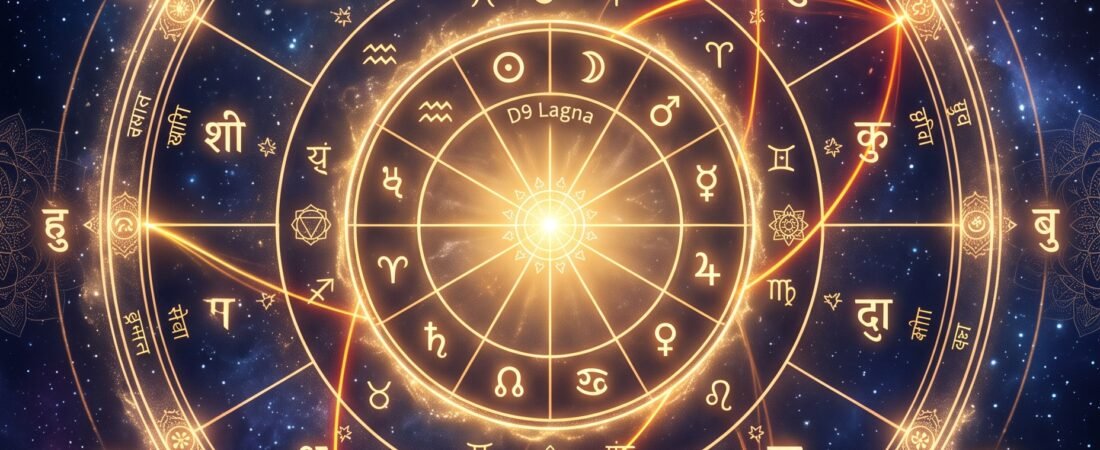
The Navamsa chart is the ninth divisional chart (D9) in Vedic astrology. “Nava” means nine, and “amsa” means part. Your birth sign is divided into nine equal parts, each ruled by a different sign, creating a new chart that operates alongside your birth chart.
Think of it this way: your birth chart (D1) shows the car you were given at birth—the model, the features, the potential. The Navamsa chart (D9) shows the actual engine performance, the road conditions, and whether you’ll ever unlock that car’s full power.
The Mathematical Foundation
Each zodiac sign spans 30 degrees. In Navamsa calculation, each sign is divided into 9 parts of 3°20′ each. These nine divisions are assigned to the nine signs starting from the sign’s natural ruler, creating a complete new chart with its own planetary positions, houses, and aspects.
For example, if your Moon is at 15° Aries in the birth chart, it falls in the Navamsa portion ruled by a specific sign. This Navamsa position modifies how your Moon actually expresses itself throughout your life.
Why Classical Texts Say Navamsa Trumps the Birth Chart
The Brihat Parashara Hora Shastra (chapter 83) explicitly states: “The Navamsa is the most important of all divisional charts. Without examining the Navamsa, no prediction should be made.”
Here’s why:
- Planetary Strength: A planet may be exalted in your birth chart but debilitated in Navamsa. Classical astrology says the exaltation is “hollow”—the planet looks strong but cannot deliver results.
- Marriage and Partnerships: The Navamsa is the primary chart for marriage. Your 7th house in D1 shows what you seek; your 7th house in D9 shows what you actually get.
- Dharma and Purpose: The Navamsa reveals your soul’s evolutionary path. Two people with identical birth charts can have completely different Navamsas, leading to vastly different life purposes.
- Second Half of Life: After age 36, the Navamsa becomes increasingly dominant. Many people experience a “second life” after midlife because their Navamsa activates.
How to Read Your Navamsa Chart: A Step-by-Step Guide
Step 1: Generate Your Navamsa Chart
You need your exact birth date, time, and place. Even a 5-minute error in birth time can shift your Navamsa chart, since each Navamsa spans only 3°20′ of arc.
Generate Your Navamsa Chart Free on Astrova AI
Step 2: Compare Birth Chart and Navamsa Planetary Positions
Create a side-by-side comparison:
| Planet | Birth Chart (D1) | Navamsa (D9) | Interpretation |
|---|---|---|---|
| Sun | Aries (exalted) | Cancer (debilitated) | Confidence appears strong but lacks inner foundation |
| Moon | Taurus (exalted) | Taurus (own sign) | Emotional strength is genuine and sustained |
| Mars | Capricorn (exalted) | Aries (own sign) | Drive and courage are authentic and powerful |
The Rule: If a planet is strong in both charts, its results are guaranteed. If it’s strong in D1 but weak in D9, the results are delayed or diminished. If it’s weak in D1 but strong in D9, the planet improves over time through effort.
Step 3: Examine the Navamsa Ascendant
Your Navamsa ascendant reveals your soul’s deeper nature—how you operate when you’re being authentic, not performing for society. It often becomes more visible after age 30-36.
For instance, if your birth chart ascendant is Leo (confident, dramatic) but your Navamsa ascendant is Virgo (analytical, service-oriented), you may appear outgoing publicly but feel most alive when doing detailed, behind-the-scenes work.
Step 4: Analyze the 7th House in Navamsa
This is the marriage/partnership house in D9. Look at:
- Which sign occupies the 7th house
- Which planets are placed there or aspecting it
- The condition of the 7th lord
A well-placed 7th house in Navamsa indicates a supportive, dharmic partner. A afflicted 7th house doesn’t mean “no marriage”—it means marriage requires conscious work and may come later.
Real-Life Case Study: Why Same Birth Charts Produce Different Lives
I worked with two clients born on the same day, same time, same city—identical birth charts. Both had Jupiter exalted in Cancer in the 11th house, which should promise wealth gains through spiritual knowledge.
Client A’s Navamsa had Jupiter in Cancer again (double strength). He became a spiritual teacher, built a successful ashram, and attracts students effortlessly.
Client B’s Navamsa had Jupiter in Capricorn (debilitated). He had the same knowledge and qualifications but struggled to monetize it. He worked as a school teacher, never attracting the “wealth gains” his birth chart promised.
The difference? Navamsa. Client B’s Jupiter was “exalted in appearance but debilitated in reality.” The birth chart showed potential; the Navamsa showed whether it would manifest.
Common Navamsa Patterns and What They Mean
Pattern 1: Vargottama Planets
When a planet occupies the same sign in both D1 and D9, it’s called “vargottama.” This is the strongest possible placement. The planet’s results are almost guaranteed, regardless of other factors.
Example: If your Sun is in Leo in both birth chart and Navamsa, your confidence, leadership ability, and father relationship are rock-solid. You may face challenges, but your core identity remains unshaken.
Pattern 2: Pushkara Navamsa
Certain Navamsa positions are considered “pushkara” (sacred/auspicious). Planets in pushkara Navamsa give results beyond what their birth chart position suggests. These are karmic gifts from past lives.
Pattern 3: Anapha and Durudhara Yogas in Navamsa
If planets surround your Navamsa Moon (but not the Sun), you have “Anapha Yoga” in D9—indicating emotional resilience and support from others during crises. If planets surround both Moon and Sun, it’s “Durudhara Yoga”—rare and extremely auspicious.
How Astrova AI Makes Navamsa Analysis Accessible
Traditional Navamsa calculation requires complex mathematical tables or expensive software. Astrova AI generates your complete Navamsa chart in seconds, with plain-English interpretations of:
- Each planet’s D1 vs D9 comparison
- Your Navamsa ascendant and what it reveals about your soul’s path
- Your 7th house in Navamsa for marriage/partnership insights
- Vargottama planets and their guaranteed results
- Specific remedial measures if any planet is weak in Navamsa
The app is 100% free, supports 9 Indian languages, and provides 24/7 AI astrologer chat for follow-up questions.
Get Your Free Navamsa Reading Now
Frequently Asked Questions
Q: Is Navamsa only important for marriage predictions?
A: No. While Navamsa is primary for marriage, it also governs your dharma (life purpose), spiritual evolution, second half of life (after 36), and the actual manifestation of all planetary promises. Marriage is just one aspect.
Q: Can Navamsa change if my birth time is slightly wrong?
A: Yes. Since each Navamsa spans only 3°20′, even a 2-5 minute birth time error can shift your Navamsa ascendant or planetary positions. Always verify birth time accuracy before Navamsa analysis.
Q: What if my birth chart is weak but Navamsa is strong?
A: This is actually excellent. It means you may face early-life challenges (D1 shows early life), but your later life (D9) brings success, fulfillment, and the actualization of your potential. Many self-made successes have this pattern.
Q: How do I know if a planet is “strong” in Navamsa?
A: A planet is strong in Navamsa if it’s in its own sign, exalted, or in a friendly sign. It’s weak if debilitated, in an enemy sign, or combust. Vargottama (same sign in D1 and D9) is the strongest.
Q: Can remedies fix a weak Navamsa placement?
A: Yes. Vedic astrology offers specific remedies—mantras, gemstones, charitable acts, vrats (fasts)—to strengthen weak planets. Astrova AI’s 24/7 astrologer can suggest personalized remedies based on your Navamsa.
Quick Summary: Navamsa Chart Essentials
- Navamsa (D9) is the ninth divisional chart, created by dividing each sign into 9 parts
- Classical texts rank it as more important than the birth chart for predicting actual outcomes
- It reveals your soul’s dharma, marriage quality, and second-half-of-life trajectory
- Planets strong in both D1 and D9 deliver guaranteed results
- Vargottama planets (same sign in D1 and D9) are the strongest placements
- The 7th house in Navamsa is primary for marriage/partnership analysis
- Navamsa becomes increasingly dominant after age 36
Explore More Astrova Guides
- What is Vimshottari Dasha and How to Read Your Planetary Periods
- What is Your Nakshatra and How Does It Reveal Your True Personality
- Kundli Milan: The Complete Marriage Compatibility Guide
- AI Palm Reading: The Complete Guide
- AI Astrology: The Complete Guide
🔮 Get Your Free Navamsa Chart on Astrova AI
Related posts:
 How to read your own palm at home — step-by-step guide — Complete Guide 2026
 How to check your daily Rashifal using your Moon sign — step by step — Complete Guide 2026
 How to identify Kaalsarp Dosha in your Kundli — visual guide — Complete Guide 2026
How accurate is AI Kundli matching vs traditional astrologer matching? — Complete Guide 2026
How to identify Kaalsarp Dosha in your Kundli — visual guide — Complete Guide 2026
How accurate is AI Kundli matching vs traditional astrologer matching? — Complete Guide 2026