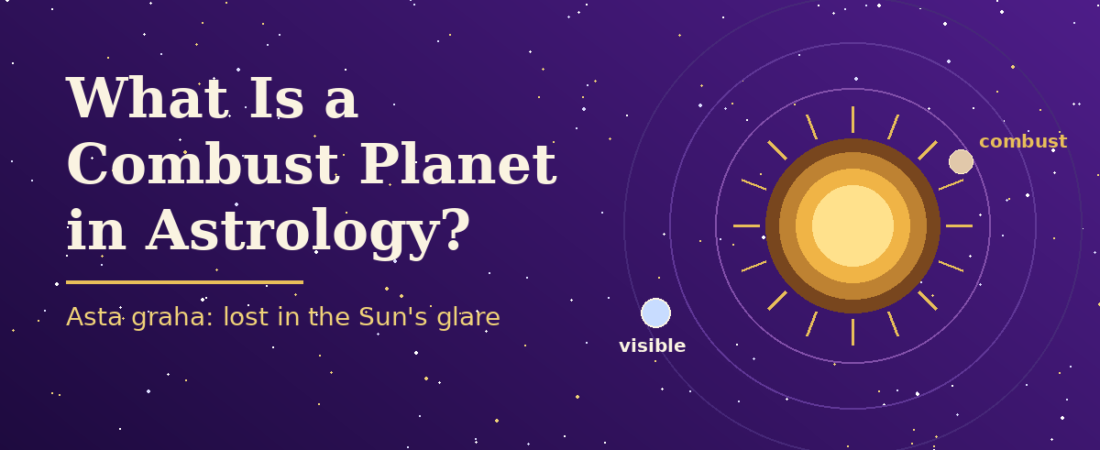
A combust planet (asta graha) is one so close to the Sun in the sky that its light is lost in the Sun’s glare. Vedic astrology reads it as weakened, its themes overshadowed by the Sun. Each planet has its own distance limit, from 10 to 17 degrees, and a combust planet is not automatically bad.
Key takeaways
- Meaning: “asta” means “set”. The planet has set into the Sun’s light and can’t be seen, much like a star at sunrise.
- Distances: Moon 12°, Mercury 14° (12° retrograde), Venus 10° (8° retrograde), Mars 17°, Jupiter 11°, Saturn 15°, from the Surya Siddhanta.
- Never combust: the Sun itself, Rahu and Ketu.
- Sign doesn’t matter, degrees do: a planet in the next sign can still be combust.
- Weak, not doomed: astrologers weigh combustion against sign, house, aspects and dasha.
- Real sky, traditional meaning: planets really do vanish near the Sun; what that means for a person is tradition, not science.
See your Kundli free in Astrova AI
If an astrologer or a Kundli app has told you that one of your planets is “combust”, it can sound alarming. This guide explains what the word actually means, where the degree limits come from, how to check a chart yourself in a minute, how tradition reads a combust planet, and where that tradition ends and evidence begins.
What does combust mean in astrology?
Every planet, as seen from Earth, regularly passes close to the Sun. For a few days or weeks around that meeting it rises and sets with the Sun, so it is up only in daylight and can’t be seen. Astronomers call the last evening a planet is visible its heliacal setting, and the first morning it reappears its heliacal rising.
Indian astronomy described the same thing. The Surya Siddhanta, a classical Sanskrit astronomy text, says that within certain distances the planets “become invisible, their forms being swallowed up by the brightness of the sun” (chapter IX, verse 9, in Ebenezer Burgess’s 1860 translation on Internet Archive). The Sanskrit words for this are asta or astangata (“set”) and moudhya. In English, astrologers call such a planet combust, as if burnt by the Sun.
Jyotish then gives this sky event a meaning. A planet stands for certain parts of life, and when it is hidden in the Sun’s light, tradition says it can’t express those things fully on its own. The Sun, which stands for the self, authority and the father, takes over.
How many degrees from the Sun is a planet combust?
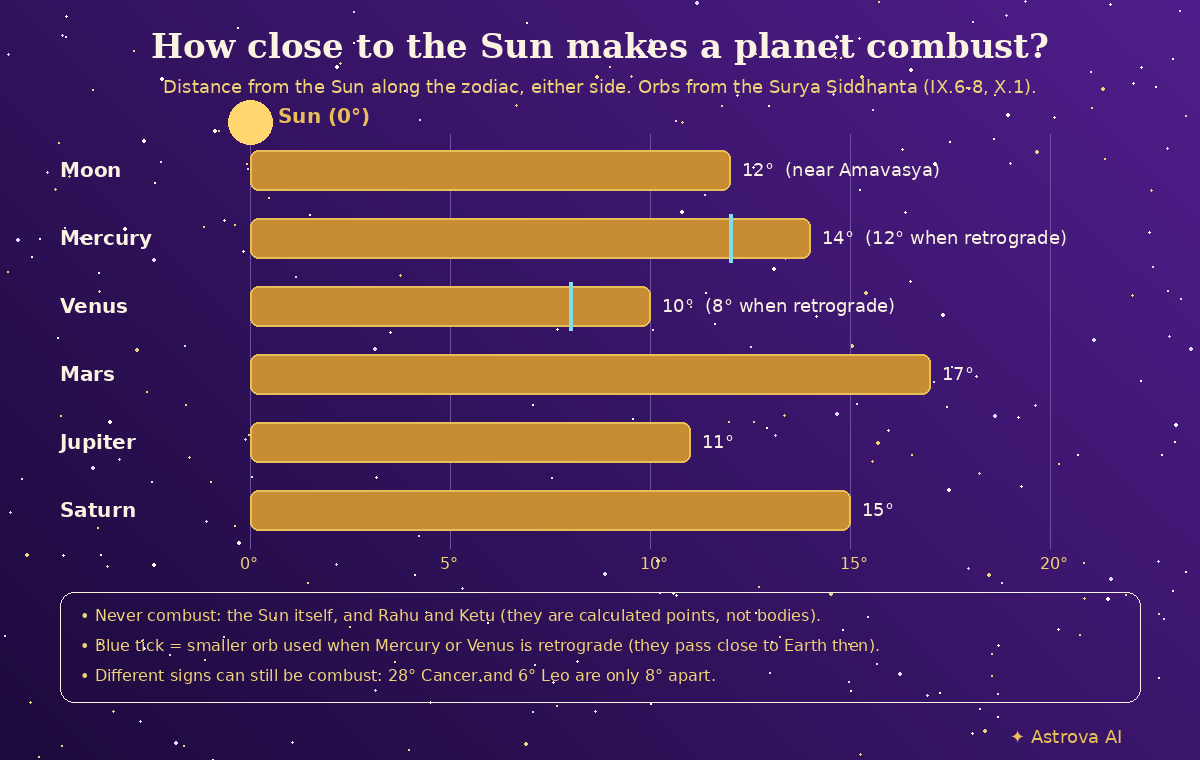
Each planet has its own limit. These figures come from the Surya Siddhanta (IX.6–8 for the planets, X.1 for the Moon) and are the ones most Kundli software and panchangs use.
| Planet | Combust within (either side of the Sun) | Sanskrit name for its combustion |
|---|---|---|
| Moon (Chandra) | 12° | Usually judged by lunar phase instead (see below) |
| Mercury (Budh) | 14°, or 12° when retrograde | Budh Asta |
| Venus (Shukra) | 10°, or 8° when retrograde | Shukra Asta |
| Mars (Mangal) | 17° | Mangal Asta |
| Jupiter (Guru) | 11° | Guru Asta |
| Saturn (Shani) | 15° | Shani Asta |
| Sun, Rahu, Ketu | Never combust | The Sun can’t be close to itself; Rahu and Ketu are calculated points, not bodies |
Why the smaller numbers for retrograde Mercury and Venus? Both turn retrograde when they pass between Earth and the Sun. They are then much nearer to us and look bigger, so they stay visible closer to the Sun. The Surya Siddhanta says Venus sets at 8° “by reason of her greatness” at that time. You can read more about backward motion in our guide to retrograde planets (vakri graha).
One technical note: the Surya Siddhanta measured these limits in “time-degrees” along the celestial equator. Modern software usually applies the same numbers to the simple distance along the zodiac. That is close enough for most charts, but it is one reason two apps can disagree when a planet sits right at the edge.
How to check if a planet is combust in your Kundli
- Get each planet’s exact degree, not just its sign. Any Kundli app or the planet table in your chart shows this.
- Turn sign and degree into one number from 0 to 360. Aries is 0–30, Taurus 30–60, and so on: Leo 10° becomes 130°.
- Find the gap between the Sun and the planet. Subtract the smaller number from the larger. If the answer is over 180, subtract it from 360.
- Compare the gap with that planet’s limit in the table above, using the retrograde limit for a retrograde Mercury or Venus.
- Note how deep it is. A planet 2° from the Sun is read as far more combust than one just inside its limit.
Don’t stop at the sign. A planet in a different sign from the Sun can still be combust, and a planet in the same sign may not be.
Worked example (illustrative)
This is a made-up chart used only to show the method. It is not a reading of a real person.
The Sun is at 10° Leo, which is 130° on the 0–360 scale.
| Planet | Position | On 0–360 | Gap from Sun | Limit | Combust? |
|---|---|---|---|---|---|
| Mercury (direct) | 21° Leo | 141° | 11° | 14° | Yes |
| Venus | 26° Leo | 146° | 16° | 10° | No |
| Mars | 28° Cancer | 118° | 12° | 17° | Yes, though in a different sign |
| Jupiter | 5° Virgo | 155° | 25° | 11° | No |
Two lessons from this chart. Venus shares the Sun’s sign but is safely outside its 10° limit, while Mars sits in the previous sign and is still combust. And if this Mercury were retrograde and 13° from the Sun, it would not count as combust, because the retrograde limit is 12°.
An astrologer reading this chart would not stop at “Mercury and Mars are combust”. They would ask which houses those planets rule, what signs they are in, and whether either one’s Mahadasha is running.
Ask Astrova AI’s astrologer about your chart
What does a combust planet mean? The traditional reading
The common idea is simple: the planet is still in your chart and still rules its houses, but it struggles to act on its own. Its themes get pulled into the Sun’s themes of ego, status, authority and the father, or come through with more effort. In everyday terms:
| Combust planet | What tradition says is overshadowed |
|---|---|
| Mercury | Speech, learning, judgement, trade. Read lightly, because Mercury is so often near the Sun. |
| Venus | Love, marriage, comfort, the arts |
| Mars | Courage, energy, siblings, property |
| Jupiter | Wisdom, teachers, children, good fortune |
| Saturn | Discipline, work, endurance |
| Moon | Mind and emotions; the dark Moon around Amavasya is traditionally read as weak |
Most astrologers soften the reading when the combust planet is in its own or exaltation sign, sits near the edge of its limit, or gets support from benefic planets. Many also say combustion matters most during that planet’s own dasha. For the Sun’s side of the story, see what happens during Surya Mahadasha, and for a weak planet that can still rise, Neecha Bhanga Raj Yoga.
Combust Mercury and Budhaditya Yoga
Mercury’s orbit is inside Earth’s, so it never strays far from the Sun: at most about 18° to 28° (Wikipedia, Elongation). That means it often falls inside its 14° limit. Using the PyEphem astronomy library, we counted every day from 2000 to 2029 and found Mercury combust by this rule on about 41% of days (Venus about 15%).
So a combust Mercury is common, not a rare flaw. It is also why the Sun–Mercury pair is celebrated as Budhaditya Yoga, and why many astrologers say that yoga works best when Mercury is a little further from the Sun. Our guide to Budh Mahadasha covers how Mercury’s strength is judged.
Is the Moon combust? The Amavasya link
By the Surya Siddhanta’s figure, the Moon is lost in the Sun’s light within 12°. A tithi is exactly 12° of Moon–Sun distance, so the Moon is “combust” roughly during the Amavasya tithi and the first tithi after it (Shukla Pratipada). In practice, most Jyotish teachers don’t call the Moon combust at all. They judge its strength by its phase instead: a Moon near Amavasya is weak, a Moon near Purnima strong.
Combust planets in transit: 2026 dates
Combustion also happens in transit, as each planet passes the Sun. These are the 2026 windows by the degree method above, which we calculated with PyEphem and checked against the conjunction dates published by Japan’s National Astronomical Observatory. Dates are in IST and may be a day off at either end.
| Planet | Combust in 2026 (degree method) |
|---|---|
| Jupiter (Guru Asta) | 14 Jul 2026 to 13 Aug 2026 |
| Venus (Shukra Asta) | 26 Nov 2025 to 17 Feb 2026; 19 Oct 2026 to 29 Oct 2026 (includes retrograde) |
| Saturn | 08 Mar 2026 to 12 Apr 2026 |
| Mars | 07 Nov 2025 to 26 Mar 2026 |
| Mercury | 28 Dec 2025 to 10 Feb 2026; 28 Feb 2026 to 13 Mar 2026 (includes retrograde); 02 May 2026 to 27 May 2026; 05 Jul 2026 to 21 Jul 2026 (includes retrograde); 14 Aug 2026 to 13 Sep 2026; 30 Oct 2026 to 10 Nov 2026 (includes retrograde); 07 Dec 2026 to 23 Jan 2027 |
Some panchangs use the actual visibility of the planet from a given city instead of a fixed degree, so their dates differ. For New Delhi, Drik Panchang lists Guru Asta 2026 as 15 July to 12 August, close to the table, but begins Shukra Asta on 12 October, a week earlier. For a ceremony date, follow the panchang your family priest uses.
Guru Asta and Shukra Asta matter most in muhurat planning: most panchangs give no wedding dates while Jupiter or Venus is combust. For how transits work more generally, see our guide to gochar (planetary transits).
Are there remedies for a combust planet?
Traditional remedies are usually aimed at the combust planet itself: its mantra, charity on its weekday, or prayers linked to the Sun, such as Surya namaskar or the Aditya Hridayam. Gemstones are the one remedy to be careful with: astrologers disagree on whether a combust planet’s stone helps or harms, so don’t buy one on the strength of the word “combust” alone. Treat all of these as spiritual practice, not a fix. Our article on whether Vedic remedies work looks at this honestly.
Tradition vs science
The sky part is real. Planets really do disappear into the Sun’s glare and reappear weeks later, and the Surya Siddhanta’s limits are a reasonable early attempt to measure when. You can check any of the 2026 dates above against an observatory almanac.
The meaning is tradition. There is no scientific evidence that a planet’s distance from the Sun at your birth shapes your speech, marriage or career, and controlled tests of astrology have not supported its claims (Astrology and science, Wikipedia). Use combustion as one detail in a traditional reading and a prompt for reflection, not as a reason for fear or a big decision.
FAQs
Can a combust planet give good results?
Yes, in traditional reading. Combustion is one weakness among many, not a verdict. Astrologers weigh it against the planet’s sign, house, aspects and the running dasha, and many treat a combust planet in its own or exaltation sign, or only lightly combust near the edge of its orb, as still able to give good results.
Is combust Mercury bad?
Not by itself. Mercury never gets more than about 28 degrees from the Sun, so it is combust in a large share of charts; by our calculation it was within its combust distance on roughly 4 days in 10 between 2000 and 2029. That is why many astrologers judge Mercury’s combustion lightly and read the Sun–Mercury pair as Budhaditya Yoga.
Which planets cannot be combust?
The Sun cannot be combust, because combustion means being close to the Sun. Rahu and Ketu are never combust either, because they are calculated points where the Moon’s path crosses the Sun’s, not bodies that give light. That leaves the Moon, Mercury, Venus, Mars, Jupiter and Saturn.
What is the difference between combust and retrograde?
Combust is about distance: the planet is too close to the Sun to be seen. Retrograde is about motion: the planet appears to move backwards against the stars. They can overlap. Mercury and Venus turn retrograde as they pass between Earth and the Sun, which is why they get a smaller combust distance when retrograde.
Why are weddings avoided when Jupiter or Venus is combust?
Muhurta tradition treats Jupiter (Guru) and Venus (Shukra) as the planets of marriage and auspicious beginnings, so most panchangs do not give wedding dates during Guru Asta or Shukra Asta. In 2026 Jupiter was combust from mid-July to mid-August. This is a custom about timing, not evidence that such marriages fare worse.
Download Astrova AI on Google Play
Free Kundli, daily Rashifal, AI palm reading and 24/7 AI astrologer chat in 9 Indian languages. For entertainment and self-reflection.
Sources: Surya Siddhanta, tr. Ebenezer Burgess (1860; 1935 reprint), chapters IX and X (Internet Archive) · Heliacal rising (Wikipedia) · Elongation (astronomy) (Wikipedia) · Celestial phenomena, NAOJ · Guru Asta 2026, Drik Panchang · Astrology and science (Wikipedia). Combustion windows and Mercury/Venus percentages calculated by Astrova with PyEphem using the Surya Siddhanta limits on zodiac distance.