A Simian line is one crease that runs straight across the palm where most people have two separate lines, the heart line and the head line. Doctors call it a single transverse palmar crease. It is usually a normal variation. Palmistry tradition reads it as intense focus, with thinking and feeling working as one.
Key takeaways
- The medical name is single palmar crease (or single transverse palmar crease). The older word “simian” (ape-like) is used less now because it sounds negative.
- MedlinePlus puts it at about 1 in 30 people, and males are twice as likely to have it. Rates vary by population, and a Central Indian study found it in 14.4% of people.
- It is often completely normal. It is seen more often in some conditions, such as Down syndrome, but it does not diagnose anything on its own.
- Palmistry tradition (Cheiro, 1916) links it with intense concentration, where heart and mind act as one. It is neither lucky nor unlucky.
- Check both hands, and don’t confuse it with a Sydney or Suwon line, where one of the two usual lines is still present.
Scan your palm free in Astrova AI
What is a Simian line?
Most palms have three main creases: the heart line under the fingers, the head line across the middle, and the life line curving around the thumb. On a Simian line palm, the heart and head lines don’t appear as two lines. Instead, one deep crease runs from one side of the palm to the other.
The old name “simian crease” came from its likeness to the creases on ape hands. MedlinePlus, the US National Library of Medicine’s health site, notes that the term has fallen out of use because it sounds negative, and uses single palmar crease instead. Palm creases form before birth, usually by the 12th week of pregnancy, so this is a line you are born with, not one that appears later.
Why do we have creases at all? They let the skin fold when you close your hand, so you can make a fist or grip a cup without loose skin bunching up (BBC Science Focus).
How rare is a Simian line?
It depends on where you look. MedlinePlus gives a general figure of about 1 in 30 people, with males twice as likely as females to have one. Population studies vary widely. In a 2011 study, researchers D. K. Sharma and Vandana Sharma examined 1,000 people in Central India and found the crease in 14.4% of them: 8.7% on one hand and 5.7% on both. One-hand cases were more often on the right hand, and the crease was a little more common in men (Sharma & Sharma, International Journal of Morphology).
So “rare” is relative. Having one on both hands is less common than on one hand, but in the one Indian population studied it turned up in about 1 in 7 people.
How to check your palm in 4 steps
- Use good light. Open your hand fully, then cup it slightly so the creases deepen.
- Find the two horizontal lines. Look for a line under the fingers (heart) and one across the middle (head). If you see both, you don’t have a Simian line.
- Trace the single line edge to edge. A true Simian line crosses the palm from the thumb side to the little-finger side as one crease. Two lines that touch for a short stretch, or are joined by a small branch, are not the same thing.
- Check both hands. It is often on one hand only. Note which hand, and whether the line sits low (where the head line usually is) or high (where the heart line usually is).
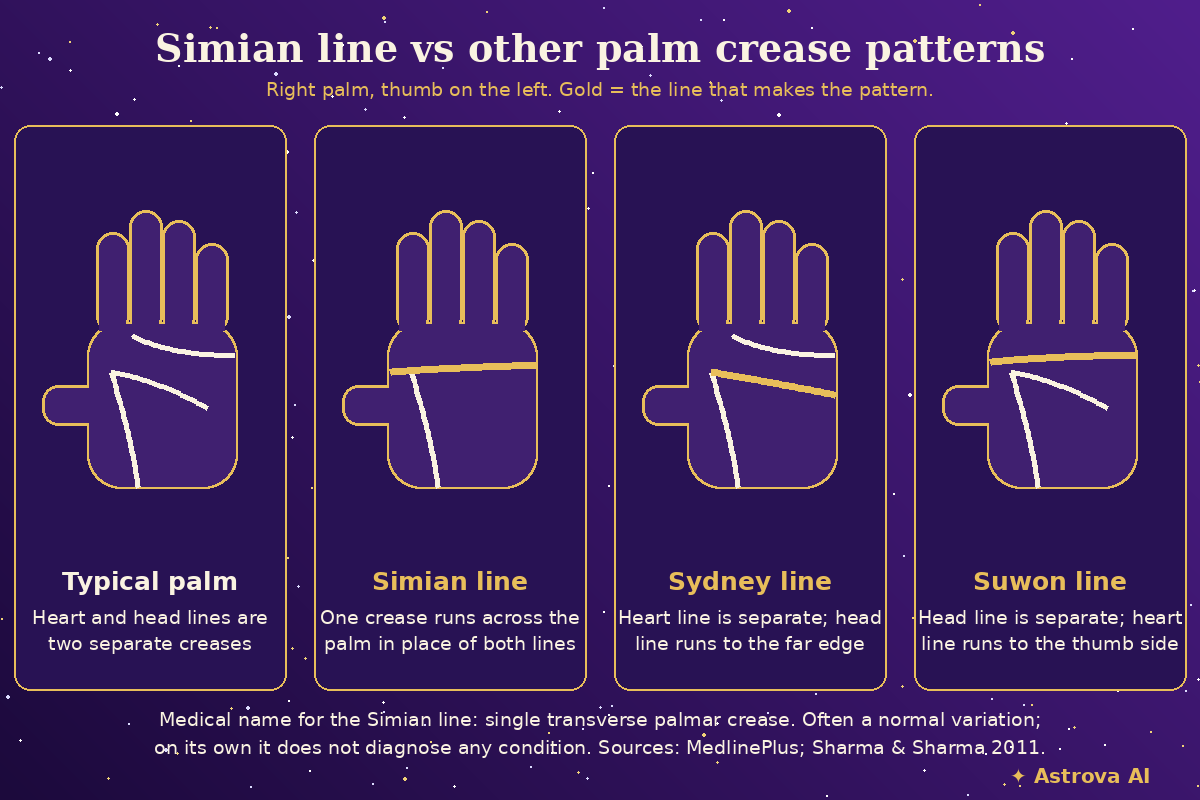
| Pattern | What you see | Is it a Simian line? |
|---|---|---|
| Typical palm | Separate heart line and head line | No |
| Simian line (single palmar crease) | One crease across the whole palm, no separate heart or head line | Yes |
| Sydney line | Heart line present; head line runs all the way to the little-finger edge | No, it is an extended head line |
| Suwon line | Head line present; heart line runs all the way to the thumb side | No, it is an extended heart line |
| Lines touching or joined by a branch | Two lines that meet briefly, then separate | No, still two lines |
The Sydney and Suwon descriptions follow Sharma and Sharma’s 2011 paper. The Suwon crease was first described as a full-width crease with an extra crease below it; the authors read it as an extended heart line. In their sample, Sydney lines appeared in 3.6% of people and Suwon lines in 2.4%.
What palmistry tradition says
The best-known description comes from Cheiro, a famous palmist of the early 20th century. In Palmistry for All (1916, free on Project Gutenberg), he wrote: “When only one deep, straight line is found across the hand from side to side, the two lines both Head and Heart appear to blend together.”
His reading, in plain words:
- Intensity and concentration. He saw it as “tremendous intensity of character, for good or evil”, with great power of concentration.
- Heart and mind together. When such a person loves, they bring their whole mind to it. When they take up a goal, they put their whole heart into it.
- Where the line sits matters. If the single line lies where the head line normally is, he read it as mainly mental intensity. If it lies higher, near the heart line’s usual place, he read it as mainly emotional intensity.
- Left vs right hand. Cheiro read the left hand as natural tendencies and the right hand as what a person develops, and said a mark on both hands is “more decided”.
Cheiro also added gloomy claims about loneliness, accidents and unhappy partnerships. These are a century-old writer’s opinions, with no evidence behind them, and you can safely set them aside. Read this way, the Simian line is neither lucky nor unlucky. It describes a focused, all-in temperament, and a palmist reads it alongside the rest of the hand.
Worked example (illustrative)
Rohan is a made-up person used only to show the method. This is not a reading of a real hand.
- What he sees. Rohan is right-handed. On his right palm there is one deep crease from edge to edge and no separate line above it. His left palm has a normal heart line and head line.
- Is it a true Simian line? Yes, on the right hand only. That one-hand pattern is the more common kind in the Central India study.
- Where it sits. The crease runs across the middle of the palm, where a head line usually lies. In Cheiro’s system that points to mental focus more than emotional intensity.
- Which hand. Using Cheiro’s rule, a line on the right hand only is read as a trait Rohan has developed, rather than one he was born leaning towards.
- Traditional summary. A person who goes all in once he picks a goal, and may need to step back and let feelings have a say before big decisions.
- What it does not tell him. Nothing about his health, luck, marriage or money. For a healthy adult, a single crease on its own is usually just a normal variation.
Get your full palm reading in Astrova AI
Does a Simian line mean something is wrong?
Usually not. MedlinePlus states that having a single palmar crease is often normal. It is listed alongside several conditions that affect growth and development, because it is seen more often in them. Examples include Down syndrome, fetal alcohol syndrome, Turner syndrome and Klinefelter syndrome.
“Seen more often” is not the same as “caused by”. Many people with these conditions don’t have the crease, and most people with the crease don’t have any of them. In the Central India study, the researchers found no link between the crease and any anomaly, disease or syndrome in the people they examined.
When a doctor notices a single crease on a newborn, they look at it together with other signs, family history and a full examination before deciding whether any test is needed. If you have a question about your own or your child’s health, ask a doctor. Don’t rely on the palm alone, and don’t rely on a palm reader for medical advice.
Tradition vs science
The crease is real anatomy. Whether you have one, on which hand and where it sits are facts anyone can check.
The personality reading is tradition. There is no scientific evidence that palm lines reveal character or the future (BBC Science Focus). Enjoy the palmistry meaning as a cultural practice and a prompt for self-reflection. To see how your other lines and mounts fit together, try an AI palm reading, or read whether AI palmistry really works first.
Want to compare with another popular palm pattern? See what the M sign on your palm means.
FAQs
Is a Simian line rare?
It is uncommon but not very rare. MedlinePlus puts it at about 1 in 30 people, and males are twice as likely to have it. Rates vary a lot between populations: a 2011 study of 1,000 people in Central India found it in 14.4%, mostly on one hand only.
Does a Simian line mean Down syndrome?
Not on its own. A single palmar crease is often completely normal. It is seen more often in some conditions, including Down syndrome, but many people with those conditions do not have it and most people who have it are healthy. Doctors diagnose a condition from family history, medical history and a full examination, not from one palm crease.
What does a Simian line on both hands mean?
In palmistry tradition, the same mark on both hands is read as a stronger, more settled trait. Cheiro read the left hand as natural tendencies and the right as what you develop. Medically, having it on both hands is less common than on one hand and, on its own, still not a diagnosis.
Is a Simian line lucky or unlucky?
Neither. Palmistry tradition reads it as intensity and strong concentration, which can work for or against you. There is no evidence that any palm crease predicts luck, wealth, marriage or health.
What is the difference between a Simian line and a Sydney line?
On a Simian line palm, one crease replaces both the heart line and the head line. On a Sydney line palm, the heart line is still there, and the head line runs all the way across to the little-finger edge of the palm. They are separate patterns.
Download Astrova AI on Google Play
AI palm reading, Kundli, daily Rashifal and 24/7 AI astrologer chat in 9 Indian languages. For entertainment and self-reflection.
Sources: Single palmar crease (MedlinePlus, US National Library of Medicine) · Sharma D.K. & Sharma V., Prevalences of Simian, Sydney and Suwon creases in a population of Central India, Int. J. Morphol. 29(3), 2011 · Cheiro, Palmistry for All, 1916 (Project Gutenberg) · Why do we have lines on our palms? (BBC Science Focus)