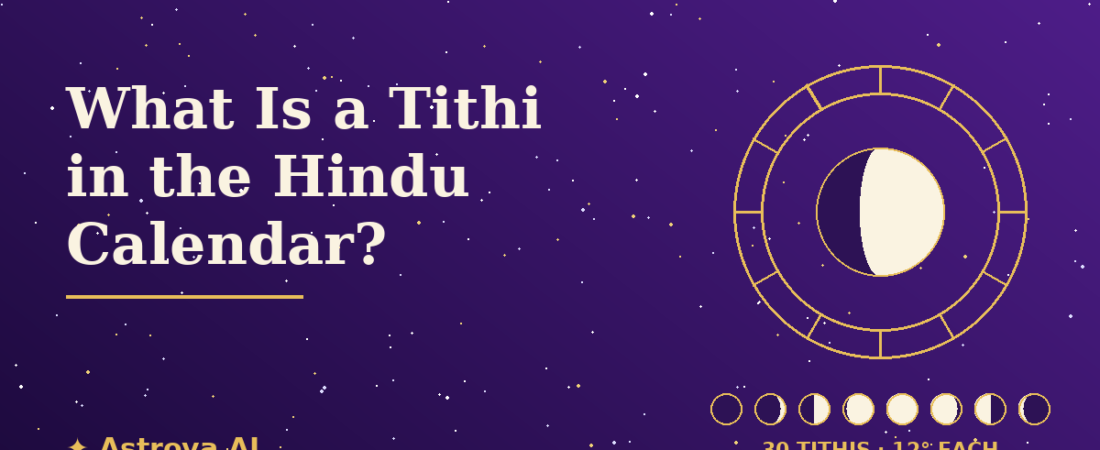
A tithi is a Hindu lunar day: the time the Moon takes to move 12° further ahead of the Sun. There are 30 tithis in a lunar month, 15 while the Moon waxes and 15 while it wanes. To find today’s tithi, open a Panchang for your city and check which tithi is running at sunrise, and when it ends.
See your Rashi and Nakshatra free in Astrova AI
Ask an elder when a vrat falls and you’ll hear a tithi, not a date: “Ekadashi”, “Purnima”, “Navami”. Then the calendar shows it starting at 10:52 am, or on two days, or not at all. It all follows one simple rule. Here’s that rule, how to find today’s tithi, and where astronomy ends and tradition begins.
The short answer
- What it is: one 12° step in the angle between the Moon and the Sun, as seen from Earth.
- How many: 30 per lunar month, in two halves (pakshas) of 15.
- How long: not a fixed 24 hours. A tithi can last from about 20 to almost 27 hours.
- Which one counts for the day: usually the tithi running at your local sunrise.
- Where to find it: any Panchang (printed, website or app) set to your city.
Tithi is the first of the five limbs of the Panchang. The other four are vara (weekday), nakshatra, yoga and karana. For the full picture, see our guide on what Panchang is and how to read it daily.
How a tithi works: the 12° rule
At Amavasya (new moon), the Moon and the Sun sit in roughly the same direction in the sky. Each day the Moon moves ahead of the Sun by about 12° on average. Every time that gap grows by another 12°, one tithi ends and the next begins. A full circle is 360°, and 360 ÷ 12 = 30, so there are 30 tithis from one new moon to the next.
30 tithis in two pakshas
The first 15 tithis form Shukla Paksha, the bright half, when the Moon grows towards full. The next 15 form Krishna Paksha, the dark half, when it shrinks back. The names repeat in each half, so “Shukla Ekadashi” and “Krishna Ekadashi” are two different days about two weeks apart.
| No. | Tithi | Moon–Sun gap (Shukla) | Moon–Sun gap (Krishna) |
|---|---|---|---|
| 1 | Pratipada | 0°–12° | 180°–192° |
| 2 | Dwitiya | 12°–24° | 192°–204° |
| 3 | Tritiya | 24°–36° | 204°–216° |
| 4 | Chaturthi | 36°–48° | 216°–228° |
| 5 | Panchami | 48°–60° | 228°–240° |
| 6 | Shashthi | 60°–72° | 240°–252° |
| 7 | Saptami | 72°–84° | 252°–264° |
| 8 | Ashtami | 84°–96° | 264°–276° |
| 9 | Navami | 96°–108° | 276°–288° |
| 10 | Dashami | 108°–120° | 288°–300° |
| 11 | Ekadashi | 120°–132° | 300°–312° |
| 12 | Dwadashi | 132°–144° | 312°–324° |
| 13 | Trayodashi | 144°–156° | 324°–336° |
| 14 | Chaturdashi | 156°–168° | 336°–348° |
| 15 | Purnima (Shukla) / Amavasya (Krishna) | 168°–180° | 348°–360° |
Why a tithi is not 24 hours long
The Moon’s orbit is an oval, so it speeds up when it is closer to Earth and slows down when it is farther away. When it moves fast, it covers 12° quickly and the tithi is short. When it moves slowly, the tithi is long. On average a tithi lasts about 23 hours 37 minutes, but it can be as short as about 20 hours or as long as almost 27. That’s why a tithi can begin or end at any time of day or night, and why every Panchang prints an end time next to it.
How to find today’s tithi
Method 1: Check a Panchang for your city
This is the easy and reliable way. Open a printed Panchang, a Panchang website or a calendar app, choose your city, and look for two things:
- The tithi at sunrise. For most vrats and pujas, tradition treats the tithi running at local sunrise as the tithi of the whole day, even if it ends a few hours later.
- Its end time. This tells you when the next tithi takes over, which matters if your puja or fast is tied to a specific tithi.
Choose your own city. A tithi changes at the same moment everywhere, but sunrise doesn’t: Kolkata’s sunrise comes almost an hour before Ahmedabad’s. So the tithi “of the day” can differ between cities, and especially between India and abroad.
Method 2: Work it out yourself
If you like numbers, here is the basic formula used to calculate a tithi:
- Take the Moon’s longitude and the Sun’s longitude (from an astronomy ephemeris or app).
- Subtract: Moon − Sun. If the answer is negative, add 360°.
- Divide by 12 and drop the decimals. Add 1. That’s the tithi number (1–30).
- Numbers 1–15 are Shukla Paksha. Numbers 16–30 are Krishna Paksha (subtract 15 to get the name).
Worked example: say the Moon is at 65° and the Sun is at 300°. 65 − 300 = −235, plus 360 = 125°. 125 ÷ 12 = 10.4, so drop the decimals to get 10, then add 1 to get 11. That’s tithi 11 in Shukla Paksha: Shukla Ekadashi. The hard part is getting accurate Sun and Moon positions, which is why most people simply use a Panchang.
Real examples that make tithis click
One tithi across two calendar days
Take Monday, 19 October 2026. Panchangs for Delhi showed Shukla Ashtami at sunrise (about 6:24 am), ending at about 10:52 am. Navami then began and ran until about 12:51 pm on Tuesday. So one tithi, Navami, ran from late Monday morning to early Tuesday afternoon, across two calendar days. The Kolkata Panchang showed the same 10:52 am change, even though sunrise there was around 5:34 am. That is the “same moment, different sunrise” rule at work.
Ekadashi
Ekadashi is the 11th tithi, so it comes twice a month, once in each paksha. Many devotees of Vishnu fast on Ekadashi and traditionally break the fast on Dwadashi, the next tithi, within a set window called parana. When Ekadashi stretches across two sunrises, calendars sometimes list two dates for different traditions. That is often why one family fasts a day before another.
Purnima and Amavasya
Purnima is the last tithi of Shukla Paksha. It ends at the exact moment of the full moon, when the Moon is 180° from the Sun. Amavasya is the last tithi of Krishna Paksha and ends at the exact new moon. For example, the new moon of October 2026 fell on 10 October at 15:50 UTC, which is about 9:20 pm IST. Shukla Pratipada began at that moment and was still running at sunrise on 11 October, the first day of Sharad Navratri.
Skipped and repeated tithis
A short tithi can begin after one sunrise and end before the next, so no day is named after it: a kshaya (skipped) tithi. A long tithi can be running at two sunrises in a row, so two days share its name: a vriddhi or adhika (repeated) tithi. Neither is a printing mistake. Read more on why Hindu festivals fall on specific dates.
What is your birth tithi?
Your birth tithi (janma tithi) is the tithi running at the moment you were born. To find it, you need your birth date, time and place. Many families celebrate birthdays or perform rituals by tithi. Shraddha for departed elders, for example, is traditionally done on the tithi of their passing (see our guide on Pitru dosha and ancestral rites).
A tithi birthday moves around the normal calendar each year. Twelve lunar months add up to about 354 days, roughly 11 days shorter than a solar year, and the Hindu calendar adds an extra month every few years to catch up.
Your birth tithi is different from your birth nakshatra and Moon sign, though all three come from the Moon. For those, read about the 27 nakshatras and how to find your Moon sign (Rashi), or generate your free Kundli.
Get your free Janam Kundli in Astrova AI
Auspicious tithis in tradition
Traditional muhurat texts sort the 15 tithis of each paksha into five groups:
- Nanda (1, 6, 11): the name means “joy”.
- Bhadra (2, 7, 12): means “auspicious” or “good”.
- Jaya (3, 8, 13): means “victory”.
- Rikta (4, 9, 14): means “empty”. Tradition usually avoids these for new beginnings like a griha pravesh.
- Purna (5, 10, 15): means “full” or “complete”.
In practice, astrologers combine the tithi with the nakshatra, weekday and periods like Rahu Kaal before suggesting a time. If you are planning a wedding or business launch, see how to choose an auspicious muhurat. Many festivals also use their own rule instead of sunrise. Janmashtami, for example, looks at the tithi around midnight.
Tradition vs science
The astronomy is real. The 12° Moon–Sun angle is a measurable fact, and modern ephemerides calculate it very precisely. That’s why good Panchangs agree on tithi times to within minutes. Older calculation methods based on traditional tables can differ from modern ones by several minutes, and rarely by up to an hour. And because a tithi depends only on the gap between the Moon and the Sun, the sidereal-versus-tropical zodiac debate doesn’t change it.
The meaning is tradition. Which tithis are lucky, which to fast on, and what a birth tithi says about a person come from religious and astrological tradition. Science hasn’t tested these ideas and found them to work, and astrology in general has not shown predictive power. Follow tithis for faith and festival timing, and use common sense for big decisions.
Once you know the day’s tithi from a Panchang, Astrova AI can help with the personal side: your Janam Kundli with Rashi and Nakshatra, your daily Rashifal, and an AI astrologer chat for questions.
FAQs
How many tithis are there in a month?
There are 30 tithis in a lunar month: 15 in Shukla Paksha (waxing), ending with Purnima, and 15 in Krishna Paksha (waning), ending with Amavasya.
Why does the tithi change in the middle of the day?
A tithi follows the Moon–Sun angle, not the clock. Each 12° step takes about 20 to 27 hours because the Moon’s speed varies, so a tithi can begin or end at any time.
Which tithi counts for a fast or festival?
Usually the tithi running at local sunrise counts for the whole day. Some festivals use other rules, for example Janmashtami looks at midnight, so follow the Panchang your family uses.
Is the tithi the same in every city?
A tithi changes at the same moment everywhere, but local clock time and sunrise differ. So the tithi of the day can differ between cities, especially between India and abroad.
How do I find my birth tithi?
You need your birth date, time and place. A janma Panchang calculator or an astrologer works out the tithi running at the moment of birth, such as Shukla Panchami.
Download Astrova AI on Google Play
Free Janam Kundli, daily Rashifal and 24/7 AI astrologer chat in 9 Indian languages. For entertainment and self-reflection.
Further reading: Tithi (Wikipedia) · The lunar month (timeanddate)