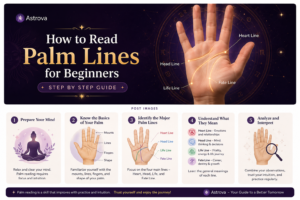
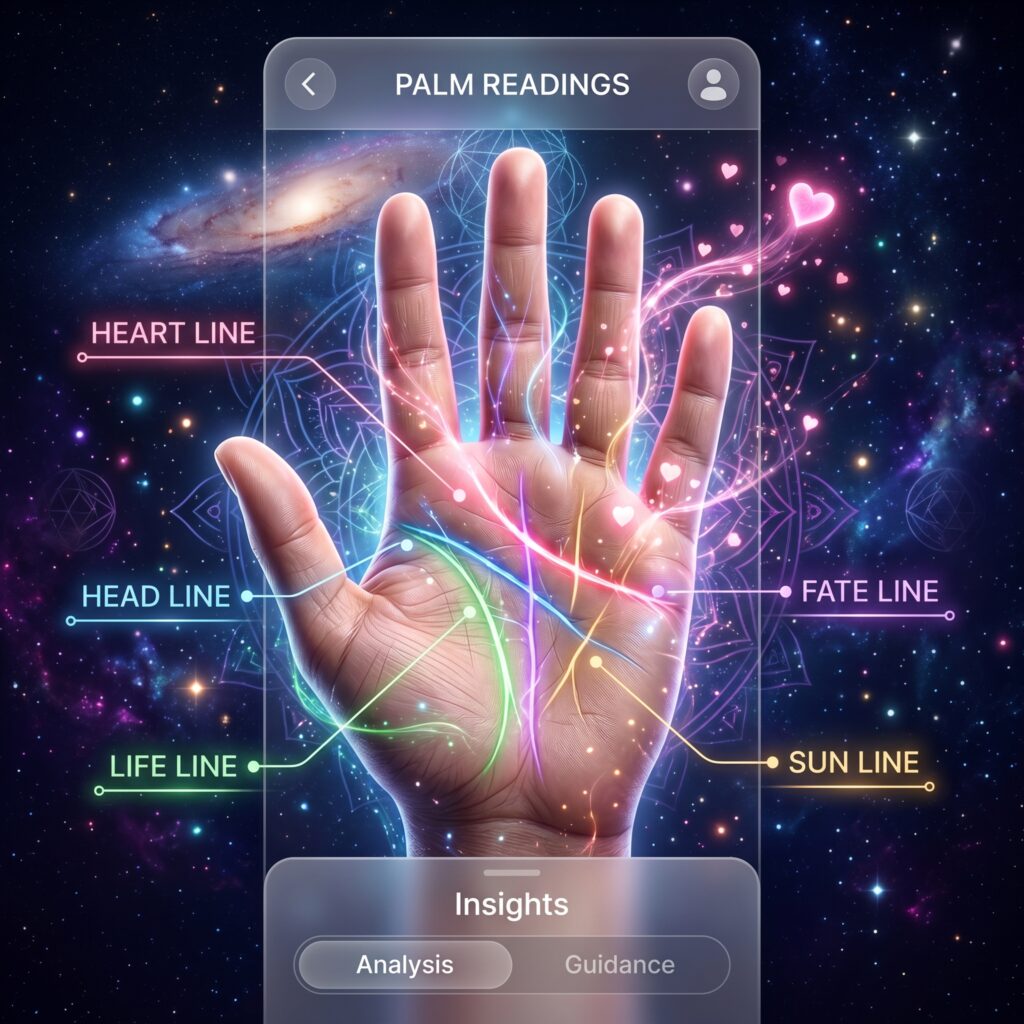
Figure: A diagram of the major palm lines (life, head, heart, sun/Apollo, fate) labelled on a palm. Palmistry (chiromancy) interprets the lines on your hand as symbolic clues about your life and personality. Each major line is thought to reflect a different area: for example, the life line (curving around the thumb base) represents vitality and general well-being (not lifespan), the head line (across the palm’s center) relates to thinking style and intellect, and the heart line (underneath the fingers) indicates emotions and relationships. In beginners’ guides, it’s common to focus on these five main creases (life, head, heart, fate, and sun) along with smaller lines like the Mercury (health) line and marriage lines. Remember that palmistry is generally considered an interpretive art – it can offer insight or fun self-reflection, but it is not a precise science. Always use any reading as guidance rather than literal truth.
Major Palm Lines (Location & Meaning): In practice, you identify and interpret each line one by one. Key lines include:
- Life Line: Curves around the base of the thumb toward the wrist. A deep, long life line suggests strong energy and vitality, while a short or faint life line often means a more cautious nature. (Contrary to myth, it does not literally indicate how long you’ll live.) Breaks or chains in the life line are traditionally read as significant life changes or disruptions.
- Head (Wisdom) Line: Runs horizontally near mid-palm, below the fingers. A long, straight head line indicates a logical, analytical mindset, whereas a curved or sloping head line suggests creativity or intuition. Gaps or forks in this line often signal mental stress or shifts in thinking.
- Heart (Love) Line: Runs horizontally just below the fingers at the top of the palm. A clear, long heart line is thought to mean emotional expressiveness and compassion (deep affection for others). A curved heart line often implies a romantic, idealistic nature, while a straighter line suggests practicality in love. Breaks or islands on the heart line may reflect emotional ups-and-downs or relationship challenges.
- Fate (Destiny) Line: A vertical line running up toward the middle finger (Saturn finger). Not everyone has a visible fate line. When present, it is associated with career and life path. A strong, unbroken fate line is said to indicate a clear sense of purpose and success at work, while a faint or broken fate line can mean a more flexible, self-directed life path. (For example, one guide notes a deep, straight fate line “is greatly related with luck and success” in career.)
- Sun (Apollo) Line: A vertical line under the ring finger. The sun line is linked to fame, talent and success. A clear, long sun line suggests creativity, recognition or even ease (like good fortune or inheritance). Many artists and leaders have prominent sun lines. If the sun line is absent or weak, it simply means you may achieve success by steady effort rather than sudden fame. (A strong sun line can even compensate for a weak fate line.)
- Mercury (Health/Communication) Line: Runs from the base of the palm toward the little finger. Its presence relates to health and communication skills. A well-defined, long Mercury line is taken to indicate strong communication, intuition and overall health, while a faint or broken Mercury line might point to communication struggles or stress periods. Many people have no visible Mercury line at all – it’s considered a bonus rather than a problem if it’s missing.
- Marriage (Relationship) Lines: These are short horizontal lines on the palm’s edge under the little finger (Mercury mount). Each significant line is traditionally read as a major romantic or marital relationship. A single, clear marriage line usually denotes one long-term partnership, whereas multiple or forked lines suggest multiple relationships or challenges. For example, a fork at the end of a marriage line often signals a breakup or separation. In general, long, deep lines here mean strong, enduring connections, while short, faint, or broken lines suggest less stable relationships.
Step-by-Step Palmistry Procedure: To do a simple palm reading:
- Prepare your hand. Wash and dry your hand so the lines are clear. Relax your hand and hold it flat, fingers slightly spread. Take a moment to visually scan the palm.
- Choose a hand. Many readers use the non-dominant hand (the hand you use less) to see inborn traits, and the dominant hand for your current path. (For instance, one tradition holds that for men the left hand is innate and the right is “what you’ve accumulated”, and vice versa for women.) For a beginner, you can simply read both hands: one shows your potential, the other your present situation.
- Locate the major lines. Identify each key line’s start and end on your chosen hand(s). For example, trace the life line from the edge of the palm around the thumb, find the head line across the palm, and so on. You may lightly mark or point to each line.
- Observe line qualities. For each major line, note its length, depth, shape and any breaks or branches. Is the line long or short? Deep or shallow? Straight or curved? Does it fork or break anywhere? (For example, a fork at the end of the life line traditionally means extra support or protection in life, while a deep, clear life line indicates strong vitality.) Look at any intersecting or unusual markings too (crosses, stars, chains, etc.).
- Interpret with context. Relate each line’s qualities back to the basic meanings above. For instance, a long, deep head line suggests clear thinking; a wavy or broken head line might signal mental restlessness. A faint heart line could hint at reservation in love, whereas a very deep heart line means warmth and empathy. Remember the interpretations are traditional guidelines: for example, palmists say a break in the life line often means a major life event or transition. Consider the whole hand – mounts (fleshy pads) and minor lines – for more nuance, but keep it simple at first.
- Use responsibly. Keep in mind that palmistry is not an exact science. Interpretations vary by culture and reader. Use your reading as a fun insight or reflection on possible strengths or challenges, not as a definitive prediction.
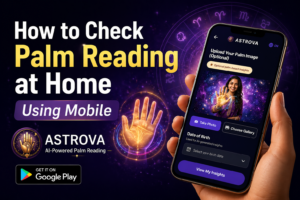
By following these steps you’ll get a basic palm reading. An app like Astrova can help beginners by using your phone camera: for example, it may allow you to take a photo of your palm and automatically highlight the lines you’ve learned about. (Astrova’s development hints at features like zoom overlays or quizzes to practice identifying lines.) Over time, comparing both hands and noting changes can build insight, since palm lines can evolve with your life.
How to Check Your Kundli by Date of Birth and Time
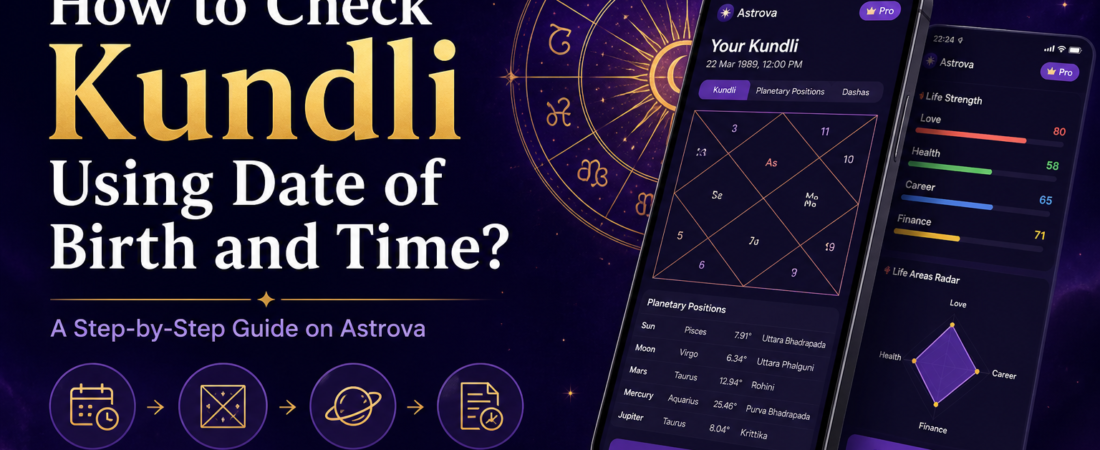
Figure: An example Vedic birth chart (kundli) showing the 12 astrological houses and planetary positions for a given birth time. In Vedic astrology, your Janam Kundli (birth chart) is a “cosmic blueprint” of your life created from your exact birth date, time and place. It is essentially a map of where the Sun, Moon, planets and constellations (nakshatras) were at your birth. Each of the 12 houses in the chart represents different life areas (wealth, career, relationships, etc.), and the signs/planets in them color your personality and destiny. To generate your Kundli, you need only accurate birth details and an astrology calculator.
Step-by-step Kundli generation (Astrova and similar):
- Gather your birth data. You’ll need your full date of birth (day/month/year), exact time of birth (hour:minute AM/PM), and place of birth (city or town). These details are crucial – even minutes’ difference can change your rising sign or moon sign.
- Open the Astrology/Kundli feature. In the Astrova app, tap the option for Horoscope, Janam Kundli or Birth Chart. (This works just like other astrology tools – for example, Astroyogi’s free Kundli tool prompts for these same details.)
- Enter your details. Fill in each field: select your birth date, choose AM/PM and enter the time, and select or type your birthplace. You may also need to choose your gender.
- Generate the chart. Once all fields are complete, tap “Submit” or “Create Kundli”. The app will compute your chart and display the Vedic birth chart (as in the image above). You’ll see a wheel or square divided into 12 houses with planets placed, along with key details like your Ascendant (Lagna), Moon sign (Rashi), Nakshatra, and any doshas (like Manglik or Sade Sati).
- Review the interpretation. Astrova will typically provide descriptions or predictions based on your Kundli. For example, it may explain how the position of Saturn or the Moon affects your career and emotions. Use the app’s insights or consult with an astrologer if you want deeper analysis. Remember, the Kundli is intended as a guide: it can highlight potential strengths and cautionary areas (like a planetary placement in a challenging house), but you’re free to shape your future with informed choices.
In summary, checking your Kundli is simply a matter of using your birth details in an astrology calculator. As Astroyogi’s guide explains, once you enter your date, time and place of birth (and name), the free Kundli software instantly “reveals accurate insights into planetary positions, doshas, and key life events”. In the Astrova app, follow the same steps – and you’ll have your Janam Kundli on screen in seconds. This birth chart then serves as a roadmap for your life according to Vedic astrology, helping you understand your strengths, weaknesses and cycles ahead.
Sources: Authoritative astrology resources and published guides were used to compile this tutorial. The line meanings are based on traditional palmistry interpretations. The Kundli instructions follow standard Vedic astrology practice.