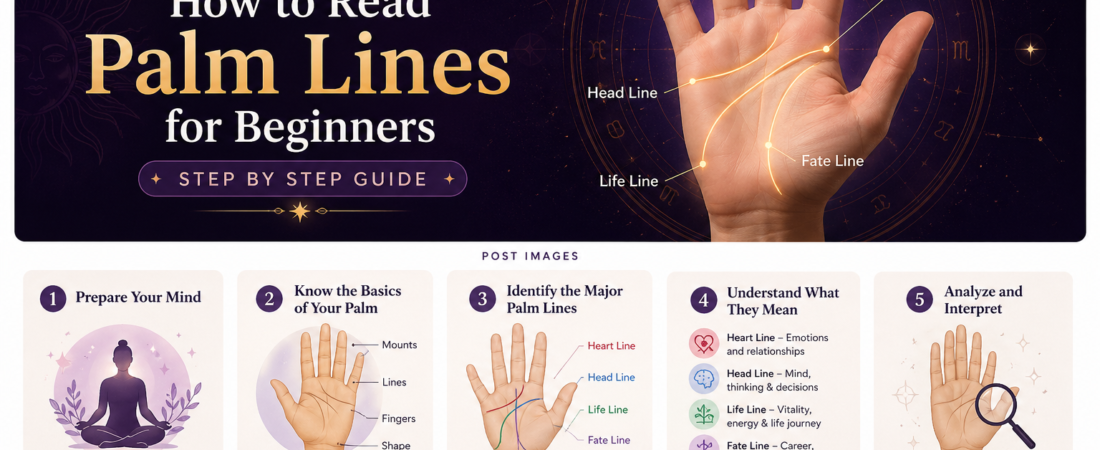
Palmistry (chiromancy) is the ancient art of interpreting your palm’s lines and shapes to gain insight into personality and life patterns. Originating in ancient India, it later spread to China, Egypt, Greece and Europe. Today it remains popular as a creative hobby or self-help tool, though it has no scientific basis. This beginner-friendly Astrova guide explains each major palm line (life, head, heart, fate, sun/Apollo, health/Mercury, marriage lines), showing you how to locate them on the hand and offering common interpretations (with caveats). We provide a clear step-by-step procedure and tips (left vs right hand), plus tables of line variations (deep, faint, broken, forks, crosses, etc.) and their meanings. Throughout, we stress cultural sensitivity and ethical disclaimers: palm reading is for fun and insight, not medical or definitive advice. Suggested in-app features (images, zoom overlays, quizzes) and interactive CTAs are also included to enhance the Astrova user experience.
A Brief History of Palmistry
Palmistry’s roots are ancient: it likely began in India over 3,000 years ago and spread across Asia and Europe. Notable philosophers like Aristotle wrote about it in 2,500 BC (arguing lines are not random). It declined in medieval times but resurged in the 19th century with occult societies and famous readers like “Cheiro” (Count Louis Hammer) popularising it. Today, palmistry is largely considered a pseudoscience – studies find no evidence that palm lines predict the future. In our guide we present it as a traditional practice or self-reflective tool. It’s an art form rooted in cultural history, not a medical or factual claim.

Major Palm Lines: Location & Meaning
A palm reader looks first at the major lines creased on the palm. Each line has a name and typical location:
- Life Line: This large arc curves around the base of the thumb toward the wrist. Contrary to myth, it does not measure longevity. Instead, it reflects vitality and energy. A deep, long life line suggests strong stamina and well-being. A short or faint life line may simply mean one has lower physical energy or needs more rest. A broken life line can signify changes or caution periods. (Double or sister lines next to it often indicate extra support or “protection” in life.)
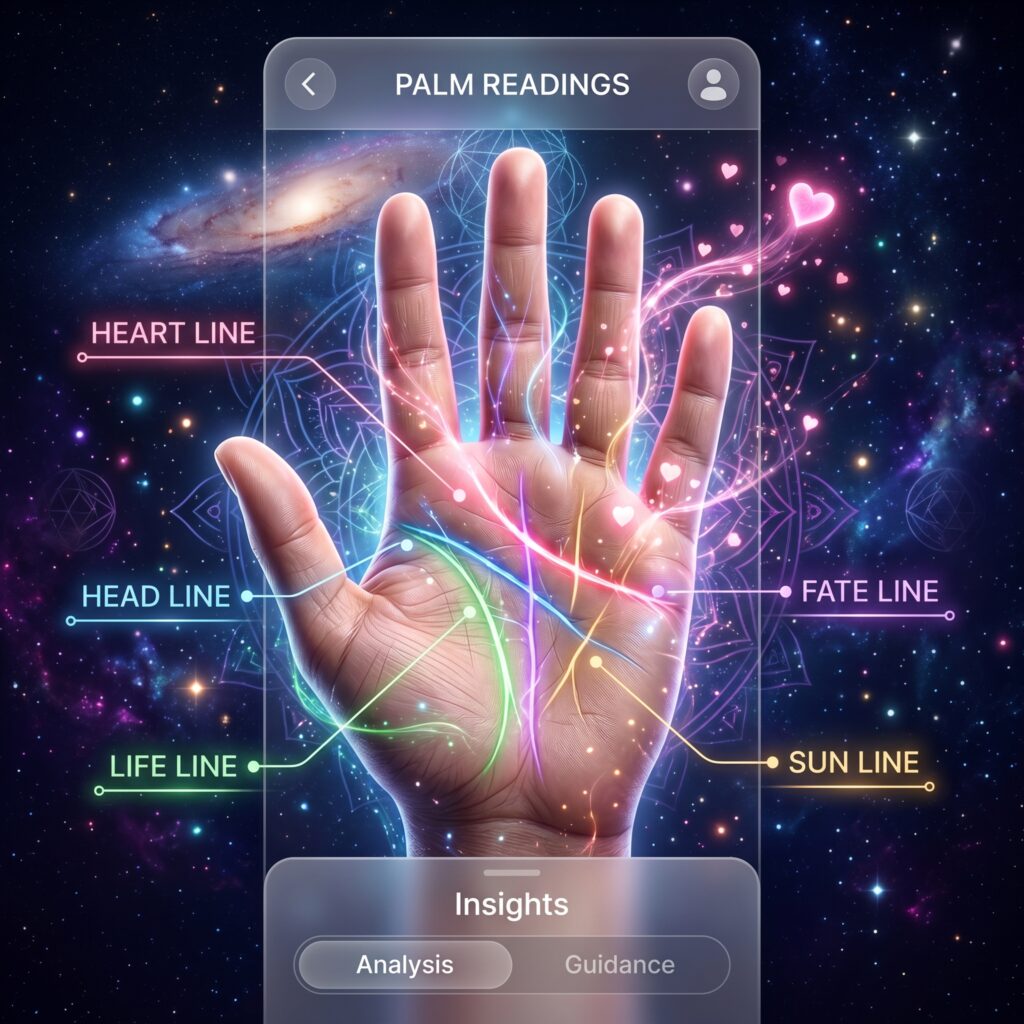
- Head Line: Runs horizontally across the middle of the palm, roughly between thumb and index finger. It represents thinking style and intellect, not raw intelligence. A long, clear head line means logical, analytical thinking. A short or faint head line may indicate a more intuitive, narrow focus. Straight head lines suggest a practical mindset, whereas curved lines suggest creativity. Breaks or forks in the head line can mark major shifts in thought or life events.
- Heart Line: Also called the “love line,” it lies above the head line at the top of the palm under the little/middle fingers. It reflects emotional life and relationships. If the heart line is long and deep, it suggests devotion and capacity for commitment. A short or shallow heart line may point to more reserved emotions. Special shapes matter: a broken or chained heart line could indicate relationship challenges or infidelity. (For example, one guide notes, “If [the heart line] is broken, it could mean many partners or divorce”.) However, interpretations vary widely by tradition.
- Fate Line: Often called the destiny or career line, it runs vertically from the wrist up toward the middle finger. Not everyone has a fate line. It indicates career, life path and external influences. A strong, deep fate line suggests drive, clear goals and influence in life. A faint or absent fate line may simply mean a free-spirited life or a career path shaped by personal choice rather than fate. Breaks or interruptions often signal life changes or obstacles.
- Sun (Apollo) Line: Runs vertically under the ring finger (on the pinky side of the palm). It is traditionally linked to fame, creativity and success. A long, clear sun line suggests recognition and achievement in one’s field. A faint or missing sun line simply means the person may focus on personal satisfaction rather than public acclaim.
- Health (Mercury) Line: This line (also called the Mercury or Budh Rekha) goes from the wrist or life line toward the little finger (mercury finger). When present, it is said to reflect communication skills and well-being. A well-defined, long Mercury line indicates strong communication and health. A broken or faint line is often interpreted as periods of stress or health challenges. (Many hands have no visible Mercury line; its absence is not usually negative, just a lack of emphasis on that theme.)
- Marriage (Relationship) Lines: These are small horizontal lines on the palm’s edge under the little finger. Each significant line is thought to represent a major romantic or marital relationship. A single clear line typically indicates one long-term relationship. Multiple parallel lines can suggest more than one significant relationship or marriage. Special markings (forks, breaks, islands, stars) on these lines are traditionally read as challenges, separations, or special events in relationships. (For example, an island on a marriage line might signal temporary challenges, and a break could suggest a separation.)
Each line’s interpretation varies by tradition, and reading is often holistic, considering many factors. The above are common beginner ideas.
Step-by-Step Palm Reading Procedure
Follow these numbered steps for a simple palmistry session:
- Prepare and Observe: Wash and dry your hands to clearly see lines. Relax your hand and make your palm flat. Let your eye roam the palm; note the major lines (life, head, heart, etc.) and overall texture (smooth, dry, etc.).
- Choose a Hand: Some readers use the non-dominant (usually left) hand to see innate traits, and the dominant hand for current life path. A common beginner tip is to read both: the “static” hand (less used) shows potential, the “active” hand shows achievements.
- Locate Major Lines: Identify each major line’s start and end. For example, find the life line curving around the thumb base, the heart line under the fingers, and so on. You may draw a light outline on a paper if needed.
- Examine Each Line: For each line note its length, depth, and shape. Ask: Is it long or short? Deep or faint? Straight or curved? Does it fork or break? As you inspect, recall the basic meanings above (e.g. a deep life line = strong vitality).
- Check Line Variations: Notice any unusual features: forks, branches, chains or markings like crosses. For instance, forks at a line’s end often indicate multiple opportunities or paths, while crosses can signal obstacles. We provide a Variations Table below for quick reference.
- Interpret and Reflect: Using your observations, tentatively interpret the lines. Keep interpretations general (energy, creativity, relationship tendencies, etc.) and remember: lines shift over time. At the end, reaffirm the disclaimer – palmistry is not definitive. For example, as the Allure guide notes, palm lines “transform” and “every day is a new opportunity”. Always encourage a positive, open-minded attitude.
mermaidCopyflowchart TD
  A([Start Reading Palm]) --> B[Prepare hand: wash & relax]
  B --> C{Choose Hand}
  C --> D[Left (Inherent traits)]
  C --> E[Right (Current life)]
  D --> F[Locate major lines on palm]
  E --> F
  F --> G[Inspect lines: length, depth, shape]
  G --> H[Observe variations: forks, breaks, etc.]
  H --> I[Compare with common meanings]
  I --> J[Reflect with caution/disclaimers]
  J --> K([End Reading])
Flowchart: Beginner’s palm-reading process – from preparing the hand to reviewing your interpretations with healthy skepticism.
Tips for Left vs. Right Hand
Palmists often distinguish between the two hands. Generally:
- Non-Dominant Hand (often left): Shows innate personality, potential and inherited traits. Think of it as your “plan from birth.”
- Dominant Hand (often right): Reflects your current life path, achievements and how traits are expressed in reality. It can change over time as you make choices.
For a balanced reading, compare both hands: inner vs. outer journeys. (For example, one theory says the right shows what you’ve done, and the left what you were born with.) In any case, pick the hand most comfortable and consistent for you as a beginner.
Variations in Palm Lines
Palm lines can appear in many forms. Here are common line variations and beginner-friendly interpretations:
| Variation | Appearance | Possible Meaning (general) |
|---|---|---|
| Deep, clear | Thick, dark line | Strong influence of that trait (e.g. vitality if on life line). |
| Faint or shallow | Light, thin line | Weaker emphasis; the quality is present but subtle or developing. |
| Broken | Line is interrupted or segmented | Periods of change, challenges or stress in that life area. |
| Branched/Forked | Ends in a Y-shape or branches at end | Multiple paths or interests; a fork on fate/head often means new opportunities. |
| Chained (bed-of-nails) | Appears as a series of linked small segments | Stressful or confused periods; sometimes seen on life or fate lines (interpret cautiously). |
| Cross or X | Small cross, star or island on line | Significant events. E.g. an island on line may mean a temporary obstacle. |
| Double line | A parallel “sister” line beside it | Added support or bonus of that trait (protection, strong backup). |
Each palm is unique. For instance, a broken life line “can mean something is changing in your life”, while a faint heart line might be interpreted as a more independent emotional nature. Use such tables as rough guides, not strict rules. Always pair interpretation with common sense – e.g. a faint line doesn’t literally mean a medical issue.
Cultural, Safety & Ethical Notes
Palmistry is culturally sensitive and symbolic. Different traditions (Indian, Chinese, Western) interpret lines differently. As a beginner, stay respectful of beliefs and avoid making personal claims. Disclaimers: Do not use palm readings to make medical, legal or mental-health decisions. Lines cannot diagnose illness or predict exact outcomes. Always emphasize to users (e.g., via the Astrova app) that readings are for entertainment or reflection. Remind readers that palms change; current moods, hydration or even minor injuries can alter lines. The Allure guide itself warns, “Palmistry is not a cut-and-dried practice” and every day is new opportunity to shape our destiny. In-app, consider a simple disclaimer like: “Palmistry insights are fun interpretations, not scientific fact.”
In-App Features and Interactive Ideas
To make learning palmistry engaging in the Astrova app, we suggest:
- Annotated Palm Images: Show a photo of a palm with overlays highlighting each major line (toggle labels on/off).
- Zoom & Scan: Allow users to zoom their own hand photo; overlays can guide them to find each line.
- Interactive Quiz: Quick quizzes like “Identify the Heart Line” or “Match the Line to Meaning” keep beginners engaged.
- Overlay Filters: Let users tap a line to see pop-up meanings or myth vs fact (e.g. “Faint life line = lower energy, not short lifespan”).
- Story Mode: A guided step-by-step tutorial (like a choose-your-path flow) for reading a palm with feedback.
- Share & Reflect: Encourage users to share fun readings (with friends or on social) and personal insights.
- Safety Prompts: Gentle reminders such as “Remember, this is for personal insight – not health advice” at the end of a reading.
Beginner’s 6-Step Checklist
For quick reference, here’s a 6-step checklist table summarising the palm reading process:
| Step | Action |
|---|---|
| 1. | Wash and dry your hand, relax palm. |
| 2. | Choose a hand (left or right) and orient palm up. |
| 3. | Locate the major lines (Life, Head, Heart, Fate, etc.). |
| 4. | Examine each line’s length, depth, shape. |
| 5. | Look for variations (breaks, forks, markings). |
| 6. | Interpret using guide meanings and add personal insight (with disclaimer). |
Use this as a quick-reference when doing a palm reading session in the app or on paper.
Scan My Palm Now
Sources: We drew on authoritative palmistry references and modern guides to ensure accuracy and responsibility. Classic wisdom (from Cheiro to Aristotle) and beginner tips form the basis of this article, but all claims are presented with caution. Enjoy learning your palm lines!