What Does the Heart Line Reveal About Love, Emotions and Relationships in Palmistry?
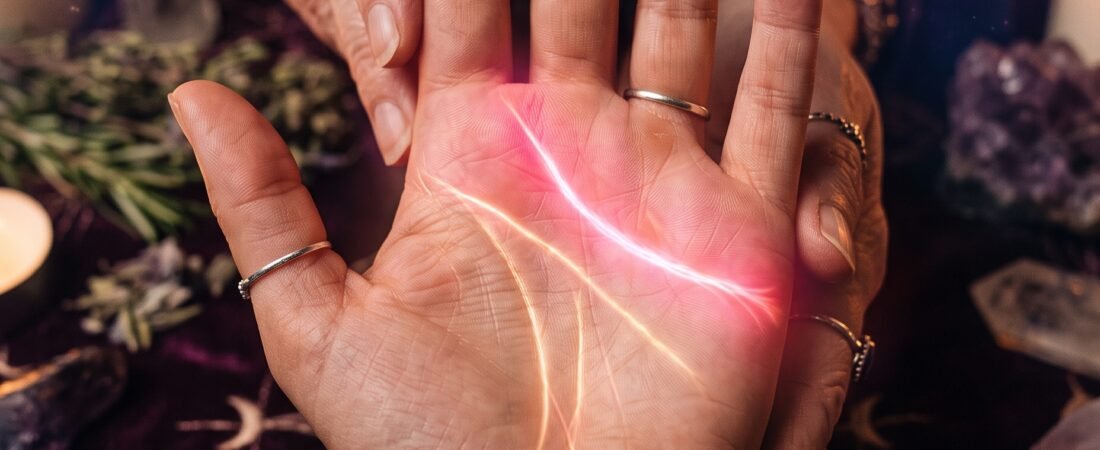
Quick Answer: The heart line — the topmost major line on your palm — reveals how you experience love, process emotions and form relationships. Its length, curve, starting point, branches and breaks each carry a distinct meaning in palmistry (hasta samudrika shastra). A heart line starting below the index finger suggests a selective, idealistic approach to love; one starting below the middle finger points to a more pragmatic, self-protective emotional style; and a long, gently curving line indicates someone who expresses warmth openly and forms deep attachments easily.
🔮 100% FREE
Read Your Heart Line with Astrova AI
AI-powered palm reading that analyses your heart line, head line, life line and more — in seconds.
✓ Palm Reading ✓ Kundli ✓ Rashifal ✓ 9 Languages
What Is the Heart Line in Palmistry?
The heart line (also called the love line or linea cordis in Latin) is one of the three major lines studied in palmistry, alongside the head line and the life line. It runs horizontally across the upper portion of your palm, typically starting from the edge of the palm below the little finger and extending toward the index or middle finger area.
In Vedic palmistry — known as hasta samudrika shastra — the heart line is interpreted as the primary indicator of a person’s emotional nature, romantic tendencies and capacity for empathy. Unlike Western pop-palmistry that reduces it to “how many relationships you’ll have,” the traditional reading considers the line’s origin, length, curvature, depth, branches (shaakhaas), chains, breaks and any islands or crosses.
A complete palm reading examines all major and minor lines together, because no single line tells the full story. The heart line’s meaning changes depending on how it relates to the head line, the fate line and the mounts of the palm (particularly the Mount of Jupiter and the Mount of Venus).
How to Locate Your Heart Line
Open your dominant hand (the hand you write with) and look at your palm. The heart line is the topmost of the three major lines. It begins near the outer edge of your palm — below the little finger — and stretches across toward your index or middle finger.
Here is a simple way to find it:
- Step 1: Hold your palm face-up under good light.
- Step 2: Identify the three major lines — the bottom curved line is the life line, the middle horizontal line is the head line, and the top horizontal line is the heart line.
- Step 3: Note where the heart line starts (below which finger), where it ends, how deep it is, and whether it curves upward, stays straight or dips downward.
- Step 4: Look for any branches, breaks, chains or islands along its path.
For a more precise analysis, you can use the AI Palm Reading feature inside the Astrova app, which maps your heart line alongside your head line, life line, fate line and other markers to give you a comprehensive reading.
📱 Try it now: Download Astrova AI — Free Palm Reading
What the Heart Line’s Starting Point Reveals
In palmistry, where the heart line begins is one of the most significant indicators of your emotional style:
| Starting Position | Emotional Style | Relationship Pattern |
|---|---|---|
| Below the index finger (Mount of Jupiter) | Idealistic, selective, romantic | Seeks a soulmate-level connection; high standards in love |
| Below the middle finger (Mount of Saturn) | Pragmatic, self-protective, cautious | Takes time to trust; values stability over passion |
| Between index and middle finger | Balanced, emotionally moderate | Balances head and heart; adaptable in relationships |
| Below the little finger (Mount of Mercury) | Charming, expressive, flirtatious | Enjoys social connection; may struggle with commitment depth |
What the Heart Line’s Shape Tells You
Beyond the starting point, the overall shape and curvature of the heart line carries important meaning:
Long, gently curving heart line: This is considered the classic “romantic” heart line in palmistry. It suggests someone who feels emotions deeply, expresses affection freely and forms strong emotional bonds. People with this pattern tend to be empathetic partners who prioritise emotional intimacy.
Straight heart line: A straighter heart line (one that runs more horizontally without much upward curve) is associated with a more rational approach to emotions. These individuals tend to process feelings through logic and may appear reserved even when they care deeply. In relationships, they value intellectual compatibility as much as emotional connection.
Short heart line: A shorter heart line — one that does not extend past the middle of the palm — is traditionally interpreted as indicating someone who is more self-focused in emotional matters. This does not mean they lack love; rather, they tend to prioritise personal independence and may take longer to open up to a partner.
Deeply curved heart line rising toward the index finger: This upward-curving pattern is one of the most positive indicators in palmistry. It suggests a person who is emotionally generous, loyal and capable of deep, lasting love. This pattern is often found in people who become devoted, nurturing partners.
Branches, Breaks and Special Markings on the Heart Line
Palmistry also pays close attention to the smaller markings that appear on or around the heart line:
- Downward branches: Small lines branching downward from the heart line are sometimes called “cupid’s lines.” A few of them suggest a warm, affectionate nature. Too many may indicate emotional scatteredness or a tendency to spread affection thinly.
- Upward branches: Branches that rise upward from the heart line suggest emotional growth over time — someone who becomes more open and loving as they mature.
- Breaks in the line: A break or gap in the heart line is traditionally read as a period of emotional upheaval — a heartbreak, a major relationship transition or a time of emotional withdrawal. It does not predict the end of love; rather, it marks a turning point.
- Chains on the line: A chain-like pattern (a series of small connected loops) on the heart line suggests emotional sensitivity that can border on overthinking. People with this marking often feel things very deeply and may need to learn emotional boundaries.
- Crosses or stars: A cross or star on the heart line is considered a significant marking. It can indicate a transformative love experience — one that fundamentally changes how the person views relationships.
How the Heart Line Relates to Other Palm Lines
A heart line is never read in isolation. Its meaning is shaped by its relationship to the other lines on your palm:
Heart line + Head line: If the heart line and head line run parallel without touching, palmistry interprets this as a person who keeps emotions and logic separate. If they touch or merge at any point, it suggests moments where emotion and reason strongly influence each other — passionate decisions or emotionally-driven intellectual pursuits.
Heart line + Life line: Lines or branches connecting the heart line to the life line are read as indicators of how deeply emotional experiences affect one’s overall vitality and life path. Strong connections suggest that love and relationships are central to the person’s life journey.
Heart line + Fate line: When the fate line (the vertical line running up the centre of the palm) intersects or merges with the heart line, palmistry reads this as a sign that career and love are deeply intertwined — the person’s professional path may be shaped by relationships or emotional motivations.
Common Myths About the Heart Line
Before we go further, let us clear up a few common misconceptions:
Myth 1: “A broken heart line means you’ll be alone.” This is false. A break simply marks an emotional transition — it can just as easily represent growth after a difficult period as it can represent loss.
Myth 2: “A short heart line means you can’t love deeply.” Also false. A short heart line indicates a different emotional style — more independent, more self-contained — not a lack of capacity for love.
Myth 3: “The heart line predicts exactly how many relationships you’ll have.” Palmistry does not work this way. The heart line describes emotional patterns and tendencies, not a fixed number of events.
How Astrova AI Reads Your Heart Line
The Astrova AI app uses computer vision and pattern recognition to analyse the lines on your palm, including the heart line. Here is what the AI Palm Reading feature does:
- Scans your palm using your phone’s camera — no special equipment needed.
- Identifies major lines including the heart line, head line, life line and fate line.
- Analyses key markers such as line length, curvature, starting position, branches and breaks.
- Generates a detailed reading that explains what each marker means for your emotional nature, love life and relationship patterns.
- Works in 9 Indian languages — Hindi, Tamil, Telugu, Kannada, Malayalam, Marathi, Gujarati, Bengali and English.
The reading is generated in seconds and is completely free. You can use it to understand your heart line, compare it with a partner’s reading (Kundli Milan), or simply explore what palmistry has to say about your emotional nature.
Get Your Free Palm Reading Today
Join Astrova AI and discover what your heart line — and every other line on your palm — reveals about your love life.
Download Free on Google Play →
✓ AI Palm Reading ✓ Janam Kundli ✓ Daily Rashifal ✓ Kundli Milan
Frequently Asked Questions
1. Can the heart line change over time?
Yes. Palmistry traditions hold that the lines on your palm can evolve as you grow emotionally. Significant life experiences — falling in love, going through a heartbreak, or doing deep inner work — can subtly alter the appearance of the heart line over months and years.
2. Is the heart line the same on both hands?
Not always. In palmistry, the dominant hand (the one you write with) represents your present self and the choices you have made, while the non-dominant hand represents your potential and inherited tendencies. Differences between the two hands’ heart lines can show how your emotional nature has evolved.
3. What if I have no heart line at all?
Everyone has a heart line, though in some palms it may be very faint, extremely short or broken into segments. A very faint heart line is sometimes interpreted as emotional reserve — not an absence of feeling, but a tendency to keep emotions private.
4. Can palmistry predict my future relationships?
Palmistry describes patterns, tendencies and potentials — it does not predict specific events or fixed outcomes. Think of it as a map of your emotional landscape, not a fortune-telling crystal ball.
5. How accurate is AI palm reading compared to a human palmist?
AI palm reading excels at identifying line patterns, measuring proportions and cross-referencing classical interpretations consistently. A human palmist brings intuition and contextual judgment. Both have strengths, and the best approach is to use AI as a starting point for self-reflection.
Explore More Astrova Guides
- Complete Guide to AI Palm Reading — How It Works and What It Reveals
- How to Generate Your Janam Kundli Online for Free
- What Is Sade Sati and How to Check It in Your Kundli
- How to Check Kundli Milan for Marriage Compatibility
- How to Use AI Astrology for Daily Life Guidance
About Astrova AI
Astrova AI is a free AI astrology app that offers palm reading, Janam Kundli generation, daily Rashifal, Kundli Milan (compatibility matching), Sade Sati analysis and a 24/7 AI astrologer chat. The app supports 9 Indian languages and is available on Google Play.
Download Astrova AI — Free on Google Play
Related posts:
 How to read your own palm at home — step-by-step guide — Complete Guide 2026
 How to check your daily Rashifal using your Moon sign — step by step — Complete Guide 2026
 How to identify Kaalsarp Dosha in your Kundli — visual guide — Complete Guide 2026
How accurate is AI Kundli matching vs traditional astrologer matching? — Complete Guide 2026
How to identify Kaalsarp Dosha in your Kundli — visual guide — Complete Guide 2026
How accurate is AI Kundli matching vs traditional astrologer matching? — Complete Guide 2026