What Are The 27 Nakshatras And How Does Your Birth Star Shape You
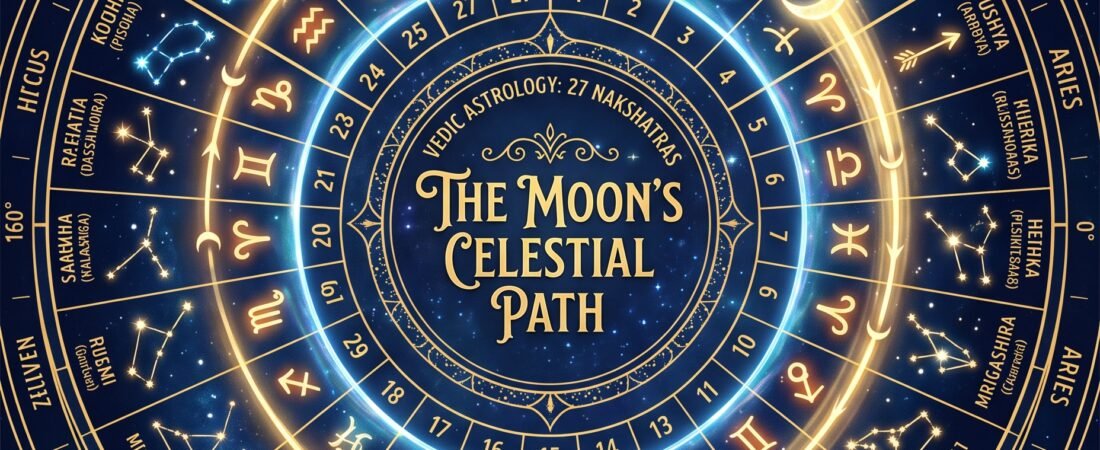
Quick Answer: The 27 Nakshatras (lunar mansions) are specific star clusters along the Moon’s path that Vedic astrology uses to understand your core nature, emotional patterns, and life purpose. Your birth nakshatra — determined by where the Moon sat at your exact birth moment — reveals more about your personality than your zodiac sign alone.
✓ Kundli Analysis
✓ 9 Languages
Why Your Nakshatra Matters More Than Your Sun Sign
Western astrology focuses on the Sun’s position (your zodiac sign), but Vedic astrology gives primacy to the Moon. The Moon represents your mind, emotions, and subconscious patterns — the part of you that reacts before you think, the instincts that drive your deepest decisions.
The 27 Nakshatras divide the zodiac into segments of 13°20′ each. While your zodiac sign (Rashi) covers 30° and changes every month, the Moon passes through a new nakshatra every ~24 hours. This makes nakshatra far more specific — it captures the subtle emotional frequency you were born into.
Think of it this way: If your zodiac sign is the ocean, your nakshatra is the specific wave pattern on the day you were born.
The Complete List Of 27 Nakshatras
| # | Nakshatra | Ruling Planet | Core Quality |
|---|---|---|---|
| 1 | Ashwini | Ketu | Speed, healing, new beginnings |
| 2 | Bharani | Venus | Transformation, endurance, creativity |
| 3 | Krittika | Sun | Purification, courage, sharp intellect |
| 4 | Rohini | Moon | Growth, beauty, nurturing, abundance |
| 5 | Mrigashira | Mars | Searching, curiosity, gentle exploration |
| 6 | Ardra | Rahu | Storm, breakthrough, emotional depth |
| 7 | Punarvasu | Jupiter | Renewal, optimism, spiritual return |
| 8 | Pushya | Saturn | Nourishment, discipline, devotion |
| 9 | Ashlesha | Mercury | Intensity, mysticism, psychological insight |
| 10 | Magha | Ketu | Authority, lineage, ancestral power |
| 11 | Purva Phalguni | Venus | Creativity, romance, leisure |
| 12 | Uttara Phalguni | Sun | Service, friendship, commitment |
| 13 | Hasta | Moon | Skill, craftsmanship, manifestation |
| 14 | Chitra | Mars | Beauty, design, artistic vision |
| 15 | Swati | Rahu | Independence, adaptability, commerce |
| 16 | Vishakha | Jupiter | Focus, determination, goal-achievement |
| 17 | Anuradha | Saturn | Devotion, loyalty, mystical connection |
| 18 | Jyeshtha | Mercury | Seniority, protection, senior leadership |
| 19 | Mula | Ketu | Root causes, destruction-rebirth, philosophy |
| 20 | Purva Ashadha | Venus | Invincibility, charisma, early victory |
| 21 | Uttara Ashadha | Sun | Universal responsibility, final victory |
| 22 | Shravana | Moon | Learning, listening, knowledge absorption |
| 23 | Dhanishta | Mars | Wealth, music, fame, self-promotion |
| 24 | Shatabhisha | Rahu | Healing, medicine, cosmic veil |
| 25 | Purva Bhadrapada | Jupiter | Spiritual warrior, fierce wisdom |
| 26 | Uttara Bhadrapada | Saturn | Depth, austerity, hidden treasures |
| 27 | Revati | Mercury | Compassion, protection, journey’s end |
Source: Rig Veda (Mandala 1, Hymn 164) references the lunar mansions; the system is codified in Brihat Parashara Hora Shastra, Chapter 5.
A Personal Story: Why She Always Felt “Different”
Anjali (name changed), a 28-year-old marketing manager from Mumbai, always knew she was intense. While her friends breezed through social situations, she felt everything deeply — sometimes to the point of overwhelm. She’d cry at movies, get obsessed with projects, and struggle to “switch off.”
“I thought I was just overly sensitive,” she told us. “My therapist said I had high emotional intelligence, but it didn’t explain why I felt so out of sync with everyone else.”
When Anjali generated her free Kundli on Astrova AI, she discovered her Moon was in Ashlesha nakshatra — the 9th nakshatra, ruled by Mercury, symbolized by a coiled serpent. Ashlesha natives are known for psychological depth, mystical intuition, and the ability to see through social masks. They’re often drawn to healing professions, research, or investigative work.
“Reading about Ashlesha was like looking in a mirror,” Anjali said. “It wasn’t that I was ‘too sensitive’ — I was wired for depth. Once I understood that, I stopped trying to be like my friends and started leaning into what made me different.”
She switched from general marketing to user research, where her intensity became an asset. She could spot patterns in customer behavior that others missed. Within a year, she was leading a team.
The takeaway: Your nakshatra doesn’t limit you — it reveals your operating system. When you align with it instead of fighting it, your “flaws” become superpowers.
How To Find Your Nakshatra (And What It Reveals)
Finding your birth nakshatra requires your exact birth details:
- Date of birth (DD/MM/YYYY)
- Exact time of birth (HH:MM, preferably from a birth certificate or family record)
- Place of birth (city and country)
The Moon moves approximately 13°20′ per day, passing through one nakshatra every ~24 hours. If you were born at 3:47 PM on a specific date, the Moon was in a specific nakshatra at that moment — and that nakshatra shapes your emotional nature.
Why precision matters: The Moon can change nakshatras within a single day. If you were born at 11 PM and your birth time is rounded to “morning,” you might get the wrong nakshatra entirely. Even a 2-hour error can shift your nakshatra pada (quarter), which further refines the interpretation.
The Four Padas: Even More Specific
Each nakshatra is divided into four padas (quarters), each spanning 3°20′. The padas add another layer of nuance:
- Pada 1 — Connected to Dharma (purpose, ethics, dharma-driven action)
- Pada 2 — Connected to Artha (material goals, wealth, practicality)
- Pada 3 — Connected to Kama (desire, relationships, creative expression)
- Pada 4 — Connected to Moksha (spiritual liberation, detachment, transcendence)
For example, someone with Moon in Rohini Pada 1 will express Rohini’s nurturing quality through purpose-driven work, while Rohini Pada 3 will express it through relationships and creative pursuits.
How Astrova AI Makes Nakshatra Analysis Accessible
Astrova AI’s free Kundli generator calculates your birth nakshatra, its ruling planet, the deity associated with it, and your current nakshatra pada. You’ll also get:
- Personality insights — Core traits, strengths, and challenges associated with your nakshatra
- Compatibility notes — Which nakshatras harmonize with yours for relationships and partnerships
- Career guidance — Professions and work styles that align with your nakshatra’s energy
- AI Astrologer chat — Ask follow-up questions like “How does my Ashlesha Moon affect my relationships?” or “What remedies strengthen my birth nakshatra?”
All of this is available in 9 Indian languages: Hindi, Tamil, Telugu, Kannada, Malayalam, Bengali, Marathi, Gujarati, and English.
Frequently Asked Questions
1. Can my nakshatra change if I was born during a leap year or daylight saving time?
No. Your nakshatra is based on the Moon’s actual astronomical position at your birth moment, which is independent of calendar adjustments. However, if your birth time was recorded in daylight saving time and not converted to standard time, your calculated nakshatra could be off by one. Always confirm whether your birth time is in standard or daylight saving time.
2. What if I don’t know my exact birth time?
Without an accurate birth time, your nakshatra calculation may be wrong. Some people use “Moon rise” time or noon as a default, but this can place the Moon in the wrong nakshatra. If possible, ask older family members or check hospital records. If you truly can’t find it, an experienced Vedic astrologer can sometimes “rectify” your birth time using life events — but this is advanced work.
3. Is nakshatra more important than zodiac sign (Rashi)?
In Vedic astrology, nakshatra is considered more specific for understanding emotional nature and subconscious patterns, while Rashi gives the broader life themes. Both are used together — nakshatra refines the Rashi’s expression. For example, a Leo Rashi (Sun-ruled, confident, creative) with Moon in Ashlesha (Mercury-ruled, intense, psychological) will express Leo’s confidence very differently than a Leo with Moon in Rohini (Moon-ruled, nurturing, sensual).
4. Can two people born on the same day have different nakshatras?
Yes — because the Moon changes nakshatras every ~24 hours, two people born on the same calendar day but at different times will likely have different nakshatras. This is why twins born minutes apart usually share the same nakshatra, but siblings born years apart (even on the same date) will have different ones.
5. How does my nakshatra affect my relationships?
Nakshatra compatibility (called “Nakshatra Milan” or “Tara Bali”) is a key part of Vedic marriage matching. Certain nakshatras harmonize naturally (e.g., Rohini and Uttara Phalguni), while others create friction (e.g., Ashlesha and Jyeshtha). However, nakshatra is just one factor — the full Kundli Milan considers 36 gunas (qualities) across multiple dimensions.
Explore More Astrova Guides
- Complete Guide to AI Palm Reading — What your palm lines reveal about your destiny
- Kundli Milan for Marriage Compatibility — Match horoscopes before marriage
- Navagraha Remedies for Planetary Peace — Ancient remedies for modern challenges
- Sade Sati Explained — Navigate Saturn’s 7.5-year transit
- AI Astrology Complete Guide — How AI is transforming Vedic astrology
About the Astrova AI Editorial Team
The Astrova AI Editorial Team combines traditional Jyotish scholarship with modern AI technology. Our content is rooted in classical texts like Brihat Parashara Hora Shastra, Phaladeepika by Mantreswara, and Brihat Jataka by Varahamihira, while leveraging machine learning to make Vedic wisdom accessible to everyone. We believe astrology should empower, not intimidate — which is why we offer free tools in 9 Indian languages, with no credit card required.
Have a correction or question? We welcome feedback. Reach us at support@theastrova.com.
Related posts:
 How to Read Palm Lines for Beginners – Step by Step Guide
 Why Do Hindu Festivals Fall on Specific Dates? The Astrological Science Behind Muhurat Timing
 What Your Finger Length Ratios Reveal About Your Personality — The Science of 2D:4D
 What Is the Bhrigu Samhita — The Ancient Palm Leaves That Predict Your Destiny?