
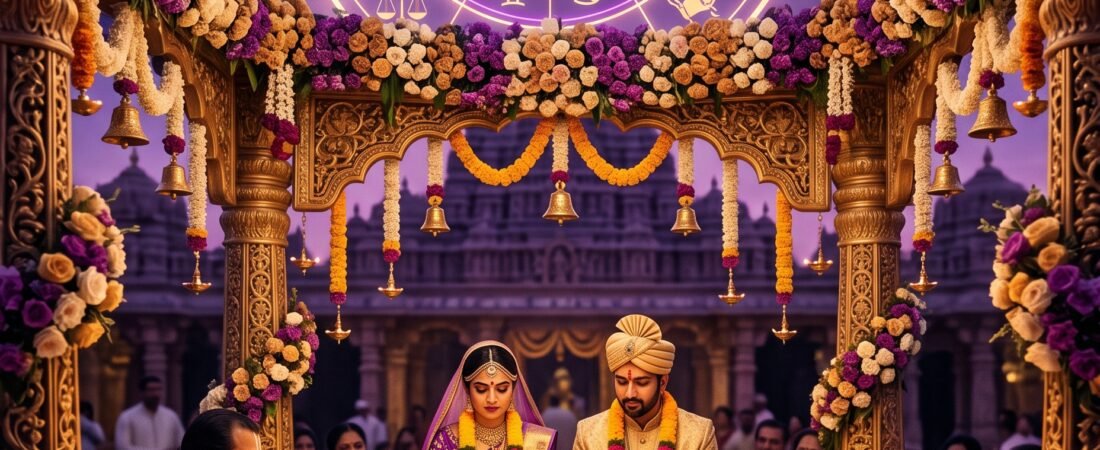
How To Choose An Auspicious Date (Muhurat) For Marriage Or Business
Quick Answer: Muhurat is the Vedic astrology practice of selecting an auspicious date and time for important life events like weddings, business launches, housewarming, or travel. A good muhurat aligns planetary energies to support success, while a poor muhurat can create obstacles. The right timing combines favorable planetary positions, lunar phases, and avoidance of inauspicious periods.
✓ Kundli Analysis
✓ 9 Languages
Why Muhurat Matters: The Science Of Auspicious Timing
In Vedic astrology, time is not neutral. Every moment carries a unique combination of planetary energies that either support or hinder specific activities. Muhurat is the art of choosing a moment when cosmic forces align with your intention.
Think of it like planting a seed: you can plant it in fertile soil during spring (favorable conditions) or in frozen ground during winter (unfavorable conditions). The seed is the same, but the timing determines whether it thrives or struggles.
Classical texts emphasize: Muhurta Chintamani, written by King Bhoja in the 11th century, states that even the best plan executed at the wrong time will face obstacles, while a mediocre plan at the right time can succeed.
The Five Essential Elements Of A Good Muhurat
When selecting an auspicious date, Vedic astrologers consider five key factors:
| Factor | What It Means | Favorable Conditions |
|---|---|---|
| Tithi (Lunar Day) | The Moon’s phase (1-15 in waxing, 1-15 in waning) | 2nd, 3rd, 5th, 7th, 10th, 11th, 13th tithis are generally favorable |
| Vara (Weekday) | Day of the week, each ruled by a planet | Monday (Moon), Wednesday (Mercury), Thursday (Jupiter), Friday (Venus) are auspicious |
| Nakshatra (Lunar Mansion) | The star cluster the Moon occupies | Rohini, Uttara Phalguni, Uttara Ashadha, Uttara Bhadrapada, Revati are “fixed” nakshatras ideal for lasting events |
| Yoga (Planetary Combination) | Specific Sun-Moon angular relationships | Avoid Vyatipata, Vaidhriti, and other inauspicious yogas |
| Karana (Half Lunar Day) | Half of a tithi (11 types, 7 recurring) | Avoid Vishti/Bhadra karana; prefer Bava, Balava, Kaulava |
Source: Muhurta Chintamani, Chapters 1-3; Kala Prakashika (traditional Hindu almanac).
Real-Life Case Study: The Wedding That Almost Didn’t Happen
Ravi and Priya (names changed) had planned their wedding for December 15th. The venue was booked, 300 guests had RSVP’d, and everything seemed perfect. But two weeks before the date, Ravi’s father consulted a family astrologer.
The astrologer’s verdict: December 15th fell during Shukra Asta (Venus combust — when Venus is too close to the Sun and loses its strength). Venus rules marriage, love, and partnership. A wedding during this period, the astrologer warned, could bring marital discord.
“I thought it was superstition,” Ravi told us. “But my father insisted we check another date.”
They found an alternative: January 18th, during Uttarayan (the Sun’s northward journey), on a Friday (Venus’s day), with the Moon in Rohini nakshatra (known for stability and growth). The new date was three weeks later, which meant rescheduling vendors and some guests couldn’t attend — but Ravi’s father believed the timing mattered more than the convenience.
Two years later, Ravi shared their experience: “We’re happily married. I don’t know if the muhurat made the difference, but I do know that starting our marriage with my father’s blessing and a sense of cosmic alignment gave us confidence. When challenges came — and they did — we had that foundation.”
The lesson: Muhurat isn’t about guaranteeing a perfect outcome. It’s about beginning with intention, alignment, and the support of tradition.
Periods To Avoid When Choosing A Muhurat
Certain time periods are considered inauspicious for important events:
- Shukra Asta — Venus combust (typically 8-10 days, occurs several times a year). Avoid for weddings, engagements, and relationship milestones.
- Guru Asta — Jupiter combust. Avoid for education, spiritual initiations, and financial investments.
- Chaturmas — The four monsoon months (roughly July-October) when gods are said to “sleep.” Many avoid weddings during this period.
- Mala Masa — “Impure month” in the lunisolar calendar (extra month added every 3 years). Avoid for auspicious ceremonies.
- Adhika Masa — Another intercalary month considered inauspicious for new beginnings.
- Dhanur Masa — When the Sun is in Sagittarius (roughly mid-December to mid-January). Many South Indian traditions avoid weddings during this month.
- Eclipses (Grahan) — Solar and lunar eclipses are universally avoided for any auspicious activity.
- Amavasya — New Moon day, considered inauspicious for new beginnings (though ideal for ancestor rituals).
Muhurat For Different Life Events
Not all muhurats are created equal — the ideal timing depends on what you’re starting:
Wedding Muhurat
- Prefer fixed nakshatras: Rohini, Uttara Phalguni, Uttara Ashadha, Uttara Bhadrapada, Revati
- Avoid Tuesdays and Saturdays (Mars and Saturn days, considered harsh for relationships)
- Ensure Venus and Jupiter are strong (not combust, not in 6th/8th/12th houses from the Moon)
- Check both bride and groom’s charts for compatibility (Kundli Milan)
Business Launch Muhurat
- Prefer movable nakshatras: Ashwini, Pushya, Punarvasu, Swati, Hasta, Shravana, Dhanishta
- Wednesday (Mercury) and Thursday (Jupiter) are ideal for commerce and wealth
- Avoid Rahu Kaal (inauspicious 90-minute window each day) for the launch moment
- Ensure Mercury (communication) and Jupiter (expansion) are well-placed
Housewarming (Griha Pravesh) Muhurat
- Prefer fixed nakshatras for stability and long-term residence
- Vasant Panchami (spring festival) and Diwali are traditionally auspicious
- Avoid entering a new home during Rahu Kaal or at night
- Perform a Ganesh puja before entering to remove obstacles
Travel Muhurat
- Avoid Tuesdays (Mars day) for long journeys
- Check for “travel yogas” — favorable planetary combinations for safe passage
- East and North directions are generally auspicious; South and West require stronger charts
How Astrova AI Helps You Find The Perfect Muhurat
Astrova AI’s free Kundli generator includes muhurat guidance for major life events. You’ll get:
- Personalized muhurat dates — Based on your birth chart and the event type
- Auspicious time windows — Not just the date, but the specific hora (hour) to begin
- Periods to avoid — Clear warnings about inauspicious dates for your specific chart
- AI Astrologer guidance — Ask questions like “Is this date good for my business launch?” or “What if I can’t find a perfect muhurat — what’s the next best option?”
All of this is available in 9 Indian languages, with no credit card required.
Frequently Asked Questions
1. What if I can’t find a “perfect” muhurat date?
In practice, a 100% perfect muhurat is rare. Vedic astrology prioritizes the most important factors: avoid the clearly inauspicious periods (eclipses, Chaturmas, Asta), then choose the best available date within your practical constraints. A “good enough” muhurat with the right intention is better than delaying indefinitely for perfection.
2. Does muhurat apply to everyday decisions?
For major life events (weddings, business launches, buying property), muhurat is strongly recommended. For daily activities, you can avoid Rahu Kaal (the 90-minute inauspicious window that changes each day) for important meetings or signing contracts, but you don’t need to calculate a full muhurat for routine tasks.
3. Can I choose a muhurat without knowing my birth time?
General muhurat (based on calendar factors like tithi, vara, nakshatra) works for anyone. However, a personalized muhurat — one that considers your birth chart’s planetary strengths and weaknesses — requires your exact birth time. Without it, you’re using a general almanac rather than a tailored recommendation.
4. Is muhurat scientific?
Muhurat is based on astronomical observations (planetary positions, lunar phases) that are measurable and predictable. Whether these positions causally influence human outcomes is a matter of belief. Classical texts like Muhurta Chintamani provide the framework; modern practitioners use software to calculate the timing. Whether you view it as science, tradition, or psychology, muhurat offers a structured way to approach important decisions with intention.
5. What’s the difference between Muhurat and Panchang?
Panchang is the daily Hindu almanac that lists tithi, vara, nakshatra, yoga, and karana for each day. Muhurat is the practice of using Panchang data (plus additional factors like planetary strength and personal charts) to select an auspicious time. Panchang is the data; muhurat is the application.
Explore More Astrova Guides
- Complete Guide to AI Palm Reading — Discover what your palm lines reveal
- Kundli Milan for Marriage Compatibility — Match horoscopes before marriage
- Navagraha Remedies for Planetary Peace — Ancient solutions for modern challenges
- Sade Sati Explained — Navigate Saturn’s 7.5-year transit
- AI Astrology Complete Guide — How AI is transforming Vedic astrology
About the Astrova AI Editorial Team
The Astrova AI Editorial Team combines traditional Jyotish scholarship with modern AI technology. Our content is rooted in classical texts like Brihat Parashara Hora Shastra, Muhurta Chintamani by King Bhoja, and Kala Prakashika, while leveraging machine learning to make Vedic wisdom accessible to everyone. We believe astrology should empower, not intimidate — which is why we offer free tools in 9 Indian languages, with no credit card required.
Have a correction or question? We welcome feedback. Reach us at support@theastrova.com.
Related posts:
 How to Read Palm Lines for Beginners – Step by Step Guide
 Why Do Hindu Festivals Fall on Specific Dates? The Astrological Science Behind Muhurat Timing
 What Your Finger Length Ratios Reveal About Your Personality — The Science of 2D:4D
 What Is the Bhrigu Samhita — The Ancient Palm Leaves That Predict Your Destiny?