💑 Check Your Marriage Compatibility — Free Kundli Milan
Get your complete Ashtakoot Guna Milan score in 30 seconds. 100% FREE, no credit card required.
What Is Ashtakoot Guna Milan and Why Does It Matter for Marriage?
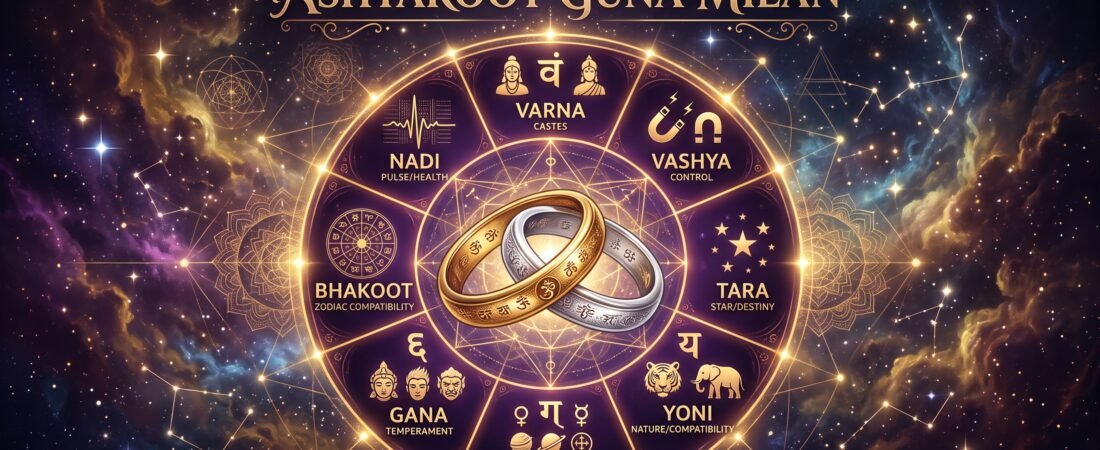
Ashtakoot Guna Milan is the most widely used method of horoscope matching in North Indian Vedic astrology — a systematic 36-point compatibility assessment that evaluates 8 categories (Ashta = eight, Koot = categories) to determine whether two people are astrologically suited for marriage.
Unlike Western compatibility tests that focus on personality or emotional connection, Ashtakoot Guna Milan is rooted in the Moon’s position at birth. It assumes that the Moon represents mind, emotions, and temperament — and that compatible Moon placements create harmony in marriage.
In traditional Hindu families, no arranged marriage proceeds without a Guna Milan score of at least 18 out of 36. Below 18 is considered “Ashtakoot Milan Dosha” — astrologically inauspicious. But the reality is more nuanced: a low score doesn’t doom a marriage, and a high score doesn’t guarantee happiness. The score is one input, not the final verdict.
This article draws on classical texts including Brihat Parashara Hora Shastra, Vivaha Muhurta Chintamani, and regional marriage-matching traditions from Rajasthan, Gujarat, and Maharashtra.
💡 Quick Insight: The Astrova AI app calculates your complete Ashtakoot Guna Milan score with detailed explanations for each category. Get your free compatibility report →
The 8 Categories of Ashtakoot Guna Milan — Explained
Each of the 8 Koots evaluates a different dimension of compatibility. Here’s the complete breakdown:
1. Varna Koot (1 Point) — Spiritual Compatibility
What it measures: Ego, spiritual evolution, and willingness to learn from each other.
How it’s calculated: Based on the Moon sign (Rashi) of both partners. Each Rashi belongs to one of four Varnas:
- Brahmin (spiritual, intellectual): Cancer, Scorpio, Pisces
- Kshatriya (warrior, leadership): Aries, Leo, Sagittarius
- Vaishya (merchant, practical): Taurus, Virgo, Capricorn
- Shudra (service, labor): Gemini, Libra, Aquarius
Scoring: The groom’s Varna should be equal to or higher than the bride’s. If it is, you get 1 point. If the bride’s Varna is higher, you get 0 points.
Note: This Varna system is astrological, not social. It has nothing to do with caste.
2. Vashya Koot (2 Points) — Mutual Attraction and Control
What it measures: Physical attraction, magnetic pull, and who “controls” the relationship dynamic.
How it’s calculated: Each Moon sign belongs to a Vashya category:
- Chatushpada (four-legged): Aries, Taurus, Leo, Sagittarius, Capricorn
- Manava (human): Gemini, Virgo, Libra, Aquarius
- Jalachara (water): Cancer, Scorpio, Pisces
- Vanachara (forest/wild): (Not used in modern practice)
Scoring: If both partners belong to the same Vashya, or if their Vashyas are mutually friendly, you get 2 points. Otherwise, 0.
3. Tara Koot (3 Points) — Health and Longevity
What it measures: Physical health, vitality, and whether the partners support each other’s well-being.
How it’s calculated: Count the number of Nakshatras (lunar mansions) from the bride’s Moon to the groom’s Moon. If the count falls on certain auspicious Nakshatras (Janma, Sampat, Vipat, Kshema, Pratyari, Sadhaka, Vadha, Mitra, Parama Mitra), you get points.
Scoring: 3 points if both partners’ Nakshatras are mutually beneficial, 1.5 points if only one is beneficial, 0 if neither.
4. Yoni Koot (4 Points) — Sexual and Physical Compatibility
What it measures: Sexual chemistry, physical compatibility, and intimate harmony.
How it’s calculated: Each Nakshatra is associated with an animal (Yoni) representing sexual energy:
- Horse, Elephant, Sheep, Snake, Dog, Cat, Rat, Cow, Buffalo, Tiger, Deer, Monkey, Mongoose, Lion
Scoring: Certain animal pairs are highly compatible (e.g., Horse + Tiger), while others are enemies (e.g., Cat + Rat). The closer the Yonis, the higher the score.
5. Graha Maitri Koot (5 Points) — Mental and Intellectual Compatibility
What it measures: Friendship between the Moon-sign lords, indicating mental rapport and shared values.
How it’s calculated: Check the relationship between the rulers of the bride’s and groom’s Moon signs. If they’re friends, you get 5 points. If neutral, 3 points. If enemies, 0.
Example: If the bride’s Moon is in Cancer (ruled by Moon) and the groom’s Moon is in Pisces (ruled by Jupiter), Moon and Jupiter are friends → 5 points.
6. Gana Koot (6 Points) — Temperament and Character
What it measures: Behavioral compatibility — are you both similar in temperament, or do your natures clash?
How it’s calculated: Each Nakshatra belongs to one of three Ganas (temperaments):
- Deva (divine): Gentle, ethical, spiritual
- Manushya (human): Balanced, practical, emotional
- Rakshasa (demonic): Intense, passionate, aggressive
Scoring: Same Gana = 6 points. Deva + Manushya = 5 points. Manushya + Rakshasa = 3 points. Deva + Rakshasa = 0 points (considered highly incompatible).
7. Bhakoot Koot (7 Points) — Emotional and Financial Compatibility
What it measures: Emotional bonding, family harmony, and financial stability after marriage.
How it’s calculated: Check the positional relationship between the bride’s and groom’s Moon signs. Certain combinations are auspicious (e.g., 2/12, 3/11, 4/10, 5/9), while others are inauspicious (6/8, called “Shadashtaka”).
Scoring: Auspicious positions = 7 points. Inauspicious positions = 0 points. Bhakoot Dosha (6/8) is considered serious and often requires remedies.
8. Nadi Koot (8 Points) — Genetic and Health Compatibility
What it measures: Genetic compatibility, progeny health, and avoidance of hereditary diseases.
How it’s calculated: Each Nakshatra belongs to one of three Nadis:
- Adi (Vata): Air constitution
- Madhya (Pitta): Fire constitution
- Antya (Kapha): Water constitution
Scoring: If both partners have the same Nadi, you get 0 points (Nadi Dosha — considered the most serious dosha in Guna Milan). If different, you get 8 points.
Nadi Dosha is believed to cause health issues in offspring or marital discord. Many traditional families reject matches with Nadi Dosha outright, though modern astrologers often prescribe remedies.
🎯 Get Your Complete Ashtakoot Score
The Astrova AI app calculates all 8 Koots and explains what each score means for your marriage.
How to Interpret Your Guna Milan Score
Here’s the scoring breakdown and what it means:
| Score Range | Interpretation | Recommendation |
|---|---|---|
| 0-17 | Ashtakoot Dosha — Inauspicious | Not recommended without strong remedies and astrologer consultation |
| 18-24 | Average compatibility | Acceptable with minor remedies; focus on strengthening weak Koots |
| 25-32 | Good compatibility | Favorable for marriage; minor doshas may need remedies |
| 33-36 | Excellent compatibility | Highly auspicious; rare and blessed match |
Real-Life Case Study: When a Low Score Didn’t Matter
Case Study: Priya and Rahul, Score 16/36
Priya and Rahul came for a consultation in 2022. Their Ashtakoot score was 16 — below the traditional 18-point threshold. The family priest advised against the match.
But when I analyzed their charts in detail, I found:
- Their 7th houses (marriage houses) were strongly placed — Priya’s 7th lord Jupiter was exalted in Cancer, Rahul’s 7th lord Venus was in its own sign Taurus
- Their Jupiter positions were harmonious — both had Jupiter in water signs, indicating shared spiritual values
- Their Mars positions were compatible — both had Mars in fire signs, indicating similar energy levels
- The low Guna score was mainly due to Bhakoot Dosha (6/8), but both had strong 7th houses that could override it
I told them: “The Guna score is a general compatibility check, but your individual charts show strong marriage potential. If you’re committed to each other and willing to do simple remedies for Bhakoot Dosha, this marriage can work.”
They married in 2023. In 2024, they told me: “We argue sometimes, but we’re deeply connected. The priest was wrong about us.”
This case shows why Guna Milan should never be the sole criterion. It’s one tool among many — individual chart analysis, Dasha compatibility, and mutual commitment matter equally.
Common Doshas in Ashtakoot Milan and Their Remedies
1. Nadi Dosha (Most Serious)
What it is: Both partners have the same Nadi (Adi, Madhya, or Antya).
Believed effects: Health issues in offspring, marital discord, infertility.
Remedies:
- Perform Nadi Shanti Puja before marriage
- Donate grain, clothes, or gold to a temple on a Saturday
- Chant the Mrityunjaya Mantra 108 times daily for 21 days
- Visit a Shiva temple and offer Bilva leaves
2. Bhakoot Dosha (Serious)
What it is: Moon signs are in 6/8 relationship (e.g., Aries-Virgo, Taurus-Libra).
Believed effects: Financial problems, emotional distance, family conflicts.
Remedies:
- Perform Bhakoot Shanti Puja
- Fast on the day of the week ruled by the 7th lord
- Donate food to the poor on Ekadashi
- Wear a gemstone recommended by an astrologer
3. Gana Dosha (Moderate)
What it is: One partner is Deva Gana, the other is Rakshasa Gana.
Believed effects: Temperament clashes, ego conflicts, lack of understanding.
Remedies:
- Practice patience and active listening
- Chant the Gayatri Mantra together daily
- Visit a temple on Purnima (full moon day)
- Respect each other’s differences consciously
Limitations of Ashtakoot Guna Milan
While Guna Milan is valuable, it has limitations:
1. It’s Moon-Centric
Guna Milan focuses almost entirely on Moon sign compatibility. But marriage involves the 7th house, Venus, Jupiter, Mars, and the Dasha periods — all of which Guna Milan ignores.
2. It Doesn’t Account for Free Will
Two people with a 36/36 score can still divorce if they don’t work on the relationship. Two people with 16/36 can have a beautiful marriage if they’re committed.
3. It’s One-Dimensional
Guna Milan doesn’t assess career compatibility, parenting styles, financial habits, or long-term goals — all of which matter in real life.
4. It Can Be Manipulated
Some astrologers “adjust” scores to make a match look better (or worse) based on family pressure or financial incentives. Always get a second opinion if the score seems suspicious.
When to Use Guna Milan (and When Not To)
Use Guna Milan When:
- You’re considering an arranged marriage and want a traditional compatibility check
- Your family insists on astrological matching
- You want a general sense of compatibility before deeper analysis
- You’re curious about Vedic astrology and want to learn
Don’t Rely Solely on Guna Milan When:
- You’re in a love marriage and already know each other well
- The score is low but your individual charts show strong marriage potential
- You’re using it to justify prejudice or family pressure
- You haven’t consulted a qualified astrologer for a second opinion
Frequently Asked Questions (FAQ)
Q1: Is 18/36 the minimum acceptable score?
A: Traditionally, yes. But many modern astrologers accept 16-17 if other factors (7th house, Venus, Jupiter) are strong. Below 16 is generally not recommended without extensive remedies.
Q2: Can Nadi Dosha be cancelled?
A: Some astrologers say Nadi Dosha is cancelled if the Moon signs are the same, or if the lords of the Moon signs are friends. Others say it’s never fully cancelled. Consult a qualified astrologer for your specific case.
Q3: What if the groom’s Varna is lower than the bride’s (Varna Dosha)?
A: Traditionally, this is considered inauspicious. But in modern practice, many astrologers ignore Varna Koot or consider it less important than other Koots.
Q4: Can Guna Milan predict divorce?
A: No. Guna Milan assesses compatibility, not destiny. Divorce depends on many factors — individual charts, Dasha periods, free will, and effort. A low score doesn’t mean divorce is inevitable.
Q5: Is Guna Milan used in South Indian astrology?
A: South Indian astrology uses a different system called “Dashakoot Milan” (10 categories) or “Porutham” (10 matches). Ashtakoot is primarily North Indian.
Q6: Can I do Guna Milan without exact birth time?
A: No. Guna Milan requires the exact Moon sign, which depends on the birth time. If the birth time is unknown, the astrologer may use the Moon sign at sunrise or ask you to do a birth time rectification.
Quick Summary: Your Guna Milan Action Plan
- Get both partners’ birth details — date, time, and place
- Calculate the Ashtakoot score using the Astrova AI app or a qualified astrologer
- Understand each Koot — don’t just look at the total score
- Check for doshas — Nadi, Bhakoot, Gana, Varna
- Analyze individual charts — 7th house, Venus, Jupiter, Mars
- Consider remedies if doshas are present
- Don’t rely solely on the score — mutual commitment matters more
Ashtakoot Guna Milan is a valuable tool, but it’s not the final word on marriage compatibility. Use it as one input among many — and remember that love, respect, and effort can overcome any astrological obstacle.
🌟 Get Your Free Kundli Milan Report
The Astrova AI app calculates your complete Ashtakoot score with detailed explanations and remedies.
⭐ 4.6★ rating • No credit card required • Available in 9 Indian languages
Explore More Astrova Guides
- Kundli Milan Marriage Compatibility Guide
- How to Calculate Guna Milan Score — The 36-Point System Explained
- What Is Nadi Dosha and How Does It Affect Marriage Compatibility?
- What Is Manglik Dosha — Complete Guide
- What Is Bhakoot Dosha in Kundli Milan and Can It Be Cancelled?
- How to Generate Your Janam Kundli Online for Free
About the Author
Astrova AI Editorial Team
The Astrova AI Editorial team combines classical Vedic astrology knowledge with modern AI technology to make marriage matching accessible to everyone. Our content is reviewed by experienced astrologers trained in Brihat Parashara Hora Shastra and Vivaha Muhurta Chintamani. We believe astrology should empower, not frighten — every article is written to help you make informed decisions about your relationships.
Get your personalised reading in the Astrova AI app
Free AI palm reading, Janam Kundli and daily Rashifal on your phone.