Your ring finger and index finger hold a secret about your personality that scientists have been studying for over 30 years. The ratio between these two fingers — called the 2D:4D ratio — is formed in the womb and reveals surprising insights about your temperament, risk-taking behavior, and even your career tendencies. This isn’t palmistry’s mystical lines; it’s measurable biology that palm readers have intuitively understood for centuries.
In this guide, you’ll discover what your finger ratios mean, how they connect to traditional palm reading, and how modern AI can combine both methods for deeper insights. Astrova AI offers free palm readings that analyze both your lines and finger proportions in under 30 seconds.
What Is the 2D:4D Finger Ratio?
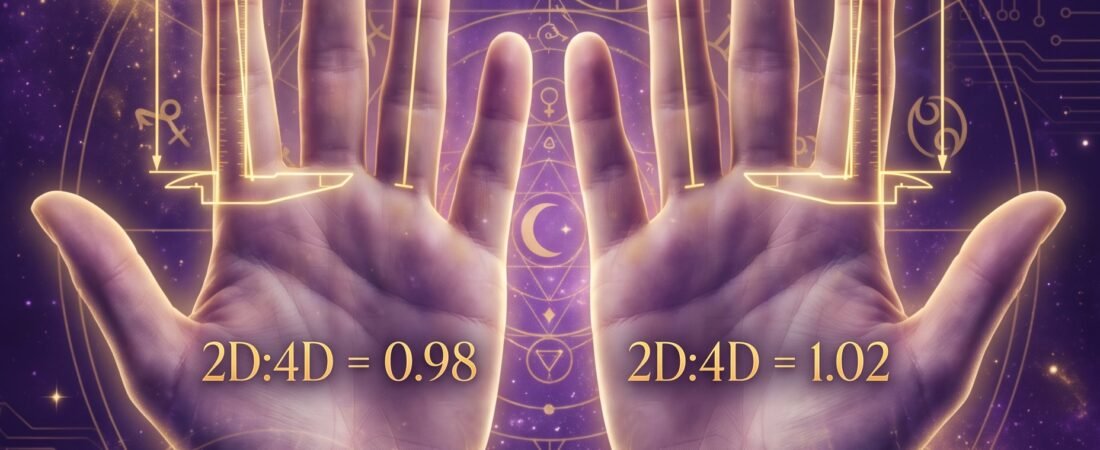
The 2D:4D ratio is the length of your index finger (2D) divided by your ring finger (4D). Researchers at the University of Liverpool first documented its significance in 1998, and over 200 studies since then have linked it to prenatal testosterone exposure.
The Three Types
| Finger Pattern | 2D:4D Ratio | What It Means | Personality Traits |
|---|---|---|---|
| Ring finger longer than index | Low ratio (<1.0) | Higher prenatal testosterone | Competitive, athletic, risk-taking, systemizing thinking, good at spatial tasks |
| Index finger longer than ring | High ratio (>1.0) | Higher prenatal estrogen | Communicative, empathetic, detail-oriented, verbal skills, nurturing |
| Both fingers equal length | Balanced ratio (=1.0) | Balanced hormonal exposure | Adaptable, diplomatic, balanced temperament, good mediator |
Source: Manning, J.T. (2002). Digit Ratio: A Pointer to Fertility, Behavior, and Health. Rutgers University Press.
What the Research Shows
Over two decades of peer-reviewed studies have found consistent correlations between 2D:4D ratios and various traits:
For Low Ratios (Ring Finger Longer)
- Athletic performance: Studies show correlation with running speed, football ability, and tennis success (Manning & Taylor, 2001)
- Career tendencies: Overrepresented in engineering, mathematics, and finance (Coates & Herbert, 2008)
- Risk behavior: More likely to take financial risks and engage in competitive activities
- Spatial abilities: Better at mental rotation tasks and navigation
For High Ratios (Index Finger Longer)
- Verbal fluency: Stronger language skills and verbal memory (Kimura, 1999)
- Empathy: Higher scores on empathy quotient tests
- Career patterns: More common in teaching, counseling, and nursing professions
- Decision style: More cautious, thorough, detail-oriented approach
Sources: Manning, J.T. “Digit Ratio: A Pointer to Fertility, Behavior, and Health” (Rutgers University Press, 2002); Coates, J.M. & Herbert, J. “Endogenous steroids and financial risk taking on a London trading floor” (PNAS, 2008); Kimura, D. “Sex and Cognition” (MIT Press, 1999).
How This Connects to Traditional Palm Reading
Ancient palm readers didn’t have scientific studies, but they observed the same patterns. In Samudrika Shastra (ancient Indian palmistry), finger proportions are called “Anguli Pramana” and have been used for thousands of years:
- Long ring finger: Associated with Apollo/Sun mount — creativity, fame, artistic talent
- Long index finger: Associated with Jupiter mount — leadership, ambition, authority
- Equal fingers: Balanced Saturn influence — wisdom, fairness, justice
Modern AI palm reading combines these ancient observations with computer vision to give you both the traditional interpretation and the scientific perspective.
How to Check Your 2D:4D Ratio
Step 1: Place your hand flat on a table, palm facing up.
Step 2: Measure from the bottom crease to the tip of your index finger.
Step 3: Measure from the bottom crease to the tip of your ring finger.
Step 4: Divide index finger length by ring finger length.
Example: If your index finger is 7.5cm and ring finger is 8cm, your ratio is 0.94 (low ratio — ring finger longer).
Or Use AI for Instant Analysis
Astrova AI analyzes your finger proportions automatically when you take a palm photo. The AI measures:
- 2D:4D ratio and what it reveals about your temperament
- Relative finger lengths and their palmistry meanings
- Mount development (the fleshy pads below each finger)
- All major palm lines (Heart, Head, Life, Fate)
- Complete personality and life path analysis
What Your Ratio Means for Your Career
| 2D:4D Pattern | Natural Strengths | Best Career Fits | Work Style |
|---|---|---|---|
| Low ratio (Ring longer) |
Competitive drive, spatial reasoning, risk tolerance | Engineering, trading, athletics, entrepreneurship, surgery | Fast decisions, big-picture thinking, action-oriented |
| High ratio (Index longer) |
Communication, empathy, attention to detail | Teaching, writing, counseling, research, healthcare | Thorough analysis, collaborative, methodical planning |
| Balanced (Equal length) |
Adaptability, diplomacy, balanced perspective | Management, mediation, law, consulting, administration | Flexible approach, good judge of character, fair decisions |
Can Your Finger Ratio Predict Your Future?
No — and this is important to understand. Your 2D:4D ratio shows inclinations, not destiny. It’s like knowing you’re right-handed: it tells you which hand you naturally prefer, but you can still learn to use both.
The ratio reveals:
- ✅ Your natural temperament and energy style
- ✅ Activities you might find easier or more rewarding
- ✅ Decision-making tendencies under pressure
It does NOT reveal:
- ❌ Your exact career path (that’s shaped by choices, education, opportunity)
- ❌ Your relationship success (that depends on communication, values, effort)
- ❌ Your lifespan or health outcomes (lifestyle matters far more)
Combining Finger Ratios with Palm Lines
The most accurate palm readings combine multiple factors. Here’s how finger ratios interact with your major lines:
Example 1: Low Ratio + Strong Head Line
Pattern: Ring finger longer than index, plus a deep, clear Head Line
Interpretation: You have the competitive drive of a low 2D:4D ratio, combined with the focused thinking of a strong Head Line. This suggests success in fields requiring both analytical depth and decisive action — engineering, surgery, financial trading, or competitive sports.
Example 2: High Ratio + Strong Heart Line
Pattern: Index finger longer than ring, plus a long, deep Heart Line
Interpretation: You have the empathy and communication skills of a high 2D:4D ratio, amplified by emotional depth from your Heart Line. This suggests natural talent in counseling, teaching, nursing, or any role requiring emotional intelligence.
Example 3: Balanced Ratio + Strong Fate Line
Pattern: Equal finger lengths, plus a clear, straight Fate Line
Interpretation: You have balanced temperament plus strong sense of purpose. This suggests leadership potential in roles requiring fairness and diplomacy — management, law, mediation, or public service.
How AI Palm Reading Analyzes Your Hands
Astrova AI uses computer vision to measure:
- Finger proportions: 2D:4D ratio and relative lengths of all five fingers
- Mount development: Size and prominence of the fleshy pads below each finger
- Line analysis: Depth, length, and clarity of Heart, Head, Life, and Fate lines
- Hand shape: Elemental hand type (Earth, Air, Fire, Water)
- Skin texture: Firmness, flexibility, and overall hand characteristics
The AI then synthesizes all these factors into a coherent reading that covers personality, career tendencies, relationship patterns, and life path guidance.
Frequently Asked Questions
Is the 2D:4D ratio the same for both hands?
Usually, but not always. Most people have similar ratios on both hands, but some show variation. Palm readers typically focus on the dominant hand (right for right-handed people) as it shows your expressed personality, while the non-dominant hand shows your innate potential.
Can your finger ratio change over time?
No. The 2D:4D ratio is set before birth and remains constant throughout life. This is why it’s considered a marker of prenatal hormonal exposure. However, your palm lines can change — they reflect your current state and evolve with your experiences.
Is this scientifically proven or just palmistry?
The 2D:4D ratio research is published in peer-reviewed journals and based on measurable biology. Traditional palmistry is an ancient interpretive system. Modern AI palm reading combines both: the scientific measurements (finger ratios, hand proportions) with the traditional wisdom (line meanings, mount interpretations).
What if my fingers are the same length?
A balanced ratio (around 1.0) is actually quite common and suggests a well-rounded personality. You likely have good adaptability, diplomatic skills, and the ability to see multiple perspectives. In palmistry, this indicates balanced Saturn influence — wisdom and fairness.
Can AI palm reading replace a professional palmist?
For standard readings, yes — AI is consistent, detailed, and available 24/7. For complex life decisions or when you want human intuition and experience, a professional palmist adds value. Many people use both: AI for regular self-reflection and professionals for major life questions.
Your Next Step
Curious about your 2D:4D ratio and what your palm reveals? Astrova AI gives you a complete palm reading in under 30 seconds — completely free. The AI analyzes your finger proportions, all major lines, mounts, and hand shape, then delivers personalized insights about your personality, career path, relationships, and life direction.
Download Astrova AI from Google Play and discover what your hands reveal about you. Available in 9 Indian languages.
Explore More Astrova Guides
- What Do the Mounts on Your Palm Reveal About Your Personality?
- How to Read Your Own Palm at Home — Step-by-Step Guide
- How to Identify the Major Lines on Your Palm
- What Your Heart Line Reveals About Your Love Life
- How to Use Palm Reading for Career Guidance
About the Author
Astrova AI Editorial Team
The Astrova AI Editorial Team combines expertise in Vedic astrology, palmistry, and artificial intelligence to create accessible, accurate guidance for modern seekers. Our content draws from classical texts including Samudrika Shastra (ancient Indian palmistry), Brihat Parashara Hora Shastra, and contemporary research in computational astrology. Every article is reviewed for accuracy, cultural sensitivity, and practical value.
Have a correction or question? We welcome feedback. Reach us at support@theastrova.com.
Get your personalised reading in the Astrova AI app
Free AI palm reading, Janam Kundli and daily Rashifal on your phone.
Related posts:
 What Your Thumb Shape Reveals About Willpower and Determination
 What Does a Forked Fate Line Mean in Palm Reading — And What It Reveals About Your Destiny
 What Is the Bhav Chalit Chart and Why Does It Change Everything Your Kundli Predicts?
 What Does Mercury (Budh) in Your Kundli Reveal About Intelligence, Communication and Business Success?