What Is Pitru Dosha in Your Kundli and How Do You Know If You Have It?
Pitru Dosha is an ancestral karmic affliction in your Kundli, usually seen when the Sun, the 9th house or its lord is afflicted by Rahu, Ketu or Saturn. Signs include repeated delays in marriage, money troubles and family discord. Shraddha, Pitru Paksha rituals and charity are the traditional remedies.
If you have been facing recurring obstacles in life — delays in marriage, financial instability, health issues that defy diagnosis, or a persistent sense of unease that no amount of material success can shake — Vedic astrology points to a karmic factor that most people overlook: Pitru Dosha. This dosha, rooted in the lunar nodes Rahu and Ketu, reflects unresolved karmic debt to your ancestors. And unlike other doshas, it cannot be understood through planetary positions alone — it requires reading the deeper layers of your Kundli.
In this guide, you will learn exactly what Pitru Dosha is, how it forms in your birth chart, the specific signs that reveal it, and the most effective remedies drawn from the Garuda Purana, the Bhavishya Purana, and living Jyotish tradition. By the end, you will know whether your Kundli carries this dosha — and what to do about it.
100% FREE • No Credit Card
Check Your Kundli for Pitru Dosha Instantly
Generate your Janam Kundli with AI-powered Vedic astrology — free on Astrova AI
⭐ 4.5 rating • 500+ downloads • Available in 9 Indian languages
What Exactly Is Pitru Dosha?
Pitru Dosha (also written as Pitru Dosh or Pitrudosh) is a karmic imbalance in your birth chart caused by the affliction of the Sun and the lunar nodes — specifically when Rahu or Ketu conjunct the Sun, or when the Sun is placed in certain houses with malefic influences. In Vedic cosmology, the Sun represents the soul of the native and the lineage of the father (Pitru). When Rahu — the shadow planet of karmic obsession — or Ketu — the planet of detachment and past-life residue — sits with the Sun, it signals that the ancestral line carries unresolved karma that manifests in the current generation.
The Garuda Purana, one of the eighteen Mahapuranas, describes this extensively. In the Preta Khanda (section on ancestral rites), it states that when ancestors are not properly honoured through Shraddha, Tarpan, or righteous living, their unfulfilled desires create a karmic imprint that travels through the bloodline. This imprint shows up in the Kundli of descendants as Pitru Dosha.
The Bhavishya Purana (Pratisarga Parva) adds another dimension: Pitru Dosha can also form when a person’s forefathers died under unnatural circumstances — unfulfilled wishes, violent death, or death without proper last rites. These events create what Jyotish scholars call Pitru Rin (ancestral debt), which the native must address in this lifetime.
How Does Pitru Dosha Form in Your Kundli?
Pitru Dosha is not a single planetary placement — it is a pattern. Here are the specific configurations that astrologers look for:
| Kundli Configuration | How It Forms | Intensity |
|---|---|---|
| Sun conjunct Rahu | Rahu’s karmic obsession merges with the Sun’s soul-energy, creating ancestral karmic pressure | High |
| Sun conjunct Ketu | Ketu’s past-life detachment weakens the Sun’s vitality, indicating ancestral spiritual debt | High |
| Sun in 9th house with Rahu/Ketu | The 9th house is the house of Dharma and father — affliction here directly impacts ancestral karma | Very High |
| Sun debilitated (Libra) with malefics | A weak Sun combined with Rahu/Ketu or Saturn amplifies ancestral karmic burden | Moderate to High |
| 9th lord afflicted by Rahu/Ketu | Even without Sun involvement, if the 9th house lord is with Rahu/Ketu, Pitru Dosha can form | Moderate |
| Amavasya (New Moon) birth with afflicted Moon | Born on New Moon day with Moon conjunct Rahu/Ketu — Pitru Dosha through lunar ancestral connection | Moderate |
Important nuance: Not every Sun-Rahu conjunction creates a severe Pitru Dosha. The strength of the Sun, its dignity (whether it is in its own sign, exalted, or debilitated), the aspect of benefic planets like Jupiter, and the overall strength of the 9th house all modify the intensity. A strong Sun in Aries conjunct Rahu, for example, may manifest as ancestral ambition driving you toward power — not necessarily as suffering.
What Are the Signs That Pitru Dosha Is Affecting Your Life?
Vedic astrology describes specific life patterns that signal active Pitru Dosha. If you recognise three or more of these in your life, it is worth examining your Kundli closely:
- Repeated delays or obstacles in marriage — especially when horoscope matching (Kundli Milan) shows compatibility but the alliance still falls through
- Difficulty conceiving children or recurring health issues in children that resist medical treatment
- Financial instability — money comes in but drains away through unexpected expenses, medical bills, or legal disputes
- Chronic health problems with no clear diagnosis — particularly headaches, eye problems, bone disorders, or digestive issues
- Recurring nightmares about deceased family members, or a persistent feeling of being watched or followed
- Family discord — constant arguments between parents, siblings turning against each other, or estrangement from the father
- A sense of purposelessness despite material success — the feeling that something is missing that no achievement can fill
- Repeated failures in education or career at critical junctures — clearing every hurdle except the final one
The Manu Smriti (Chapter 3, verses 122-124) warns that when ancestors are displeased, the entire family lineage suffers — not just one individual. This is why Pitru Dosha often manifests as a family pattern rather than a personal one: your grandfather faced the same obstacle, your father faced it, and now it appears in your life.
Pitru Dosha and the Timing: When Does It Activate?
Having Pitru Dosha in your Kundli does not mean you will suffer throughout your entire life. Like all karmic factors, it activates during specific planetary periods (Dasha) and transits (Gochar):
- Sade Sati of the Moon — when Saturn transits over your natal Moon, it often triggers ancestral karmic patterns, including Pitru Dosha effects
- Sun Dasha or Sun Antardasha — the Vimshottari Dasha period of the Sun (6 years) or its sub-period within another planet’s Dasha can activate dormant Pitru Dosha
- Rahu-Ketu transit over your natal Sun — approximately every 18 months, the nodes transit over the same zodiac sign as your birth Sun, creating a temporary activation window
- Amavasya (New Moon) days — especially the Amavasya that falls in the Pitru Paksha fortnight (September-October) — are when ancestral karma is most active
- Solar eclipses — a solar eclipse occurring in a sign connected to your 9th house or your natal Sun can trigger ancestral karmic events
This is why many people notice a worsening of ancestral-karma-related problems during Pitru Paksha (the fortnight dedicated to ancestors, falling in the Hindu month of Bhadrapada). The cosmic window opens, and whatever karma remains unaddressed becomes more visible in daily life.
AI-Powered Vedic Analysis
Find Out If Pitru Dosha Is Active in Your Chart Right Now
Astrova AI analyses your Dasha, transits and 9th house to show you exactly when ancestral karma activates
The Most Effective Remedies for Pitru Dosha
Vedic tradition offers a layered approach to resolving Pitru Dosha. The remedies range from simple daily practices to elaborate annual rituals. The key principle across all of them is the same: honour the ancestors consciously, and the karmic debt begins to dissolve.
1. Pitru Tarpan (Daily Water Offering)
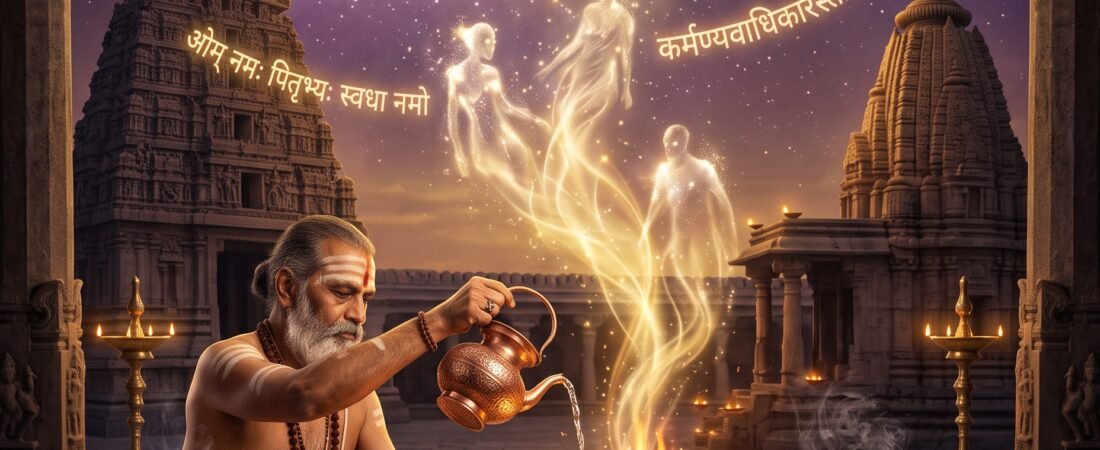
The simplest and most powerful daily remedy. Every morning, after bathing, stand facing south (the direction of the ancestors) and offer water mixed with black sesame seeds from a copper vessel. While pouring, chant: “Om Pitru Devataabhyo Namah” or the Mahamrityunjaya Mantra. This takes less than two minutes and, according to the Garuda Purana, satisfies the ancestors for the entire day.
2. Shraddha During Pitru Paksha
The 16-lunar-day fortnight of Pitru Paksha (September 7 – September 21, 2026) is the most important window for ancestral rites. Performing Shraddha on the specific tithi (lunar day) corresponding to the death date of your father, grandfather, or other departed family members is considered essential. If the exact death date is unknown, the Sarva Pitru Amavasya (the final New Moon of the fortnight — September 21, 2026) covers all ancestors.
3. Feeding Brahmins and the Needy
The Agni Purana prescribes feeding Brahmins, cows, and the underprivileged as a direct remedy for Pitru Dosha. On Amavasya days or during Pitru Paksha, preparing a simple meal and offering it to a Brahmin priest, or feeding crows (considered messengers of the ancestors), is believed to reach the departed souls directly.
4. Recitation of the Garuda Purana
Reading or listening to the Garuda Purana — particularly the Preta Khanda — during Pitru Paksha or on Amavasya days is considered one of the most powerful remedies. Many families arrange a complete recitation (Parayana) in their home during this period.
5. Visiting Sacred Sites Associated with Ancestors
Gayaji Shraddha — performing ancestral rites at Gaya in Bihar — is considered the most meritorious location for Pitru Dosha nivaran (removal). The Mahabharata records that Lord Rama himself performed Pitru Tarpan at Gaya after the passing of King Dasharatha. Other sacred sites include Varanasi (Kashi), Prayagraj (Triveni Sangam), and Rameshwaram.
6. Wearing a Copper Ring or Rudraksha
For those who cannot perform elaborate rituals, wearing a copper ring on the ring finger (right hand for men, left hand for women) and a 5-mukhi Rudraksha bead are traditional remedies that strengthen the Sun’s energy and pacify Rahu-Ketu’s affliction.
How Astrova AI Helps You Identify and Address Pitru Dosha
Identifying Pitru Dosha requires careful analysis of multiple factors in your Kundli — the Sun’s position, Rahu-Ketu placement, 9th house condition, Dasha periods, and current transits. Astrova AI’s Janam Kundli feature generates your complete Vedic birth chart and highlights these configurations automatically.
- Complete Kundli generation — your birth chart with all 12 houses, planetary positions, and Dasha periods calculated using the Swiss Ephemeris for astronomical precision
- Dosha identification — the AI flags Manglik Dosha, Kaalsarp Dosha, Sade Sati, and ancestral karmic indicators including Pitru Dosha configurations
- 24/7 AI Astrologer — ask specific questions like “Is Pitru Dosha active in my chart?” or “When will the current Pitru Paksha affect me?” and receive instant, personalised answers rooted in Vedic principles
- Available in 9 Indian languages — Hindi, Tamil, Telugu, Kannada, Malayalam, Marathi, Gujarati, Bengali, and English, so you can read your analysis in your mother tongue
- 100% free — no credit card, no hidden charges, no paywall on core features
🔮 Try It Now — Completely Free
Generate your Kundli, check for Doshas, and speak with the AI Astrologer — all inside the Astrova AI app.
Frequently Asked Questions About Pitru Dosha
Can Pitru Dosha be cured completely?
Vedic tradition holds that consistent performance of Pitru Tarpan, Shraddha, and charitable acts during Pitru Paksha can significantly reduce and eventually dissolve the effects of Pitru Dosha. The Garuda Purana states that sincere devotion to ancestors removes the karmic burden within three generations at most — and often within the current generation if the remedies are performed with genuine faith.
Does Pitru Dosha affect marriage?
Yes. Pitru Dosha is one of the doshas checked during Kundli Milan (horoscope matching). If either the bride’s or the groom’s chart shows strong Pitru Dosha, traditional astrologers may recommend performing Pitru Dosha Nivaran Puja before the wedding. Astrova AI’s Kundli Milan feature flags this automatically when you check compatibility.
Is Pitru Dosha the same as Kaalsarp Dosha?
No. Kaalsarp Dosha occurs when all seven planets are hemmed between Rahu and Ketu in the birth chart — it is a separate karmic configuration. Pitru Dosha specifically involves the Sun and the lunar nodes and relates to ancestral karma. A person can have one, both, or neither. Astrova AI identifies both doshas separately in your Kundli.
When is the best time to perform Pitru Dosha remedies?
The most powerful window is Pitru Paksha (September 7–21, 2026), with the final day Sarva Pitru Amavasya (September 21) being the most significant. Amavasya (New Moon) days throughout the year, especially Mahalaya Amavasya, are also effective. Daily Tarpan can be performed every morning without waiting for a specific date.
Can women perform Pitru Tarpan?
Traditional texts primarily assign Shraddha and Tarpan to male descendants. However, modern Jyotish scholars — including those referenced in the Nirnayasindhu (a classical text on Hindu rituals) — acknowledge that when no male descendant is available, women can and should perform these rites. Many contemporary priests also support women performing Tarpan independently.
Explore More Astrova Guides
- What Is a Janam Kundli and How to Generate Yours Free
- Kundli Milan for Marriage: How to Check Compatibility Free
- Sade Sati and Kaalsarp Dosha: Complete Guide with Remedies
- What is AI Palm Reading and How Does It Work?
- What Is Daily Rashifal and How Does AI Horoscope Work
- AI Astrology vs Traditional Astrologers: Complete Comparison
About the Astrova AI Editorial Team
This article was researched and written by the Astrova AI Editorial team, drawing on classical Vedic texts including the Garuda Purana (Preta Khanda), the Bhavishya Purana (Pratisarga Parva), the Agni Purana, the Manu Smriti, and the Nirnayasindhu by Dalapati. Our editorial team combines traditional Jyotish scholarship with modern AI technology to make Vedic astrology accessible, accurate, and free for everyone. Astrova AI is available on Android in 9 Indian languages.
Start Your Free Reading Today
Download Astrova AI — 100% Free
Kundli • Rashifal • Palm Reading • AI Astrologer • Kundli Milan
Related posts:
 Kundli Milan for Marriage: How to Check Compatibility Free
 What Your Heart Line Reveals About Your Love Life: A Personal Discovery
 Can You Get Accurate Astrology Readings in Hindi, Tamil, Telugu and Other Indian Languages?
 What Is Nadi Dosha and How Does It Affect Marriage Compatibility? Complete Guide