What Is a Nakshatra in Vedic Astrology?
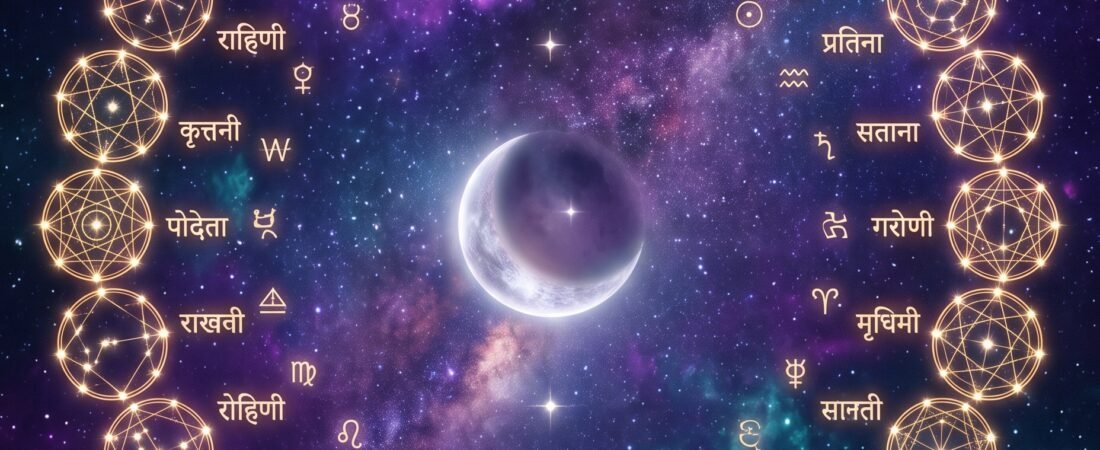
If you have ever felt that your zodiac sign description does not fully capture who you are, there is a good reason why. Western astrology divides the sky into 12 zodiac signs, but Vedic astrology goes much deeper — it divides the Moon’s path into 27 Nakshatras (lunar mansions), each spanning just 13 degrees and 20 minutes of the zodiac.
Your Nakshatra is determined by the position of the Moon at the exact moment of your birth. While your Sun sign (what most horoscope columns use) shows your outer identity, your Nakshatra reveals your emotional core, your subconscious patterns, and the deeper motivations that drive your decisions.
Get your personalised reading in the Astrova AI app
Free AI palm reading, Janam Kundli and daily Rashifal on your phone.
In the ancient text Brihat Parashara Hora Shastra, Sage Parashara describes the Nakshatras as the foundational building blocks of predictive astrology — more granular than rashis (signs) and essential for accurate timing of events through the Vimshottari Dasha system.
Why Is Your Nakshatra More Specific Than Your Zodiac Sign?
Think of it this way: if your zodiac sign is a city, your Nakshatra is the neighbourhood. Two people born under the same Moon sign (rashi) can have completely different life experiences because they were born in different Nakshatras within that sign.
Each zodiac sign contains roughly 2.25 Nakshatras. For example, the sign Aries (Mesha) contains the Nakshatras Ashwini, Bharani, and the first quarter of Krittika. A person with Moon in Ashwini will feel very different from someone with Moon in Bharani — even though both are “Aries Moons.”
| Feature | Zodiac Sign (Rashi) | Nakshatra |
|---|---|---|
| Total count | 12 | 27 |
| Span each | 30° | 13°20′ |
| Based on | Sun’s apparent path | Moon’s actual path |
| Reveals | Outer personality, identity | Emotional core, subconscious |
| Used for | General horoscopes | Dasha timing, compatibility, muhurat |
The 27 Nakshatras: A Complete Reference Guide
Here is the full list of Nakshatras with their ruling deity, planet, and the core personality trait each one carries. Find the one that matches your Moon position (you can check yours free on the Astrova AI app).
| # | Nakshatra | Ruling Planet | Deity | Core Trait |
|---|---|---|---|---|
| 1 | Ashwini | Ketu | Ashwini Kumars | Speed, healing, initiative |
| 2 | Bharani | Venus | Yama | Endurance, transformation, intensity |
| 3 | Krittika | Sun | Agni | Purity, sharpness, courage |
| 4 | Rohini | Moon | Brahma | Creativity, beauty, nurturing |
| 5 | Mrigashira | Mars | Soma | Searching, curiosity, tenderness |
| 6 | Ardra | Rahu | Rudra | Depth, emotional storms, rebirth |
| 7 | Punarvasu | Jupiter | Aditi | Renewal, optimism, return |
| 8 | Pushya | Saturn | Brihaspati | Nurturing, devotion, wisdom |
| 9 | Ashlesha | Mercury | Nagas | Mystery, intuition, penetration |
| 10 | Magha | Ketu | Pitris | Authority, lineage, tradition |
| 11 | Purva Phalguni | Venus | Bhaga | Enjoyment, creativity, generosity |
| 12 | Uttara Phalguni | Sun | Aryaman | Service, partnership, duty |
| 13 | Hasta | Moon | Savitar | Skill, craftsmanship, resourcefulness |
| 14 | Chitra | Mars | Vishwakarma | Artistry, beauty, perfection |
| 15 | Swati | Rahu | Vayu | Independence, adaptability, freedom |
| 16 | Vishakha | Jupiter | Indra-Agni | Focus, determination, purpose |
| 17 | Anuradha | Saturn | Dharma | Devotion, loyalty, friendship |
| 18 | Jyeshtha | Mercury | Indra | Seniority, protection, complexity |
| 19 | Mula | Ketu | Nirriti | Root-seeking, destruction-rebirth, truth |
| 20 | Purva Ashadha | Venus | Apas | Invincibility, inspiration, confidence |
| 21 | Uttara Ashadha | Sun | Vishvedevas | Universal duty, leadership, victory |
| 22 | Shravana | Moon | Vishnu | Listening, learning, connection |
| 23 | Dhanishta | Mars | Eight Vasus | Wealth, music, abundance |
| 24 | Shatabhisha | Rahu | Varuna | Healing, secrecy, cosmic order |
| 25 | Purva Bhadrapada | Jupiter | Aja Ekapada | Spiritual fire, transformation, depth |
| 26 | Uttara Bhadrapada | Saturn | Ahir Budhydnya | Wisdom, calm depth, hidden knowledge |
| 27 | Revati | Mercury | Pushan | Compassion, journey, protection |
How to Find Your Nakshatra
Finding your Nakshatra requires your exact birth details — date, time, and place of birth. Here is how the calculation works:
- Step 1: Your birth time is used to calculate the exact longitude of the Moon at that moment.
- Step 2: The Moon’s longitude is mapped to one of the 27 Nakshatra segments (each 13°20′ of the 360° zodiac).
- Step 3: The Nakshatra is further divided into four padas (quarters), each linked to a Navamsha sign, which adds another layer of personality detail.
For example, if the Moon was at 45° of the zodiac at your birth, that falls in Krittika Nakshatra (which spans 26°40′ to 40° in Aries-Taurus). If it was at 47°, you would be in Krittika’s second pada, which carries a slightly different expression of that Krittika energy.
This is why birth time accuracy matters so much in Vedic astrology — even a difference of 15-30 minutes can shift your Nakshatra pada and change the interpretation.
How Your Nakshatra Shapes Your Personality
Each Nakshatra carries a unique combination of elements that influence who you are at the deepest level:
1. Your Emotional Nature
Your Nakshatra shows how you process emotions. For instance, someone with Moon in Ardra (ruled by Rahu, deity Rudra) experiences emotions as intense storms — they feel everything deeply and go through periodic emotional rebirths. Meanwhile, a Pushya Moon (ruled by Saturn, deity Brihaspati) processes emotions through nurturing others — they feel most secure when caring for someone.
2. Your Relationship Style
Nakshatras are the foundation of Kundli Milan (marriage compatibility) in Vedic astrology. The 36-point Guna Milan system starts with Nakshatra comparison (Nadi, Bhakoot, Gana, and more). Two people with compatible Nakshatras tend to have natural emotional harmony, even if their Sun signs clash.
3. Your Career Instincts
Certain Nakshatras naturally gravitate toward specific types of work. Chitra (ruled by Mars, deity Vishwakarma — the cosmic architect) produces designers, artists, and engineers. Shravana (ruled by Moon, deity Vishnu) produces researchers, teachers, and anyone who thrives on listening and synthesizing information. Dhanishta (ruled by Mars, deity the Eight Vasus) carries an instinct for wealth creation and music.
4. Your Spiritual Path
Each Nakshatra has a presiding deity, and connecting with that deity’s energy is considered a powerful spiritual practice. For example, if you were born in Anuradha (deity Dharma), devotional practices related to discipline, loyalty, and service will resonate more deeply with you than abstract meditation.
How Nakshatras Are Used in Daily Life
Beyond personality analysis, Nakshatras play a practical role in several areas of Vedic astrology:
- Muhurat (auspicious timing): Every day’s energy is influenced by the Nakshatra the Moon is transiting. Starting a business on a Pushya day is considered favourable; avoiding travel on an Ashlesha day is a traditional precaution.
- Vimshottari Dasha: Your life’s major periods (Mahadashas) are determined by your birth Nakshatra’s ruling planet. If you were born in Ashwini (Ketu-ruled), your first Mahadasha is Ketu’s 7-year period. This system is the backbone of predictive Vedic astrology.
- Name selection: In Hindu tradition, a child’s name is often chosen based on the Nakshatra, with specific syllables assigned to each Nakshatra’s four padas.
- Compatibility: As mentioned, Nakshatra matching is the core of Kundli Milan — more nuanced than simple Sun-sign compatibility.
How Astrova AI Helps You Understand Your Nakshatra
The Astrova AI app generates your complete Janam Kundli, which includes your Nakshatra, its pada, ruling planet, deity, and a detailed personality analysis. Here is what you get:
- Full Nakshatra profile — your birth star, pada, and what it reveals about your emotional nature
- AI-powered interpretation — not just the data, but a conversational explanation of what it means for your life
- 24/7 AI Astrologer — ask follow-up questions about your Nakshatra, its Dasha effects, or compatibility with someone else’s
- Available in 9 Indian languages — Hindi, Tamil, Telugu, Kannada, Malayalam, Bengali, Marathi, Gujarati, and English
- 100% free — your Nakshatra reading, Kundli generation, and daily Rashifal are all free on Astrova
Frequently Asked Questions About Nakshatras
How is Nakshatra different from Rashi (Moon sign)?
Your Rashi (Moon sign) covers 30 degrees of the zodiac, while your Nakshatra covers just 13°20′. Each Rashi contains 2.25 Nakshatras, so the Nakshatra gives a much more specific picture of your Moon’s influence. Two people with the same Moon sign but different Nakshatras will feel quite different emotionally.
Can my Nakshatra change?
No. Your Nakshatra is fixed at birth based on the Moon’s position. However, as the Moon transits through different Nakshatras each day (spending roughly one day in each), the daily energy around you shifts — this is why certain days feel different from others.
Which is more important — Nakshatra or Sun sign?
In Vedic astrology, the Nakshatra (specifically the birth Nakshatra of the Moon) is considered more important for predictive work and compatibility than the Sun sign. The Sun sign is a Western astrology concept that Vedic astrology acknowledges but does not prioritise.
How accurate is Nakshatra-based personality reading?
Nakshatra analysis is one of the most time-tested systems in Vedic astrology — it has been used for thousands of years. Its accuracy depends on having an accurate birth time. Even a small error in birth time can shift the Nakshatra pada. Astrova AI uses precise Swiss Ephemeris calculations to ensure your Nakshatra is computed correctly from your birth details.
What if I do not know my exact birth time?
Without an exact birth time, your Nakshatra cannot be determined precisely. Some people use birth time rectification (a technique where an astrologer works backward from life events to estimate the birth time). Astrova AI’s Kundli generator will prompt you for your birth time — the more accurate it is, the more precise your Nakshatra reading will be.
Explore More Astrova Guides
- Complete Guide to AI Palm Reading
- How to Read Your Janam Kundli
- Daily Rashifal — Your Horoscope Guide
- Kundli Milan — Marriage Compatibility
- Sade Sati Explained — Effects and Remedies
- AI Astrology — Complete Guide
About the Author
Astrova AI Editorial — The Astrova editorial team combines traditional Vedic astrology knowledge with modern AI technology. Our content is grounded in classical Jyotish texts including Brihat Parashara Hora Shastra, Phaladeepika by Mantreswara, and Brihat Jataka by Varahamihira. We believe everyone deserves access to accurate, personalised astrological guidance — which is why the Astrova AI app is 100% free. Have a correction or question? Reach us at support@theastrova.com.
Get your personalised reading in the Astrova AI app
Free AI palm reading, Janam Kundli and daily Rashifal on your phone.
Related posts:
 How to Check Your 7th House for Marriage Timing: The Complete Guide
 How to Use Your Kundli for Career Decisions — Astrology Guide
 What Does the 11th House of Your Kundli Reveal About Income, Gains and Social Networks?
 What Is Darakaraka in Your Kundli and What Does It Reveal About Your Life Partner?