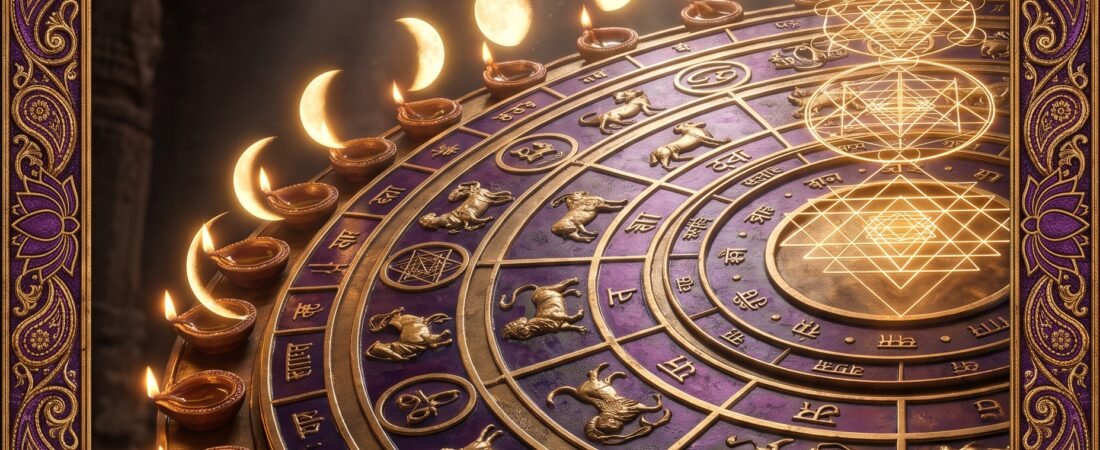
Why Do Hindu Festivals Fall on Specific Dates? The Astrological Science Behind Muhurat Timing
Hindu festivals fall on specific dates because they follow the lunar calendar. They are set by the Tithi (lunar day), the Nakshatra and the Sun's position, not by the Gregorian calendar. That is why Diwali always falls on Amavasya in Kartik and Ganesh Chaturthi on the fourth day of the waxing Moon.
Ever wondered why Diwali always falls on the darkest night, or why Ganesh Chaturthi is celebrated on the fourth day of the waxing moon? These aren’t random choices. Hindu festivals are precisely aligned with astrological muhurats—auspicious time windows calculated from planetary positions, lunar phases, and cosmic energy cycles. This ancient system ensures that collective spiritual practices happen when cosmic support is strongest.
Discover how astrology guides your life too: Get Free Astrova AI Reading →
What Is a Muhurat and How Does It Work?
A muhurat is an auspicious time window calculated from the positions of the Moon, Sun, and planets. In Vedic astrology (Jyotish Shastra), every moment carries a specific energetic quality based on celestial alignments. Certain combinations create favorable conditions for specific activities—spiritual practices, new beginnings, marriages, or journeys.
The muhurat system works on three levels:
- Lunar phase (Tithi): The 30 lunar days that track the Moon’s journey around Earth
- Lunar mansion (Nakshatra): The 27 star constellations the Moon passes through each month
- Planetary hour (Hora): Time divisions ruled by specific planets throughout the day
When a festival falls on a specific Tithi and Nakshatra combination, it amplifies the spiritual energy available to everyone. For example, Full Moon (Purnima) naturally heightens emotional and intuitive energies, making it ideal for devotion and gratitude practices.
How Do Major Hindu Festivals Align with Astrological Timing?
Let’s examine the astrological precision behind India’s most celebrated festivals:
Diwali: The Darkest Night of the Year
Diwali falls on Kartik Amavasya (new moon day) in the month of Kartik (October-November). Astrologically, this is the darkest night—when the Moon is completely absent. The darkness symbolizes the victory of light over ignorance, and the timing is chosen because:
- New moon days are traditionally inauspicious for worldly activities but highly auspicious for spiritual transformation
- The Sun and Moon are conjunct in Libra, balancing solar (action) and lunar (reception) energies
- Lakshmi, the goddess of prosperity, is believed to visit homes that are lit and clean during this transition point
The festival’s timing acknowledges that true prosperity begins when we illuminate our inner darkness.
Ganesh Chaturthi: The Fourth Day of New Beginnings
Ganesh Chaturthi occurs on Bhadrapada Shukla Chaturthi (fourth day of the waxing moon in August-September). The number four represents stability and foundation in Vedic numerology. Astrologically:
- The waxing moon phase supports growth and new beginnings
- Ganesh rules the Muladhara chakra (root energy center), and starting ventures during his time removes obstacles
- The fourth Tithi is ruled by Mars, giving courage to initiate bold actions
This is why businesses, students, and artists begin new projects during Ganesh Utsav—they’re riding a cosmic wave of obstacle-clearing energy.
Navratri: Nine Nights of Planetary Alignment
Navratri (nine nights) occurs during Ashwin Shukla Pratipada to Navami (September-October). Each night is dedicated to a form of Durga, but there’s deeper astrological logic:
- The nine nights correspond to the nine planets (Navagrahas) in Vedic astrology
- Each goddess form balances a specific planetary energy (Kaalratri for Saturn, Durga for Mars, Lakshmi for Venus)
- The festival occurs during the autumn equinox period, when day and night energies are equal—ideal for balancing masculine and feminine forces within
Fasting and prayer during Navratri align your personal energy with these planetary frequencies, creating internal harmony.
Maha Shivaratri: The Night of Cosmic Consciousness
Maha Shivaratri falls on Phalguna Krishna Chaturdashi (14th day of the waning moon in February-March). This is not a celebration but a solemn observance, and the timing reflects that:
- The waning moon represents dissolution of ego and material attachments
- The 14th Tithi is ruled by Shiva himself in the muhurat system
- Staying awake all night harnesses the natural insomnia energy of this Tithi for spiritual awakening
- It occurs in late winter, when nature is dormant—mirroring the inward journey of consciousness
Shiva represents pure consciousness beyond form, and this muhurat supports meditation that transcends the mind.
What Does This Mean for Your Personal Life?
You don’t need to celebrate every festival to benefit from muhurat timing. The same principles apply to your personal decisions:
Starting a business? Choose a waxing moon day (Shukla Paksha) when energy is building. Avoid new moon days when energy is contracting.
Planning a marriage? Traditional Kundli Milan checks if the couple’s Moon signs are compatible, and the wedding date is chosen during an auspicious Nakshatra like Rohini, Uttara Phalguni, or Revati.
Feeling stuck? Check if you’re experiencing Sade Sati (Saturn’s 7.5-year transit) or Rahu-Ketu influence. These periods aren’t punishments—they’re cosmic pressure to grow. Remedies like Shani Shanti Puja or wearing specific gemstones can ease the transition.
Want daily guidance? Your Rashifal (daily horoscope) tracks the Moon’s daily Nakshatra position and tells you which activities are favored. Reading it each morning helps you work with cosmic timing instead of against it.
How Can You Use Muhurat Principles Today?
Here’s how to apply ancient muhurat wisdom to modern life:
- Track the Moon phases: Use the lunar calendar to plan important activities. Waxing moon (Shukla Paksha) supports growth projects. Waning moon (Krishna Paksha) supports release and reflection.
- Check daily Panchang: The Panchang is the Hindu almanac that lists each day’s Tithi, Nakshatra, and planetary hours. Apps like Astrova AI provide this in your regional language.
- Avoid Rahu Kaal: Each day has a 90-minute period ruled by Rahu (the north lunar node) that’s considered inauspicious for starting new ventures. Check your daily Rashifal to know when to avoid important decisions.
- Use festival energy intentionally: Don’t just celebrate—use the specific energy of each festival. On Diwali, set prosperity intentions. On Navratri, fast to cleanse. On Makar Sankranti, donate to balance Saturn’s energy.
- Get a personalized Kundli: Your birth chart shows your personal planetary cycles. Understanding your Dasha periods (planetary cycles) helps you know when to push forward and when to wait.
Reference Table: Festival Timing and Astrological Significance
| Festival | Lunar Timing | Astrological Purpose | Best For |
|---|---|---|---|
| Diwali | Kartik Amavasya (New Moon) | Spiritual transformation, prosperity | Setting intentions, inner work |
| Ganesh Chaturthi | Bhadrapada Shukla Chaturthi | New beginnings, obstacle removal | Starting ventures, education |
| Navratri | Ashwin Shukla Pratipada-Navami | Balancing planetary energies | Fasting, spiritual practice |
| Maha Shivaratri | Phalguna Krishna Chaturdashi | Cosmic consciousness, ego dissolution | Meditation, night-long vigil |
| Holi | Phalguna Purnima (Full Moon) | Joy, color, spring renewal | Celebration, social harmony |
| Raksha Bandhan | Shravana Purnima | Sibling bonds, protection | Strengthening relationships |
| Makar Sankranti | Solar transition to Capricorn | Saturn balance, harvest gratitude | Donation, kite flying |
How Astrova AI Helps You Track Muhurat Timing
Astrova AI brings ancient muhurat wisdom to your phone with features designed for modern life:
- Daily Rashifal in 9 Indian languages: Get personalized muhurat guidance in Hindi, Tamil, Telugu, Kannada, Malayalam, Marathi, Gujarati, Bengali, or English
- AI Palm Reading: Upload a photo of your palm and receive instant analysis of your life path, career, and relationships based on hasta samudrika shastra (palmistry)
- Janam Kundli generation: Create your complete birth chart in seconds, showing planetary positions at your birth and current Dasha periods
- Kundli Milan for marriage: Check compatibility with your partner using the 36-point Guna Milan system, with remedies for low scores
- Sade Sati and Kaalsarp Dosha analysis: Understand challenging planetary periods and get proven remedies to ease their effects
- 24/7 AI Astrologer: Ask specific questions about muhurat timing, festival significance, or personal decisions anytime
Ready to align your life with cosmic timing? Download Astrova AI Free →
Frequently Asked Questions
Why do festival dates change every year on the Gregorian calendar?
Hindu festivals follow the lunisolar calendar, which tracks both the Moon’s phases and the Sun’s position. The Gregorian calendar is purely solar. Since a lunar year is about 11 days shorter than a solar year, festivals shift earlier each year until an extra month (Adhik Maas) is added to realign them.
Can I start important work during any festival?
Not all festivals are equally auspicious for new beginnings. Ganesh Chaturthi, Akshaya Tritiya, and Vijayadashami are considered highly auspicious for starting ventures. However, festivals like Maha Shivaratri or solar/lunar eclipse days are better for spiritual practices than material pursuits. Always check the specific Tithi and Nakshatra.
What if I don’t know my exact birth time?
Without a birth time, you can’t generate an accurate Janam Kundli because the Ascendant (Lagna) and house positions change every two hours. However, you can still use Moon sign astrology (Chandra Rashi), which only requires your birth date. Astrova AI offers Moon sign readings and palm reading as alternatives when birth time is unknown.
Are muhurat timings the same everywhere in India?
No. Muhurat timings are calculated based on local sunrise, sunset, and planetary positions, which vary by location. A muhurat that’s auspicious in Mumbai might be different in Chennai. Astrova AI adjusts muhurat calculations based on your city, ensuring accurate timing for your region.
How accurate is AI astrology compared to a human astrologer?
AI astrology excels at calculating planetary positions, generating Kundlis, and providing standardized interpretations based on classical texts. Human astrologers add intuition and contextual judgment. For muhurat timing, Kundli generation, and daily Rashifal, AI is highly accurate because it’s based on precise astronomical calculations. For complex life decisions, combining AI insights with human consultation works best.
Explore More Astrova Guides
- Complete Guide to AI Palm Reading — Learn how hasta samudrika shastra reveals your destiny through palm lines
- How to Read Your Janam Kundli — Understand your birth chart and planetary positions
- Daily Rashifal Guide — Use horoscopes to make better decisions every day
- Kundli Milan for Marriage — Check compatibility using the 36-point Guna system
- Sade Sati Explained — Understand Saturn’s transit and proven remedies
- AI Astrology Complete Guide — How artificial intelligence is transforming Vedic astrology
About the Author
Astrova AI Editorial Team
The Astrova AI Editorial team combines traditional Jyotish Shastra knowledge with modern AI technology to make Vedic astrology accessible to everyone. Our content is based on classical texts including Brihat Parashara Hora Shastra, Phaladeepika, and Uttara Kalamrita, verified by experienced astrologers and translated into practical guidance for contemporary life. We believe astrology should empower, not intimidate—and that ancient wisdom deserves modern delivery.
Get your free personalized reading today: Download Astrova AI →
Related posts:
 What Your Heart Line Reveals About Your Love Life: A Personal Discovery
 What Is Guru Chandala Dosha in Your Kundli and How to Reduce Its Effects? Complete Guide
 What Your Thumb Shape Reveals About Willpower and Determination
 What Does Mercury (Budh) in Your Kundli Reveal About Intelligence, Communication and Business Success?