How to Read Your Varshphal (Annual Horoscope) — A Practical Guide to Your Yearly Predictions
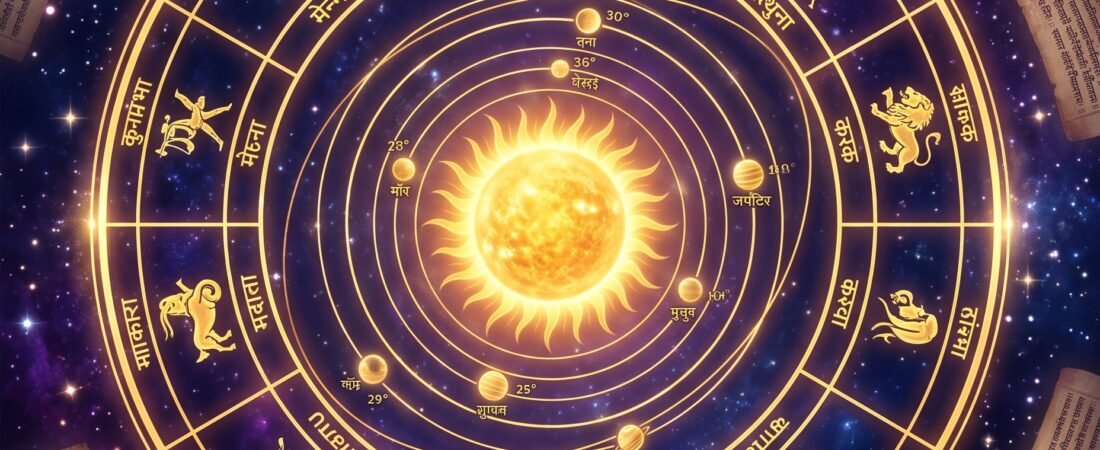
Quick Answer: A Varshphal (annual horoscope) is a specialised birth chart cast for the exact moment the Sun returns to its natal position each year — typically around your birthday. It reveals the themes, opportunities and challenges likely to unfold in the coming 12 months across career, health, relationships and finances. In Vedic astrology, the Varshphal is built using the Tajika system and examines the year’s Ascendant (Varshaphal Lagna), the Muntha planet, and annual planetary placements to give a month-by-month or quarter-by-quarter forecast.
✓ 100% FREE • No Credit Card Required
Get Your Free Varshphal & Yearly Horoscope on Astrova AI
✓ Free Kundli ✓ AI Astrologer ✓ 9 Indian Languages ✓ 24/7 Access
What Exactly Is a Varshphal (Annual Horoscope)?
The word Varshphal comes from two Sanskrit roots: Varsha (year) and Phal (result or fruit). Literally, it means “the fruit of the year” — a prediction of what the coming 12 months will deliver based on your birth chart.
Unlike your natal Kundli (Janam Kundli), which is a snapshot of the sky at the moment of your birth and remains fixed for life, the Varshphal is recalculated every year. It uses a technique called Solar Return — the chart is cast for the exact moment the transiting Sun returns to the same degree, minute and second it occupied at your birth.
In practical terms, this happens around your birthday each year. If you were born on 15 July 1995 at 3:22 PM, your Varshphal for 2026-2027 would be cast for 15 July 2026 at approximately 3:22 PM (adjusted for the precise solar return moment, which can differ by a few hours).
How Is Varshphal Different From Your Regular Kundli?
| Feature | Janam Kundli (Birth Chart) | Varshphal (Annual Horoscope) |
|---|---|---|
| Calculated for | Moment of birth | Moment of Solar Return (around birthday) |
| Validity period | Entire lifetime | One year (birthday to birthday) |
| Primary use | Life blueprint — personality, destiny, strengths | Yearly forecast — events, timing, opportunities |
| Ascendant | Natal Lagna (fixed) | Varshaphal Lagna (changes yearly) |
| Key special elements | Dasha system, Yogas, Divisional charts | Muntha, Varshaphal Lagna, Yearly Dasha |
| System used | Parashari (primarily) | Tajika system (Persian-origin Vedic astrology) |
Think of it this way: your Janam Kundli is the map of your entire journey, while the Varshphal is the weather forecast for the next leg of the trip.
The 5 Key Elements of a Varshphal Chart
When you generate your Varshphal on Astrova AI, here are the five elements the analysis examines:
1. Varshaphal Lagna (Annual Ascendant)
This is the rising sign at the moment of your Solar Return. It sets the tone for the entire year. If your Varshaphal Lagna falls in a sign ruled by a benefic planet (Jupiter, Venus, Mercury, or a well-placed Moon), the year tends to flow more smoothly. A Lagna ruled by a malefic or a debilitated planet suggests a year that demands effort and resilience.
2. The Muntha Planet
The Muntha is a unique feature of Tajika astrology — it is a sensitive point that progresses through your chart over the years, spending roughly 2-3 years in each house. The house where Muntha sits in your Varshphal indicates the area of life that will be most active this year. If Muntha is in your 10th house, expect career developments. In the 7th house, relationship events are highlighted. In the 4th house, matters of home, property or mother come to the fore.
3. Yearly Dasha (Annual Planetary Period)
Just as your lifetime Vimshottari Dasha cycles through different planetary periods, the Varshphal has its own shorter Dasha system. The year’s Dasha lord colours the overall experience — a Jupiter year brings expansion and learning, a Saturn year brings discipline and karmic reckoning, a Rahu year brings sudden changes and unconventional opportunities.
4. Annual Planetary Placements
The positions of all nine planets in the Varshphal chart are examined relative to the Varshaphal Lagna. A planet placed in a friendly sign and a beneficial house (1st, 4th, 5th, 7th, 9th, 10th) delivers positive results for that year. A planet in an unfriendly sign or a difficult house (6th, 8th, 12th) creates friction in the areas it governs.
5. Tajika Yogas (Annual Combinations)
The Tajika system has its own set of yogas — planetary combinations that modify the year’s results. Key ones include Itthasali Yoga (a favourable exchange between two planets that brings the desired result), Easarpha Yoga (a planetary configuration that creates obstacles), and Kambool Yoga (a powerful combination that grants success after initial struggle).
How to Generate Your Varshphal on Astrova AI — Step by Step
Astrova AI makes the Varshphal calculation instant and free. Here is how to get yours:
- Download Astrova AI from the Google Play Store (100% free, no credit card required).
- Enter your birth details — date, time and place of birth. The more accurate your birth time, the more precise your Varshphal will be.
- Navigate to the Horoscope section and select the yearly horoscope / Varshphal option.
- Review your annual chart — Astrova AI generates the Varshaphal Lagna, Muntha position, yearly planetary placements and Tajika yogas automatically.
- Read the AI-generated interpretation — the AI astrologer explains what each element means for your specific year, covering career, health, relationships and finances.
- Ask follow-up questions — use the AI Astrologer chat or voice chat to ask specific questions like “What does this year hold for my career?” or “When is the best time for a job change this year?”
✓ 100% FREE • No Credit Card Required
Generate Your Varshphal Now — Free on Astrova AI
Available in Hindi, Tamil, Telugu, Kannada, Marathi, Gujarati, Bengali, Malayalam & English
How to Actually Read Your Varshphal — A Practical Framework
Once you have your Varshphal chart, here is a simple framework to interpret it:
Step 1: Check the Varshaphal Lagna lord. Find which planet rules your annual Ascendant. Is that planet well-placed in the Varshphal chart? If it is in a Kendra house (1st, 4th, 7th, 10th) or a Trikona house (5th, 9th), the year is likely to be productive. If it is in the 6th, 8th or 12th house, expect challenges that require patience.
Step 2: Note where the Muntha sits. The Muntha’s house tells you which area of life is in the spotlight. Write it down — this is the theme of your year.
Step 3: Examine the year’s Dasha lord. Which planet’s annual Dasha are you running? Check its placement and strength in the Varshphal chart. A strong Dasha lord makes the year’s energy work in your favour.
Step 4: Look for Tajika Yogas. Are any Itthasali Yogas forming between beneficial planets? These indicate areas where desires will be fulfilled. Are there Easarpha Yogas? These flag areas where you may face resistance.
Step 5: Cross-reference with your natal Dasha. The Varshphal does not operate in isolation. If your Varshphal shows a good year but your natal Vimshottari Dasha is running a challenging period, the results will be mixed. The best outcomes occur when both the natal Dasha and the Varshphal point in the same direction.
When Should You Check Your Varshphal?
The ideal time to review your Varshphal is around your birthday — that is when the new annual cycle begins. However, you can generate it at any point during the year. The Varshphal covers the period from one Solar Return to the next, so even if you check it six months after your birthday, it still applies to the remaining months of your annual cycle.
Many Astrova AI users find it helpful to check their Varshphal at three points during the year:
- Around their birthday — to set the overall theme and intentions for the year.
- Mid-year — to assess whether the year is unfolding as predicted and adjust plans.
- Near the end of the annual cycle — to prepare for the transition into the next year’s energy.
Common Mistakes People Make When Reading Varshphal
Mistake 1: Treating the Varshphal as a replacement for the natal chart. The Varshphal is a supplement, not a substitute. It shows the year’s weather, but your natal chart shows the climate. A good Varshphal cannot override a fundamentally weak natal placement, and a challenging Varshphal cannot destroy a strong natal foundation.
Mistake 2: Ignoring birth time accuracy. The Varshphal Lagna changes approximately every two hours, just like the natal Ascendant. If your birth time is off by even 15-20 minutes, your Varshaphal Lagna could shift to a different sign, completely changing the year’s interpretation. If you do not know your exact birth time, use the noon chart as a fallback and treat the results as approximate.
Mistake 3: Panicking over a “bad” Varshphal. No Varshphal is entirely good or entirely bad. Every year has areas of strength and areas of challenge. The purpose of reading the Varshphal is not to fear the difficult areas but to navigate them with awareness. Vedic astrology offers remedies — mantras, gemstones, fasting, charitable acts — that can mitigate challenging planetary influences.
How Astrova AI Makes Varshphal Accessible to Everyone
Traditionally, getting a Varshphal reading required visiting a Jyotish (Vedic astrologer), paying a consultation fee, and waiting days or weeks for the analysis. Astrova AI eliminates every one of those barriers:
- Instant calculation — your Varshphal is generated in seconds using the Swiss Ephemeris, the same astronomical engine used by professional astrologers worldwide.
- Free of cost — the Varshphal feature is available to all Astrova AI users at no charge.
- Available in 9 languages — Hindi, Tamil, Telugu, Kannada, Marathi, Gujarati, Bengali, Malayalam and English. Read your yearly predictions in the language you think in.
- AI-powered interpretation — the AI astrologer does not just show you the chart; it explains what each placement means for your specific life areas.
- Interactive follow-up — use voice chat or text chat to ask specific questions about your year. “Is this a good time to start a business?” “What does the Varshphal say about my health this year?” The AI astrologer responds in real time.
Explore More Astrova Guides
- How to Generate Your Janam Kundli Online Free
- How to Check Your Daily Rashifal Using Your Moon Sign
- How to Check Kundli Milan for Marriage Compatibility
- How to Check If You Have Sade Sati — Step-by-Step Remedies
- AI Palm Reading Complete Guide
- How to Use AI Astrology for Daily Life Guidance
About the Astrova AI Editorial Team
The Astrova AI Editorial Team combines traditional Vedic astrology scholarship with modern AI technology. Our content is rooted in classical Jyotish texts including the Brihat Parashara Hora Shastra, the Tajika Neelakanthi (the foundational text on annual horoscopy), and the Phaladeepika by Mantreswara. We believe that Vedic astrology should be accessible to everyone — which is why Astrova AI offers free Kundli generation, daily Rashifal, Varshphal, Kundli Milan and 24/7 AI astrologer consultations in 9 Indian languages.
Download Astrova AI — Free on Google Play →
Related posts:
 What Does Your Marriage Line on the Palm Reveal About Your Love Life and Relationship Timing?
 What Is Kemadruma Yoga In Your Kundli And Does It Really Cause Poverty?
 What Is Ashtakavarga in Vedic Astrology and How Does This Point System Predict Planetary Strength
 What Does Jupiter (Guru) in Your Kundli Reveal About Wisdom, Wealth and Spiritual Growth?